
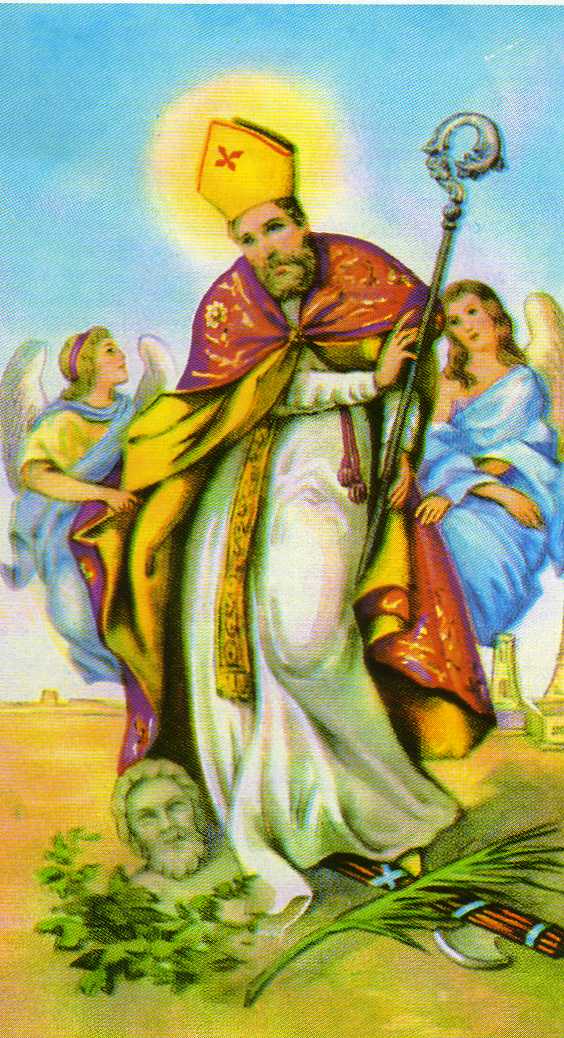
Feast Day: 26 August
Also known as: Saint Oronzo, Oronzio, Aronzo
Died: Traditionally 26 August 68
Patron Saint: Lecce and the Salento region of Italy
Companions in martyrdom: Saints Justus and Fortunatus
Introduction
Saint Orontius of Lecce, better known in Italy as Sant’Oronzo, is one of the most beloved saints of the Italian region of Apulia, particularly in the city of Lecce and throughout the Salento. He is traditionally honoured as the first Bishop of Lecce and as a courageous martyr who gave his life for the Gospel during the persecution of Christians under the Roman Emperor Nero.
His feast is celebrated on 26 August, together with Saints Justus and Fortunatus. The Diocese of Lecce and the city continue to celebrate these three saints with solemn liturgical celebrations and popular festivities.
The traditional account of his life tells of a wealthy and respected man who encountered Christianity through Saint Justus, a disciple associated with Saint Paul. Converted to Christ, Orontius became a zealous evangelizer and was eventually appointed the first bishop of Lecce. He preached the Gospel courageously despite persecution and ultimately sealed his faith with martyrdom.
Although some details of the traditional biography are difficult to establish historically, his ancient and enduring cult has made Saint Orontius an important figure of Christian devotion in southern Italy.
The Early Life of Orontius
According to the traditional account, Orontius was born in Rudiae, an ancient city near present-day Lecce, during the first century.
He belonged to a prominent family. His father, Publius, is traditionally described as having held an important financial position under the Roman authorities. Orontius succeeded him in this position and therefore enjoyed social status and material security.
His life changed dramatically when he encountered the Christian faith.
The traditional biography associates his conversion with Saint Justus, who was travelling toward Rome. According to the tradition preserved by the Diocese of Lecce, Justus was shipwrecked on the coast of Salento and eventually encountered Orontius and his nephew Fortunatus. Through his preaching, the two came to believe in Jesus Christ.
The encounter transformed the direction of Orontius’ life.
He had possessed earthly honour and position, but he discovered a treasure greater than everything the world could offer: Jesus Christ.
The Conversion of Orontius
The conversion of Orontius illustrates a recurring pattern in the lives of the saints.
God often enters a person’s life through an unexpected encounter.
Orontius encountered a Christian missionary.
He heard the Gospel.
He opened his heart to Christ.
And his conversion did not remain merely a private religious experience.
It changed his entire life.
He became convinced that the Gospel had to be proclaimed.
The Christian faith he had received became a faith he wanted to share with others.
This is one of the most important characteristics of authentic conversion:
Those who encounter Christ are called to become witnesses of Christ.
Meeting Saint Paul
According to the traditional account, Orontius and his companions eventually travelled to Corinth, where they encountered Saint Paul the Apostle.
The Diocese of Lecce’s traditional biography states that Paul confirmed Orontius in the faith and appointed him the first bishop of Lecce, while Fortunatus was designated as his successor.
This tradition gives Saint Orontius a special place in the early Christian history of southern Italy.
His episcopal mission was not simply an honour.
It was a call to evangelization.
He was sent back to his homeland to proclaim Christ.
The First Bishop of Lecce
Saint Orontius is traditionally honoured as the first Bishop of Lecce.
His mission took place during the earliest period of Christianity, when the Church was still small and frequently persecuted.
There were no great Christian basilicas.
There were no established Christian institutions.
There was no social prestige attached to being a Christian.
To confess Jesus Christ could mean imprisonment, torture or death.
Yet Orontius preached.
He travelled.
He celebrated the Eucharist.
He instructed converts.
He strengthened Christian communities.
And he remained faithful when persecution intensified.
Evangelization in Salento
According to the tradition, Orontius and Justus travelled through various areas of southern Italy proclaiming the Gospel.
The Diocese of Lecce associates their missionary activity with places including Ostuni, Turi, Siponto, Potenza and Taranto. During periods of persecution, they are said to have taken refuge in caves, where they also prayed and celebrated the Eucharist.
Their missionary journeys demonstrate the missionary character of the early Church.
The Gospel was not meant to remain within one city.
It was carried from village to village and from person to person.
The early missionaries travelled with little security, often facing danger and uncertainty.
Their strength came from the conviction that Christ had entrusted them with a mission.
Persecution under Nero
The traditional story places the martyrdom of Orontius during the persecution associated with the Roman Emperor Nero.
The first Christians were frequently regarded with suspicion because they refused to worship the Roman gods.
For Christians, there was only one God.
Jesus Christ was Lord.
This confession could place them in direct conflict with the religious expectations of the Roman Empire.
Orontius refused to renounce Christ.
According to the traditional account, an imperial representative named Antoninus ordered his arrest.
Orontius and his companions were subjected to persecution and imprisonment.
But threats did not silence them.
Faith in the Face of Death
The courage of Saint Orontius is perhaps the central message of his life.
He had every reason, from a worldly perspective, to preserve his life.
He had status.
He had influence.
He could have avoided suffering by denying his faith.
But he chose Christ.
The martyrs understood that physical life is precious but not the greatest treasure.
The greatest treasure is eternal life with God.
Jesus Himself had said:
“Whoever loses his life for my sake will find it.”
For Orontius, these words became a reality.
The Martyrdom of Saint Orontius
The traditional account states that Orontius and Justus were eventually brought back to the area around Lecce.
After refusing to renounce their Christian faith, they were condemned to death.
According to the traditional biography preserved by the Diocese of Lecce, Orontius and Justus were executed by decapitation about three kilometres from Lecce, traditionally on 26 August in the year 68.
Their martyrdom became the seed of Christian memory in Lecce.
The place associated with his martyrdom eventually became connected with the church popularly known as Sant’Oronzo fuori le mura, or Saint Orontius Outside the Walls.
Saint Fortunatus
Saint Orontius is closely associated with Saint Fortunatus, traditionally described as his nephew and fellow missionary.
Fortunatus shared Orontius’ conversion and missionary vocation.
The two travelled together, preached together and suffered persecution together.
Eventually, they shared the crown of martyrdom.
Their story reminds us of the strength that comes from Christian companionship.
The Christian life is not meant to be lived in isolation.
We need people who encourage us in faith.
We need companions who pray with us.
We need brothers and sisters who remain faithful when difficulties come.
Saint Justus
The third figure associated with the feast is Saint Justus.
Tradition identifies him as a disciple of Saint Paul who brought the Gospel to the Salento region.
He played a decisive role in the conversion of Orontius and Fortunatus.
Thus the story of these three saints illustrates the missionary chain through which Christianity spread:
Paul → Justus → Orontius and Fortunatus → the people of Salento
The Gospel is received and then handed on.
Every generation of Christians has the responsibility to continue that mission.
Historical Caution
It is important to distinguish between devotional tradition and historically certain information concerning Saint Orontius.
The principal written traditions about Orontius appear relatively late. The Diocese of Lecce’s historical chronology notes, for example, that the passio associated with Orontius was recorded in a work of the sixteenth century, while earlier documentary evidence for his cult exists in medieval records.
Some modern historians have therefore questioned aspects of the traditional biography and even the precise historical identification of Orontius.
Nevertheless, the devotion to Saint Orontius became deeply established in Lecce and Salento, and the Church continues to celebrate his liturgical memory.
For devotional purposes, the essential message remains clear: the Christian community of Lecce has long venerated Orontius as its apostolic bishop and martyr.
The Growth of His Cult
The devotion to Saint Orontius became especially strong in Lecce and throughout Salento.
Historical records show references to places associated with his name as early as the twelfth century. By the sixteenth century, written accounts of his passio had emerged, and in the seventeenth century his cult received significant ecclesiastical recognition.
In 1656, a devastating plague struck the region. The people of Lecce attributed their protection from the epidemic to the intercession of Saint Orontius. This event greatly strengthened his devotion and contributed to his prominence as patron of the city.
In 1658, the cult of Orontius, Justus and Fortunatus received formal recognition from the Sacred Congregation of Rites.
Later, Saint Orontius’ patronage extended throughout the Salento region.
Patron of Lecce
Saint Orontius is especially honoured as the principal patron of Lecce, one of the most beautiful historic cities of southern Italy.
He is also venerated in several other towns of Apulia.
His patronage became associated with protection from epidemics, earthquakes and other calamities. Historical devotional traditions credit him with intercession during various crises affecting the region.
For generations, the people of Lecce have turned to him during times of danger.
This is an important characteristic of popular Catholic devotion.
The saints are not worshipped in place of God.
Rather, Christians ask the saints to intercede before God.
Saint Orontius is therefore remembered as a spiritual father and protector who directs his people toward Christ.
Feast of Saint Orontius
The principal feast of Saint Orontius is celebrated on 26 August.
In Lecce, the feast is celebrated together with Saints Justus and Fortunatus.
The celebration traditionally extends over several days, combining liturgical prayer, processions and popular celebrations. The city of Lecce continues to organize major celebrations from 23 to 26 August, culminating in the solemnity of the patron saints.
The feast is not merely a cultural festival.
At its heart is the Eucharistic celebration in honour of the patron saints.
The Church gathers to thank God for the witness of His saints and to ask for their intercession.
Saint Orontius and the Eucharist
The traditional account of Orontius’ missionary activity includes prayer and the celebration of the Eucharist even while the missionaries were hiding from persecution.
This detail beautifully expresses the relationship between martyrdom and the Eucharist.
The Eucharist makes present the sacrifice of Christ.
The martyr offers his own life in union with Christ.
Saint Orontius ultimately followed the path of the Eucharistic Lord:
Christ gave Himself for him;
Orontius gave himself for Christ.
This is the deepest meaning of Christian martyrdom.
A Bishop Who Became a Martyr
Saint Orontius is remembered both as a bishop and as a martyr.
These two dimensions belong together.
A bishop is called to shepherd God’s people.
A martyr demonstrates the ultimate extent of that shepherding love.
He does not abandon his flock when danger comes.
Instead, he remains faithful.
The blood of martyrs has often strengthened the Church throughout history.
The early Christian writer Tertullian famously expressed this conviction:
“The blood of Christians is seed.”
Saint Orontius’ witness became part of the spiritual heritage of Lecce.
Lessons from Saint Orontius
1. Conversion must transform our lives
Orontius did not merely accept Christianity as an idea.
His encounter with Christ changed the direction of his entire life.
Our own faith should likewise influence our choices, priorities and relationships.
2. Faith must be shared
After receiving the Gospel, Orontius became an evangelizer.
Every Christian is called to witness to Christ according to his or her vocation.
3. Courage is necessary for discipleship
Orontius faced persecution without abandoning Christ.
We may not face physical persecution, but we can still experience pressure to compromise our Christian values.
His example encourages us to remain faithful.
4. Christian companionship matters
Orontius, Fortunatus and Justus supported one another.
We need communities of faith that strengthen us.
5. The Eucharist gives strength
The early missionaries remained connected with the Eucharistic life of the Church.
The Eucharist gives Christians strength to live and witness faithfully.
6. Suffering can become an offering
Orontius’ suffering became an offering of love.
Christians are called to unite their sufferings with Christ rather than allowing suffering to destroy their hope.
7. The saints point us toward Christ
The ultimate purpose of devotion to Saint Orontius is not to stop at the saint.
He points beyond himself to Jesus.
His message is:
Be faithful to Christ.
Love Christ.
Serve Christ.
Remain with Christ until the end.
Saint Orontius for Christians Today
The world today needs witnesses who are willing to live their faith sincerely.
We may not be asked to die as martyrs, but we are frequently asked to make smaller sacrifices:
To forgive when it is difficult.
To speak truth when lies are easier.
To remain faithful in marriage.
To protect human dignity.
To defend the weak.
To resist corruption.
To pray when others ridicule prayer.
To remain faithful to Christ when faith is unpopular.
Saint Orontius reminds us that holiness is not merely about saying that we believe.
It is about allowing faith to shape our entire lives.
A Message for Young People
Young people can find a powerful example in Saint Orontius.
He did not live his life merely for comfort or social status.
He discovered a greater purpose.
His life asks every young Christian:
What are you living for?
Money cannot give ultimate meaning.
Success cannot give eternal happiness.
Popularity does not last forever.
Christ alone gives life its deepest meaning.
Saint Orontius chose Christ when the cost was high.
Young people today are called to make the same fundamental choice:
“Jesus, I choose You.”
A Message for Priests
Saint Orontius is especially meaningful for priests because he is traditionally remembered as the first bishop of Lecce.
His life reminds every priest that ministry is fundamentally about Christ and His people.
A priest is called to preach the Gospel faithfully.
He is called to celebrate the Eucharist reverently.
He is called to reconcile sinners.
He is called to accompany the suffering.
He is called to defend the truth.
And, above all, he is called to give his life in service.
Saint Orontius reminds priests that pastoral ministry is not a career.
It is a vocation of self-giving love.
Prayer to Saint Orontius
O glorious Saint Orontius,
faithful disciple of Jesus Christ,
first Bishop of Lecce
and courageous martyr of the Gospel,
pray for us.
You who received the faith
and gave yourself completely to Christ,
help us to deepen our own faith.
You who proclaimed the Gospel
throughout the land of Salento,
make us courageous witnesses
of Jesus in our homes, workplaces
and communities.
You who remained faithful
when persecution threatened your life,
give us strength when we are tempted
to compromise our Christian values.
You who offered your life for Christ,
teach us to unite our sufferings
with the Cross of Jesus.
Pray for our families
and protect them from every danger.
Pray for our children and young people,
that they may discover the joy of following Christ.
Pray for our priests and bishops,
that they may shepherd God’s people
with holiness, courage and love.
Pray for the Church,
for the sick and suffering,
for those who are persecuted because of their faith,
and for all who seek God’s mercy.
O Saint Orontius,
beloved patron of Lecce and Salento,
intercede for us before the throne of God.
Help us to remain faithful to Christ
through every trial
and to persevere until the end.
May we one day share with you
the joy of eternal life in heaven.
Through Christ our Lord.
Amen.
Conclusion
Saint Orontius of Lecce stands in the Christian memory of southern Italy as a bishop, missionary and martyr.
His traditional story begins with an encounter with the Gospel and ends with the ultimate witness of martyrdom.
He received Christ and then proclaimed Christ.
He experienced persecution but did not abandon Christ.
He suffered for Christ and ultimately gave his life for Christ.
His feast on 26 August, celebrated together with Saints Justus and Fortunatus, is therefore more than a commemoration of the past. It is an invitation to every Christian to renew his or her commitment to the Gospel.
Saint Orontius teaches us that faith is not simply something we inherit.
It is something we must live.
He teaches us that the Gospel is worth proclaiming.
He teaches us that Christ is worth following.
And he teaches us that even when discipleship becomes costly, God’s grace is greater than our fears.
May the example of Saint Orontius inspire us to live with greater faith, courage, charity and perseverance.
May he intercede for the Church in Lecce, for the people of Salento, for Italy and for Christians throughout the world.
And may his life lead us always to the One for whom he lived and died:
Jesus Christ, our Lord and Saviour.
Saint Orontius of Lecce, Bishop and Martyr, pray for us!
Leave a Reply