
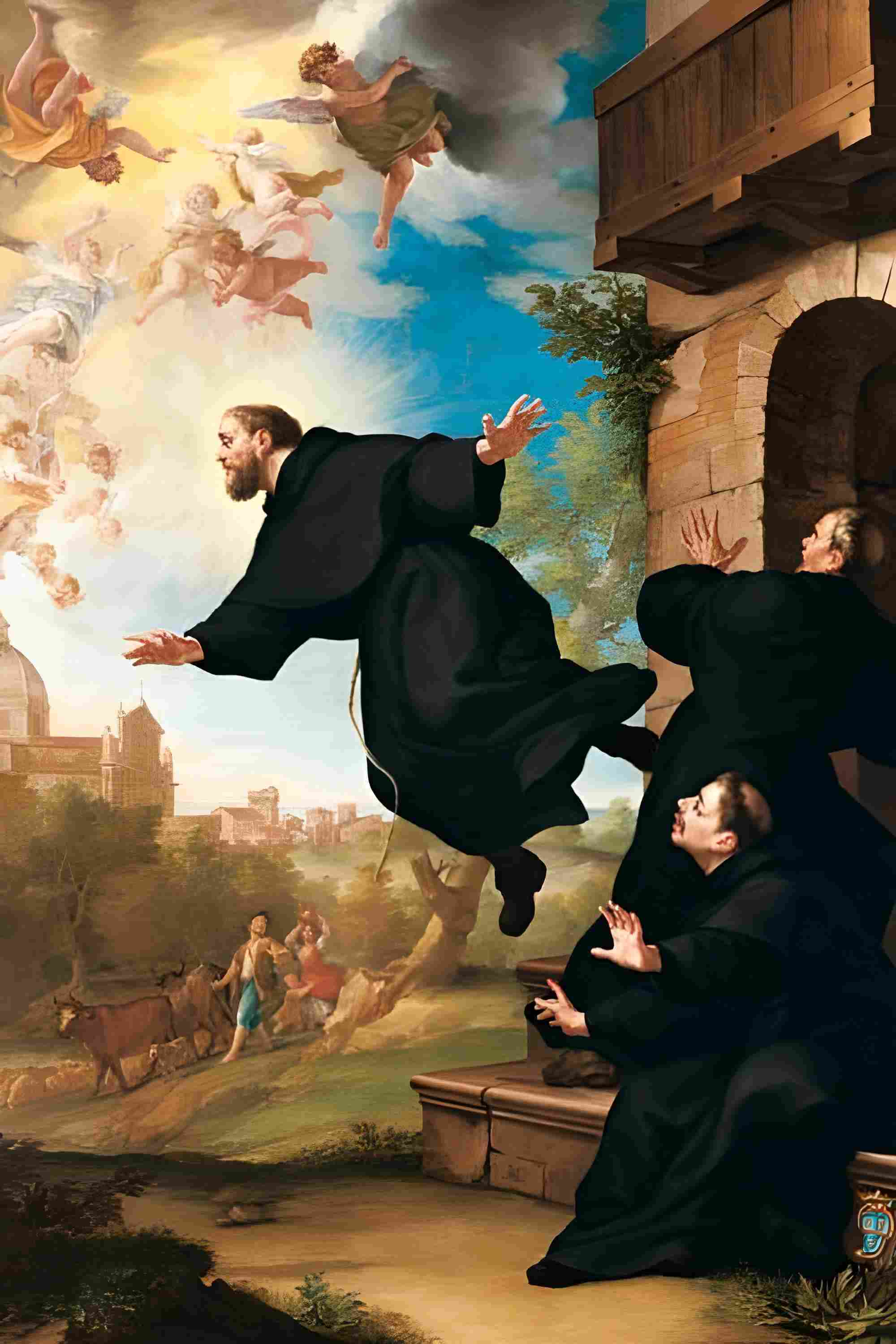
The “Flying Friar,” Patron Saint of Students and Examinations
Feast Day: September 18
Saint Joseph of Cupertino (1603–1663) is one of the most extraordinary saints in the history of the Catholic Church. A humble Conventual Franciscan friar, he struggled greatly with formal education and was often regarded by others as incapable of achieving much. Yet through prayer, humility, obedience, perseverance, and an extraordinary love for Jesus Christ, he became a priest and a renowned mystic.
He is especially remembered for the reports of ecstasies and levitations during intense prayer, which earned him the popular title “the Flying Friar.” But the most important lesson of his life is not his extraordinary mystical experiences. It is the way he surrendered his weaknesses to God.
Today, Saint Joseph of Cupertino is particularly invoked by students, those preparing for examinations, pilots, air travelers, and people facing difficult academic challenges. His story offers powerful encouragement to anyone who feels inadequate, rejected, academically weak, or overwhelmed by life’s demands. (Vatican News)


1. Early Life
Saint Joseph was born Giuseppe Desa on June 17, 1603, in the small town of Copertino (Cupertino) in southern Italy, then part of the Kingdom of Naples.
His parents were Felice Desa, a carpenter, and Francesca Panara. Joseph’s father died before he was born, leaving the family burdened by debts. Their property was taken by creditors, and Joseph was born in extremely poor circumstances. Traditional accounts relate that his mother gave birth to him in a stable because the family had lost its home. (New Advent)
His difficult beginning would become an important part of the story of his life. Joseph experienced poverty, rejection, misunderstanding, and personal limitations, yet these circumstances did not prevent God from accomplishing something beautiful through him.
2. A Child Drawn to God
From an early age, Joseph showed an unusual attraction toward prayer and religious things.
Traditional biographies describe mystical experiences beginning during his childhood. At times he would become completely absorbed in contemplation and apparently lose awareness of what was happening around him. Because of his tendency to stand with his mouth open while gazing into the distance, other children reportedly called him “Bocca Aperta,” meaning “open mouth.” (New Advent)
His childhood, however, was not without difficulties. Joseph struggled with his temperament and was sometimes quick-tempered. His mother was strict with him and tried to correct his faults.
This is an important aspect of his story: Joseph did not begin life as a perfect saint.
Holiness was a journey.
He had weaknesses to overcome. He experienced rejection. He struggled academically. He sometimes failed to meet the expectations of others.
Yet he continued to seek God.
3. His Struggle with Education
Perhaps the most encouraging aspect of Saint Joseph’s life for students is his extraordinary difficulty with formal studies.
Joseph had great difficulty learning and remembering academic material. His intellectual abilities were considered limited by those around him. He was not naturally suited to the kind of academic formation normally expected of someone preparing for the priesthood.
At one point he was apprenticed to a shoemaker. He desired religious life, however, and attempted to join the Conventual Franciscans. His first attempt was unsuccessful because of his lack of education. He was also briefly associated with the Capuchins but was eventually dismissed. (New Advent)
For a young man who desired to serve God, these failures must have been deeply painful.
But Joseph did not give up.
4. Accepted by the Franciscans
Eventually Joseph approached the Conventual Franciscan friars near Copertino and asked to be allowed to serve them.
He was initially given humble work, particularly in the friary’s stable.
Joseph accepted this lowly position with remarkable humility.
He cared for the animals, served the community, prayed, and tried to live faithfully. His simplicity and devotion gradually impressed the friars.
What appeared to be a failure became the beginning of a new chapter.
The man who had been rejected as unsuitable for religious life eventually became a member of the religious community.
In 1625, he was admitted to the Franciscan Order, and he began preparation for the priesthood. He was ordained a priest on March 28, 1628. (St. Joseph Cupertino)
5. The Examination That Made Him Patron of Students
One of the most famous stories connected with Saint Joseph concerns his examination for ordination.
Joseph found theological examinations extremely difficult. Traditional accounts relate that there was only a very limited amount of material he could explain confidently.
During one examination, the Gospel passage presented to him was one he knew particularly well:
“Blessed is the womb that carried you and the breasts at which you nursed!”
— Luke 11:27
Joseph was able to explain the passage.
According to the traditional account, the examination proceeded in such a way that Joseph was eventually able to receive the necessary approval for ordination. His academic limitations did not prevent God from opening a way for him to become a priest. (Wikipedia)
This story helps explain why Saint Joseph became especially associated with students and examinations.
His patronage does not mean that students should neglect preparation and simply expect a miracle.
Rather, his life teaches:
Study faithfully. Pray sincerely. Do your best. Trust God with what you cannot control.
6. A Priest Deeply in Love with Jesus
After his ordination, Joseph’s love for Christ became increasingly evident.
The Eucharist occupied a central place in his spiritual life. The mysteries of Christ’s Passion, the Blessed Virgin Mary, the saints, the name of Jesus, sacred music, and other signs connected with divine worship could profoundly affect him.
Franciscan sources emphasize Joseph’s profound love for Christ’s Real Presence in the Eucharist and for the Blessed Virgin Mary. (Conventual Franciscans)
His prayer was not merely intellectual.
It was deeply personal.
He sought Jesus with his whole heart.
7. The Mystical Ecstasies
Saint Joseph became famous because of extraordinary mystical phenomena associated with his prayer.
During moments of profound contemplation, he was sometimes reported to enter an ecstatic state in which he appeared to lose awareness of his surroundings.
The most famous phenomenon associated with him was levitation.
According to historical accounts, Joseph was sometimes seen rising from the ground while praying, especially during Mass or when confronted with something that directed his attention intensely toward God. The reports became so frequent that his superiors were concerned about the attention they attracted. (New Advent)
Franciscan sources describe him as the “Flying Friar.”
The extraordinary phenomena, however, were not the heart of his holiness.
The real test of Joseph’s sanctity was how he responded to them.
He did not seek popularity.
He did not turn mystical experiences into a spectacle.
He obeyed his superiors and accepted restrictions placed upon him.
8. The Church Investigates Joseph
Joseph’s unusual experiences naturally attracted attention.
In seventeenth-century Europe, extraordinary mystical phenomena could be viewed with suspicion. Joseph was reported to Church authorities and was investigated by the Inquisition.
He was examined and moved between different religious houses.
According to Franciscan and Catholic sources, the investigations did not result in a condemnation of Joseph. Instead, because his mystical experiences continued to cause attention and disruption, restrictions were imposed on his public activities. (Encyclopedia.com)
This period reveals something important about Joseph’s character.
He did not respond to suspicion with anger.
He accepted humiliation.
He accepted isolation.
He trusted God.
9. The Humble Saint Who Was Hidden Away
Because Joseph’s ecstasies attracted crowds and disturbed the normal life of the religious community, he was frequently separated from other friars.
Traditional accounts state that for many years he was prevented from participating publicly in certain community activities. He was sometimes confined to a room with a private chapel. (New Advent)
Imagine the paradox.
A man who was becoming famous was being hidden.
People wanted to see him, but Church authorities wanted him away from crowds.
Joseph accepted this.
This is one of the great spiritual lessons of his life:
God’s work does not depend upon our visibility.
A person does not become holy because everyone knows his name.
Sometimes holiness grows precisely in hiddenness.
10. Humility Was His Greatest Lesson
The extraordinary phenomena surrounding Saint Joseph could easily have produced pride.
Instead, his life was marked by humility and obedience.
He accepted difficult assignments.
He endured misunderstanding.
He experienced separation from others.
He submitted to his superiors.
He continued praying.
Franciscan sources describe his simplicity, obedience, and humility as central features of his life. (Conventual Franciscans)
This is why Saint Joseph’s story should not be reduced to the sensational image of a friar flying through the air.
The deeper miracle was a human being becoming increasingly surrendered to God.
11. His Love for the Poor and Simple
Joseph’s personality and spirituality attracted ordinary people.
He was not a great academic theologian.
He did not write massive theological treatises.
He did not become famous because of intellectual achievement.
His appeal was much simpler.
He was a man who loved God.
His simplicity made him accessible to people who themselves felt weak or inadequate.
Those who believed they were not intelligent enough, important enough, successful enough, or holy enough could look at Joseph and find hope.
His life says:
God does not need a perfect résumé to accomplish His purposes.
12. His Spirituality of Obedience
Obedience was one of the great virtues of Saint Joseph.
When his superiors instructed him to remain apart from the community, he obeyed.
When he was transferred, he went.
When people misunderstood him, he remained patient.
When extraordinary experiences came, he did not seek to control or publicize them.
His life demonstrates a central Christian principle:
Holiness is not merely having extraordinary experiences; holiness is faithfully loving God in whatever circumstances He permits.
13. His Ascetic Life
Joseph practiced significant forms of fasting and mortification.
Historical accounts describe periods of severe fasting and bodily penance. The Catholic Encyclopedia records that he practiced considerable austerity and that his fasting could be extremely severe. (New Advent)
These practices need to be understood within the spiritual culture of seventeenth-century religious life.
For contemporary Catholics, the central lesson is not necessarily to imitate every physical penance associated with Joseph.
Rather, we can imitate his self-discipline, prayer, sacrifice, simplicity, and detachment from worldly approval.
Christian asceticism ultimately has one purpose:
to make the heart freer for God.
14. His Relationship with the Blessed Virgin Mary
Saint Joseph had a deep devotion to the Blessed Virgin Mary.
The Virgin Mary occupied an important place in his spirituality, and traditional accounts associate his mystical experiences with his devotion to Christ and the saints as well as Mary. Franciscan sources specifically emphasize his love for the Blessed Virgin. (Conventual Franciscans)
For Joseph, Mary was not a substitute for Jesus.
She always directed the Christian heart toward her Son.
His devotion can therefore be summarized in the words of the Gospel:
“Do whatever he tells you.”
— John 2:5
Mary teaches us what Joseph himself learned:
complete surrender to God.
15. His Final Years at Osimo
Eventually Joseph was permitted to live at Osimo, in central Italy.
He spent his final years there in relative seclusion.
The years of suffering, misunderstanding, restrictions, and mystical experiences had formed him deeply.
He died at Osimo on September 18, 1663, at the age of sixty. (New Advent)
His body is venerated in the church dedicated to him at Osimo, which became an important place of pilgrimage. (New Advent)
16. Beatification and Canonization
The Church eventually recognized Joseph’s holiness formally.
He was beatified by Pope Benedict XIV in 1753.
On July 16, 1767, he was canonized by Pope Clement XIII. (New Advent)
His liturgical memorial is celebrated on September 18.
His canonization came more than a century after his death, following the Church’s investigation of his life and reported miracles.
Franciscan sources note that the investigation preceding his canonization recorded numerous incidents of levitation. (Franciscan Media)
17. Why Is Saint Joseph of Cupertino the Patron of Students?
Perhaps the most beloved aspect of Saint Joseph’s patronage today is his connection with students and examinations.
This is particularly meaningful because Joseph himself struggled with academic study.
He was not naturally gifted in the way the world normally measures academic success.
Yet he became a priest.
His story therefore gives hope to students who think:
- “I am not intelligent enough.”
- “I cannot remember what I study.”
- “I am afraid of the examination.”
- “Everyone else seems better than me.”
- “I have failed before.”
- “I don’t know whether I can succeed.”
Saint Joseph’s life teaches that academic difficulty does not determine a person’s worth.
A person’s dignity comes from being created and loved by God.
At the same time, his story should never be interpreted as an excuse for laziness.
The proper prayer is not:
“Lord, let me avoid studying.”
It is:
“Lord, help me study faithfully, remember what I have learned, remain calm during the examination, and accept the result with trust.”
18. Saint Joseph of Cupertino and Examination Anxiety
Many students experience tremendous anxiety before examinations.
Saint Joseph can be a beautiful companion during those moments.
Before studying, a student can say:
“Saint Joseph of Cupertino, pray for me.”
Before entering the examination hall:
“Jesus, I have prepared as well as I could. I place my mind, my memory, my understanding, and my future into Your hands.”
During a difficult question:
“Lord, give me peace and clarity.”
After the examination:
“Jesus, I trust in You.”
This spirituality changes the meaning of an examination.
The examination remains important, but it no longer becomes the measure of one’s entire identity.
19. Patron of Aviation and Air Travelers
Saint Joseph is also associated with aviation, pilots, astronauts, and air travelers because of the traditional accounts of his levitations.
His connection with flight has made him particularly popular among those who work in or travel through the aviation world. Franciscan and Catholic sources list air travelers and astronauts among his patronages. (Franciscan Media)
For travelers, devotion to Saint Joseph can become a simple reminder:
Every journey is ultimately placed in God’s hands.
20. What Can We Learn from Saint Joseph of Cupertino?
Saint Joseph’s life gives us several powerful lessons.
1. God can work through our weaknesses
Joseph’s limitations did not prevent God from calling him.
What others regarded as weakness became part of his testimony.
2. Failure is not the end
Joseph experienced rejection from religious communities and struggled with his studies.
Yet his story continued.
A failure is an event—not an identity.
3. Do not compare yourself with others
Joseph could not compete academically with many of his fellow seminarians.
But God had a particular path for him.
We should not measure our worth by someone else’s gifts.
4. Prayer is more important than reputation
Joseph became famous without seeking fame.
His deepest desire was communion with God.
5. Humility protects the soul
Even when extraordinary things were attributed to him, Joseph remained obedient and humble.
The Christian must never seek spiritual experiences for prestige.
6. Obedience can be a path to holiness
Joseph’s obedience was tested repeatedly.
He accepted difficult decisions made by his superiors.
His obedience became a form of sacrifice.
7. God works in hidden lives
For years Joseph was hidden from crowds.
Yet those hidden years were not wasted.
God was forming him.
8. Holiness does not require worldly success
Joseph was not celebrated for academic brilliance.
He became a saint because he loved God.
21. Saint Joseph of Cupertino and the Eucharist
One of the most beautiful aspects of his spirituality was his intense love for the Eucharist.
For Joseph, the Mass was not merely a religious obligation.
It was an encounter with Christ.
His reported ecstasies frequently occurred in connection with prayer and the celebration of the sacred mysteries. (New Advent)
His life therefore invites Catholics to recover a sense of wonder before the Eucharist.
When we come before the Blessed Sacrament, we should remember:
Jesus is not merely an idea to be studied. He is a Person to be loved.
22. Saint Joseph of Cupertino and the Power of Simplicity
The world often celebrates complicated things.
Saint Joseph reminds us of something different.
He was simple.
He prayed.
He obeyed.
He served.
He fasted.
He loved Jesus.
He loved Mary.
He accepted correction.
He endured suffering.
He trusted God.
His holiness was not based on worldly sophistication.
It was based on surrender.
23. The Meaning of His Levitation
The reports of Saint Joseph’s levitations are undoubtedly the most famous feature of his life.
Catholic tradition preserves these accounts as part of the historical testimony surrounding him, and the Church’s investigation before canonization considered such reports. Franciscan Media notes that seventy incidents of levitation were recorded in the investigation preceding his canonization. (Franciscan Media)
But Catholics should keep proper perspective.
Levitation is not the essence of Christian holiness.
The Gospel does not command Christians to perform miracles.
Jesus calls us to love God and neighbor.
Saint Joseph’s extraordinary experiences are interesting and remarkable, but the more important signs of his holiness were:
- humility,
- obedience,
- patience,
- prayer,
- penance,
- Eucharistic devotion,
- Marian devotion,
- perseverance,
- and trust in God.
24. A Saint for Those Who Feel “Not Good Enough”
Perhaps this is the greatest reason Saint Joseph of Cupertino remains so relevant.
Many people secretly believe:
“I am not good enough.”
A student may think:
“I am not intelligent enough.”
A young person may think:
“I have failed too many times.”
A person beginning a new career may think:
“Everyone else is more capable than I am.”
Someone struggling spiritually may think:
“God cannot possibly use someone like me.”
Saint Joseph answers such discouragement with his entire life.
He was rejected.
He struggled.
He was misunderstood.
He experienced limitations.
And yet God called him.
Therefore:
Your weakness does not cancel God’s call.
25. Saint Joseph of Cupertino for Today’s Students
For students, Saint Joseph is not simply a saint to whom one turns five minutes before an examination.
He can become a model for an entire way of life.
Before studying
Pray.
While studying
Work diligently.
When you cannot understand
Ask for help.
When you fail
Begin again.
When others succeed
Do not become jealous.
When you succeed
Remain humble.
Before the examination
Trust God.
After the examination
Accept the result peacefully.
This is a much deeper devotion than simply asking for a good mark.
26. A Short Prayer to Saint Joseph of Cupertino Before an Examination
Dear Saint Joseph of Cupertino,
you experienced great difficulties in your studies, yet God opened a way for you to become a priest and a faithful servant of Christ.
Pray for me as I prepare for my examination.
Obtain for me from God the grace to study with diligence, understand what I learn, remember what I have studied, and remain calm and confident during the examination.
When I become anxious, help me to trust in God.
When I become discouraged, give me perseverance.
When I face difficult questions, obtain for me clarity of mind.
Help me to remember that my worth does not depend upon my marks or achievements, but upon God’s love for me.
May I use whatever gifts God has given me for His glory and for the service of others.
Saint Joseph of Cupertino, patron of students and examinations, pray for me.
Amen.
27. A Prayer for Students
Lord Jesus,
through the intercession of Saint Joseph of Cupertino,
bless all students who are preparing for examinations.
Give them wisdom to understand,
memory to remember,
patience to study,
discipline to persevere,
and peace to overcome anxiety.
Bless especially those who struggle with learning.
Comfort those who have failed.
Strengthen those who have lost confidence.
Guide those who do not know what to do with their future.
Help every student discover that his or her true dignity comes not from marks, degrees, or achievements, but from being Your beloved child.
May Saint Joseph of Cupertino accompany them in every examination and every challenge.
May the Holy Spirit fill their minds with light and their hearts with peace.
Through Christ our Lord.
Amen.
28. Prayer to Saint Joseph of Cupertino for Students
Saint Joseph of Cupertino,
friend of students and patron of examinations,
you knew the pain of struggling with studies
and the fear of not being able to answer.Pray for all students who are preparing for examinations.
Help them to study faithfully,
think clearly,
remember what they have learned,
and remain peaceful under pressure.Obtain for them the grace to do their best
without losing hope or confidence.Help them understand that failure does not make them failures
and that success should always lead to gratitude.May they place their future into God’s loving hands.
Saint Joseph of Cupertino, pray for us.
Amen.
29. A Message from Saint Joseph’s Life
Saint Joseph of Cupertino’s life can be summed up in one beautiful truth:
God does not call only the gifted; He also transforms the weak who trust Him.
The world may ask:
“How talented are you?”
God asks:
“Will you trust Me?”
The world may ask:
“How successful are you?”
God asks:
“Will you remain faithful?”
The world may ask:
“What can you accomplish?”
God asks:
“Will you allow Me to work through you?”
Saint Joseph answered these questions with his life.
He did not become a saint because he was academically brilliant.
He did not become a saint because he was popular.
He did not become a saint because he sought extraordinary experiences.
He became a saint because, amid his weaknesses and limitations, he surrendered himself to God.
30. Conclusion
Saint Joseph of Cupertino remains one of the most fascinating saints of the Catholic Church.
His reported levitations have made him famous throughout the centuries, but his true legacy is much deeper.
He was a poor child who experienced hardship.
He was a young man who struggled with learning.
He was rejected.
He failed.
He was misunderstood.
He was investigated.
He was isolated.
Yet he continued to pray.
He continued to obey.
He continued to love.
He continued to trust.
And God transformed his life into a testimony of grace.
For students, he is a compassionate heavenly friend.
For those facing examinations, he is a reminder to combine hard work with prayer.
For those who feel intellectually inadequate, he offers hope.
For those who feel rejected, his life proclaims that human rejection cannot cancel God’s love.
For those who seek holiness, he teaches humility and obedience.
For those who love the Eucharist, he points toward Christ.
And for everyone who feels weak, Saint Joseph of Cupertino offers a message that remains timeless:
Your limitations do not determine what God can do with your life.
May Saint Joseph of Cupertino pray for every student preparing for examinations, every person facing a difficult challenge, every traveler beginning a journey, and everyone who feels inadequate or discouraged.
Saint Joseph of Cupertino,
patron of students and examinations,
pray for us.
Saint Joseph of Cupertino,
friend of those who struggle,
pray for us.
Saint Joseph of Cupertino,
lover of Jesus in the Eucharist,
pray for us.
Saint Joseph of Cupertino,
humble Franciscan servant of God,
pray for us.
Amen.
Feast Day: September 18
Born: June 17, 1603, Copertino, Italy
Died: September 18, 1663, Osimo, Italy
Religious Order: Order of Friars Minor Conventual (O.F.M. Conv.)
Beatified: 1753 by Pope Benedict XIV
Canonized: July 16, 1767 by Pope Clement XIII
Patronage: Students, examinations, air travelers, pilots and astronauts, among others. (New Advent)
Sources for further reading: Vatican News – Saint Joseph of Cupertino · Franciscan Media – Saint Joseph of Cupertino · Catholic Encyclopedia – Saint Joseph of Cupertino · Conventual Franciscan Friars – Franciscan Saints
Leave a Reply