
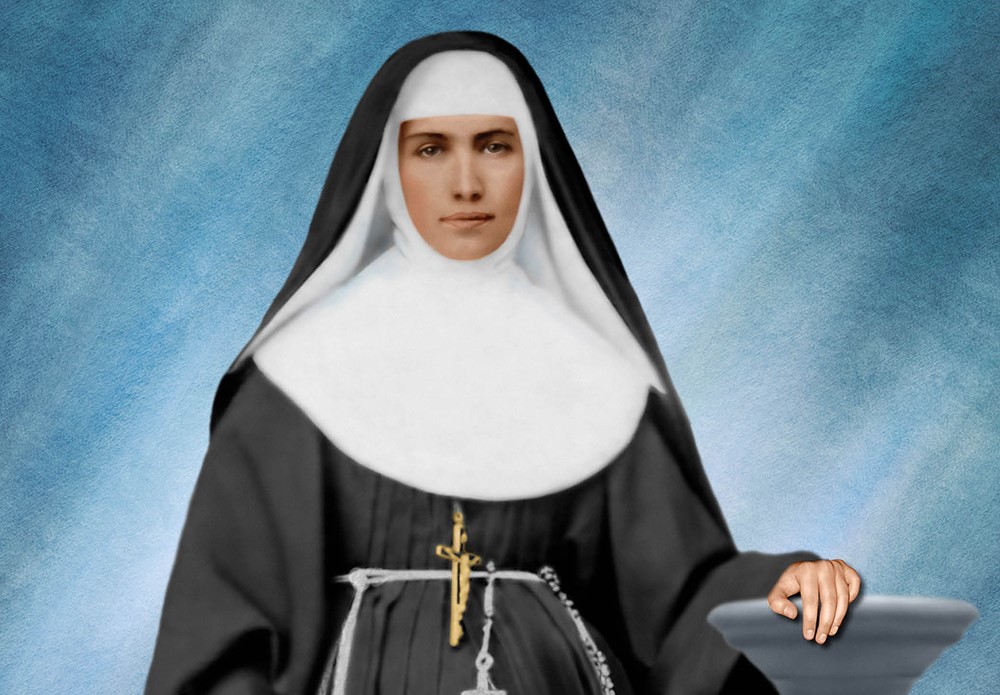
The Franciscan Mother of Molokai Who Served the Abandoned
Feast Day: January 23
Born: January 23, 1838, Heppenheim, Grand Duchy of Hesse, Germany
Died: August 9, 1918, Molokai, Hawaii
Canonized: October 21, 2012, by Pope Benedict XVI
Religious Congregation: Sisters of St. Francis of Syracuse
Known as: Mother Marianne of Molokai
Saint Marianne Cope was a woman who transformed fear into courage, suffering into compassion, and abandonment into a ministry of love. A German-born immigrant who became a Franciscan religious sister in the United States, she devoted the final decades of her life to caring for people afflicted with Hansen’s disease—historically called leprosy—on the Hawaiian islands.
Her life was closely associated with the ministry of Saint Damien of Molokai, but Marianne had a mission of her own. She did not merely care for the sick; she restored their dignity, brought beauty into their lives, protected children and women, and showed them that they had not been forgotten by God.
The Church celebrates her as a powerful witness to Christian charity, especially toward those whom society considers undesirable or forgotten.
1. From Barbara Koob to Mother Marianne
Saint Marianne was born Barbara Koob on January 23, 1838, in Heppenheim, Germany. Her parents were Peter Koob and Barbara Witzenbacher Koob.
When Barbara was only about one year old, her family emigrated to the United States and settled in Utica, New York. The family became part of St. Joseph’s Parish, where Barbara received her early education.
Her childhood was not one of privilege. When her father became seriously ill, Barbara had to leave school after the eighth grade and work in a factory to help support her family.
This experience would later help her understand the struggles of ordinary people.
She learned early that love often means sacrifice.
The young Barbara gradually felt called to religious life. Following the death of her father in 1862, she was able to pursue the vocation she had desired. She entered the Sisters of St. Francis in Syracuse, New York, and took the religious name Marianne.
She professed her vows in 1863.
2. A Franciscan Woman of Service
Sister Marianne did not spend her religious life hidden away from the needs of society.
She became a teacher, principal, administrator and hospital leader. Her ministry brought her into contact with immigrants, the sick, the poor and people who were often neglected by society.
She helped establish and manage hospitals in New York. In her work she promoted cleanliness, organization and compassionate treatment of patients. The hospitals under her care welcomed people regardless of nationality or religion—an approach that was significant in nineteenth-century America.
Her experience in healthcare would prove providential.
God was preparing her for a mission she could not yet imagine.
3. The Call from Hawaii
In the nineteenth century, Hansen’s disease was a source of tremendous fear.
People suffering from the disease in Hawaii were often separated from their families and sent to isolated communities, particularly at Kalaupapa on the island of Molokai.
The Hawaiian government sought religious communities willing to care for those suffering from the disease.
Many religious communities were reluctant to accept the mission.
But when the request reached the Sisters of St. Francis in Syracuse, Mother Marianne responded with extraordinary courage.
The Vatican biography records her remarkable response:
“I am not afraid of any disease.”
She also expressed her desire to minister to those whom society had abandoned.
For Marianne, the sick were not a threat to be avoided.
They were people to be loved.
And in every suffering person she saw Christ.
4. Journey to Hawaii
In November 1883, Mother Marianne and six other Franciscan sisters arrived in Honolulu.
Their first major responsibility was the Kaka’ako Branch Hospital, which received people suffering from Hansen’s disease.
The conditions were difficult. Yet the sisters immediately began cleaning the hospital, improving the living conditions and caring for the patients.
Mother Marianne also helped establish the Kapiolani Home, which provided care for healthy daughters of people suffering from Hansen’s disease.
Her ministry was therefore much broader than nursing.
She cared for bodies.
She protected children.
She created homes.
She organized communities.
And above all, she restored dignity.
5. Mother Marianne Goes to Molokai
In 1888, Mother Marianne accepted an even more demanding mission.
She went to Kalaupapa on Molokai, where people with Hansen’s disease had been isolated.
The following year, she formally arrived at Kalaupapa and continued the work of Father Damien.
The National Park Service records that she served the people of Kalaupapa for approximately thirty years. She worked as an administrator, nurse and pharmacist while insisting on the dignity and quality of life of those under her care.
She became especially involved in caring for women and girls and later assumed responsibility for the home for boys that had been established through Father Damien’s ministry.
Her presence brought stability and hope to a community that had experienced enormous suffering.
6. She Did More Than Treat Disease
One of the most beautiful aspects of Saint Marianne’s ministry is that she understood that human beings need more than medicine.
A sick person needs dignity.
A lonely person needs friendship.
A frightened person needs reassurance.
A child needs education.
A suffering person needs beauty.
A forgotten person needs someone to say:
“You matter.”
Mother Marianne worked to improve living conditions and create an environment in which people could experience joy despite their illness and isolation.
She encouraged cleanliness and order. She cared about clothing and appearance. She created opportunities for recreation and education.
She did not want the people of Kalaupapa merely to survive.
She wanted them to live.
This is an important Christian lesson.
Charity is not simply giving people things. Charity gives people back their dignity.
7. A Mother to the Abandoned
Mother Marianne gradually became known as a mother to the people of Molokai.
She did not treat them as patients alone.
She treated them as sons and daughters.
She shared their life.
She remained with them through difficult circumstances.
She did not run away from suffering.
Her ministry was an embodiment of the Gospel:
“I was sick and you visited me.”
— Matthew 25:36
Jesus teaches that what we do for the suffering, the poor and the forgotten, we do for Him.
Mother Marianne lived this teaching literally.
When she looked at a person suffering from Hansen’s disease, she saw not a disease but a human person created in God’s image.
And ultimately, she saw Christ.
8. Courage Without Fear
The courage of Saint Marianne is particularly remarkable because Hansen’s disease was widely feared.
Yet she willingly entered places from which others withdrew.
Her courage was not recklessness.
It was love stronger than fear.
She trusted that God’s love was greater than the dangers surrounding her.
Her life reminds us that Christian courage does not mean that we never experience fear.
It means that love gives us the strength to move beyond fear.
There are many forms of “leprosy” in today’s world.
People may be rejected because of poverty.
Others may be abandoned because of old age.
Some are isolated because of disability.
Some are forgotten because they have no family.
Others suffer from addiction, homelessness, loneliness or social rejection.
Saint Marianne asks us:
Whom have we pushed to the margins?
9. Her Relationship with Saint Damien
Mother Marianne’s story is closely connected with that of Saint Damien de Veuster, the famous priest who devoted himself to the people of Molokai.
Damien had already spent many years serving the community before Mother Marianne arrived.
When she came to Molokai, she continued and developed the work that had begun there.
The two saints represent complementary expressions of Christian charity.
Saint Damien became a father to the abandoned.
Saint Marianne became a mother.
Together their lives demonstrate that holiness is not merely a matter of prayer inside a church.
Holiness can mean entering a hospital ward.
It can mean washing wounds.
It can mean feeding someone.
It can mean protecting a child.
It can mean sitting beside a dying person.
It can mean remaining faithful when everyone else has left.
10. “Where Love Is Needed Most”
Saint Marianne’s life can be summarized in one powerful principle:
Go where love is needed most.
She could have remained in New York.
She had already established herself as an experienced religious superior and hospital administrator.
Instead, she responded to a call that took her thousands of miles away to an isolated island.
She did not know exactly what the future would bring.
But she knew that God was asking her to serve.
This is the nature of Christian vocation.
God does not always reveal the whole road.
He often reveals only the next step.
And faith means taking that step.
11. A Life of Joy Amid Suffering
It would be easy to imagine Mother Marianne’s life as gloomy because she lived among people suffering from a terrible disease.
But her spirituality was not centered on sadness.
She believed that suffering people deserved joy.
She brought beauty into their surroundings.
She encouraged dignity.
She helped create a community.
She understood something profoundly Christian:
Suffering does not cancel the human capacity for joy.
Even in the darkest circumstances, grace can create moments of beauty.
A smile can become ministry.
A song can become prayer.
A clean room can become an expression of dignity.
A loving presence can become an encounter with God.
12. Her Deep Franciscan Spirit
Saint Marianne was a daughter of Saint Francis of Assisi.
The Franciscan spirit is characterized by simplicity, humility, poverty, compassion and love for God’s creation.
Mother Marianne expressed that spirituality through service.
She did not seek prestige.
She did not seek comfort.
She did not seek recognition.
She sought Christ among the suffering.
Her life reminds us that the Franciscan way is ultimately a way of seeing.
See Christ in the poor.
See Christ in the sick.
See Christ in the rejected.
See Christ in the forgotten.
And once we see Christ, we cannot simply walk away.
13. The Final Years
Mother Marianne remained in Hawaii for the rest of her earthly life.
She spent approximately three decades serving the people of Kalaupapa.
She died on August 9, 1918, at the age of 80. She had given the final decades of her life to people whom society had isolated and forgotten.
She had gone to Hawaii as a missionary.
She died as a mother.
14. Beatification and Canonization
The Church officially recognized the holiness of Mother Marianne Cope.
She was beatified by Pope Benedict XVI on May 14, 2005.
Her canonization followed on October 21, 2012, when Pope Benedict XVI declared her a saint of the Catholic Church.
She became one of the saints associated especially with the care of people suffering from Hansen’s disease and with the Christian ministry of compassion.
Her feast day is celebrated on January 23.
She is remembered particularly as:
- Mother Marianne of Molokai
- A Franciscan missionary
- A servant of the sick
- A protector of women and children
- A witness to human dignity
- A model of compassionate charity
15. What Saint Marianne Teaches Us Today
Saint Marianne Cope is not merely a saint from nineteenth-century Hawaii.
Her message is urgently relevant today.
1. Do not be afraid to serve
Fear can prevent us from doing good.
Mother Marianne teaches us that love must sometimes be stronger than fear.
2. Never define a person by an illness
A person is never merely a diagnosis.
Every human being possesses God-given dignity.
3. The forgotten are not forgotten by God
Society may ignore people.
God never does.
4. Charity requires presence
Sometimes people do not need advice.
They simply need someone to remain beside them.
5. Small acts of dignity matter
Cleanliness, clothing, education, friendship and beauty may appear ordinary.
For a suffering person, they can be extraordinary.
6. Holiness is practical
Saint Marianne did not merely speak about love.
She washed, cleaned, organized, protected, taught, nursed and served.
Christian love must eventually become action.
7. God can use our ordinary abilities
Mother Marianne’s experience as a teacher, administrator and hospital worker became preparation for her mission.
Our own skills can become instruments of God’s grace.
16. Saint Marianne and the Gospel of the Good Samaritan
The Parable of the Good Samaritan in Luke 10:25–37 provides a beautiful lens through which to understand her life.
The Samaritan encountered a wounded man whom others had passed by.
He did not merely feel sorry for him.
He approached him.
He treated his wounds.
He carried him.
He paid for his care.
He took responsibility.
Mother Marianne did something similar on a much larger scale.
She went toward people others feared.
She touched lives others avoided.
She gave dignity to people others had rejected.
She remained where others might have left.
Her life asks each Christian:
“Who is my neighbour?”
The answer is not merely the person who lives next door.
Our neighbour is the person God places before us who needs our love.
17. A Saint for the Forgotten
There are still people today who experience a kind of social “leprosy.”
They may not have Hansen’s disease.
But they may carry other wounds:
- loneliness
- poverty
- homelessness
- addiction
- abandonment
- old age
- disability
- rejection
- grief
- family problems
- social isolation
They may sit beside us in church.
They may live in our neighbourhood.
They may work with us.
They may even belong to our own families.
Saint Marianne challenges us not merely to pray for such people from a distance.
She challenges us to approach them.
18. A Powerful Spiritual Lesson
The greatest lesson of Saint Marianne Cope may be this:
Love changes the way we see people.
Fear sees a disease.
Love sees a person.
Fear sees a problem.
Love sees a brother or sister.
Fear asks:
“What will happen to me if I go near?”
Love asks:
“What will happen to this person if I do not?”
That is the difference between ordinary compassion and Gospel charity.
19. A Prayer Through the Intercession of Saint Marianne Cope
Saint Marianne Cope,
servant of the sick and abandoned,
you saw Christ in every suffering person.
Teach us to look beyond appearances
and recognize the dignity of every human being.
Give us courage when fear prevents us from serving.
Give us compassion when we are tempted to judge.
Give us generosity when we are tempted to keep everything for ourselves.
Help us to remember those whom society forgets—
the lonely, the sick, the poor, the elderly,
the abandoned and the rejected.
Teach us to serve with joy,
to love without discrimination,
and to remain faithful when the road becomes difficult.
Saint Marianne,
Mother of Molokai,
pray for us.
May we learn from you
to see the face of Christ
in every person who suffers.
Amen.
20. Conclusion: “Love Without Fear”
Saint Marianne Cope’s life can be summed up in a simple Christian message:
Do not allow fear to decide whom you will love.
She crossed oceans because people were suffering.
She entered places others feared.
She remained with those others had abandoned.
She transformed a place of isolation into a place where people could experience dignity, friendship and love.
She reminds us that holiness is not always found in extraordinary experiences.
Sometimes holiness is found in extraordinarily faithful service.
A saint may be someone who spends thirty years caring for people whom the world has forgotten.
A saint may be someone who sees Christ where others see only suffering.
A saint may be someone who simply refuses to abandon another human being.
Saint Marianne Cope lived that holiness.
And her life continues to speak to the Church:
Go where love is needed.
Serve without fear.
Protect the vulnerable.
Restore dignity.
And see Christ in every suffering person.
Saint Marianne Cope, Mother of Molokai, pray for us!
Key Facts at a Glance
| Detail | Information |
|---|---|
| Name | Saint Marianne Cope |
| Birth Name | Barbara Koob |
| Born | January 23, 1838 |
| Birthplace | Heppenheim, Germany |
| Religious Congregation | Sisters of St. Francis of Syracuse |
| Mission | Care of people with Hansen’s disease |
| Main Mission Field | Hawaii, especially Molokai |
| Died | August 9, 1918 |
| Beatified | May 14, 2005 |
| Canonized | October 21, 2012 |
| Canonized By | Pope Benedict XVI |
| Feast Day | January 23 |
| Known As | Mother Marianne of Molokai |
| Patronal Significance | Compassionate care of the sick and marginalized |
Suggested Scripture for Reflection
“Whatever you did for one of the least of these brothers and sisters of mine, you did for me.”
— Matthew 25:40
Saint Marianne Cope’s life is a living commentary on these words of Jesus.
Leave a Reply