
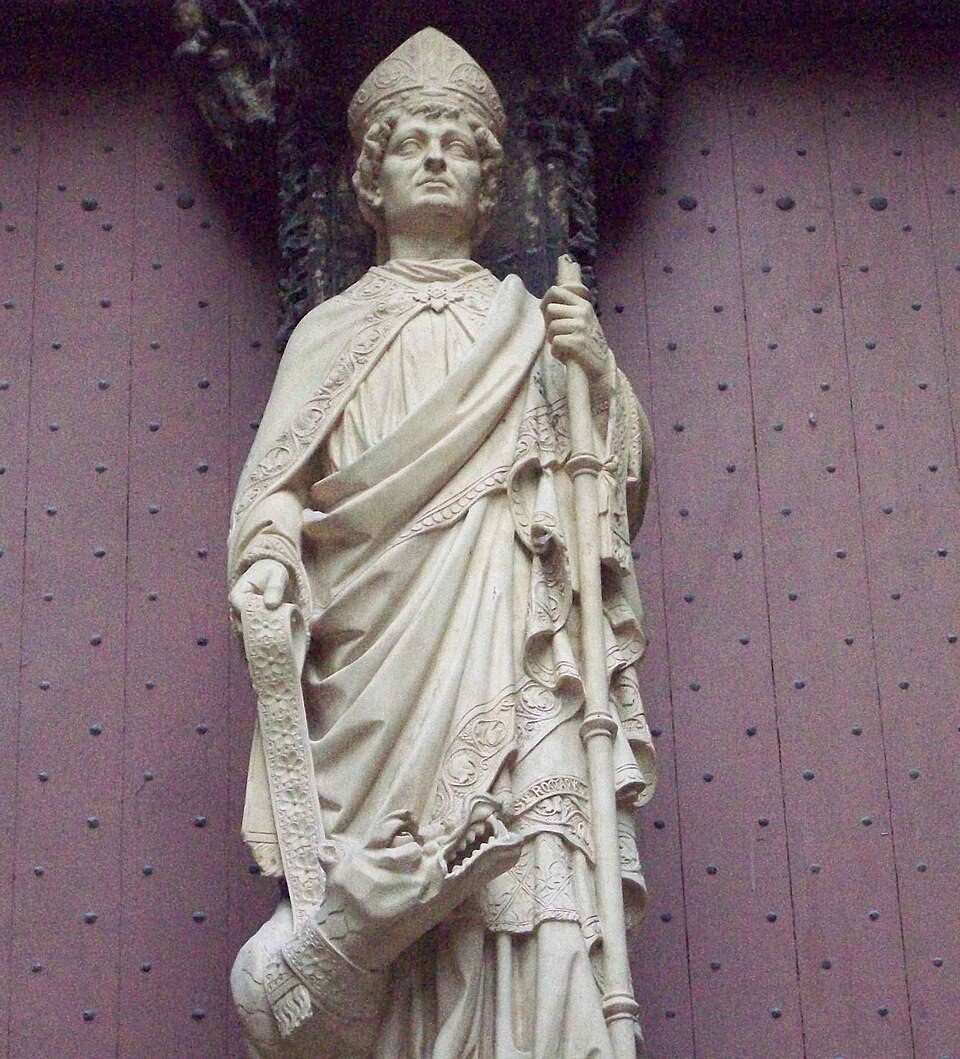
Bishop, Missionary, and Shepherd of Souls
Feast Day: August 9
Also known as: Maurilius, Maurilius of Rouen, Maurille of Rouen
Died: c. 650
Venerated in: The Catholic Church
Patronal associations: Rouen and the Archdiocese of Rouen
Saint Maurilius of Rouen was a sixth- and seventh-century bishop remembered for his missionary zeal, pastoral courage, and dedication to the conversion of the people entrusted to his care. His life belongs to the period when Christianity was becoming firmly established in the regions of what is now northern France.
Though many details of his life come from medieval traditions and are difficult to verify historically, the Church remembers him as a faithful shepherd who sought to bring the Gospel to a people still emerging from pagan traditions.


Early Life and Calling
Maurilius was born in the sixth century, probably in the region of Gaul. According to traditional accounts, he came from a noble family but was drawn toward a life devoted to God.
At a time when the Church was expanding throughout Gaul, monasteries and missionary centers played an important role in evangelization. Maurilius embraced this missionary spirit and eventually became associated with the Christian communities around Rouen.
Tradition connects his formation with the great missionary bishop Saint Martin of Tours, although some details of this association are uncertain.
What is clear from his later reputation is that Maurilius became a man deeply committed to the proclamation of the Christian faith.
Bishop of Rouen
Maurilius eventually became Bishop of Rouen, succeeding Saint Pretextatus according to traditional episcopal lists.
Rouen was an important city in the Frankish kingdom. The bishop of Rouen therefore carried a significant responsibility—not merely for liturgical life but also for evangelization, pastoral care, education and the moral formation of Christian society.
Maurilius faced a religious landscape in which Christianity coexisted with older pagan customs and beliefs.
His mission was not simply to baptize individuals.
He sought to establish a Christian way of life.
A Missionary Bishop
Saint Maurilius is particularly remembered for his missionary activity.
He preached the Gospel among people who were still influenced by pagan religious practices. He encouraged the destruction or abandonment of pagan shrines and promoted Christian worship.
His ministry illustrates one of the great challenges faced by bishops during the early medieval period:
How could the Gospel take root deeply within an entire society?
The answer required patience, preaching, catechesis, sacramental life and the witness of Christian communities.
Maurilius dedicated himself to this work.
The Conversion of Pagan Society
Christianization during this period was a gradual process.
Receiving baptism did not necessarily mean that every old religious practice immediately disappeared.
People continued to observe customs inherited from previous generations.
Missionary bishops therefore had to teach the faith patiently.
Maurilius worked to replace pagan practices with Christian devotion.
Churches and Christian communities became centers of worship and instruction.
The Gospel gradually shaped the culture and religious life of the region.
His ministry therefore belongs to the larger story of the Christianization of Gaul.
The Famous Legend of the Dragon
One of the most famous traditions associated with Saint Maurilius concerns a dragon.
According to medieval legend, a terrifying dragon lived in a cave near the Loire and was causing great fear among the local population.
The creature was associated in the popular imagination with evil and paganism.
Maurilius confronted the dragon and, through the power of Christ, defeated it.
The story eventually became one of the most recognizable elements of his legend.
However, it should be understood primarily as a hagiographical tradition, rather than as a historically verified event.
Medieval Christian stories frequently used dragons and other monsters symbolically.
The dragon represented:
- paganism
- Satan
- sin
- spiritual darkness
- the powers opposed to Christ
Thus, the story communicates a theological message:
Christ is stronger than every power of evil.
The Spiritual Meaning of the Dragon
The dragon legend can also be read as a reflection on the spiritual battle that every Christian faces.
Every age has its “dragons.”
Sometimes they are external:
- persecution
- injustice
- violence
- hatred
- false teaching
Sometimes they are internal:
- pride
- greed
- resentment
- jealousy
- addiction
- unforgiveness
Saint Maurilius reminds us that Christians are called to confront evil with faith rather than surrender to fear.
The victory ultimately belongs to Christ.
A Shepherd Who Cared for His People
Maurilius was not merely an evangelist.
He was a bishop.
The word bishop comes from the Greek episkopos, meaning an overseer or one who watches over.
The bishop is called to watch over the spiritual welfare of God’s people.
Maurilius took this responsibility seriously.
His ministry included preaching, pastoral leadership and the strengthening of Christian communities.
He sought to make the Church a place where people could encounter Christ and grow in faith.
The Importance of Christian Leadership
The life of Saint Maurilius offers an important lesson about leadership.
Christian leadership is not about power.
It is about service.
A bishop, priest, religious superior, catechist, parent or parish leader is called to imitate Christ the Good Shepherd.
Jesus says:
“I am the good shepherd. The good shepherd lays down his life for the sheep.”
— John 10:11
Saint Maurilius tried to live this pastoral ideal.
His authority was meant to serve the salvation of others.
Evangelization Requires Courage
Maurilius lived during a time when evangelization could be difficult and sometimes dangerous.
The Gospel challenged established religious practices and social structures.
Yet he continued to preach.
His example reminds Christians today that evangelization requires courage.
The Church is not called merely to preserve its traditions internally.
She is also called to proclaim Christ.
That proclamation must be accompanied by charity, patience and respect for human dignity.
Saint Maurilius and the Power of the Gospel
The missionary work of saints such as Maurilius helped Christianity move from being a relatively new faith in many regions of Europe to becoming deeply rooted in European society.
Their work included:
Preaching → Baptism → Catechesis → Christian community → Christian culture
The process took generations.
The saints understood that conversion was not simply an event.
It was a journey.
His Death
Saint Maurilius is traditionally believed to have died around 650.
He was buried at Rouen, where his memory continued to be honored.
His relics and cult became important in the religious history of the region.
Over the centuries, churches and works of art were dedicated to him, and his name became particularly associated with Rouen.
Saint Maurilius in the Art and Tradition of the Church
Saint Maurilius is often represented wearing episcopal vestments and carrying the symbols of his office:
- a mitre
- a crozier
- episcopal robes
Because of the famous dragon tradition, he may also be portrayed with a dragon.
The dragon should not be understood merely as a fantastic detail.
It symbolizes the saint’s victory over paganism and evil through the power of Christ.
What Saint Maurilius Teaches Us Today
Although Saint Maurilius lived more than a thousand years ago, his example has contemporary relevance.
1. Faith must be proclaimed
The Gospel is meant to be shared.
Every Christian has a responsibility to witness to Christ.
2. Conversion takes time
Changing hearts and cultures is not accomplished overnight.
We must be patient with people.
3. Evil must be confronted
Christians cannot simply ignore injustice, hatred or sin.
We must confront evil with truth and love.
4. Leaders must serve
Christian authority exists for the good of God’s people.
5. Faith must transform life
Christianity is not merely a collection of beliefs.
It should influence our families, communities, values and choices.
The “Dragons” We Face Today
Perhaps the most practical way to reflect on Saint Maurilius is to ask:
What is the dragon in my life?
For one person it may be anger.
For another, pride.
For another, fear.
Someone else may struggle with jealousy, materialism or unforgiveness.
We may also face social dragons such as:
- poverty
- exploitation
- corruption
- discrimination
- violence
- loneliness
- indifference
The Christian response is not despair.
We place ourselves under the lordship of Christ and confront these realities with faith, truth and love.
Saint Maurilius and the New Evangelization
The Church today again lives in a missionary environment.
Many people know little about Christianity.
Some have abandoned religious practice.
Others have never encountered the Gospel in a meaningful way.
In this sense, the missionary challenge faced by Saint Maurilius has returned in a new form.
The Church needs men and women who are willing to say:
“Christ must be proclaimed.”
But evangelization today must involve more than words.
We evangelize through:
- holiness
- friendship
- service
- compassion
- truth
- forgiveness
- works of mercy
- faithful Christian families
The witness of a Christian life can become a powerful form of evangelization.
A Saint for Priests and Bishops
Saint Maurilius has a special message for pastors.
A shepherd must know his people.
A shepherd must teach the truth.
A shepherd must defend the vulnerable.
A shepherd must correct what is harmful.
A shepherd must encourage the discouraged.
A shepherd must bring people to Christ.
Most importantly:
A shepherd must love the flock.
This is the heart of pastoral ministry.
A Reflection for Parish Communities
Every parish can learn something from Saint Maurilius.
A parish is not merely a building.
It is a missionary community.
The parish should be:
- a place of prayer
- a place of catechesis
- a place of reconciliation
- a place of charity
- a place of welcome
- a place of evangelization
Saint Maurilius challenges every parish to ask:
Are we simply maintaining our community, or are we actively bringing people to Christ?
Prayer to Saint Maurilius of Rouen
Saint Maurilius of Rouen,
faithful bishop and missionary,
you proclaimed Christ in a world
still searching for the light of the Gospel.
Pray for us that we may never be ashamed
to profess our faith.
Give courage to our bishops and priests
who shepherd God’s people.
Help our parishes become
communities of prayer, charity and mission.
Teach us to confront the “dragons”
of sin, fear, hatred and indifference
with the strength of Christ.
Pray for those who have lost their faith.
Pray for those who are searching for truth.
Pray for missionaries throughout the world.
May we become courageous witnesses
of the Gospel in our families, workplaces
and communities.
Saint Maurilius,
faithful shepherd of Rouen,
pray for us.
Amen.
Conclusion
Saint Maurilius of Rouen belongs to the generation of missionary bishops who helped establish Christianity in the lands of ancient Gaul.
His life was characterized by faith, courage, missionary zeal and pastoral service.
The famous story of the dragon has made his name memorable, but the deeper message of his life is more important.
The true “dragon” is whatever stands against God, truth and human dignity.
And the Christian response is not fear.
It is faith.
Saint Maurilius teaches us that the Gospel can overcome darkness when it is proclaimed with courage and lived with love.
His life invites us to become missionaries in our own time.
We may not travel to distant lands.
We may not preach to thousands.
But we can bring Christ to the person beside us.
We can forgive.
We can serve.
We can speak the truth.
We can welcome the stranger.
We can care for the suffering.
We can live our faith faithfully.
And in doing so, we continue the missionary work of the saints.
Saint Maurilius of Rouen, pray for us!
Saint Maurilius, courageous missionary and faithful shepherd, help us to proclaim Christ and overcome every darkness with the light of the Gospel.
:::
Historical note: The details of Saint Maurilius’ early life and especially the dragon episode come largely from medieval hagiographical traditions, so they should not be presented as equally certain historical facts. His association with the episcopal see of Rouen and his veneration are much more securely established.
Leave a Reply