
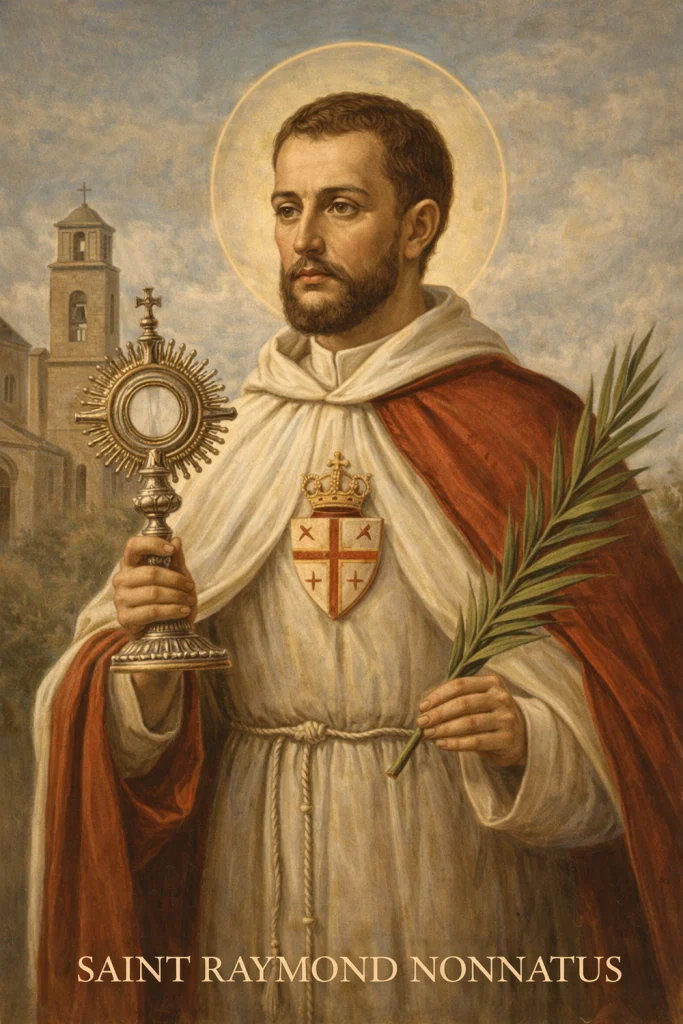
The Redeemer of Captives and Protector of Mothers and Infants
Saint Raymond Nonnatus (c. 1204–1240) was a Spanish Mercedarian religious, priest, missionary, and renowned redeemer of Christian captives. He dedicated his life to the liberation of Christians held in slavery in North Africa and became celebrated for his extraordinary courage, charity, and devotion to the Blessed Sacrament.
His unusual name, Nonnatus, meaning “not born” or “not born in the ordinary way,” comes from the tradition that he was delivered by Caesarean section after his mother died during childbirth.
His liturgical memorial is celebrated on 31 August.


1. Who Was Saint Raymond Nonnatus?
Saint Raymond Nonnatus was born around 1204 in Portell, in Catalonia, Spain.
He belonged to a noble family, but from his youth he showed a strong attraction toward prayer and the service of God.
His life unfolded during a period when Christians in the Mediterranean were frequently captured during conflicts between Christian and Muslim powers and sold into slavery.
Raymond eventually joined the Order of the Blessed Virgin Mary of Mercy, commonly known as the Mercedarians or Order of Mercy.
The primary mission of this order was the redemption of Christian captives.
Raymond embraced this mission with extraordinary dedication.
2. Why Was He Called “Nonnatus”?
The name Nonnatus comes from the Latin non natus, meaning “not born.”
According to the traditional account, Raymond’s mother died while giving birth to him.
Because the child was still alive, relatives or others present at the scene reportedly delivered him by Caesarean section.
Thus he became known as:
Raymond Nonnatus — Raymond “Not Born.”
This unusual story contributed greatly to his popular devotion.
He eventually became especially associated with:
- pregnant women,
- mothers,
- infants,
- childbirth,
- and those seeking protection during pregnancy.
The historical details surrounding his birth should be understood as part of the traditional accounts of his life, which contain elements that are difficult to verify independently.
3. His Early Life
Raymond grew up in Catalonia.
Even as a young man, he was attracted to a life of prayer and service.
His father reportedly wanted him to pursue a respectable worldly career and entrusted him with responsibility for family property.
Instead, Raymond felt called to consecrate himself completely to God.
He became increasingly involved with the Mercedarian movement.
Eventually he entered the religious order and devoted himself to the liberation of captives.
4. The Mercedarian Order


The Order of the Blessed Virgin Mary of Mercy was founded in the thirteenth century to redeem Christians who had been captured and enslaved.
The members of the order regarded this work as a practical expression of Christian charity.
They would travel to regions where Christians were held captive and negotiate their release.
Money was raised to pay ransoms.
But the Mercedarians made an extraordinary commitment: when necessary, a religious could offer himself in exchange for a captive.
Raymond became one of the most heroic examples of this vocation.
5. Raymond the Redeemer of Captives
Raymond traveled to North Africa, where many Christian captives were being held.
There he worked to obtain their freedom.
He negotiated with their captors and used whatever resources were available to ransom prisoners.
According to traditional accounts, when the money available for ransom was exhausted, Raymond offered himself as a hostage in exchange for the freedom of another Christian.
This act expresses one of the deepest principles of Christian discipleship:
“Greater love has no one than this, that someone lay down his life for his friends.”
— John 15:13
Raymond did not merely preach the Gospel.
He embodied it.
6. When His Money Was Exhausted
One of the most moving traditions about Raymond concerns the moment when his financial resources were exhausted.
He had succeeded in freeing many captives.
But there were still Christians in slavery.
Raymond had no more money with which to purchase their freedom.
Rather than abandon them, he offered himself.
He became a prisoner in their place.
This was not merely symbolic.
He actually endured captivity and suffering so that another person might be free.
7. His Suffering in Captivity
During his captivity, Raymond continued his priestly ministry.
He encouraged the prisoners.
He prayed with them.
He celebrated or administered the sacraments insofar as circumstances permitted.
He strengthened Christians who were tempted to lose hope.
His captors eventually attempted to prevent him from preaching and ministering.
According to traditional accounts, they subjected him to severe punishment.
8. The Padlock on His Mouth
One of the most famous stories associated with Saint Raymond concerns a padlock placed through his lips.
According to tradition, because Raymond continued preaching Christ and encouraging Christian captives despite threats, his captors pierced his lips and attached a padlock to them.
This horrifying punishment was intended to silence him.
But Raymond remained spiritually courageous.
The image of the padlock became one of the most recognizable symbols associated with him.


9. A Symbol of Courageous Evangelization
The traditional story of the padlock carries a powerful spiritual message.
Human beings can attempt to silence a Christian.
They can imprison the body.
They can threaten the preacher.
They can even inflict suffering.
But they cannot imprison the Word of God.
Raymond’s life therefore reminds Christians:
Do not be ashamed of the Gospel.
Faith should not disappear simply because witnessing to Christ becomes difficult.
10. His Love for the Eucharist
Saint Raymond had a profound devotion to the Blessed Sacrament.
The Eucharist was the source of his strength during captivity and suffering.
Traditional representations of the saint frequently show him with a monstrance, emphasizing his Eucharistic devotion.
For Raymond, the imprisoned Christian could still possess the greatest treasure:
Jesus Christ.
His life teaches that external freedom is precious, but spiritual freedom in Christ is even more important.
11. His Love for the Blessed Virgin Mary
Raymond was deeply associated with the Blessed Virgin Mary and the Mercedarian Order.
The Order itself was founded under her patronage as Our Lady of Mercy.
Raymond therefore saw the liberation of captives as a work carried out under Mary’s protection.
Mary is the Mother of Mercy.
The Christian who serves suffering people participates in her maternal compassion.
12. Raymond’s Priesthood
Raymond was not simply a social worker or political negotiator.
He was a priest.
His work of liberating captives flowed from his priestly identity.
He preached.
He prayed.
He celebrated the Eucharist.
He encouraged the imprisoned.
He reconciled sinners.
He strengthened people who were suffering.
His ministry demonstrates the unity between:
sacramental life + evangelization + charity.
13. His Concern for the Captives
Raymond saw every captive as a person created in the image of God.
He did not ask:
- What country are you from?
- What is your social status?
- How much money do you have?
- Are you important?
He simply saw someone who was suffering.
This is the heart of Christian mercy.
14. A Life of Self-Sacrifice
Raymond’s life can be summarized by one word:
Self-giving.
He gave:
- his wealth,
- his freedom,
- his comfort,
- his safety,
- his health,
- and eventually his life.
He followed the example of Christ, who gave Himself for the salvation of humanity.
15. Raymond’s Journey Back to Spain
Eventually, Raymond was released from captivity.
He returned to Spain.
His reputation for holiness had already spread widely.
He became an important figure in the Mercedarian Order.
His humility, however, remained characteristic of his spirituality.
He did not regard his sufferings as achievements.
He saw them as opportunities to serve Christ.
16. Called to Rome
According to tradition, Raymond’s holiness and reputation reached Pope Gregory IX.
The pope appointed Raymond as a cardinal.
However, Raymond did not seek ecclesiastical honors.
He remained attached to his religious vocation and preferred the simplicity of religious life.
This reflects an important lesson:
Holiness does not seek status.
The saint is interested not in titles but in serving God.
17. His Final Journey
Raymond did not live long after his return.
He became seriously ill and died in 1240, traditionally at the age of about 36.
He died at Cardona, in Catalonia.
His life had been short, but extraordinarily intense.
In little more than three decades, he had become:
- a religious,
- a priest,
- a missionary,
- a redeemer of captives,
- a prisoner,
- a preacher,
- and a witness to Christ.
18. His Death
Tradition says that Raymond died on 31 August 1240.
His body was buried at the chapel of the castle at Cardona, where devotion to him developed.
His tomb later became a place of pilgrimage.
His memory spread throughout Spain and eventually throughout the Catholic world.
19. Canonization
Saint Raymond was canonized by Pope Alexander VII in 1657.
His cult had already existed for centuries.
His canonization formally recognized his holiness and his place among the saints of the universal Church.
20. Feast Day
The liturgical memorial of Saint Raymond Nonnatus is celebrated on:
31 August
He is particularly remembered as:
The Redeemer of Captives
and as a heavenly patron associated with:
- expectant mothers,
- childbirth,
- infants,
- and those seeking protection from dangers associated with childbirth.
21. Patron of Expectant Mothers
Saint Raymond’s connection with childbirth comes primarily from the tradition surrounding his unusual birth.
Because his mother died before he was delivered, Christians began invoking him for women facing difficult pregnancies and childbirth.
Over time, he became especially popular among:
- pregnant women,
- women experiencing difficult pregnancies,
- mothers preparing for childbirth,
- newborn children,
- and families praying for safe delivery.
22. Saint Raymond and the Unborn
His story has also made him an important figure in Catholic reflection on the sanctity of human life.
His own birth was surrounded by danger.
Yet he lived a life of remarkable service.
His story reminds Christians that every human life possesses dignity and purpose.
A child whose future is unknown to the world may nevertheless have a unique mission in God’s providence.
23. Patron of Those Who Need Courage
Raymond can also be invoked by people facing difficult circumstances.
He experienced:
- imprisonment,
- violence,
- humiliation,
- hunger,
- uncertainty,
- and separation from freedom.
Yet he continued serving Christ.
His example is particularly meaningful for those who feel trapped by circumstances.
24. His Message to Prisoners and Captives
Raymond’s ministry offers a powerful message:
Physical captivity cannot imprison the human spirit when that spirit is united to Christ.
A prisoner can still:
- pray,
- forgive,
- love,
- hope,
- encourage others,
- and witness to Christ.
Raymond did exactly this.
25. Saint Raymond and Christian Social Action
Saint Raymond’s life reminds the Church that faith must respond to human suffering.
He did not simply pray for captives.
He went to them.
He negotiated for them.
He raised money for them.
He risked his own life for them.
He eventually became a captive himself.
This is authentic Christian charity.
26. A Message for Today’s World
Human trafficking, slavery, exploitation, forced labor, kidnapping, and abuse continue to affect millions of people around the world.
Saint Raymond’s example therefore remains deeply relevant.
His life challenges Christians to defend the dignity and freedom of vulnerable people.
The Church’s mission includes:
- defending human dignity,
- protecting vulnerable people,
- opposing exploitation,
- assisting victims,
- supporting families,
- and proclaiming the freedom offered by Christ.
27. Saint Raymond and the Meaning of Freedom
Saint Raymond understood two forms of freedom.
Physical freedom
Freedom from imprisonment, slavery, violence, and oppression.
Spiritual freedom
Freedom from:
- sin,
- hatred,
- despair,
- selfishness,
- fear,
- and separation from God.
Christian mission must care about both.
Raymond worked to free people physically because he believed every human person belongs to God.
28. His Spirituality of Mercy
The spirituality of Saint Raymond can be expressed in one sentence:
Mercy means entering another person’s suffering and doing something to relieve it.
Raymond did not remain at a safe distance.
He entered the suffering of captives.
He accepted their danger as his own.
This is precisely what Jesus teaches in the Gospel.
29. Saint Raymond and the Corporal Works of Mercy
His life beautifully illustrates the Corporal Works of Mercy:
- feed the hungry,
- give drink to the thirsty,
- clothe the naked,
- shelter the homeless,
- visit the sick,
- visit prisoners,
- bury the dead.
Raymond especially embodied:
Visiting prisoners and ransoming captives.
His entire religious vocation centered upon mercy toward imprisoned Christians.
30. Saint Raymond and the Spiritual Works of Mercy
He also practiced the spiritual works of mercy:
- instructing the ignorant,
- counseling the doubtful,
- comforting the sorrowful,
- bearing wrongs patiently,
- forgiving injuries,
- praying for others.
His preaching among captives was itself an act of mercy.
31. The Virtues of Saint Raymond Nonnatus
Faith
He trusted God even in captivity.
Hope
He refused to surrender to despair.
Charity
He sacrificed himself for others.
Courage
He continued preaching despite threats.
Perseverance
He remained faithful through suffering.
Humility
He did not seek worldly glory.
Compassion
He identified with the suffering of captives.
Eucharistic devotion
He drew strength from Christ present in the Blessed Sacrament.
Marian devotion
He served under the patronage of Our Lady of Mercy.
32. Symbols of Saint Raymond
Saint Raymond is commonly depicted with several distinctive symbols.
1. The Monstrance
Represents his love for the Eucharist.
2. The Palm
Represents martyrdom and victory, although Raymond is traditionally venerated as a confessor rather than as a martyr.
3. The Padlock
Represents the traditional account of his imprisonment and the attempt to silence his preaching.
4. The Mercedarian Habit
Represents his membership in the Order of Mercy.
5. The Cardinal’s Hat
Represents the tradition that Pope Gregory IX appointed him cardinal.
6. A Child or Pregnant Woman
Represents his patronage of mothers and infants.
33. Saint Raymond’s Relationship with the Mercedarians
Raymond remains one of the most beloved saints of the Mercedarian Order.
His life embodies the charism of the order:
Mercy for captives.
The Mercedarian vocation was not simply about financial ransom.
It was about proclaiming that no human being should be treated as a disposable object.
Every person belongs to God.
34. Saint Raymond and the Cross
The Mercedarian spirituality of Raymond is deeply connected with the Cross.
Christ Himself became a ransom for humanity.
Raymond imitated Christ by becoming a kind of ransom for captive Christians.
His life therefore reflects the words of Jesus:
“The Son of Man came not to be served but to serve, and to give his life as a ransom for many.”
— Mark 10:45
35. What Can We Learn from Saint Raymond?
Lesson 1: Love requires sacrifice.
It is easy to say, “I care.”
Raymond actually sacrificed himself.
Lesson 2: We must defend the vulnerable.
The weakest members of society need the strongest protection.
Lesson 3: Faith must produce action.
Prayer and charity belong together.
Lesson 4: Suffering does not have to destroy us.
Suffering can become an opportunity for witness.
Lesson 5: Christ gives freedom.
The deepest freedom is freedom in Christ.
Lesson 6: Never be ashamed of the Gospel.
Raymond continued preaching even when preaching cost him dearly.
36. A Message for Families
Saint Raymond has a special message for families.
Parents can ask his intercession for:
- the protection of mothers,
- safe childbirth,
- the health of newborn children,
- peace in the family,
- protection from danger,
- and deeper trust in God.
His life also reminds parents that children are gifts entrusted to them by God.
37. A Message for Expectant Mothers
The traditional devotion to Saint Raymond can be a beautiful source of spiritual encouragement for pregnant women.
A mother awaiting the birth of a child can pray:
“Saint Raymond Nonnatus, pray for me and for the child whom God has entrusted to me.”
The prayer should always be accompanied by appropriate medical care and responsible attention to maternal and infant health.
Faith and responsible care belong together.
38. A Message for Priests
Saint Raymond is also an inspiring model for priests.
He reminds priests that their ministry should reach people who are:
- forgotten,
- imprisoned,
- marginalized,
- afraid,
- suffering,
- and spiritually wounded.
A priest is called not only to preach to those who come to church.
He must also seek those who are unable to come.
Raymond went to the captives.
39. A Message for Kerala Parishes
Saint Raymond’s life can be especially meaningful in parish preaching.
Many families experience:
- migration,
- financial struggles,
- uncertainty,
- illness,
- difficult pregnancies,
- family separation,
- and anxiety about the future.
Raymond teaches us to place these difficulties before Christ.
But he also teaches us to become instruments of mercy for others.
A parish inspired by Saint Raymond should ask:
Who are the “captives” in our community today?
Perhaps they are:
- people trapped in addiction,
- elderly people abandoned by their families,
- migrants facing exploitation,
- children suffering abuse,
- families burdened by debt,
- prisoners,
- people suffering loneliness,
- or those enslaved by fear and despair.
The parish is called to bring them the freedom and mercy of Christ.
40. Saint Raymond Nonnatus and the Eucharist
One of the most beautiful aspects of his traditional iconography is his connection with the Blessed Sacrament.
The Eucharist teaches us what Raymond lived:
Christ gives Himself for us.
Raymond responded:
“I too must give myself for others.”
This is the logic of Eucharistic Christianity.
We receive Christ who gives Himself, and we are sent to become people who give ourselves in love.
41. A Beautiful Spiritual Reflection
Saint Raymond’s life can be understood through three words:
Freedom – Mercy – Sacrifice
He saw people who were imprisoned.
He showed them mercy.
He sacrificed himself for their freedom.
This is the Gospel in action.
And ultimately, this points us toward Christ.
Jesus is the One who came to liberate humanity from the slavery of sin.
42. Saint Raymond’s Legacy
Saint Raymond died young, but his mission continued long after his death.
His name became associated with:
- the liberation of captives,
- mercy,
- Eucharistic devotion,
- courage,
- Marian devotion,
- mothers,
- childbirth,
- and protection of infants.
The Mercedarian tradition preserved his memory as one of its greatest examples of self-sacrificing service.
43. Short Biography at a Glance
| Detail | Information |
|---|---|
| Name | Saint Raymond Nonnatus |
| Born | c. 1204 |
| Birthplace | Portell, Catalonia, Spain |
| Died | 1240 |
| Place of Death | Cardona, Catalonia |
| Religious Order | Mercedarians |
| Vocation | Priest, religious, redeemer of captives |
| Known for | Ransoming Christian captives |
| Traditional symbol | Padlock |
| Special devotion | Blessed Sacrament and Our Lady of Mercy |
| Patronage | Expectant mothers, childbirth, infants, captives |
| Canonized | 1657, Pope Alexander VII |
| Feast | 31 August |
44. Prayer to Saint Raymond Nonnatus
Prayer to Saint Raymond Nonnatus
O glorious Saint Raymond Nonnatus,
faithful servant of Christ and devoted son of Mary,
you who dedicated your life to the liberation of captives
and willingly suffered for those who were oppressed,
look with compassion upon us who turn to you in prayer.
Obtain for us a strong and living faith,
a firm hope in times of difficulty,
and a generous heart that never remains indifferent
to the suffering of others.
Pray for all those who are imprisoned,
enslaved, exploited, persecuted, or forgotten.
May they experience freedom, dignity, protection,
and the compassionate love of Christ.
Pray especially for expectant mothers
and for children awaiting birth.
Ask the Lord to protect mothers and infants,
to strengthen families,
and to grant peace and confidence to those who are afraid.
Saint Raymond,
you who remained faithful to Christ in captivity,
help us to break free from every slavery of sin,
fear, hatred, selfishness, and despair.
Teach us to love the Eucharist,
to trust in the Blessed Virgin Mary,
and to serve Christ in the poor and suffering.
May we never be silent before injustice
and never lose courage in times of trial.
Through your intercession,
may our homes be filled with faith,
our families with love,
our hearts with mercy,
and our lives with the peace of Christ.
Saint Raymond Nonnatus,
Redeemer of Captives and servant of mercy,
pray for us.
Amen.
45. Conclusion
Saint Raymond Nonnatus was a man who understood the meaning of Christian freedom.
He did not use his freedom merely for himself.
He used it to liberate others.
When his money was gone, he gave himself.
When he was imprisoned, he continued to serve.
When he was threatened, he continued to proclaim Christ.
When suffering came, he remained faithful.
His life can therefore be summed up in the words:
He became a captive so that others might become free.
And this is ultimately the heart of the Gospel.
Christ became our servant so that we might become children of God.
Saint Raymond Nonnatus invites every Christian to ask:
Whom can I help to become free?
Whom can I serve?
Whom can I encourage?
Whose suffering can I lighten?
His answer is clear:
**Mercy is not merely something we receive.
Mercy is something we must become.**
Saint Raymond Nonnatus, pray for us!

Leave a Reply