
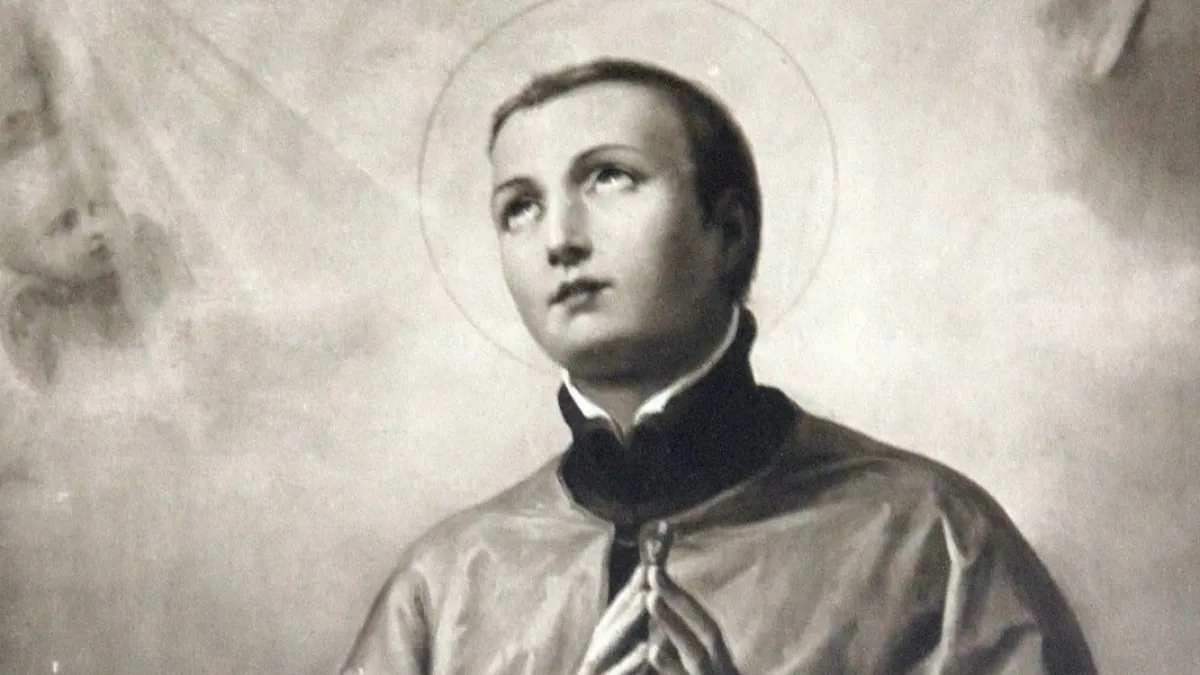
Saint Stanislaus Kostka (1550–1568) was a Polish Jesuit novice whose short life became a remarkable testimony to youthful faith, courage, perseverance, prayer, and wholehearted dedication to God. He died at only 17 years of age—although some historical and ecclesiastical sources describe him as 18 depending on how his age is reckoned—and was later canonized by the Catholic Church. He is particularly remembered as a patron of youth, students, and Jesuit novices, and as one of the most beloved saints of Poland.
Early Life
Stanislaus Kostka was born on 28 October 1550 at Rostkowo in the region of Masovia, Poland, into a noble Catholic family. His father, Jan Kostka, was a senator of the Kingdom of Poland, while his mother was Margaret Kryska. He was the second of seven children. His upbringing emphasized prayer, discipline, modesty, self-control, and religious devotion.
From his childhood, Stanislaus displayed a serious and sincere approach to his faith. His religious life was not merely an outward observance; prayer and spiritual discipline became central to his daily life.
Education in Vienna
At about the age of fourteen, Stanislaus went with his elder brother Paul to study at the Jesuit college in Vienna. There he encountered the spirituality and educational tradition of the Society of Jesus.
During his years in Vienna, his desire to become a Jesuit gradually became stronger. He practiced prayer and penance with great seriousness and sought to deepen his relationship with God. His spiritual aspirations, however, were not easily accepted by his family.
His elder brother Paul and their tutor did not understand or support Stanislaus’s desire to enter religious life. The young man nevertheless remained convinced that he was being called to the Society of Jesus.
A Determined Journey Toward His Vocation
The Jesuit superior in Vienna was reluctant to admit Stanislaus without his father’s permission. Stanislaus feared that his family would never give him permission to pursue his vocation.
Eventually, he decided to leave Vienna and seek admission elsewhere.
He travelled toward Dillingen in Bavaria, where he met Saint Peter Canisius, the Jesuit provincial. Canisius tested the young man’s vocation rather than simply accepting him immediately. Stanislaus was given responsibilities in the Jesuit boarding school, where his character and commitment could be observed.
Canisius eventually decided that Stanislaus should continue to Rome and seek admission to the Jesuit novitiate there.
The Journey to Rome
Stanislaus undertook the difficult journey to Rome and arrived there on 25 October 1567.
He was received by Saint Francis Borgia, then Superior General of the Society of Jesus. On 28 October 1567, his seventeenth birthday, Stanislaus entered the Jesuit novitiate.
For Stanislaus, this was the fulfillment of a deeply cherished vocation. He had overcome opposition, uncertainty, and considerable physical hardship in order to follow what he believed to be God’s call.
Life as a Jesuit Novice
Stanislaus spent only about ten months in the novitiate, but those months left a deep impression on those who knew him.
According to testimonies preserved in accounts of his life, he was noted for his prayerfulness, humility, obedience, simplicity, and intense devotion. His novice masters regarded him as an example of religious fervor.
The Church’s later tradition especially remembered his childlike trust in God. His spirituality was characterized by a sincere desire to belong completely to Christ.
He did not measure his vocation by the length of his life. Instead, he sought to live each day faithfully.
Devotion to the Blessed Virgin Mary
Marian devotion was an important part of Stanislaus’s spirituality.
According to traditional accounts of his life, during a serious illness while he was in Vienna, Stanislaus experienced a profound spiritual encounter involving the Blessed Virgin Mary and the Christ Child. These accounts strengthened his conviction that he should enter the Society of Jesus.
His death on the Solemnity of the Assumption of the Blessed Virgin Mary, August 15, later became particularly meaningful in the devotional tradition surrounding him.
His Final Illness and Death
In August 1568, Stanislaus became seriously ill. Despite medical attention, his condition deteriorated rapidly.
He died in Rome during the early hours of 15 August 1568, the feast of the Assumption of the Blessed Virgin Mary. He was still a Jesuit novice.
His death was striking because of his youth. He had lived only a very short earthly life, yet his spiritual influence continued to grow after his death.
The Jesuit community and the people of Rome soon developed a strong devotion to him.
Beatification and Canonization
The Church formally recognized Stanislaus’s sanctity relatively quickly.
He was beatified in 1605 and was canonized on 31 December 1726 by Pope Benedict XIII. He was canonized together with Saint Aloysius Gonzaga and other saints.
His liturgical memorial is celebrated on 13 November.
He became particularly associated with Poland and with the Jesuit tradition of forming young people and religious novices.

Patron of Youth and Students
Saint Stanislaus Kostka has a special place in the Catholic Church’s spirituality of youth.
He demonstrates that holiness is not something reserved for old age. A young person can seek God seriously, make courageous decisions, overcome obstacles, and live a life of profound holiness.
Pope Francis highlighted precisely this aspect of Stanislaus’s life when commemorating the 450th anniversary of his death in 2018. The Pope presented him as an inspiring example for young people and emphasized the Christian journey toward holiness.
Patron of Jesuit Novices
Saint Stanislaus is especially associated with Jesuit novices.
His own journey toward religious life is a powerful example of vocational perseverance. He faced resistance, uncertainty, and difficulties, but remained faithful to what he believed was God’s call.
The Jesuit church of Sant’Andrea al Quirinale in Rome, closely connected with his novitiate and burial, preserves his memory and remains an important place associated with his life.
His Spiritual Message
The life of Saint Stanislaus Kostka offers several important lessons.
1. Holiness has no age limit
Stanislaus became a model of holiness while still a teenager. His life reminds young people that they can take their faith seriously and seek holiness now rather than waiting for adulthood.
2. Follow God’s call courageously
Stanislaus faced opposition when he sought to become a Jesuit. His determination shows the importance of listening carefully to God’s call and courageously responding to it.
3. Prayer transforms life
For Stanislaus, prayer was not simply a religious obligation. It shaped his decisions, priorities, relationships, and understanding of his vocation.
4. Do not allow obstacles to destroy your vocation
His journey from Vienna to Dillingen and then Rome demonstrates extraordinary determination. His story encourages people not to abandon a genuine vocation simply because difficulties arise.
5. Live each day faithfully
Stanislaus did not know how short his life would be. His example reminds Christians that the value of a life is not measured simply by its length, but by the love, faith, and goodness with which it is lived.
Saint Stanislaus and Young People Today
Young people today face very different circumstances from those of sixteenth-century Europe, but many of the fundamental questions remain the same:
What is the purpose of my life?
What kind of person should I become?
What is God calling me to do?
How can I use my talents in the service of others?
Saint Stanislaus offers a powerful response: seek truth sincerely, listen to God, cultivate a life of prayer, have the courage to follow your vocation, and place love of God and neighbor at the center of life.
His story is especially relevant in a world in which young people can experience enormous pressure concerning success, popularity, wealth, education, and social expectations. Stanislaus reminds them that holiness, character, integrity, and love are greater measures of a successful life.
Symbols and Artistic Representations
Saint Stanislaus is commonly portrayed wearing the Jesuit religious habit. Traditional representations may show him with the Child Jesus, receiving Holy Communion, or with symbols associated with his Marian devotion.
His connection with the Eucharist, the Blessed Virgin Mary, and the Society of Jesus is central to his iconography.
Saint Stanislaus Kostka and August 15
There is a particularly beautiful historical connection between Saint Stanislaus Kostka and August 15.
August 15 is celebrated by the Catholic Church as the Solemnity of the Assumption of the Blessed Virgin Mary. It was also the day on which Stanislaus died in Rome in 1568.
Thus, August 15 carries a special significance in his story: on the feast celebrating Mary’s entrance into heavenly glory, a young Jesuit novice completed his own short earthly pilgrimage.
A Saint for Our Time
Saint Stanislaus Kostka lived for only a few years, but the influence of his life has lasted for centuries.
His story is not primarily about extraordinary achievements in the worldly sense. He did not become a famous politician, scientist, writer, or military leader. His greatness came from something simpler and deeper: he sought to give his whole life to God.
His journey from Rostkowo to Vienna, from Vienna to Dillingen, and finally to Rome can be understood as a journey toward holiness. Pope Francis recalled Saint John Paul II’s description of that journey as a kind of race toward the goal of Christian life—holiness.
For young Catholics, students, seminarians, religious novices, and anyone discerning a vocation, Saint Stanislaus remains a compelling example of courage and fidelity.
Prayerful Reflection
The life of Saint Stanislaus Kostka invites us to ask:
Am I willing to listen to God’s call?
Do I have the courage to follow what is right even when others do not understand me?
Do I make time for prayer?
Am I using my youth, talents, education, and opportunities for something greater than myself?
What kind of person is God calling me to become?
Saint Stanislaus teaches that a life does not have to be long to be meaningful. A life offered sincerely to God can bear fruit far beyond its earthly years.
🙏 Prayer to Saint Stanislaus Kostka
Saint Stanislaus Kostka,
young servant of God and faithful son of Mary,
you listened courageously to God’s call
and persevered in your vocation despite difficulties.
Help young people to discover God’s purpose for their lives.
Give students wisdom, discipline, and courage.
Strengthen those who are discerning a vocation
to the priesthood or religious life.
Teach us to love Jesus sincerely,
to trust Mary faithfully,
and to seek holiness in our daily lives.
Pray for us, Saint Stanislaus Kostka,
that we may have the courage to follow Christ
with an undivided heart.
Amen.
Feast Day and Patronage
Name: Saint Stanislaus Kostka
Born: 28 October 1550, Rostkowo, Poland
Died: 15 August 1568, Rome
Religious Order: Society of Jesus (Jesuits)
Entered the Jesuit novitiate: 28 October 1567
Beatified: 1605
Canonized: 31 December 1726
Liturgical Memorial: 13 November
Known as: Jesuit novice and patron of youth
Patronage: Youth, students, and Jesuit novices; especially associated with Poland
Conclusion
Saint Stanislaus Kostka was young in years but mature in faith. His life demonstrates that holiness is possible at every age and that responding generously to God’s call may require courage and perseverance.
He left the security of what was familiar because he believed that God was calling him to something greater. He endured opposition, travelled great distances, entered religious life, and lived his brief remaining months with remarkable devotion.
His example continues to speak especially to young people:
Listen to God.
Trust your vocation.
Persevere through difficulties.
Pray deeply.
Love Christ wholeheartedly.
And never think that you are too young to become a saint.
Saint Stanislaus Kostka, pray for us!
Leave a Reply