
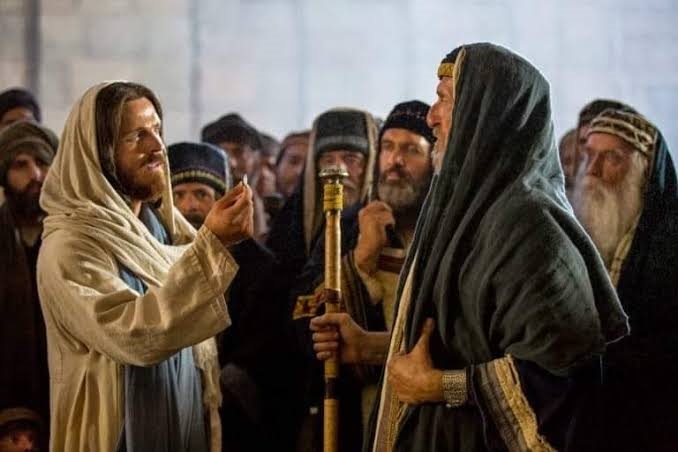
The Coin Belongs to Caesar, but You Belong to God | Matthew 22:15–22
Image is very important in our media-conscious age. The way a person looks, speaks, and presents himself can sometimes make a greater impression than what he actually says or does. Yet we know that image is not everything. We expect people to live up to the image they present. We value authenticity, honesty, and sincerity. We feel disappointed when someone appears friendly on the outside but hides hostility or dishonesty within.
This is precisely what we encounter in today’s Gospel.
The Pharisees and the Herodians, two groups that would not normally work together, join forces against Jesus. They approach Him with flattering words: “Master, we know that you are a truthful man and that you teach the way of God in accordance with the truth.” Their words sound respectful, but their intentions are far from honest. They are not seeking the truth; they want to trap Jesus with a question about paying taxes to Caesar.
So, they ask “Is it lawful to pay the census tax to Caesar or not?”
If Jesus says no, they can accuse him of opposing Roman authority. If he says yes, they can turn people against him. They want to force him into a simple yes-or-no answer that serves their plan.
But Jesus sees through their intentions and asks them to show him the coin used for the tax. “Whose image is this, and whose inscription?” “Caesar’s,” they reply. Then Jesus says, “Repay to Caesar what belongs to Caesar and to God what belongs to God.”
By asking them to produce the coin, Jesus exposes their insincerity. They are already using Roman currency, yet they pretend to be concerned about the legitimacy of paying the tax. They are not genuinely searching for the truth; they are looking for an opportunity to condemn Him.
Jesus’ answer is not a way of saying that faith and public life have nothing to do with each other. Nor does it mean that earthly authority is absolute. Jesus recognizes that we have real responsibilities in society, while making clear that God’s claim upon us is greater.
As Pope St. John Paul II explained, Jesus acknowledges a distinction, but not a separation, between the Kingdom of God He proclaims and the earthly realm in which we live as citizens of our respective countries and members of the one human family. Our faith belongs in the way we live and act in society.
The coin may bear Caesar’s image; our lives belong to God. But what bears the image of God?
The Book of Genesis tells us that human beings are created in God’s image and likeness (Genesis 1:26–27). So, Jesus’ question reaches beyond the coin: if the coin bears Caesar’s image, and we bear God’s image, to whom do we ultimately belong? We can give Caesar a coin. We cannot give Caesar our whole selves. Our lives, our conscience, our hopes, and our future belong to God.
That does not excuse us from being responsible citizens. We should fulfill our obligations, contribute to the good of society, and work for justice. Loving God and loving our neighbors are not competing duties. The Christian’s love of neighbor should shape the way we take part in public life and help build a just and humane society.
But no government, political movement, or worldly ambition can take God’s place. Earthly authority has limits. When the demands of society conflict with God’s law, our loyalty to God must come first. Faith does not make us careless about civic life; it forms our conscience so that we can serve the common good without treating any human power as ultimate.
The first reading gives us a striking example. Through the prophet Isaiah, God speaks of Cyrus, king of Persia, as an instrument through whom Israel’s exiles will find a way home. Cyrus is a powerful ruler, and God can work through him even though Cyrus does not know God. But Cyrus is not Israel’s savior. God is. The passage proclaims: “I am the Lord, and there is no other.”
That is a truth we need to hear in every age. God can work through unexpected people and circumstances. No ruler or institution controls God’s purposes. We may be anxious about the direction of the world, but no earthly power is God, and no earthly power can prevent God from remaining faithful.
So, what does it mean to give God what belongs to God? It means more than setting aside a little time for prayer while keeping the rest of life untouched by faith. It reaches into our choices, our relationships, our work, and the way we use our time and resources. If our life comes from God, then all of our life is called to be shaped by him.
We are often careful about our worldly responsibilities. We make sure our bills are paid, our work is done, and our commitments are kept. It is worth asking whether we show the same care in our relationship with God. Do we make room for prayer? Do we listen to his Word? Do we come to the Eucharist with a heart ready to be changed? Do our family members, neighbors, and those in need encounter patience and compassion in us?
God does not ask merely for a portion of our time. He invites us to surrender our whole lives to Him, not because He wants to take something away from us. He calls us to himself because he is the source of our life and the one who can bring it to its fullness. Our faith is not simply an image we display. It is a way of living that allows God’s truth and love to become visible in us.
And if we bear God’s image, so does every other human being. Every person possesses a dignity that no one can erase. We cannot claim to belong to God while treating another person with contempt, ignoring the poor, refusing to forgive, or using people for our own advantage. Love of God must become visible in the way we treat our neighbors, especially the vulnerable and those who are easily overlooked.
That brings us back to the question of image. The Pharisees and Herodians offered Jesus an appearance of respect, but their hearts were elsewhere. Jesus calls us to something deeper than appearing faithful. He calls us to be truthful, merciful, and sincere to let our words and actions match the faith we profess.
Dear brothers and sisters, the coin bears the emperor’s image, but we bear God’s image. Let us fulfill our earthly responsibilities, while remembering that our deepest belonging is to God. And let us offer him not only our prayers, but our choices, our relationships, our work, and our future. May our lives reflect the One whose image we bear, and make his love visible to the world.
✍ Fr. Tojan Abraham MCBS
Leave a Reply