
Introduction
Saint Luke the Evangelist is one of the most beloved figures in the history of Christianity. He is traditionally recognized as the author of the Gospel according to Saint Luke and the Acts of the Apostles, two New Testament books that together offer a profound account of the life and ministry of Jesus Christ and the growth of the early Church.
Luke presents Jesus as the Saviour of all humanity, the compassionate Lord who seeks the lost, forgives sinners, welcomes the poor, heals the sick, and offers salvation to every nation. His Gospel is especially treasured for its emphasis on divine mercy, prayer, the action of the Holy Spirit, the dignity of women, and God’s preferential concern for the poor and marginalized.
Celebrated on October 18, Saint Luke is honoured as an Evangelist, a physician, a missionary, and a faithful companion of Saint Paul. His writings continue to nourish Christian prayer, preaching, liturgy, and missionary life throughout the world.
1. Who Was Saint Luke?
Saint Luke was a Christian missionary and writer who lived during the first century. According to ancient Christian tradition, he was a physician from Antioch in Syria, a city known for its cultural diversity and its important role in the early Church.
Saint Paul refers to him as the “beloved physician” in Colossians 4:14. He also mentions Luke among his fellow workers in Philemon 24. Near the end of his life, while facing imprisonment, Paul writes to Timothy, “Only Luke is with me” (2 Timothy 4:11). This brief statement reveals something important about Luke’s character: he remained faithful to his companion even during a time of loneliness, suffering, and uncertainty.
The New Testament does not provide a detailed biography of Luke. Much of what is known about his life comes from these brief references in Paul’s letters, clues within the Acts of the Apostles, and the testimony of early Christian writers.
Christian tradition identifies Luke as a Gentile Christian, although his precise ethnic and religious background before his conversion cannot be established with complete certainty. His Gospel demonstrates a deep knowledge of Jewish Scripture, Greek literary expression, and the religious hopes of the people of Israel.
Luke did not belong to the Twelve Apostles. In the introduction to his Gospel, he explains that he relied on the testimony of those who had witnessed the events and served the word of God from the beginning (Luke 1:1–4). His contribution was to investigate these traditions carefully and present an orderly account for the strengthening of Christian faith.
2. Saint Luke as a Physician
One of the most distinctive details about Saint Luke is his profession as a physician. Saint Paul calls him the beloved physician in Colossians 4:14, and this title has become an enduring part of Luke’s identity in Christian tradition.
Medicine requires observation, patience, knowledge, and compassion. These qualities also characterize the Gospel traditionally attributed to Luke. He pays careful attention to human suffering, physical illness, emotional anguish, social exclusion, and the healing power of Jesus.
Throughout his Gospel, Jesus encounters people burdened by illness, poverty, grief, sin, and rejection. He does not treat them as insignificant individuals. He sees their dignity, listens to their cries, and restores them to life and community.
The healing of the bent woman (Luke 13:10–17), the cleansing of the ten lepers (Luke 17:11–19), and the restoration of the ear of the high priest’s servant during Jesus’ arrest (Luke 22:50–51) illustrate this compassionate dimension of Christ’s ministry.
Luke’s medical background is traditionally associated with his sensitivity to the suffering of others, although the Gospel’s compassion cannot be explained simply by his profession. His faith enabled him to recognize in Jesus the divine Physician who heals not only the body but also the human heart.
Saint Luke remains an important patron of physicians, surgeons, nurses, and other healthcare professionals. His example reminds all who care for the sick that genuine healing involves respect for the whole person, including physical, emotional, social, and spiritual needs.
3. Saint Luke and Saint Paul
Saint Luke is closely associated with Saint Paul, the Apostle to the Gentiles. Paul’s letters identify Luke as a fellow worker and a trusted companion. The Acts of the Apostles also contains several passages in which the narrative changes from “they” to “we,” suggesting that the author was personally present during certain stages of Paul’s missionary journeys.
These passages appear particularly in Acts 16:10–17, Acts 20:5–15, Acts 21:1–18, and Acts 27:1–28:16.
The traditional understanding is that Luke accompanied Paul on some of his travels, sharing in the difficulties of missionary life. These journeys involved long distances, dangerous sea voyages, opposition, imprisonment, and the uncertainty of proclaiming the Gospel in unfamiliar places.
Luke’s presence during Paul’s final imprisonment is particularly moving. When Paul writes to Timothy, he reports that many have abandoned him, yet Luke remains with him (2 Timothy 4:9–11).
This brief testimony reveals the quiet heroism of Christian friendship. Luke did not merely write about the Gospel; he lived its demands through loyalty, service, and perseverance.
His relationship with Paul also illustrates how God works through different gifts within the Church. Paul was a powerful preacher and missionary, while Luke served through his careful observation, writing, medical knowledge, and companionship. Their lives demonstrate that the mission of evangelization requires many kinds of service, all united in Christ.
4. The Gospel According to Saint Luke
The Gospel according to Saint Luke is the third Gospel in the New Testament. Together with the Acts of the Apostles, it forms a two-part work that traces the saving mission of Jesus Christ and its continuation through the early Church.
Luke begins his Gospel with a carefully composed introduction addressed to Theophilus. He explains that he has investigated the events and traditions handed down by eyewitnesses and ministers of the word so that Theophilus may have confidence in the teachings he has received (Luke 1:1–4).
This introduction reveals Luke’s concern for careful inquiry, reliable testimony, and an orderly presentation of the Christian faith.
The Gospel recounts the birth and infancy of Jesus, His public ministry, His journey toward Jerusalem, His Passion and death, and His Resurrection. It concludes with the risen Christ blessing His disciples and ascending into heaven.
Luke’s Gospel is particularly rich in material not found in the other Synoptic Gospels. Among its distinctive passages are the Annunciation to Mary, the Visitation, the Magnificat, the birth of John the Baptist, the parables of the Good Samaritan and the Prodigal Son, the encounter with Zacchaeus, and the story of the repentant criminal crucified beside Jesus.
These accounts have shaped Christian spirituality, liturgical prayer, preaching, sacred art, and the Church’s understanding of mercy.
5. The Gospel of Mercy and Compassion
One of the most distinctive characteristics of Luke’s Gospel is its portrayal of God’s mercy. Luke repeatedly presents Jesus as the One who seeks those who are lost, restores the dignity of sinners, and offers hope to people whom society has rejected.
The Good Samaritan
In Luke 10:25–37, Jesus tells the parable of the Good Samaritan. A wounded man lies beside the road after being attacked by robbers. A priest and a Levite pass by without helping him, but a Samaritan stops, cares for his wounds, and ensures that he receives further assistance.
The parable challenges every attempt to restrict love to people who belong to our own community, religion, nationality, or social group. True neighbourliness is expressed through compassionate action.
For Christians, this story remains a call to recognize Christ in the suffering person before us. Love of neighbour cannot remain merely a feeling or an idea; it must become practical service.
The Prodigal Son and the Merciful Father
Luke 15:11–32 contains one of the most treasured parables in the entire Bible: the story commonly known as the Prodigal Son.
A younger son abandons his father, wastes his inheritance, and eventually finds himself in misery. When he decides to return home, his father sees him from a distance, runs to meet him, embraces him, and restores him to the family.
The father represents the extraordinary mercy of God. He does not deny the son’s wrongdoing, but neither does he allow the son’s failure to become the final word about his life.
This parable has become a profound source of Christian reflection on repentance, forgiveness, reconciliation, and the Sacrament of Reconciliation. It reminds us that conversion begins when we turn back to God, and that divine mercy welcomes the repentant sinner with love.
The elder brother introduces another challenge. He remains physically close to his father but struggles to rejoice in his brother’s restoration. His attitude invites believers to examine their own hearts and recognize how resentment, self-righteousness, and jealousy can prevent them from sharing God’s compassion.
The Lost Sheep and the Lost Coin
In Luke 15:1–10, Jesus tells two parables about something lost and subsequently found. A shepherd searches for a lost sheep, while a woman carefully looks for a lost coin.
Both stories emphasize the joy of recovering what has been lost. Jesus uses them to explain the joy in heaven over one sinner who repents.
Luke’s message is clear: no person is insignificant in the eyes of God. The Church is called not merely to preserve those who are already gathered but also to seek those who have become distant, wounded, or discouraged.
The Penitent Criminal
In Luke 23:39–43, one of the criminals crucified beside Jesus recognizes his own guilt and asks Jesus to remember him when He comes into His kingdom. Jesus responds with a promise of paradise.
This moving encounter reveals that God’s mercy can reach a person even at the final hour of life. The repentant criminal has no opportunity to rebuild his earthly reputation or compensate fully for his past. Yet he turns to Jesus with faith and receives a promise of salvation.
Luke’s account offers hope to those who fear that their sins have placed them beyond God’s forgiveness. It also reminds us never to presume that another person’s life is beyond redemption.
6. Saint Luke and the Poor and Marginalized
Luke gives special attention to people who were economically disadvantaged, socially excluded, or regarded with suspicion.
In the Magnificat, Mary praises God for lifting up the lowly, bringing down the mighty, and filling the hungry with good things (Luke 1:46–55). This canticle introduces themes that run throughout the Gospel: God’s faithfulness to His promises, His concern for the humble, and His challenge to unjust arrangements of power and wealth.
In Luke 4:16–21, Jesus reads from the prophet Isaiah in the synagogue at Nazareth and declares that the Spirit of the Lord has anointed Him to proclaim good news to the poor, liberty to captives, sight to the blind, and freedom for the oppressed.
This passage serves as a programmatic statement of Jesus’ mission. His ministry is directed toward the restoration of human dignity and the liberation of those burdened by sin, suffering, and exclusion.
Luke also records the parable of the rich man and Lazarus (Luke 16:19–31). The rich man lives in luxury while Lazarus lies hungry at his gate. Their situations are reversed after death, and the story exposes the spiritual danger of indifference to the suffering person immediately before us.
The lesson is not simply that wealth is evil or poverty automatically guarantees holiness. Rather, material possessions carry moral responsibilities. Those who have resources are called to generosity, justice, and concern for those in need.
For the Church, Luke’s Gospel remains a summons to charitable service, the defence of human dignity, and a preferential concern for the poor.
7. Saint Luke and the Blessed Virgin Mary
Saint Luke’s Gospel has a particularly intimate relationship with the Blessed Virgin Mary. Its opening chapters provide many of the most cherished biblical accounts concerning her faith, humility, and participation in God’s saving plan.
The Annunciation
In Luke 1:26–38, the angel Gabriel announces to Mary that she will conceive and bear Jesus, the Son of the Most High. Although she asks how this will happen, Mary ultimately responds with complete openness to God’s will: “Let it be done to me according to your word.”
Her response reveals the essence of discipleship. Faith does not mean possessing answers to every question or understanding every future event. It means trusting God enough to surrender one’s life to His purpose.
The Visitation
In Luke 1:39–45, Mary travels to visit her relative Elizabeth, who is also expecting a child. Mary does not remain absorbed in her own extraordinary experience. She goes to assist Elizabeth and share in her joy.
The Visitation reveals that genuine faith expresses itself through service. Mary’s closeness to God leads her toward another person in need.
The Magnificat
Luke 1:46–55 records Mary’s hymn of praise, traditionally known as the Magnificat. In this prayer, Mary rejoices in God her Saviour and proclaims His mercy, faithfulness, and concern for the humble.
The Magnificat is prayed daily in the Church’s Evening Prayer in the Liturgy of the Hours. It teaches Christians to recognize God’s action in history and to praise Him for His faithfulness across generations.
Mary at the Birth and Childhood of Jesus
Luke recounts the birth of Jesus in Bethlehem, the visit of the shepherds, the presentation of Jesus in the Temple, and the finding of the twelve-year-old Jesus among the teachers in Jerusalem (Luke 2).
He also notes that Mary treasured these events and pondered them in her heart (Luke 2:19, 51).
This description presents Mary as a model of contemplative faith. She does not merely experience events; she reflects on them in the light of God’s mystery.
Although Christian tradition has sometimes suggested that Luke may have received information about Jesus’ infancy through Mary or people close to her, the Gospel itself does not identify his individual sources. What is certain is that his account has deeply shaped Marian devotion, the Rosary, and the Church’s celebration of the mysteries of Christ’s birth and childhood.
8. Saint Luke and the Importance of Prayer
Prayer occupies a prominent place in Luke’s Gospel. Jesus prays at important moments of His life and teaches His disciples to persevere in prayer.
Luke records Jesus praying at His baptism (Luke 3:21), withdrawing to deserted places to pray (Luke 5:16), praying before choosing the Twelve Apostles (Luke 6:12), and praying before His Transfiguration (Luke 9:28–29).
He also preserves several important teachings about prayer.
In Luke 11:1–13, Jesus teaches His disciples to pray and encourages them to ask, seek, and knock. The passage emphasizes confidence in the Father’s goodness and the gift of the Holy Spirit.
In Luke 18:1–8, the parable of the persistent widow teaches the importance of praying always and not losing heart.
In Luke 18:9–14, the parable of the Pharisee and the tax collector contrasts self-righteousness with humble repentance. The tax collector’s simple plea for God’s mercy expresses the truth that authentic prayer begins with honesty before God.
Luke’s teaching is particularly important for those who experience delayed answers, discouragement, or spiritual dryness. Perseverance in prayer is not an attempt to force God to fulfil our wishes. It is a way of remaining in relationship with Him, trusting His wisdom, and allowing His grace to transform our hearts.
9. The Gospel of Joy
Luke’s Gospel is marked by joy. The announcement of Jesus’ birth brings good news of great joy (Luke 2:10). The shepherds glorify and praise God after seeing the child Jesus (Luke 2:20). The disciples return from their mission rejoicing (Luke 10:17), and the people rejoice when they witness the works of Jesus (Luke 13:17).
Joy reaches a special intensity in the accounts of conversion and restoration. The shepherd searches for the lost sheep and rejoices when he finds it. The woman celebrates the recovery of her coin. The father welcomes his returning son with celebration. Zacchaeus receives Jesus joyfully into his home (Luke 19:6).
At the end of the Gospel, the disciples return to Jerusalem with great joy after Jesus’ Ascension (Luke 24:52).
Luke’s understanding of joy is not dependent on an absence of suffering. His Gospel leads toward the Cross and includes betrayal, rejection, sorrow, and death. Yet the Resurrection reveals that suffering and death do not have the final word.
Christian joy arises from the conviction that God is faithful, mercy is possible, and the risen Christ remains present with His people.
10. The Acts of the Apostles: The Continuation of the Gospel
Saint Luke’s contribution to the New Testament extends beyond his Gospel. Christian tradition also identifies him as the author of the Acts of the Apostles, which continues the story of God’s saving work after the Resurrection and Ascension of Jesus.
The Gospel according to Luke describes what Jesus began to do and teach. Acts recounts how the risen Lord continues His mission through the Holy Spirit and the community of His disciples.
The two books are therefore closely connected. They present a continuous history of salvation, moving from the ministry of Jesus to the proclamation of the Gospel throughout the world.
The Coming of the Holy Spirit
Acts 2 describes the descent of the Holy Spirit upon the disciples at Pentecost. Filled with the Spirit, they begin to proclaim the mighty works of God, and people from different nations hear the message in their own languages.
This event marks a decisive moment in the life of the Church. The frightened disciples become courageous witnesses, and the message of Jesus begins to reach beyond its original geographical and cultural setting.
Luke emphasizes that the Church’s mission does not depend solely on human courage or ability. It is sustained by the Holy Spirit, who strengthens believers to proclaim Christ even in the face of opposition.
The Growth of the Early Christian Community
Acts 2:42–47 offers a beautiful picture of the first Christian community. The believers devote themselves to the teaching of the Apostles, fellowship, the breaking of bread, and prayer. They share their possessions and respond to the needs of others.
This passage has become an important biblical foundation for Christian community life. It demonstrates that authentic faith is expressed through worship, communion, mutual responsibility, and practical charity.
The early Church did not understand the Gospel merely as a message to be heard. It was a way of life to be practised together.
The Mission to the Gentiles
One of the central themes of Acts is the expansion of the Gospel to the Gentiles. The conversion of Cornelius and his household in Acts 10 reveals that God does not show partiality and that the gift of the Holy Spirit is not restricted by ethnic or cultural boundaries.
The missionary journeys of Saint Paul further demonstrate how the Gospel crosses geographical, linguistic, and social barriers.
Luke’s account highlights the universal character of Christian salvation. The Church is called to proclaim Christ to all peoples, welcoming every person who responds to God’s grace.
The Witness of the Church in Suffering
Acts does not present the growth of Christianity as an easy or uninterrupted success story. The Apostles encounter imprisonment, persecution, rejection, and violent opposition.
Yet the Word of God continues to spread. The courage of Peter and John, the martyrdom of Stephen, the conversion of Saul, and the missionary journeys of Paul demonstrate that suffering cannot extinguish the Gospel.
In this way, Luke connects the experience of the early Church with the Passion and Resurrection of Jesus. Christian witness may involve suffering, but it remains rooted in the hope that God is at work even in the most difficult circumstances.
11. The Road to Emmaus: Recognizing the Risen Christ
Among the most moving Resurrection narratives in the New Testament is the account of the disciples on the road to Emmaus, found in Luke 24:13–35.
Two disciples are travelling away from Jerusalem, overwhelmed by the death of Jesus and confused by reports of the empty tomb. The risen Jesus draws near and walks with them, but they do not recognize Him.
He listens to their disappointment and explains the Scriptures, showing how the Messiah’s suffering belongs to God’s saving plan.
When they reach their destination, they invite Him to remain with them. At table, Jesus takes bread, blesses it, breaks it, and gives it to them. Their eyes are opened, and they recognize Him. He then disappears from their sight.
The disciples later reflect that their hearts were burning within them as He explained the Scriptures along the way.
This passage is central to Christian spirituality for several reasons.
First, it reveals that the risen Christ accompanies people even when they cannot recognize His presence. Second, it shows the importance of reading Scripture in the light of Christ. Third, it connects the breaking of bread with the disciples’ recognition of the Lord.
The story also offers a beautiful model for pastoral ministry. Jesus does not begin by condemning the disciples for their confusion. He walks with them, listens to them, explains the Scriptures, and leads them toward renewed faith.
Their encounter transforms their sadness into hope and sends them back to Jerusalem to share the good news.
The road to Emmaus continues to speak to Christians who experience disappointment, unanswered questions, or the apparent absence of God. The Lord may be closer than they realize, patiently guiding them toward a deeper understanding of His presence.
12. Saint Luke as a Historian and Evangelist
Luke’s writings demonstrate a deliberate effort to present the Christian message in an orderly and meaningful narrative.
In the introduction to his Gospel, he speaks of investigating the events and consulting the testimony of eyewitnesses and ministers of the word. In Acts, he provides accounts of journeys, public speeches, missionary activity, and encounters with different communities.
His writings also reveal a strong interest in geography, public institutions, historical settings, and the circumstances in which the Gospel was proclaimed.
At the same time, Luke is not merely recording a sequence of events. He interprets history in the light of God’s saving action. The birth, ministry, death, and Resurrection of Jesus form the centre of his account, while Acts shows the Gospel advancing through the power of the Holy Spirit.
His work teaches an important lesson about evangelization: the Christian message must be proclaimed faithfully, communicated clearly, and presented in ways that help people understand its significance for their lives.
Saint Luke’s example is particularly relevant to priests, catechists, teachers, theologians, writers, journalists, and all who communicate the Christian faith. Their responsibility is not simply to transmit information but to serve the truth and lead people toward a deeper encounter with Christ.
13. The Symbol of Saint Luke: The Ox
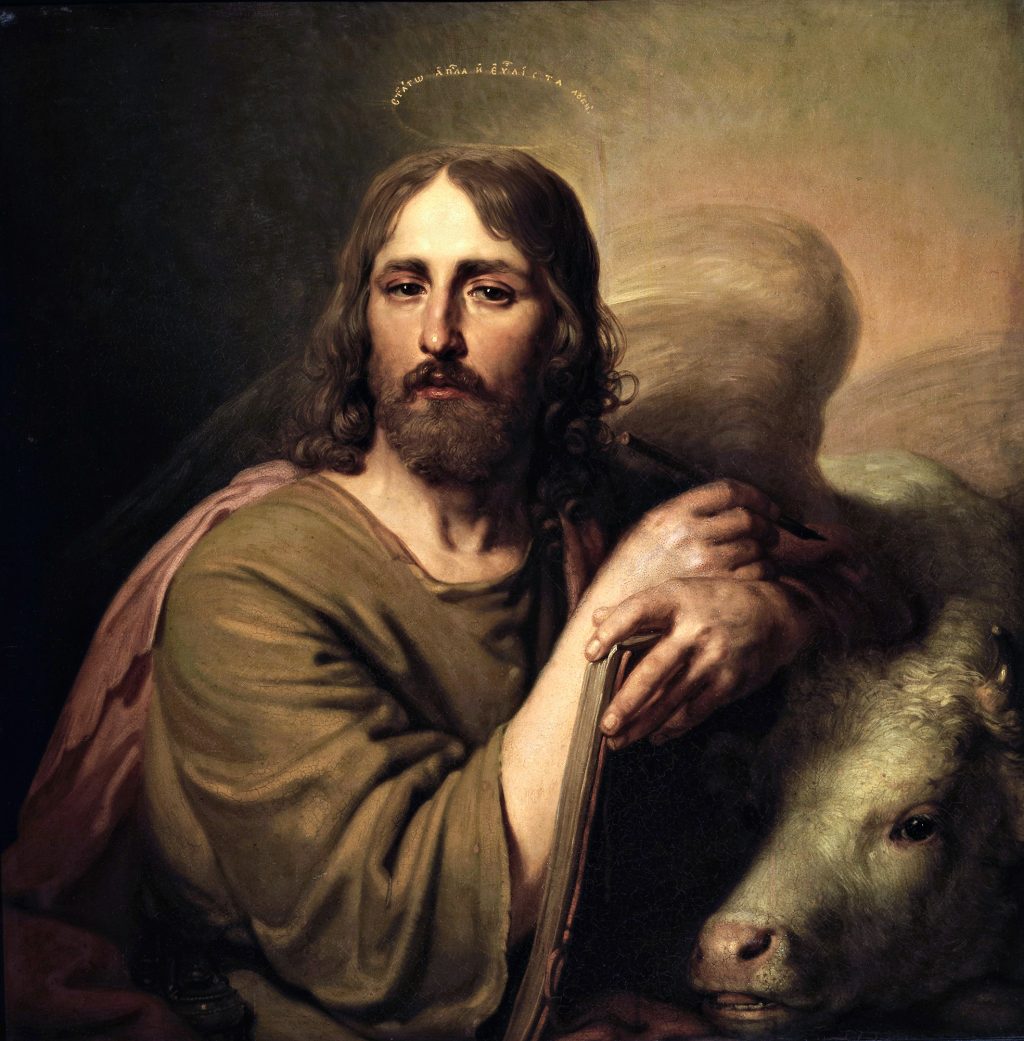
In Christian iconography, Saint Luke is traditionally represented by a winged ox or calf. The ox is one of the four living creatures associated with the vision of God’s glory in Ezekiel 1:4–14 and Revelation 4:6–8.
The four creatures became associated in Christian tradition with the four Evangelists: Matthew, Mark, Luke, and John. Although interpretations of the symbolism have varied throughout Christian history, the winged ox is the traditional emblem of Luke.
The ox has been associated with sacrifice and priestly worship. In this interpretation, the symbol points toward the sacrificial dimension of Christ’s saving mission, which reaches its climax in His Passion and death.
Saint Luke’s Gospel gives considerable attention to Jesus’ journey toward Jerusalem, where He will offer His life for the salvation of humanity. The symbol therefore directs our attention to the mystery of Christ, who freely embraces suffering and death in obedience to the Father.
In traditional religious art, Saint Luke may also be depicted holding a book, writing with a pen, or accompanied by an ox. Such representations emphasize his role as an Evangelist and his service to the Church through the written Word of God.
14. Saint Luke as Patron of Artists
Christian tradition also honours Saint Luke as the patron saint of artists, painters, and iconographers.
This association developed from the tradition that Luke was a painter and that he produced portraits of the Blessed Virgin Mary. However, there is no reliable historical evidence establishing that he personally painted these images.
The tradition reflects the close relationship between Luke’s Gospel and Christian sacred art. His detailed narratives of the Annunciation, Nativity, Presentation in the Temple, and other events in the life of Jesus have inspired generations of painters, sculptors, iconographers, and other artists.
Through their work, Christian artists have helped believers contemplate the mysteries of salvation and encounter the beauty of the Gospel.
Saint Luke’s patronage of artists also reminds us that artistic gifts can become forms of evangelization. Sacred art is not merely decoration; it can direct the heart toward God, communicate the truths of faith, and inspire prayer.
Writers, musicians, painters, photographers, and digital creators can all learn from Luke’s example. Their talents can serve the Church when they are used with integrity, beauty, and a desire to lead others toward Christ.
15. The Death of Saint Luke and the Veneration of His Relics
The exact circumstances of Saint Luke’s death are not known with certainty. Ancient Christian traditions differ regarding the place where he died, his age at death, and whether he suffered martyrdom.
Some traditions maintain that he lived to an advanced age, while others associate his death with martyrdom. These details cannot be established conclusively from the New Testament.
According to ancient tradition, Luke died in Boeotia in Greece and was buried at Thebes. Later traditions associate his relics with Constantinople and subsequently with Padua in Italy.
The Basilica of Saint Justina in Padua is particularly associated with the veneration of relics attributed to Saint Luke. Pope Saint John Paul II reflected on this tradition in his 2000 message to the Archbishop of Padua for the feast of the Evangelist.
The Church venerates saints not because every biographical detail about them is known, but because their lives bear witness to the grace of God and the transforming power of the Gospel.
Luke’s enduring legacy rests above all on the Scriptures traditionally attributed to him and the witness of faithful service reflected in Paul’s letters.
16. Feast Day of Saint Luke
The Catholic Church celebrates the feast of Saint Luke the Evangelist on October 18.
The day honours his service to the Church through the Gospel according to Saint Luke and the Acts of the Apostles, as well as his traditional association with medicine and missionary work.
The feast offers an opportunity to reflect on several important aspects of Christian discipleship:
- Faithfulness to the Word of God: Luke investigated and communicated the Christian message so that others might grow in faith.
- Compassion for the suffering: His Gospel repeatedly presents Jesus reaching out to the sick, the poor, and those burdened by sin.
- Perseverance in mission: His companionship with Paul illustrates the importance of remaining faithful through difficulties.
- The universal call to salvation: His writings emphasize that the Gospel is offered to all peoples.
- The transforming power of the Holy Spirit: Acts demonstrates how the Spirit strengthens the Church to continue Christ’s mission.
- The joy of the Resurrection: Luke’s account of the risen Christ calls believers to move from fear and discouragement toward renewed hope.
Saint Luke’s feast is especially meaningful for physicians, healthcare workers, missionaries, biblical scholars, writers, and artists. It invites them to place their professional gifts at the service of human dignity and the Gospel.
17. Spiritual Lessons from the Life of Saint Luke
1. Use Your Gifts to Serve God
Luke’s medical knowledge, literary ability, and missionary companionship became instruments of service to the Church. His example teaches us that holiness does not require abandoning every ordinary skill or profession. Rather, we are called to offer our abilities to God and use them for the good of others.
2. Remain Faithful in Difficult Times
Paul’s testimony that Luke remained with him near the end of his life reveals the importance of steadfast friendship. Christian love is not measured only by the promises we make during joyful moments but also by our willingness to remain present when others are suffering.
3. Never Despair of God’s Mercy
The parables of the Prodigal Son and the Lost Sheep remind us that God continues to seek those who have wandered away. No one should deliberately presume upon God’s mercy, but neither should anyone despair of forgiveness when sincerely turning back to Him.
4. Make Room for the Poor
Luke’s Gospel challenges indifference to poverty and suffering. Christian discipleship requires more than private devotion; it calls us to share our resources, defend human dignity, and respond to the needs of those who are overlooked.
5. Pray with Perseverance
Luke repeatedly presents Jesus at prayer and teaches His disciples to persevere. His Gospel encourages us to remain faithful in prayer even when our circumstances do not change immediately.
6. Listen to the Word of God
Luke’s account of the disciples on the road to Emmaus shows how the Scriptures can transform confusion into understanding and sorrow into hope. Regular reading, meditation, and prayerful listening to the Word of God help us recognize Christ’s presence in our lives.
7. Allow the Holy Spirit to Guide Your Mission
The Acts of the Apostles demonstrates that the Church’s mission is sustained by the Holy Spirit. Luke reminds every Christian that evangelization is not simply a human undertaking but a response to God’s initiative and grace.
18. A Short Prayer to Saint Luke the Evangelist
Saint Luke the Evangelist, beloved physician and faithful servant of the Word of God, intercede for us before the Lord.
Obtain for us a heart filled with compassion, a faith rooted in the Gospel, and the courage to remain faithful in times of difficulty. Teach us to recognize Jesus in the poor, the sick, the lonely, and those who have lost hope.
Pray for physicians, nurses, healthcare workers, missionaries, writers, teachers, and all who use their talents in the service of others. May their work become a witness to the love and mercy of Christ.
Help us to persevere in prayer, trust in God’s mercy, and welcome the guidance of the Holy Spirit. May we proclaim the Gospel not only through our words but also through our actions.
Saint Luke, pray for us.
Amen.
19. Conclusion
Saint Luke the Evangelist occupies a special place in the life of the Church because of his service to the Word of God and his presentation of Jesus Christ as the compassionate Saviour of humanity.
Through his Gospel, we encounter the merciful Father who welcomes the repentant sinner, the Good Samaritan who cares for the wounded, the shepherd who seeks the lost, and the risen Lord who walks beside discouraged disciples.
Through the Acts of the Apostles, we witness the power of the Holy Spirit at work in the early Christian community, strengthening the disciples to proclaim the Gospel across cultural and geographical boundaries.
Luke’s traditional identity as a physician also offers a lasting reminder that faith and compassionate service belong together. Whether through medicine, missionary work, teaching, writing, or ordinary acts of kindness, every Christian can become an instrument of God’s healing love.
His life and writings invite us to become attentive listeners to the Word of God, faithful companions to those who suffer, and courageous witnesses to the Resurrection.
The lasting message of Saint Luke is that God’s mercy reaches beyond human boundaries, His grace can restore those who have fallen, and His Gospel is meant to be proclaimed to every nation.
References and Further Reading
Primary Biblical Sources
1. The Gospel according to Saint Luke. The principal biblical source for Jesus’ ministry, the parables of mercy, the infancy narratives, the Passion, and the Resurrection.
https://www.vatican.va/archive/ENG0839/_INDEX.HTM
2. The Acts of the Apostles. Luke’s companion work, traditionally attributed to the same author, describing Pentecost, the early Christian community, and the missionary journeys of the Apostles.
https://www.vatican.va/archive/ENG0839/_INDEX.HTM
3. Colossians 4:14. Saint Paul’s reference to Luke as the beloved physician.
https://www.biblegateway.com/passage/?search=Colossians%204%3A14&version=NRSVCE
4. Philemon 24. Paul’s identification of Luke among his fellow workers.
https://www.biblegateway.com/passage/?search=Philemon%2024&version=NRSVCE
5. 2 Timothy 4:11. Paul’s testimony that Luke remained with him.
https://www.biblegateway.com/passage/?search=2%20Timothy%204%3A11&version=NRSVCE
Catholic and Historical References
1. Vatican News — Saint Luke, Evangelist, Physician, Patron of Artists. An overview of Luke’s life, missionary association with Paul, emphasis on mercy, and connection with Marian devotion.
https://www.vaticannews.va/en/saints/10/18/st–luke–evangelist–physician—patron-of–artists.html
2. Pope Saint John Paul II — Message for the Feast of the Evangelist Luke, October 17, 2000. A reflection on Luke’s writings, the Word of God, Christian discipleship, the Holy Spirit, and the Church’s mission.
3. The Catholic Encyclopedia — “Gospel of Saint Luke.” A historical and scholarly treatment of Luke’s traditional biography, Gospel, sources, and literary characteristics.
https://www.newadvent.org/cathen/09420a.htm
4. Eusebius of Caesarea — Ecclesiastical History, Book III, Chapter 4. An early Christian historical source discussing the traditional identity and background of Luke.
https://www.newadvent.org/fathers/250103.htm
Further Reading
- Raymond E. Brown, An Introduction to the New Testament. Doubleday, 1997.
- Joseph A. Fitzmyer, The Gospel According to Luke I–IX. Anchor Bible 28, Doubleday, 1981.
- Joseph A. Fitzmyer, The Gospel According to Luke X–XXIV. Anchor Bible 28A, Doubleday, 1985.
- Joseph A. Fitzmyer, The Acts of the Apostles: A New Translation with Introduction and Commentary. Anchor Bible 31, Doubleday, 1998.
- I. Howard Marshall, The Gospel of Luke: A Commentary on the Greek Text. New International Greek Testament Commentary, Eerdmans, 1978.
- Luke Timothy Johnson, The Gospel of Luke. Sacra Pagina Series 3, Liturgical Press, 1991.
Leave a Reply