
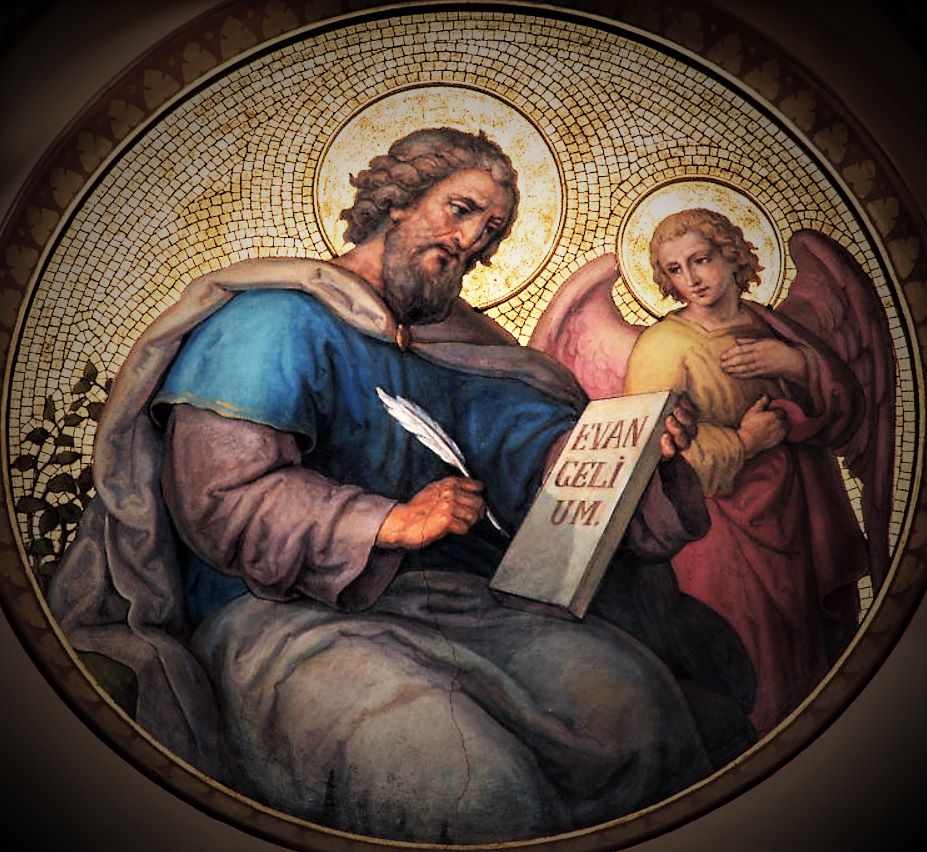
Apostle of Christ, Evangelist of the Kingdom
Feast Day: September 21
Saint Matthew the Apostle and Evangelist is one of the Twelve Apostles of Jesus Christ and is traditionally recognized as the author of the Gospel according to Matthew. His life is a beautiful testimony to the transforming power of God’s mercy. He was a tax collector—someone regarded with suspicion and contempt by many of his fellow Jews—yet Jesus looked beyond his past and called him to become one of His closest disciples.
Matthew’s story reminds us that no past is too broken, no profession too despised, and no sinner too far away for the mercy of Christ. The man who once collected taxes eventually became a preacher of the Gospel and, according to ancient Christian tradition, a martyr for the faith.
His feast is celebrated by the Catholic Church on September 21.
1. Matthew the Tax Collector
Before becoming an Apostle, Matthew was a tax collector.
The Gospel identifies him as sitting at the tax booth when Jesus called him:
“As Jesus was walking along, he saw a man called Matthew sitting at the tax booth, and he said to him, ‘Follow me.’ And he got up and followed him.”
— Matthew 9:9
Tax collectors were often deeply unpopular in Jewish society. They worked for the Roman authorities and were associated with an occupying political power. Because tax collection could also involve dishonest practices and personal profit, tax collectors were frequently regarded as sinners and social outsiders.
Yet Jesus did not allow Matthew’s profession or reputation to define him.
Jesus simply said:
“Follow me.”
And Matthew followed.
This short sentence contains one of the most powerful conversion stories in the Gospel.
2. Matthew’s Immediate Response
Matthew’s response to Jesus was remarkably direct.
He did not ask Jesus for time to think. He did not demand guarantees about his future. He did not wait until his life became perfect.
“He got up and followed him.”
The call of Matthew demonstrates that Christian vocation begins with the initiative of Christ.
Jesus calls.
The disciple responds.
Matthew left behind his former way of life and entered into the company of Jesus.
His conversion teaches us that when Christ calls a person, He does not merely ask for a change of ideas. He asks for a change of life.
3. Matthew’s Banquet for Jesus
Immediately after his call, Matthew hosted a great meal.
The Gospel tells us:
“And as he sat at dinner in the house, many tax collectors and sinners came and were sitting with him and his disciples.”
— Matthew 9:10
Matthew’s table became a place of encounter.
He brought his former associates into the presence of Jesus.
This is significant. Matthew did not hide his past. Instead, the people who had known him before his conversion were given an opportunity to meet Christ.
The banquet also provoked criticism from the Pharisees. They asked why Jesus ate with tax collectors and sinners.
Jesus answered:
“Those who are well have no need of a physician, but those who are sick.”
— Matthew 9:12
Then He declared:
“Go and learn what this means, ‘I desire mercy, not sacrifice.’”
— Matthew 9:13
Matthew’s vocation therefore became a living illustration of Christ’s mercy.
4. From Tax Collector to Apostle
Matthew was not merely a follower among the crowds. He became one of the Twelve Apostles.
His name appears in the lists of the Apostles in the New Testament.
In Matthew’s Gospel, the list reads:
“Matthew the tax collector”
— Matthew 10:3
This description is striking.
Matthew could have been remembered simply as “Matthew.” Instead, the Gospel preserves the fact that he had been a tax collector.
Perhaps there is a spiritual lesson here: grace does not erase our history; it transforms the meaning of our history.
Matthew’s former occupation, once a source of shame, became part of the testimony of God’s mercy.
5. Matthew and the Gospel According to Matthew
Christian tradition has long identified Matthew with the author of the Gospel according to Matthew.
The Gospel presents Jesus as the fulfillment of God’s promises to Israel and emphasizes the coming of the Kingdom of Heaven.
Matthew contains some of the most beloved passages in the New Testament, including:
- The genealogy of Jesus
- The visit of the Magi
- The Sermon on the Mount
- The Beatitudes
- The Lord’s Prayer
- The Golden Rule
- Jesus’ teachings about forgiveness
- Peter’s confession of faith
- The Transfiguration
- The institution of the Church
- The Great Commission
The Gospel concludes with the risen Christ sending His disciples into the world:
“Go therefore and make disciples of all nations, baptizing them in the name of the Father and of the Son and of the Holy Spirit.”
— Matthew 28:19
This missionary command beautifully corresponds to Matthew’s own journey—from a man sitting at a tax booth to an Apostle sent into the world.
6. The Gospel’s Message of the Kingdom
One of the distinctive features of Matthew’s Gospel is its emphasis on the Kingdom of Heaven.
Matthew repeatedly presents Jesus as the promised Messiah and King.
The opening chapters connect Jesus with the history of Israel. The genealogy begins:
“An account of the genealogy of Jesus the Messiah, the son of David, the son of Abraham.”
— Matthew 1:1
Jesus is presented as the fulfillment of the Old Testament hopes.
Matthew repeatedly uses the language of fulfillment:
“This took place to fulfill what had been spoken by the Lord through the prophet…”
For Matthew, Jesus is not a figure disconnected from salvation history. He is the fulfillment of God’s promises.
7. The Sermon on the Mount
The Gospel according to Matthew contains one of the greatest teaching sections in Christianity: the Sermon on the Mount, chapters 5–7.
It begins with the Beatitudes:
“Blessed are the poor in spirit, for theirs is the kingdom of heaven.”
Jesus then teaches His disciples about:
- humility,
- mercy,
- purity of heart,
- forgiveness,
- love of enemies,
- prayer,
- fasting,
- generosity,
- trust in God’s providence,
- and the proper use of material possessions.
Matthew presents Christian discipleship not merely as external religious observance but as a transformation of the heart.
Jesus calls His followers to become:
“the salt of the earth” and “the light of the world.”
8. Matthew and the Lord’s Prayer
Matthew’s Gospel preserves Jesus’ teaching of the Our Father.
Jesus teaches:
“Our Father in heaven, hallowed be your name.”
— Matthew 6:9
The prayer asks for God’s Kingdom, daily bread, forgiveness, and protection from temptation.
For Christians throughout the centuries, the Lord’s Prayer has become the central prayer of discipleship.
Matthew, the former tax collector, became the evangelist who preserved these words of Jesus for the Church.
9. Matthew’s Portrait of Mercy
Matthew’s own conversion gives particular meaning to the Gospel’s emphasis on mercy.
Jesus teaches:
“Blessed are the merciful, for they will receive mercy.”
— Matthew 5:7
He also teaches forgiveness repeatedly.
When Peter asks how often he must forgive another person, Jesus answers:
“Not seven times, but, I tell you, seventy-seven times.”
— Matthew 18:22
The Gospel therefore presents forgiveness not as an occasional virtue but as a fundamental characteristic of Christian life.
Matthew knew personally what it meant to be called despite one’s past.
10. Matthew and the Church
Matthew’s Gospel contains one of the most important passages concerning the Church.
After Peter professes Jesus as the Messiah, Jesus says:
“You are Peter, and on this rock I will build my church.”
— Matthew 16:18
The Gospel also records Jesus’ teaching about fraternal correction, reconciliation, communal prayer, and forgiveness.
Thus Matthew gives Christians an important vision of the Church as a community gathered around Christ and called to live according to His teachings.
11. Matthew at the Resurrection
Matthew concludes with the resurrection of Jesus.
The women come to the tomb and encounter the risen Lord.
The disciples then meet Jesus in Galilee.
Christ gives them the great missionary command:
“All authority in heaven and on earth has been given to me.”
— Matthew 28:18
Then:
“Go therefore and make disciples of all nations.”
— Matthew 28:19
And finally:
“And remember, I am with you always, to the end of the age.”
— Matthew 28:20
These are among the most important missionary words in the New Testament.
The Gospel begins with Emmanuel—“God is with us” (Matthew 1:23), and ends with Christ promising:
“I am with you always.”
The entire Gospel is therefore framed by the presence of Christ.
12. What Happened to Saint Matthew?
The New Testament does not provide a detailed biography of Matthew after the Ascension of Jesus.
Ancient Christian traditions describe the Apostles spreading the Gospel to different parts of the world.
Traditions concerning Matthew’s missionary destination differ. Some ancient accounts associate him with Ethiopia, while other traditions connect him with Persia or regions farther east.
There are also differing traditions concerning the circumstances of his death.
Because these accounts come from later sources and sometimes contradict one another, it is wise to distinguish firmly established New Testament information from later traditions.
The longstanding Christian tradition, however, honors Matthew as a faithful Apostle and martyr.
13. Saint Matthew as a Martyr
The Roman Martyrology commemorates Saint Matthew as an Apostle and Evangelist.
The ancient tradition of his martyrdom has contributed greatly to his place in Christian devotion.
Although the precise historical details of his death cannot be established with certainty from the earliest sources, the Church venerates him among the Apostles who bore witness to Christ.
The word martyr comes from the Greek martys, meaning witness.
In this sense, Matthew’s entire life became a witness:
The tax collector became an Apostle.
The sinner became a disciple.
The disciple became an evangelist.
The evangelist became a witness to Christ.
14. The Symbol of Saint Matthew
Saint Matthew is traditionally represented by a winged man or angel.
This is one of the four traditional symbols of the Evangelists.
The symbols derive from the mysterious vision of the four living creatures in Ezekiel 1:5–10 and Revelation 4:6–8.
The traditional associations are:
- Saint Matthew — Winged Man or Angel
- Saint Mark — Winged Lion
- Saint Luke — Winged Ox
- Saint John — Eagle
Matthew is associated with the human or angelic figure because his Gospel begins with the human genealogy and birth of Christ.
15. Patron Saint of Tax Collectors
Saint Matthew is traditionally regarded as the patron saint of tax collectors, accountants, bankers, customs officers, and people involved in financial administration.
This patronage is particularly meaningful because of his own history.
Matthew did not become an Apostle because he had already achieved religious respectability.
He became an Apostle because Jesus called him.
His life demonstrates that God can call people from every profession and every social situation.
16. Saint Matthew and the Eucharist
Matthew’s Gospel has a profound Eucharistic dimension.
At the Last Supper, Jesus takes bread and wine and says:
“This is my body.”
And concerning the cup:
“This is my blood of the covenant, which is poured out for many for the forgiveness of sins.”
— Matthew 26:26–28
Matthew therefore connects the Eucharist with Christ’s self-giving and the forgiveness of sins.
Every celebration of the Holy Eucharist invites Christians to remember that Jesus gave Himself completely for the salvation of humanity.
The former tax collector who once sat at a table became an Apostle who handed on the Gospel of the Lord’s sacrificial love.
17. Lessons from the Life of Saint Matthew
1. Jesus sees beyond our past
Matthew was known as a tax collector, but Jesus saw the disciple he could become.
We should never allow our past sins, failures, mistakes, or weaknesses to convince us that God cannot use our lives.
2. God’s call requires a response
Matthew heard:
“Follow me.”
And he followed.
Grace invites a response. Discipleship requires courage.
3. Conversion should lead to mission
Matthew did not keep Jesus to himself.
He opened his home and brought others into contact with Christ.
A person who encounters Christ is called to become a witness.
4. Mercy is at the heart of the Gospel
Matthew’s own life was a testimony to the words of Jesus:
“I desire mercy, not sacrifice.”
Christianity is not merely about appearing righteous before others. It is about receiving God’s mercy and becoming merciful toward others.
5. No honest work is outside God’s call
Matthew’s vocation began in an ordinary workplace.
Jesus met him at his tax booth.
God can meet people in offices, classrooms, hospitals, farms, shops, homes, factories, and every ordinary place of human life.
6. Christ can transform an unlikely person into an apostle
Matthew’s transformation demonstrates the extraordinary power of divine grace.
The person society rejected became one of the Twelve.
18. Saint Matthew and the Call to Conversion
The story of Matthew is particularly important for anyone who feels unworthy of God.
Many people think:
“I have made too many mistakes.”
“God cannot forgive me.”
“I am not good enough to serve Him.”
Matthew’s life gives another answer.
Jesus does not begin by asking Matthew to prove that he is worthy.
Jesus calls him.
The response of Matthew is simple:
He gets up.
This is the heart of conversion.
We rise from our old way of life and begin walking with Christ.
19. A Message for Families Today
Saint Matthew can also inspire Catholic families.
His conversion reminds parents to look at their children not merely according to their present struggles but according to the possibilities God has placed within them.
A child who struggles today may become a great instrument of God tomorrow.
A family member who has wandered away from the faith may one day return.
Someone who has made serious mistakes may experience a profound conversion.
Therefore, families should never abandon hope.
Pray.
Wait.
Forgive.
Invite.
And always leave room for God’s grace.
20. A Message for Young People
Young people today can learn something important from Matthew.
He did not need to wait until he had everything figured out.
Jesus called him in the middle of ordinary life.
God can call a young person through:
- prayer,
- Scripture,
- the Eucharist,
- a priest,
- a teacher,
- parents,
- a difficult experience,
- a moment of silence,
- or an unexpected invitation to serve.
The important question is not simply:
“What do I want to do with my life?”
but also:
“Lord, what do You want me to do with my life?”
21. Saint Matthew’s Message for Those Who Feel Rejected
Matthew knew what it meant to be judged by society.
His story speaks especially to those who feel excluded or rejected.
Jesus does not look at people merely according to labels.
He sees the person.
He sees the wounded heart.
He sees the potential for holiness.
He sees the future that grace can create.
The Church therefore cannot be merely a community of people who believe themselves perfect. It must be a community where sinners encounter the mercy of Christ and are invited to conversion.
22. Saint Matthew and the New Evangelization
The Apostle Matthew remains relevant in today’s world.
Our world needs evangelists who can speak about Christ with both truth and mercy.
Matthew’s Gospel does precisely this.
It presents the demands of discipleship clearly while constantly revealing God’s mercy.
The Church’s mission is the same today:
to lead people to Jesus Christ.
Saint Matthew reminds every Christian that evangelization begins with personal conversion.
We cannot effectively proclaim the mercy of Christ unless we have first allowed ourselves to be touched by that mercy.
23. Saint Matthew’s Spiritual Legacy
Matthew’s life can be summarized as a journey of transformation:
Tax collector → Disciple → Apostle → Evangelist → Witness
His story begins at a tax booth and ends in the proclamation of the Gospel.
The man who once handled money became a servant of the treasures of heaven.
The man who collected earthly taxes became a preacher of the Kingdom of Heaven.
The man who was once regarded as a sinner became a saint.
This is the power of God’s grace.
Saint Matthew and the Treasure of Heaven
There is a particularly beautiful connection between Matthew’s former occupation and one of Jesus’ teachings recorded in his Gospel:
“Do not store up for yourselves treasures on earth, where moth and rust consume and where thieves break in and steal; but store up for yourselves treasures in heaven.”
— Matthew 6:19–20
Matthew knew the world of money.
Jesus taught him about a greater treasure.
Matthew eventually left behind the pursuit of earthly gain and dedicated himself to the proclamation of Christ.
His life asks every Christian:
What treasure am I really seeking?
Money can disappear.
Possessions can be lost.
Human reputation can change.
But the Kingdom of God remains.
Saint Matthew’s Feast Day
The Catholic Church celebrates the feast of Saint Matthew the Apostle and Evangelist on September 21.
It is a day to thank God for the apostolic witness of Matthew and to pray for the grace of conversion and missionary courage.
On his feast day, we can especially pray for:
- accountants and financial workers,
- tax and customs officials,
- bankers and administrators,
- people struggling with financial difficulties,
- those who feel rejected because of their past,
- people seeking conversion,
- evangelists and missionaries,
- priests and religious,
- and all those who are discerning God’s call.
Prayer to Saint Matthew the Apostle
Saint Matthew the Apostle and Evangelist,
you were sitting at the tax booth when Jesus called you:
“Follow me.”
You left your former life and followed Him.
Pray for us, that we may hear the voice of Jesus clearly and respond to His call with courage.
When we are discouraged by our past, remind us that God’s mercy is greater than our sins.
When we feel unworthy, teach us to trust in the grace of Christ.
When we become attached to earthly treasures, help us seek the treasures of heaven.
When we are afraid to speak about our faith, obtain for us the courage to proclaim the Gospel.
Pray for our families, our parishes, our priests, our missionaries, and all who are searching for God.
Saint Matthew, Apostle and Evangelist,
pray that we may become faithful disciples of Jesus Christ.
May our lives proclaim the Gospel not only through our words but also through our love, mercy, forgiveness, and service.
Saint Matthew, pray for us.
Amen.
Short Reflection
Saint Matthew’s story is only a few verses long in the Gospel, but those verses contain a lifetime of meaning.
He was sitting at his tax booth.
Jesus passed by.
Jesus saw him.
Jesus called him.
Matthew got up.
And everything changed.
Perhaps that is also what Jesus is saying to us today:
“Follow me.”
We may be sitting at our own “tax booth”—perhaps trapped by fear, sin, disappointment, materialism, resentment, or the wounds of the past.
But Christ still passes by.
He still sees us.
He still calls us.
And His mercy still has the power to transform a life.
The question is whether we are willing, like Matthew, to get up and follow Him.
Feast Day
Saint Matthew the Apostle and Evangelist — September 21
Patron: Tax collectors, accountants, bankers, customs officers and financial administrators
Symbol: Winged man or angel
Apostolic identity: One of the Twelve Apostles
Gospel: Traditionally regarded as the author of the Gospel according to Matthew
Liturgical colour: Red
Key biblical call:
“Follow me.” — Matthew 9:9
Biblical References
- Matthew 9:9–13 — The call of Matthew
- Matthew 10:1–4 — The Twelve Apostles
- Matthew 16:13–20 — Peter’s confession and Christ’s promise concerning the Church
- Matthew 18:21–35 — Forgiveness
- Matthew 26:26–29 — The Eucharist
- Matthew 28:16–20 — The Great Commission
- Mark 2:13–17 — The call of Levi
- Luke 5:27–32 — The call of Levi
Sources for Further Study
- The Holy Bible, especially the Gospel according to Matthew
- Catechism of the Catholic Church
- Roman Martyrology, September 21
- Lumen Gentium, Second Vatican Council
- Early Christian traditions concerning the Apostles
- Catholic liturgical tradition concerning Saint Matthew
Final Thought
Saint Matthew teaches us that Jesus does not call only those who already seem holy. He calls ordinary, wounded, imperfect people and transforms them by His grace.
The tax collector became an Apostle.
The sinner became a saint.
The man at the tax booth became an evangelist.
And the simple words of Jesus remain the heart of his story:
Leave a Reply