
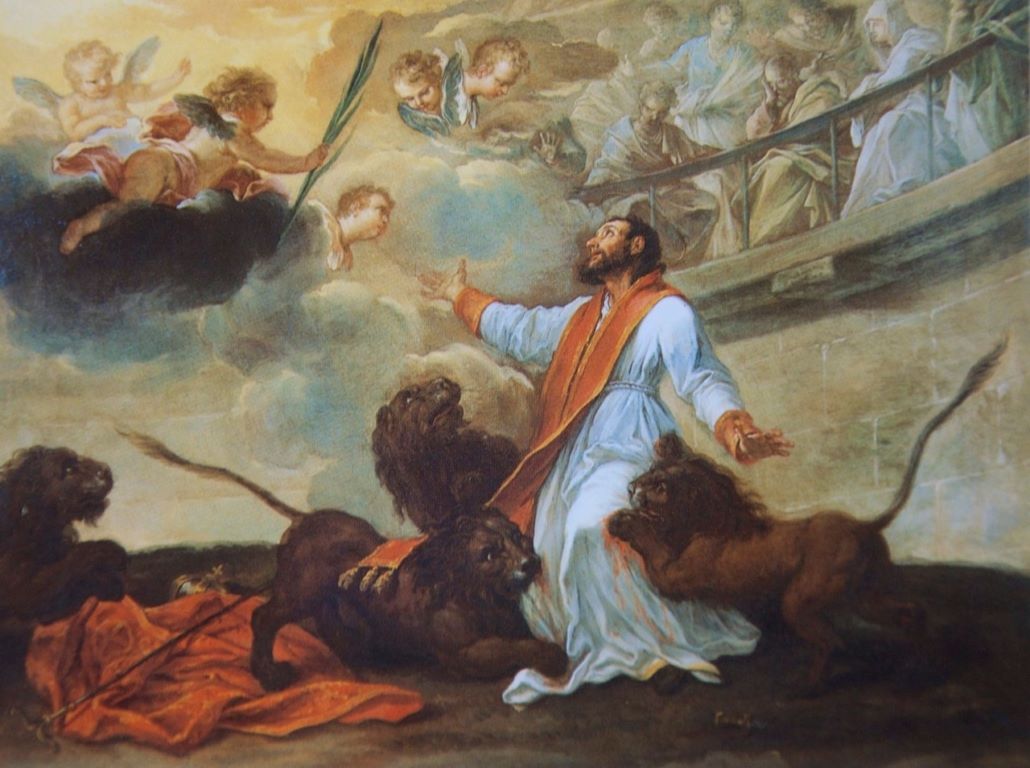
Saint Ignatius of Antioch is one of the most important figures in the history of early Christianity. A bishop, apostolic father, and courageous martyr, he witnessed to the faith during a period when Christians faced persecution and uncertainty. His letters, written while he was being taken to Rome for execution, offer a remarkable insight into the faith, worship, unity, and spiritual life of the early Church.
Ignatius is especially remembered for his profound love for Jesus Christ, his devotion to the Eucharist, his insistence on the unity of the Church under its bishops, and his willingness to embrace martyrdom rather than deny his Lord. His writings provide some of the earliest Christian testimony to the Church’s understanding of the Eucharist, the ordained ministry, and the universal communion of believers.
His life presents a powerful example of discipleship. For Ignatius, Christianity was not merely a set of doctrines to be accepted but a life to be offered entirely to Christ. Even as he faced death, he remained convinced that suffering united with Jesus could become a witness to the Gospel and a path toward eternal life.
The Church celebrates his feast on 17 October in the Roman Catholic calendar. His witness continues to inspire Christians to remain faithful to Christ, united in the Church, and steadfast in hope even in the face of suffering.
1. Early Life and Christian Formation
Saint Ignatius lived during the late first and early second centuries, when Christianity was spreading throughout the Roman Empire. The exact date and circumstances of his birth are unknown, though some ancient accounts place his birth around the middle of the first century.
Little reliable information survives about his early life. Most of what we know comes from his own letters and from early Christian writers such as Saint Irenaeus and Eusebius of Caesarea.
Ignatius became one of the earliest bishops of Antioch, an important Christian centre in ancient Syria. Antioch occupied a significant place in the history of the Church. According to the Acts of the Apostles, it was there that the disciples were first called Christians (Acts 11:26). The city became a centre of missionary activity, theological reflection, and the formation of Christian communities.
An ancient tradition associates Ignatius with the Apostles, particularly Saint Peter and Saint John. Although the precise details of this connection cannot be established with certainty, his writings reveal a deep understanding of the apostolic faith and a determination to preserve the teachings received from the earliest Christian generation.
Ignatius sometimes called himself Theophoros, a Greek word meaning “God-bearer.” This name expresses the heart of his spirituality: he belonged to Christ and desired that his entire life should bear witness to the presence of God.
For Ignatius, being a Christian meant more than professing belief in Jesus. It meant allowing Christ to shape one’s thoughts, decisions, relationships, and ultimate destiny.
2. Bishop of Antioch
Ignatius served as bishop of Antioch at a crucial time in the development of the early Church. Christian communities were growing, but they also faced internal disagreements, false teachings, and external persecution.
As bishop, Ignatius understood his responsibility as one of spiritual leadership, unity, and fidelity to the Gospel. He encouraged believers to remain united in faith and charity, to respect their spiritual leaders, and to avoid teachings that distorted the identity of Jesus Christ.
He was deeply concerned about the unity of the Church. For him, the Church was not simply a collection of independent individuals who happened to share similar religious beliefs. It was a community gathered around Christ, nourished by the Eucharist, and united in apostolic faith.
His letters repeatedly emphasize the importance of communion among bishops, presbyters, deacons, and the faithful. He believed that visible unity in the Church helped protect the Christian community from division and confusion.
Ignatius did not understand authority as a privilege to be used for personal advantage. He saw it as a responsibility to preserve the faith, serve the people of God, and guide the community toward Christ.
His episcopal ministry therefore combined doctrinal firmness with pastoral concern. He wanted Christians to remain faithful not merely in their words but also in their conduct, worship, and relationships with one another.
3. Arrest and Journey to Rome
During the reign of the Roman emperor Trajan (AD 98–117), Ignatius was arrested and condemned to death. The exact circumstances of his arrest and the specific legal charges against him remain uncertain.
He was sent from Antioch to Rome under military guard, where he was expected to face execution by wild beasts. His journey was long and difficult, yet it became one of the most significant episodes in early Christian history.
Rather than allowing the journey to silence him, Ignatius used the opportunity to encourage Christian communities. As his guards escorted him through Asia Minor, representatives of various churches visited him, offered support, and received his spiritual counsel.
He stopped at Smyrna, where he met Bishop Saint Polycarp, another important figure in early Christianity. From Smyrna, Ignatius wrote letters to the Churches of Ephesus, Magnesia, and Tralles, as well as to the Christians of Rome.
Later, while at Troas, he wrote to the Churches of Philadelphia and Smyrna and to Polycarp himself.
These seven letters have survived and remain among the most valuable writings of the Apostolic Fathers, the early Christian authors who lived during the generations closest to the Apostles.
Ignatius knew that his life was approaching its end. Yet his concern was not limited to his own suffering. He wanted to strengthen the faith of others, preserve the unity of the Church, and encourage believers to remain steadfast in the face of persecution.
His final journey became a ministry of its own. Though he was a prisoner, he continued to act as a shepherd of souls.
4. The Seven Letters of Saint Ignatius
The writings of Saint Ignatius are among the earliest and most important Christian documents outside the New Testament. They provide a vivid picture of Christian belief, worship, leadership, and community life in the early second century.
The seven letters generally recognized as authentic are:
- Letter to the Ephesians — Encourages unity, faith in Christ, and a life rooted in love.
- Letter to the Magnesians — Teaches obedience, Christian unity, and the significance of living according to the new life inaugurated by Christ.
- Letter to the Trallians — Warns against false teachings and emphasizes the importance of sound faith and ecclesial unity.
- Letter to the Romans — Expresses his desire to remain faithful to Christ even unto martyrdom.
- Letter to the Philadelphians — Urges the community to preserve unity in faith and avoid division.
- Letter to the Smyrnaeans — Defends the reality of Christ’s incarnation and resurrection and speaks about the Eucharist and Church unity.
- Letter to Polycarp — Offers pastoral advice to the bishop of Smyrna about leadership, prayer, patience, and care for the faithful.
These letters are not lengthy theological treatises. They are personal and pastoral writings, composed in the shadow of impending death. Their urgency gives them a distinctive spiritual power.
Ignatius writes as a man whose faith has been tested and whose priorities have become clear. He repeatedly returns to Jesus Christ, the unity of the Church, the Eucharist, and the hope of resurrection.
His letters also demonstrate that several central features of Catholic Christianity were already firmly present in the early Church. His witness is especially important for understanding the historical roots of the Catholic understanding of apostolic ministry, the Eucharist, and ecclesial communion.
5. His Profound Love for Jesus Christ
The central theme of Ignatius’s spirituality is his passionate desire to belong completely to Jesus Christ.
He did not view Christ merely as a teacher whose words should be admired. Jesus was his Lord, his life, his hope, and the One for whom he was willing to surrender everything.
In his Letter to the Romans, Ignatius expressed his longing to imitate the Passion of Christ and to attain eternal life through union with Him. He urged the Christians of Rome not to intervene to prevent his martyrdom.
His words are among the most moving expressions of Christian devotion in ancient literature:
“It is better for me to die on behalf of Jesus Christ than to reign over all the ends of the earth.”
— Saint Ignatius of Antioch, Letter to the Romans, 6.1; translation wording varies.
This statement reveals the depth of his faith. For Ignatius, earthly power, comfort, and security could never compare with the gift of eternal communion with Christ.
His desire for martyrdom must be understood in the context of his particular vocation and the persecution he faced. It was not a rejection of life or an invitation to seek suffering for its own sake. Rather, he wanted to remain faithful to Christ even when faithfulness demanded the ultimate sacrifice.
His spirituality was rooted in the conviction that Jesus had suffered, died, and risen for humanity. By remaining faithful in suffering, Ignatius hoped to imitate his Lord and bear witness to the reality of the Resurrection.
The same spirit challenges Christians today. We may not face the threat of execution, but we encounter other tests of faith: the temptation to compromise our principles, the pressure to remain silent before injustice, the fear of being misunderstood, and the attraction of worldly approval.
Ignatius invites us to ask whether Christ truly occupies the centre of our lives.
6. The Eucharist: The Medicine of Immortality
One of the most significant aspects of Saint Ignatius’s teaching is his profound devotion to the Eucharist.
His letters provide early evidence of the Church’s belief that the Eucharist is not merely a symbolic meal but is intimately connected with the real Body of Jesus Christ.
In his Letter to the Smyrnaeans, Ignatius criticizes those who deny the reality of Christ’s flesh and, consequently, fail to recognize the Eucharist as the flesh of the Saviour. His teaching is inseparable from his defence of the Incarnation: the Son of God truly became human, truly suffered, and truly rose from the dead.
Ignatius calls the Eucharist the “medicine of immortality,” a phrase that beautifully expresses his understanding of Holy Communion as a gift through which believers receive spiritual nourishment and the promise of eternal life.
This expression appears in his Letter to the Ephesians, 20.2.
For Ignatius, the Eucharist was also a sacrament of unity. Christians gathered around the Eucharist were called to live as one body in Christ, united in faith, charity, and communion with their shepherds.
His Eucharistic theology therefore brings together three essential realities:
- The real presence of Christ: The Eucharist is intimately connected with the true Body of the Lord who became human for our salvation.
- The promise of eternal life: Holy Communion nourishes the believer’s life in Christ and points toward the resurrection.
- The unity of the Church: Participation in the one Eucharist calls Christians to overcome divisions and live in charity.
The Eucharist was not an abstract theological subject for Ignatius. It was the centre of Christian worship and the source of his hope.
His teaching is especially meaningful when considered alongside his approaching martyrdom. The bishop who celebrated the Eucharist and received Christ in Holy Communion was preparing to offer his own life in witness to the Lord.
His example reminds us that devotion to the Eucharist must transform the way we live. Those who receive the Body of Christ are called to become instruments of reconciliation, compassion, forgiveness, and unity.
The Eucharist strengthens us to follow Jesus not only in moments of consolation but also in times of trial.
7. The Church and the Meaning of Catholic Unity
Saint Ignatius made a distinctive contribution to the Church’s understanding of ecclesial unity.
He was the earliest known Christian writer to use the Greek term katholikē—meaning “universal”—to describe the Church. In his Letter to the Smyrnaeans, 8.2, he writes:
“Wherever Jesus Christ is, there is the Catholic Church.”
This statement remains one of the most memorable passages in his writings.
For Ignatius, the Church was universal because she belonged to Christ and gathered believers into one communion. She was not simply a local association or a collection of isolated communities. Christians throughout the world shared one faith, one Lord, and one hope.
His understanding of the Church was deeply sacramental and communal. He emphasized that the faithful should remain united with their bishop, presbyters, and deacons and should celebrate the Eucharist in the communion of the Church.
He repeatedly warned against divisions that could damage the unity of Christian communities. Such divisions were not merely administrative problems; they weakened the common witness of believers and obscured the unity that Christ desired for His disciples.
Ignatius’s teaching remains relevant today. Christian unity is not achieved simply by avoiding disagreements or maintaining outward appearances of peace. It requires a shared commitment to Christ, fidelity to the apostolic faith, mutual charity, and a willingness to work for reconciliation.
His vision of unity was not opposed to diversity. Rather, he believed that the different members and ministries of the Church should work together harmoniously, as the strings of a harp produce one melody.
He therefore presents a model of communion in which leadership and service, doctrine and charity, worship and mission belong together.
8. The Ministry of Bishops, Priests, and Deacons
Saint Ignatius’s letters are especially important for understanding the development of ordained ministry in the early Church.
In several of his letters, he clearly distinguishes the roles of the bishop, the presbyters, and the deacons. He urges Christians to remain in communion with their bishop and to respect the ministry entrusted to each order.
His writings provide some of the earliest clear evidence of a pattern in which a single bishop leads a local Christian community, assisted by presbyters and deacons.
Ignatius considered this structure essential for preserving unity, sound teaching, and the integrity of Christian worship.
The bishop was not to be regarded merely as an administrator. He was a visible focus of ecclesial communion and bore a particular responsibility for guiding the community in the apostolic faith.
The presbyters served in collaboration with the bishop, while the deacons exercised their ministry of service within the Church. The faithful were called to participate actively in the life of the community and to remain united in faith and charity.
Ignatius’s emphasis on ecclesial order was accompanied by an equally strong emphasis on love. He did not imagine that the Church could be united merely through rules or structures. True unity had to be expressed in mutual service, prayer, patience, and holiness.
His message is especially important for priests and religious. Authority in the Church must be exercised in a spirit of service, and obedience must be understood within the larger vocation of building up the Body of Christ.
For the laity, his teaching is a reminder that the Church’s life flourishes when all its members work together in communion, each contributing according to their vocation and gifts.
9. His Defence of the Incarnation
Another important aspect of Ignatius’s teaching is his insistence that Jesus Christ truly became human.
Some early Christian teachers, commonly associated with Docetism, claimed that Christ’s humanity and suffering were only apparent. Such ideas threatened the heart of the Christian proclamation: if Christ had not truly become human, suffered, and died, the meaning of the Cross and the Resurrection would be fundamentally altered.
Ignatius firmly rejected these teachings.
He insisted that Jesus was truly born, truly suffered, and truly rose from the dead. The Incarnation was not an appearance or an illusion but a real act of divine love.
In his Letter to the Smyrnaeans, 1.1–2, he emphasizes the reality of Christ’s birth, suffering under Pontius Pilate, and Resurrection.
This insistence was not simply an argument over theological terminology. Ignatius understood that the reality of salvation depended on the reality of what God had done in Jesus Christ.
Because the Son of God truly entered human history, human suffering could be met by divine compassion. Because Christ truly died, death could be conquered. Because He truly rose, believers could hope for eternal life.
Ignatius’s teaching therefore directs our attention to the heart of the Christian faith: God did not remain distant from humanity. In Jesus Christ, He entered our condition and opened the way to reconciliation with Himself.
This truth also gives Christian dignity to the human body and to the material world. The body is not something to be despised, and human suffering is not an illusion. Christ assumed our humanity to redeem us wholly.
10. Sunday and the Resurrection
Saint Ignatius also bears witness to the early Christian practice of gathering on the Lord’s Day.
In his Letter to the Magnesians, 9.1, he contrasts the old way of observing the Sabbath with the Christian life shaped by the Resurrection of Jesus Christ.
He refers to Christians who live according to the Lord’s Day, the day on which life arose through Christ and death was overcome.
This testimony shows how deeply the Resurrection shaped the identity of the early Church. Sunday was not merely a convenient time for a religious gathering. It was the day that proclaimed the new creation inaugurated by the risen Lord.
The Christian community assembled to hear the Word, celebrate the Eucharist, pray together, and renew its hope in the victory of Christ.
For Ignatius, Christian worship and Christian life belonged together. The Resurrection was not simply an event remembered once a week; it was the foundation of the believer’s entire existence.
His teaching invites us to rediscover Sunday as the Lord’s Day—a day of worship, thanksgiving, rest, family life, charity, and renewed commitment to the Gospel.
Every Sunday celebration proclaims that sin and death do not have the final word. Christ has risen, and those who belong to Him are called to live as people of hope.
11. The Meaning of Martyrdom in His Life
For Saint Ignatius, martyrdom was the ultimate testimony of fidelity to Jesus Christ. The word martyr originally means “witness,” and the early Christian martyrs witnessed to the Gospel by remaining faithful even when threatened with death.
Ignatius understood that his approaching execution would become a final opportunity to proclaim the truth of the Christian faith. He did not want fear to weaken his witness or the possibility of escape to become more important than fidelity to Christ.
In his Letter to the Romans, he famously compares himself to wheat that must be ground by the teeth of wild beasts so that he may become the pure bread of Christ.
This striking image expresses his desire to be united with Jesus through the offering of his life. Just as wheat is transformed into bread, Ignatius hoped that his suffering would become a witness to the Lord whom he loved.
His words should not be understood as a glorification of violence. Christian martyrdom is not the pursuit of death for its own sake. It is the refusal to abandon Christ when faithfulness becomes costly.
Ignatius’s witness also reveals the extraordinary hope of the early Christians. They believed that death was not the end of existence but a passage toward the fullness of life with God.
His courage continues to challenge Christians who experience persecution, discrimination, or pressure to abandon their convictions. It reminds us that faithfulness to Christ may require sacrifice, but no sacrifice offered in love is meaningless before God.
12. His Martyrdom in Rome
After leaving Troas, Ignatius continued his journey toward Rome. He knew that he was being taken to the place where he would most likely be executed.
According to the ancient Christian tradition, he was put to death in Rome during the reign of Emperor Trajan, probably around AD 107–110, although the precise date remains uncertain.
The traditional account states that he was exposed to wild beasts in the Roman amphitheatre. His death became a powerful testimony to the courage and hope of the early Christian community.
Ignatius did not regard his martyrdom as a defeat. He believed that his life belonged to Christ and that his death could bear witness to the Resurrection.
His writings do not portray him as a man without fear or human weakness. Rather, they reveal someone whose love for Christ had become stronger than his fear of suffering.
His final journey demonstrates that Christian courage does not necessarily mean the absence of fear. It means entrusting oneself to God even when the future is uncertain and the cost of discipleship is great.
The memory of Ignatius was treasured by the Church of Antioch, and his letters continued to circulate among Christian communities. His friend Saint Polycarp helped preserve the memory of his writings, ensuring that subsequent generations could learn from his faith and pastoral wisdom.
The bishop who had written to encourage other Christians became himself an enduring example of the faith he proclaimed.
13. The Enduring Importance of His Writings
Saint Ignatius’s letters are important not only because of their spiritual beauty but also because of their historical value.
Written in the early second century, they provide a window into the life of Christian communities close to the apostolic age. They reveal what Christians believed about Jesus Christ, how they celebrated the Eucharist, how their communities were organized, and how they understood their relationship with the wider Church.
His letters are particularly valuable in several areas.
Early Christian theology: Ignatius firmly proclaims the real humanity and divinity of Jesus Christ and the saving significance of His Passion and Resurrection.
The Eucharist: His writings show the central place of the Eucharist in Christian worship and its close connection with faith in the Incarnation.
Ecclesiology: His use of the term Catholic Church and his emphasis on communion with the bishop offer important evidence for the early Church’s understanding of unity.
Christian spirituality: His longing for union with Christ and his willingness to suffer for the Gospel offer a profound example of discipleship.
Pastoral leadership: His advice to bishops and Christian communities demonstrates the importance of sound teaching, prayer, charity, and perseverance.
These writings should be read in their historical context. Ignatius wrote as a pastor addressing specific challenges in the communities of his time. Nevertheless, the principles he expressed remain deeply relevant.
His letters demonstrate that the early Church was not simply a loose collection of believers with no common identity. From an early period, Christians understood themselves as members of a community united in faith, worship, and apostolic teaching.
14. Spiritual Lessons from Saint Ignatius of Antioch
The life and writings of Saint Ignatius offer valuable lessons for Christians of every vocation.
1. Keep Jesus Christ at the Centre of Your Life
Ignatius’s greatest desire was to belong completely to Jesus. His faith was not a secondary part of his identity but the foundation of everything he did.
His example invites us to examine our priorities. Do our choices reflect the Gospel? Does our faith influence the way we treat others, make decisions, and respond to difficulties?
A Christian life becomes fruitful when Christ is not merely someone we worship on Sundays but the Lord who shapes our daily existence.
2. Remain Faithful in Times of Suffering
Ignatius did not abandon his faith when faced with persecution. He entrusted himself to God and continued to encourage others.
Our suffering may take different forms: illness, disappointment, family difficulties, rejection, uncertainty, or the loss of someone we love. These experiences are not identical to martyrdom, but they can test our trust in God.
Ignatius teaches us to seek God’s presence in difficult moments and to remain faithful without allowing suffering to destroy our hope.
3. Love the Eucharist
For Ignatius, the Eucharist was a source of spiritual life and a sign of the unity of the Church.
His witness invites us to approach Holy Mass with reverence, prepare our hearts for Holy Communion, and allow the Eucharistic encounter to transform our lives.
The more deeply we receive Christ, the more sincerely we should seek reconciliation, forgive those who have hurt us, and care for those in need.
4. Preserve Unity in the Church
Ignatius repeatedly warned against divisions and encouraged Christians to remain united in faith and charity.
Unity does not mean that every person must have the same personality, gifts, or opinions about every practical matter. It means that disagreements should be approached with humility, truthfulness, and a sincere desire for communion.
Families, parishes, religious communities, and Church institutions all need this spirit of unity.
5. Speak the Truth with Courage
Ignatius defended the truth about Jesus Christ even when it was unpopular or dangerous.
His example reminds us that Christian faithfulness requires courage. We must not abandon the truth simply because it is inconvenient or because others may disagree with us.
At the same time, truth must be expressed with charity, humility, and respect for the dignity of others.
6. Live with the Hope of Eternal Life
Ignatius looked beyond his earthly suffering toward the promise of life with Christ.
Christian hope does not deny the reality of pain, grief, or death. Rather, it proclaims that these realities do not have the final word.
The Resurrection of Jesus Christ assures believers that God’s love is stronger than death and that our ultimate destiny is communion with Him.
7. Let Your Life Become a Witness
Ignatius continued to encourage the faithful even while travelling as a prisoner toward his execution.
His example shows that every circumstance can become an opportunity to witness to Christ. Our witness may take the form of a word of encouragement, an act of forgiveness, a commitment to justice, or a quiet act of service.
We do not need to be famous to bear witness to the Gospel. We need to be faithful.
15. Saint Ignatius of Antioch and the Church Today
Saint Ignatius remains a significant figure for the Catholic Church because his life brings together several dimensions of Christian existence that must never be separated.
He was deeply devoted to Christ, faithful to the Eucharist, committed to the unity of the Church, courageous in defending the apostolic faith, and willing to sacrifice his life for the Gospel.
For priests and bishops, he offers a model of pastoral responsibility rooted in communion with Christ. His writings remind Church leaders that their ministry exists to strengthen the faith of the people, preserve unity, and guide the community toward holiness.
For religious men and women, his example encourages a life of prayer, obedience, perseverance, and wholehearted dedication to Christ.
For laypeople, his witness offers encouragement to live the faith courageously in families, workplaces, educational institutions, and public life.
His message is particularly relevant in a world where divisions, polarization, and individualism can weaken the bonds of community. Ignatius reminds us that Christian faith is personal, but it is never merely private. We encounter Christ within the communion of His people and are called to make His love visible through our relationships.
His Eucharistic spirituality also challenges us to ensure that our worship bears fruit in daily life. The altar and the world are not unrelated. The Christ whom we receive in Holy Communion sends us forth to serve others in His name.
Above all, Ignatius calls the Church to remain faithful to Jesus Christ. Structures, traditions, and institutions fulfil their purpose when they help believers grow in holiness, communion, and mission.
16. Feast Day of Saint Ignatius of Antioch
The Roman Catholic Church celebrates the memorial of Saint Ignatius of Antioch on 17 October.
His feast invites the faithful to remember one of the earliest witnesses to the apostolic faith and to reflect on the meaning of Christian discipleship.
The day is an opportunity to pray for persecuted Christians, for the unity of the Church, for bishops and priests, and for all those who struggle to remain faithful to the Gospel.
It is also an appropriate occasion to read one of his letters, particularly the Letter to the Romans or the Letter to the Smyrnaeans, and to reflect on his teaching about the Eucharist and the Church.
The feast of Saint Ignatius reminds us that the faith we profess today was handed down through generations of Christians who prayed, served, taught, suffered, and sometimes gave their lives for Christ.
Their witness is a gift entrusted to us. We honour them most meaningfully when we allow their faith to inspire our own.
17. Feast-Day Meditation: “I Belong to Christ”
Imagine Saint Ignatius travelling toward Rome under the watch of Roman soldiers. He knows that death awaits him. He cannot return to Antioch, resume his pastoral ministry, or gather again with the communities he has served.
Yet he continues to write letters filled with encouragement, teaching, and love.
What gives him such strength?
It is his conviction that he belongs to Jesus Christ.
Ignatius has discovered something that every Christian is invited to discover: when Christ becomes the deepest treasure of our lives, our identity is no longer determined entirely by success, recognition, comfort, or even the approval of others.
We may still experience fear. We may grieve our losses and struggle with uncertainty. But beneath these changing circumstances, we can learn to trust that we belong to God.
On his feast day, Saint Ignatius invites us to ask ourselves:
- Is Jesus truly at the centre of my life?
- Do I seek Him in the Eucharist with faith and love?
- Am I helping to build unity in my family and community?
- Can I remain faithful when doing what is right becomes difficult?
- Does my life bear witness to the hope of the Resurrection?
We may never be called to offer our lives in the same manner as Ignatius. Nevertheless, each day presents opportunities to offer ourselves to God through love, patience, forgiveness, and service.
Perhaps our martyrdom is the quiet sacrifice of choosing truth when dishonesty seems easier, remaining faithful when we are discouraged, forgiving when we have been hurt, or continuing to love when our efforts are not appreciated.
Saint Ignatius teaches us that a life offered to Christ is never wasted.
May his example help us to love Jesus more deeply, receive the Eucharist more faithfully, cherish the unity of the Church, and live each day with the hope of eternal life.
18. Prayer to Saint Ignatius of Antioch
Saint Ignatius of Antioch, courageous bishop and faithful martyr, intercede for us before the Lord.
You loved Jesus Christ so deeply that you remained faithful even when faced with persecution and death. Obtain for us the grace to love the Lord with undivided hearts and to remain steadfast in our faith through every trial.
Teach us to cherish the Holy Eucharist, to recognize Christ’s presence in His Church, and to live in communion with our brothers and sisters. Help our bishops, priests, deacons, religious, and lay faithful to serve the Church with humility, courage, and love.
Pray for Christians who suffer persecution because of their faith. Strengthen those who are imprisoned, threatened, rejected, or prevented from practising their religion freely. May they find courage in the presence of Christ and hope in His Resurrection.
Intercede for our families, our parishes, and our communities. Where there is division, help us seek reconciliation. Where there is discouragement, obtain the grace of perseverance. Where there is fear, lead us toward a deeper trust in God.
Saint Ignatius, teach us to place Jesus above every passing attraction and to remain faithful to Him in both joy and suffering. May our lives become a living witness to the Gospel, and may we one day share the eternal happiness you longed to attain.
We ask this through Jesus Christ our Lord.
Amen.
Saint Ignatius of Antioch, pray for us.
19. Saint Ignatius of Antioch at a Glance
| Detail | Information |
|---|---|
| Name | Saint Ignatius of Antioch |
| Greek name | Ignatios |
| Epithet | Theophoros, meaning “God-bearer” |
| Birth | Date unknown; traditionally placed in the first century |
| Principal ministry | Bishop of Antioch |
| Historical period | Late first and early second centuries |
| Emperor during his final journey | Trajan |
| Place of martyrdom | Rome |
| Approximate date of death | Around AD 107–110; exact date uncertain |
| Principal writings | Seven letters to Christian communities and Saint Polycarp |
| Major themes | Christ, the Eucharist, Church unity, apostolic ministry, martyrdom |
| Liturgical feast | 17 October in the Roman Catholic calendar |
| Recognized as | Bishop, Apostolic Father, and martyr |
References and Further Readings
Primary Sources
1. Saint Ignatius of Antioch, Letter to the Ephesians. Especially chapters 7, 13, and 20, on Christ, Christian unity, and the Eucharist.
2. Saint Ignatius of Antioch, Letter to the Magnesians. Especially chapters 6–9, on ecclesial unity and the Lord’s Day.
3. Saint Ignatius of Antioch, Letter to the Romans. Especially chapters 4–7, on martyrdom, discipleship, and union with Christ.
4. Saint Ignatius of Antioch, Letter to the Smyrnaeans. Especially chapters 1 and 8, on the Incarnation, the Eucharist, and the Catholic Church.
5. Saint Ignatius of Antioch, Letter to Polycarp. On pastoral leadership, perseverance, and Christian responsibility.
Church and Historical Sources
6. Pope Benedict XVI, General Audience, 14 March 2007: “Saint Ignatius of Antioch.” https://www.vatican.va/content/benedict-xvi/en/audiences/2007/documents/hf_ben-xvi_aud_20070314.html
7. Vatican News, “St. Ignatius of Antioch, Bishop, Martyr in Rome.” https://www.vaticannews.va/en/saints/10/17/st–ignatius-of-antioch–bishop–martyr-in-rome.html
8. Eusebius of Caesarea, Ecclesiastical History, Book III, Chapter 36. An important early account of Ignatius and his letters.
9. The Catholic Encyclopedia, “St. Ignatius of Antioch.” https://www.newadvent.org/cathen/07644a.htm
Biblical References for Reflection
- Acts 11:19–26 — The Christian community at Antioch.
- John 6:48–58 — Jesus, the Bread of Life.
- John 15:1–11 — Abiding in Christ, the true vine.
- John 17:20–23 — Jesus’ prayer for the unity of His disciples.
- Romans 8:31–39 — Nothing can separate us from the love of God.
- Philippians 1:20–23 — Living for Christ and the hope of being with Him.
- 2 Timothy 4:6–8 — Fighting the good fight and keeping the faith.
- Revelation 2:10 — Faithfulness even unto death.
Saint Ignatius of Antioch reminds us that the deepest purpose of Christian life is to belong to Jesus Christ, remain united in His Church, and bear witness to His love with courage and fidelity.
Leave a Reply