
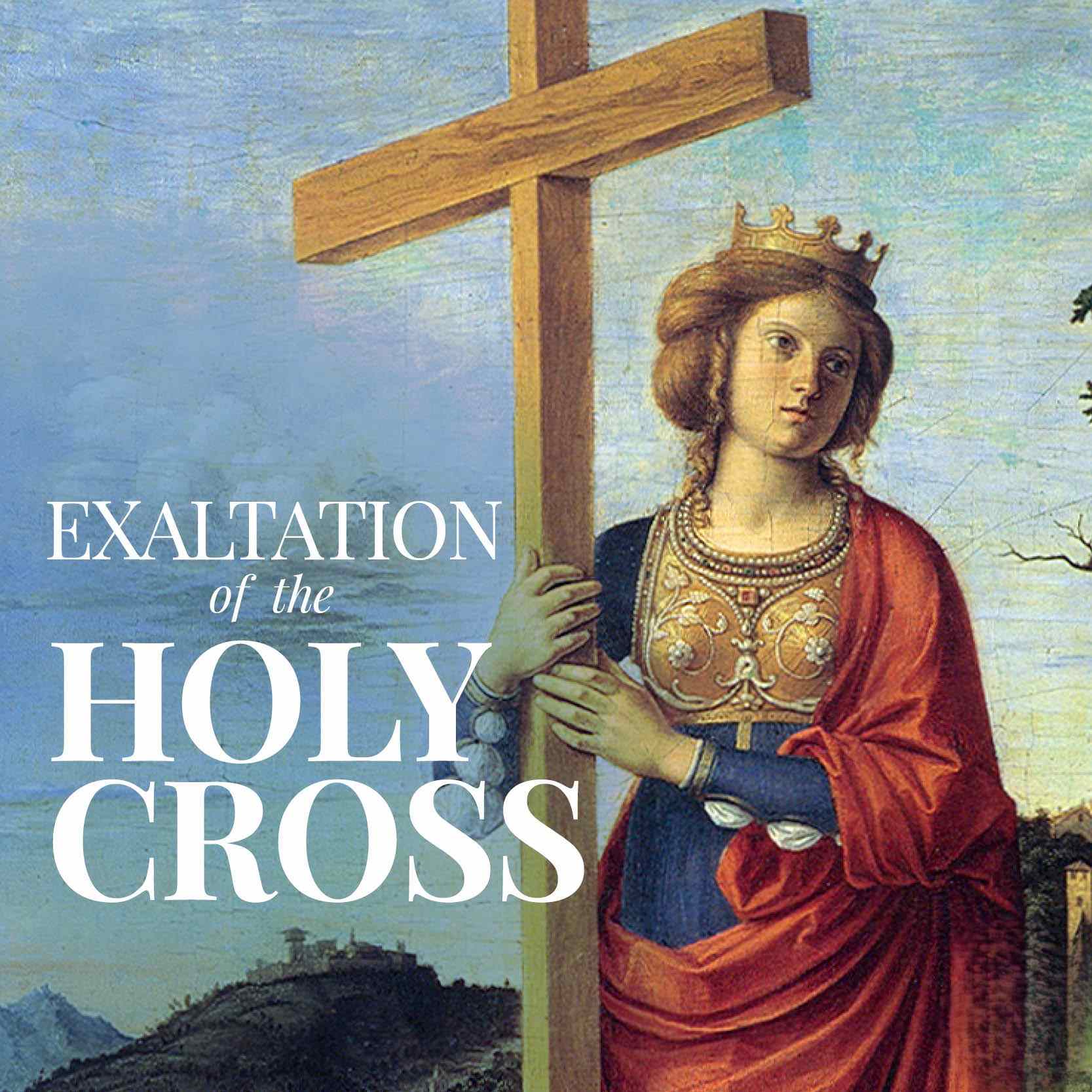
September 14
The Cross: The Throne of Christ’s Love and the Sign of Our Salvation
The Feast of the Exaltation of the Holy Cross, celebrated every year on September 14, is one of the most profound feasts of the Christian liturgical year. On this day, the Church invites us not merely to look upon the Cross as an instrument of suffering and death, but to contemplate it as the great sign of God’s love, mercy, victory and salvation.
The Cross, which appeared to be a symbol of defeat, became the throne from which Christ conquered sin and death. What the world regarded as shame became glory; what seemed to be defeat became victory; and what appeared to be death became the doorway to eternal life.
The liturgy therefore calls us to exalt the Cross because through the Cross Christ has redeemed the world.
“We adore you, O Christ, and we bless you, because by your Holy Cross you have redeemed the world.”
This ancient Christian prayer expresses the heart of today’s celebration.
The Historical Origin of the Feast
The origins of the Feast of the Exaltation of the Holy Cross are closely associated with Jerusalem and the early Christian veneration of the Cross.
According to ancient Christian tradition, Saint Helena, the mother of Emperor Constantine the Great, travelled to Jerusalem in the fourth century. Christian tradition associates her pilgrimage with the discovery of the Cross of Christ at Calvary.
Constantine subsequently built the great complex of churches associated with the places of Christ’s Passion, Death and Resurrection. The Church of the Holy Sepulchre was dedicated in the fourth century, and the Cross was solemnly presented for the veneration of the faithful. (Vatican News)
The feast developed in Jerusalem and eventually spread throughout the Christian East and West. In Rome, celebration of the feast is attested by the seventh century, and by the eighth century the observance had become established more widely in the Western Church. (Opus Dei)
The Cross and Emperor Heraclius
The history of the feast is also associated with the recovery of the Cross after it had been taken from Jerusalem by the Persians in the seventh century.
According to the traditional account, the Byzantine Emperor Heraclius defeated the Persians and recovered the Cross, which was eventually restored to Jerusalem. The memory of this restoration became connected with the September 14 celebration. (Vatican News)
Yet the Church does not celebrate the Cross merely because of the history of a relic. The deepest reason is theological:
the Cross is the place where God’s saving love was revealed most completely.
Why Do We Exalt the Cross?
At first sight, the language of “exalting” the Cross seems strange.
Why should Christians celebrate an instrument of torture?
Why should we honour an object associated with humiliation, pain and death?
The answer is found in Jesus Christ.
The Cross has no meaning apart from Christ. We do not worship wood. We do not glorify suffering for its own sake. We worship and glorify Jesus Christ who gave Himself upon the Cross for the salvation of the world.
The Cross has become holy because the Son of God transformed it through His sacrificial love.
Saint Paul expresses this mystery beautifully:
“But far be it from me to boast except in the cross of our Lord Jesus Christ.”
— Galatians 6:14
The Cross is therefore not simply the symbol of Christ’s suffering. It is the sign of Christ’s self-giving love.
The Cross Reveals the Love of God
The Gospel proclaimed for this feast, John 3:13–17, takes us directly to the heart of the mystery.
Jesus recalls the bronze serpent lifted up by Moses in the wilderness and says:
“So must the Son of Man be lifted up, that whoever believes in him may have eternal life.”
Then comes one of the most beloved verses in the entire Bible:
“For God so loved the world that he gave his only Son.”
— John 3:16
The Cross is therefore God’s answer to the deepest problem of humanity.
Human beings had turned away from God through sin. But God did not abandon humanity. Instead, He came among us in Jesus Christ and accepted the Cross for our salvation.
The Cross tells us:
God’s love is stronger than our sin.
God’s mercy is greater than our failure.
God’s grace is stronger than our weakness.
God’s life is stronger than death.
The Cross Is the Tree of Life
There is a beautiful connection between Genesis and the Cross.
In Genesis, humanity’s fall is associated with a tree. Through disobedience, sin and death entered human history.
On Calvary, another tree becomes the place of salvation.
The Fathers of the Church often reflected upon this profound contrast:
- through a tree came disobedience;
- through the Cross came obedience;
- through a tree came death;
- through the Cross came life;
- through a tree humanity experienced separation from God;
- through the Cross humanity was reconciled with God.
The Cross thus becomes the new Tree of Life.
Christ, the new Adam, offers the obedience that humanity failed to offer.
The Cross Is the Throne of Christ
The world associates a throne with power, wealth and glory.
But Jesus reveals a completely different kind of kingship.
His throne is the Cross.
His crown is a crown of thorns.
His royal garment is stripped away.
His hands are pierced.
And yet from that apparent humiliation He reigns.
The Cross reveals that God’s power is not the power of domination but the power of sacrificial love.
Jesus does not conquer His enemies by destroying them. He conquers sin by forgiving.
He conquers hatred through love.
He conquers violence through self-giving.
He conquers death by entering into death and rising again.
This is why the Cross is called the Triumph of Christ.
“When I Am Lifted Up”
In John’s Gospel, Jesus repeatedly speaks about being “lifted up.”
“And I, when I am lifted up from the earth, will draw all people to myself.”
— John 12:32
The Cross is therefore also a great invitation.
Christ stretches out His arms upon the Cross as though embracing the entire human family.
His arms are open to:
- sinners,
- the wounded,
- the lonely,
- the poor,
- the forgotten,
- the suffering,
- those who have lost hope,
- those who have wandered far from God.
No one is outside the reach of Christ’s love.
The Cross says:
“Come back to me.”
The Cross and Forgiveness
One of the most astonishing things about Calvary is that Jesus forgives while He is suffering.
From the Cross He prays:
“Father, forgive them; for they do not know what they are doing.”
— Luke 23:34
This is Christian forgiveness at its highest.
Jesus does not wait until His enemies apologize.
He does not wait until they understand.
He forgives from the Cross.
Every time we look upon the Crucifix, therefore, we are reminded of the call to forgive.
Perhaps someone has wounded us deeply.
Perhaps there is anger within our hearts.
Perhaps we have carried resentment for years.
The Cross asks us:
Can you forgive as Christ forgave you?
The Cross and Suffering
The feast does not teach us that suffering is good in itself.
Christianity does not glorify suffering.
Rather, Christianity teaches us that suffering can be transformed by love.
Jesus did not choose suffering because pain is valuable by itself. He accepted suffering because He chose to remain faithful to the Father’s will and to love humanity completely.
This is important for every Christian.
We cannot avoid every suffering in life.
There are:
- illnesses,
- disappointments,
- family problems,
- financial difficulties,
- failures,
- loneliness,
- misunderstandings,
- bereavements,
- anxieties about the future.
The Cross tells us that our suffering does not have to be meaningless.
When united with Christ, suffering can become an offering of love.
“Take Up Your Cross”
Jesus says:
“If anyone would come after me, let him deny himself and take up his cross and follow me.”
— Matthew 16:24
Every Christian has a cross.
For one person it may be illness.
For another, family responsibilities.
For another, loneliness.
For another, a difficult relationship.
For another, the sacrifice required by vocation.
For another, the struggle to remain faithful to God in a difficult environment.
To carry one’s cross does not mean carrying it alone.
Christ carries it with us.
Simon of Cyrene helped Jesus carry the Cross toward Calvary. The Church sees in this a reminder that God often gives us people who help us carry our burdens.
And we too are called to become Simons of Cyrene for others.
A kind word may help someone carry a cross.
A visit to a sick person may help.
A listening ear may help.
Forgiveness may help.
Prayer may help.
A practical act of charity may help.
Sometimes we cannot remove another person’s cross, but we can help them carry it.
The Cross and the Eucharist
The Cross is inseparable from the Holy Eucharist.
At every Holy Mass, the Church enters sacramentally into the mystery of Christ’s saving sacrifice.
The Eucharist reminds us that Jesus continues to give Himself for us.
The Cross says:
“This is how much I love you.”
The Eucharist says:
“I give myself to you.”
Therefore, participation in Holy Mass should transform our lives.
If we receive Christ’s Body and Blood but refuse to forgive, something is wrong.
If we receive the Eucharist but remain indifferent to the suffering of others, we have not fully understood the Cross.
If we kneel before the Crucifix but refuse to love our neighbour, the message of Calvary has not yet entered our hearts.
The Cross and Our Families
The Cross has a special message for Christian families.
Every family has joys and sorrows.
There are moments when husbands and wives misunderstand one another.
Parents sometimes suffer because of their children.
Children may carry wounds because of family conflicts.
There can be financial struggles, illness, migration, separation and anxiety about the future.
The Cross teaches us that love requires sacrifice.
A Christian family is not a family without problems.
It is a family that learns to carry its problems with Christ.
The Cross teaches husbands and wives:
Love requires self-giving.
It teaches parents:
Love sometimes means sacrifice without recognition.
It teaches children:
Respect, gratitude and obedience are forms of love.
It teaches everyone:
Forgiveness is stronger than resentment.
The Cross in Our Homes
For Catholic families, the Crucifix should have an honoured place in the home.
When we see the Cross in our homes, we remember:
Christ is with us.
When we are happy, Christ is with us.
When we are sick, Christ is with us.
When we are afraid, Christ is with us.
When we experience failure, Christ is with us.
When we mourn, Christ is with us.
When we cannot understand what is happening, Christ is still with us.
The Cross becomes a silent proclamation:
“Jesus, I trust in you.”
The Cross and Victory
The Cross cannot be separated from the Resurrection.
If there were only Good Friday, Christianity would be a tragedy.
But Good Friday leads to Easter.
The Crucified Christ is the Risen Christ.
Therefore, the Cross is not the final word.
Life is the final word.
Love is the final word.
Resurrection is the final word.
Christ is the final word.
The Church therefore looks upon the Cross with both tears and hope.
We see the suffering of Christ, but we also see the victory of Christ.
The Cross in Times of Crisis
There are moments when we ask:
“Where is God?”
The Cross gives us a powerful answer.
God is not distant from human suffering.
He entered into it.
He experienced rejection.
He experienced betrayal.
He experienced injustice.
He experienced physical pain.
He experienced abandonment.
He experienced death.
Therefore, when we suffer, we can say:
“Jesus, you understand me.”
The Cross assures us that God is not a spectator watching our suffering from a distance.
He is the God who entered into our suffering and transformed it through love.
The Cross and Christian Mission
A Christian cannot truly proclaim Christ without proclaiming the Cross.
Saint Paul wrote:
“We preach Christ crucified.”
— 1 Corinthians 1:23
The Cross must therefore shape Christian life and mission.
Our preaching must lead people to Christ.
Our service must reflect Christ’s self-giving love.
Our families must become places where the Cross is lived through forgiveness.
Our parishes must become communities where burdens are shared.
Our faith must become visible through charity.
The Cross is not merely something we wear around our neck.
It is something we must carry in our hearts and live through our lives.
What Does the Cross Ask of Us Today?
The Feast of the Exaltation of the Holy Cross gives us several invitations.
1. Look at Christ
Do not look only at your problems.
Look at Jesus.
When life becomes difficult, turn your eyes toward the Crucified Lord.
2. Trust God’s love
The Cross is God’s declaration:
“I have not abandoned you.”
3. Forgive
Bring your wounds to the Cross and ask for the grace to forgive.
4. Carry your responsibilities faithfully
Do not run away from every difficulty.
Ask Christ for strength to carry your daily cross with love.
5. Help others carry their crosses
Be a Simon of Cyrene to someone who is suffering.
6. Remain close to the Eucharist
The One who gave Himself on the Cross continues to give Himself to us in the Eucharist.
7. Never lose hope
The Cross leads to the Resurrection.
Your present suffering is not necessarily the end of your story.
Mary at the Foot of the Cross
The Feast of the Exaltation of the Holy Cross also naturally brings us to Mary, who stood faithfully beneath the Cross.
She did not understand everything.
She could not remove her Son’s suffering.
But she remained there.
Her presence is a lesson in faithful love.
Sometimes we cannot solve another person’s problem.
We cannot take away their illness.
We cannot change their circumstances.
But we can remain with them.
Mary teaches us the ministry of presence:
“I am here. I will not abandon you.”
This is also what Christ does for us.
The Cross Is a Sign of Hope
The Christian does not make the sign of the Cross because life is always easy.
We make the sign of the Cross because Christ is with us in every circumstance of life.
When we wake up, we can make the sign of the Cross.
Before prayer, we make the sign of the Cross.
Before meals, we can make the sign of the Cross.
When beginning a journey, we can make the sign of the Cross.
When facing difficulties, we can make the sign of the Cross.
At the moment of death, the Church blesses us with the Cross.
From beginning to end, the Cross accompanies the Christian.
It is the sign of our baptism.
It is the sign of our faith.
It is the sign of our salvation.
It is the sign of Christ’s victory.
A Message for Those Who Are Carrying a Heavy Cross
Perhaps someone reading this article is carrying a very heavy cross today.
You may be struggling with an illness.
You may be worried about your children.
You may be experiencing difficulties in your marriage.
You may be burdened by debt.
You may be waiting for a job or visa.
You may be preparing for an examination.
You may be grieving the death of someone you love.
You may feel that nobody understands you.
You may even be asking God:
“How long, Lord?”
Look at the Cross.
Do not look at it only as an object.
Look at the Person who hangs upon it.
Jesus knows what it means to suffer.
Jesus knows what it means to be rejected.
Jesus knows what it means to cry.
Jesus knows what it means to feel abandoned.
And Jesus says to you:
“You are not alone.”
Your Cross may be heavy, but Christ is carrying it with you.
The Triumph of the Cross
The Cross appears to be weakness, but it reveals strength.
It appears to be defeat, but it reveals victory.
It appears to be death, but it becomes the source of life.
It appears to be shame, but it becomes glory.
It appears to be an ending, but it becomes the beginning of the Resurrection.
That is why Christians can proclaim:
“Hail, O Cross, our only hope!”
The Cross is not a celebration of suffering.
It is a celebration of love victorious through suffering.
Prayer to the Holy Cross
Lord Jesus Christ,
we adore You upon the Holy Cross.
You stretched out Your arms to embrace the whole world.
You accepted suffering for our salvation.
You forgave those who crucified You.
You entrusted Your Mother to us.
You gave Your life so that we might have eternal life.
Lord, when our crosses become heavy, give us strength.
When we are afraid, give us courage.
When we are wounded, give us healing.
When we are discouraged, give us hope.
When we are angry, give us forgiveness.
When we are lost, lead us back to You.
Help us to carry our daily crosses with faith and love.
Teach us to become a source of strength to those who suffer around us.
May our families remain under the protection of Your Holy Cross.
May our homes be filled with Your peace.
May our parishes become communities of love and service.
And when our earthly journey is finished, lead us through Your Cross to the glory of Your Resurrection.
We adore You, O Christ, and we bless You,
because by Your Holy Cross You have redeemed the world.
Amen.
Conclusion
The Feast of the Exaltation of the Holy Cross invites us to look again at the Cross and discover in it the deepest mystery of Christianity.
The Cross tells us that love can triumph over hatred, forgiveness over revenge, humility over pride, life over death and hope over despair.
Christ does not promise that His followers will have no crosses. He promises something greater:
He will be with us as we carry them.
Let us therefore never be ashamed of the Cross.
Let us place the Cross at the centre of our homes, our families, our parishes and our own hearts.
For the Cross is not the end.
The Cross leads to the Resurrection.
And the Crucified One is risen.
“We adore you, O Christ, and we bless you, because by your Holy Cross you have redeemed the world.”
Happy Feast of the Exaltation of the Holy Cross!
Sources consulted include Vatican News, the Jerusalem Patriarchate, and historical liturgical references. (Vatican News)

Leave a Reply