
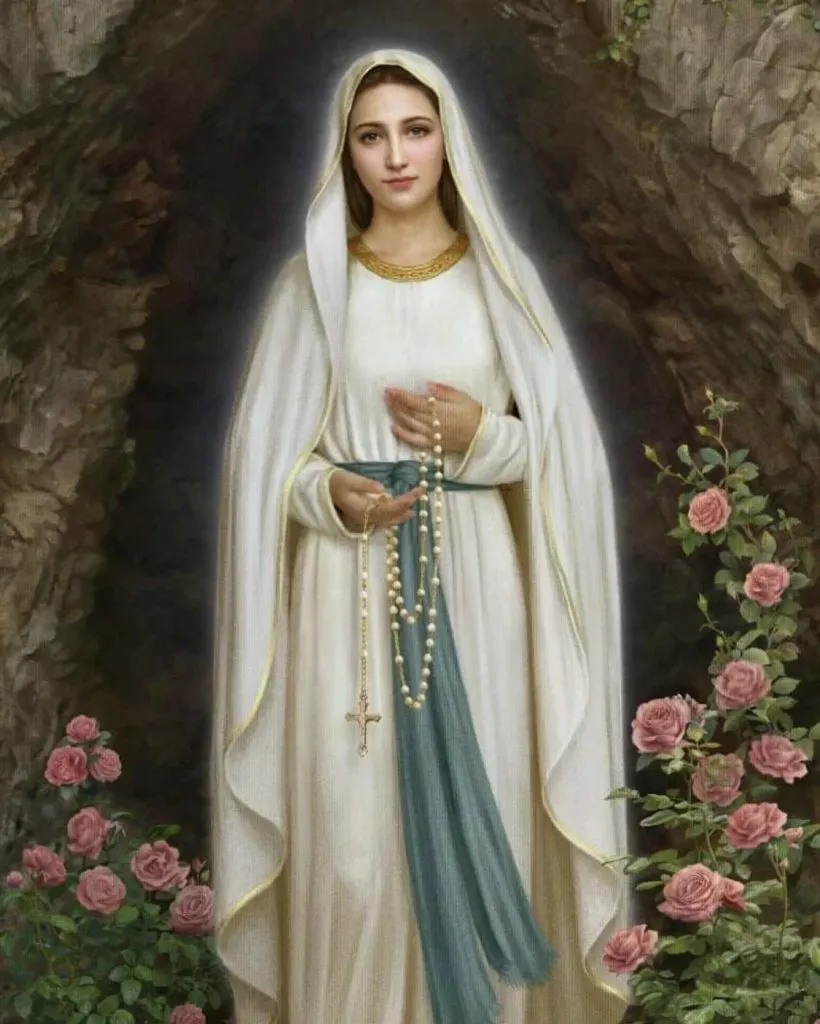
Our Lady of the Rosary is one of the beloved titles of the Blessed Virgin Mary in the Catholic Church. It expresses Mary’s special relationship with the Holy Rosary, a prayer through which Christians contemplate the life, death, and glory of Jesus Christ together with His Mother.
The feast of Our Lady of the Rosary is celebrated each year on 7 October. The feast invites Catholics to rediscover the Rosary not simply as a repetition of prayers, but as a deeply Christ-centred prayer of contemplation, conversion, intercession, and peace.
The Rosary places the mysteries of the Gospel before our hearts. As we pray the Hail Mary, we repeatedly turn our attention to Jesus and ask Mary to lead us more deeply into the life of her Son.


1. Why Is Mary Called Our Lady of the Rosary?
Mary is called Our Lady of the Rosary because the Rosary has traditionally been associated with her maternal guidance and intercession.
The Rosary developed gradually within the Church as a way of meditating upon the mysteries of Christ. Mary is not the centre of the Rosary; Jesus is. Mary accompanies us as a mother and teaches us to contemplate her Son.
Her words at Cana express the proper attitude of Marian devotion:
“Do whatever he tells you.”
— John 2:5
This is also the spirit of the Rosary. Mary always directs us toward Christ.
When we pray the Rosary, we walk with Mary through the Gospel:
- We rejoice with her in the Joyful Mysteries.
- We accompany Christ through His Passion in the Sorrowful Mysteries.
- We contemplate His Resurrection and glory in the Glorious Mysteries.
- Through the Luminous Mysteries, we contemplate the public ministry and revelation of Christ.
Thus, the Rosary becomes a school of the Gospel.
2. The Feast of Our Lady of the Rosary
The feast of Our Lady of the Rosary is celebrated on 7 October.
Its history is closely connected with the Battle of Lepanto, fought on 7 October 1571. A Christian naval coalition confronted the Ottoman fleet in the Gulf of Patras. Pope St Pius V asked Christians throughout Europe to pray the Rosary for the Church and for the success of the Christian forces.
The Christian victory at Lepanto was attributed by the faithful to the intercession of the Blessed Virgin Mary.
Pope Pius V subsequently established a feast associated with Our Lady of Victory. Over the centuries, the celebration developed into the feast now known as Our Lady of the Rosary.
The feast therefore has a strong historical connection with prayer, Mary’s intercession, and the Church’s confidence in God during times of crisis.
3. The Battle of Lepanto and the Rosary
The Battle of Lepanto has an important place in the history of the Rosary.
Before the battle, Pope Pius V encouraged Christians to invoke the Blessed Virgin Mary and pray the Rosary. The victory on 7 October 1571 was interpreted by the pope and many Catholics as a sign of Mary’s maternal protection.
The historical significance of Lepanto should not cause us to think of the Rosary merely as a prayer for military victory.
Its deeper meaning is spiritual.
The Rosary reminds us that the Church’s greatest battles are ultimately spiritual battles:
- against sin,
- against hatred,
- against despair,
- against temptation,
- against division,
- against indifference to God.
The Rosary teaches us to place these battles into God’s hands.
4. Pope St Pius V and the Rosary


Pope St Pius V played a major role in promoting the Rosary in connection with the victory at Lepanto.
He belonged to the Dominican Order, which had long been associated with the promotion of the Rosary.
His devotion demonstrates an important principle: when the Church faces serious difficulties, she does not rely only upon human strength. She turns to prayer.
The Rosary became a powerful expression of this trust.
5. What Is the Holy Rosary?
The Rosary is a prayer centred on the mysteries of the life of Jesus Christ.
A traditional five-decade Rosary consists of:
- The Sign of the Cross
- The Apostles’ Creed
- Our Father
- Three Hail Marys
- Glory Be
- Five decades of the Rosary
- Meditation on five mysteries
- Concluding prayers
Each decade consists of:
1 Our Father
10 Hail Marys
1 Glory Be
While the lips repeat the prayers, the mind and heart are invited to contemplate a mystery from the Gospel.
This is what makes the Rosary a meditative prayer rather than merely a repetition of words.
6. The Four Sets of Rosary Mysteries
Joyful Mysteries
Traditionally prayed on Monday and Saturday.
- The Annunciation
- The Visitation
- The Nativity of Jesus
- The Presentation of Jesus in the Temple
- The Finding of Jesus in the Temple
These mysteries teach us about the hidden joy of Christ’s coming and Mary’s faith.
Luminous Mysteries
Traditionally prayed on Thursday.
- The Baptism of Jesus in the Jordan
- The Wedding at Cana
- The Proclamation of the Kingdom of God
- The Transfiguration
- The Institution of the Eucharist
These mysteries were proposed by St John Paul II in 2002 in his Apostolic Letter Rosarium Virginis Mariae.
They help us contemplate important moments of Christ’s public ministry.
Sorrowful Mysteries
Traditionally prayed on Tuesday and Friday.
- The Agony in the Garden
- The Scourging at the Pillar
- The Crowning with Thorns
- The Carrying of the Cross
- The Crucifixion
These mysteries teach us to remain close to Jesus in suffering.
Mary herself stood faithfully beneath the Cross.
“Standing by the cross of Jesus were his mother…”
— John 19:25
Glorious Mysteries
Traditionally prayed on Wednesday and Sunday.
- The Resurrection
- The Ascension
- The Descent of the Holy Spirit
- The Assumption of Mary
- The Coronation of Mary as Queen of Heaven and Earth
These mysteries proclaim the victory of Christ and the hope of eternal life.
7. The Rosary Is a Christ-Centred Prayer
Sometimes people mistakenly think that praying the Rosary takes attention away from Jesus.
The opposite is true.
The Rosary repeatedly brings us back to Christ.
Consider the words of the Hail Mary:
“Blessed are you among women,
and blessed is the fruit of your womb, Jesus.”
The name Jesus is at the heart of the prayer.
We ask Mary to pray for us because she is the Mother of Jesus and a model disciple. She does not keep us for herself. She brings us to her Son.
Mary’s entire life points toward Christ.
8. “Pray for Us Sinners”
One of the most beautiful aspects of the Hail Mary is the humble petition:
“Pray for us sinners, now and at the hour of our death.”
Every time we say these words, we acknowledge two realities:
We need God’s mercy.
and
We need Mary’s maternal intercession.
The Rosary therefore becomes a prayer for every moment of life—especially moments of weakness, suffering, uncertainty, temptation, and death.
9. The Rosary and the Family
The Rosary has traditionally been called a powerful family prayer.
A family that prays the Rosary together places its joys, struggles, children, parents, illnesses, decisions, and future into God’s hands.
In a world where families can become increasingly distracted by technology, work, entertainment, and individual concerns, even one decade prayed together can become a precious moment of unity.
A family Rosary does not have to be complicated.
Even when everyone is tired, a simple prayer can be enough:
“Mary, Mother of Jesus, pray for our family.”
10. The Rosary and Children
Children can gradually learn the Rosary by beginning with one decade.
Parents and teachers can make the mysteries concrete:
- The Annunciation — saying yes to God.
- The Visitation — serving others.
- The Nativity — welcoming Jesus.
- The Finding in the Temple — seeking God.
- The Crucifixion — remaining faithful during suffering.
- The Resurrection — trusting in God’s victory.
The Rosary can become not merely something children recite but something they learn to live.
11. Our Lady of the Rosary and the Poor
The Rosary has always been a prayer accessible to everyone.
A person does not need theological education, wealth, or special surroundings to pray it.
A poor mother can pray the Rosary while working.
An elderly person can pray it from a sickbed.
A traveller can pray it on a journey.
A child can pray it before sleeping.
A priest can pray it before celebrating Holy Mass.
A family can pray it together in the evening.
The Rosary belongs to the whole Church.
12. The Rosary in Times of Suffering
Many Catholics instinctively reach for the Rosary during moments of crisis.
When someone is sick, we pray.
When a family is struggling, we pray.
When a child is in danger, we pray.
When someone is facing an examination or important decision, we pray.
When someone is dying, we pray.
When we cannot find the right words, the Rosary gives us words.
The repeated prayer becomes an act of trust:
“Jesus, I trust in You. Mary, pray for me.”
13. The Rosary and Conversion
The Rosary is not magic.
It is not a formula that forces God to give us what we want.
Rather, the Rosary gradually transforms the person who prays it.
As we meditate on Christ’s life, we are invited to imitate Him.
The Rosary can lead us toward:
- repentance,
- forgiveness,
- patience,
- humility,
- purity of heart,
- compassion,
- perseverance,
- love for the Eucharist,
- greater devotion to Scripture,
- deeper trust in God.
A Rosary prayed well should eventually change the way we live.
14. The Rosary and the Eucharist
There is a profound connection between the Rosary and the Eucharist.
The Luminous Mysteries conclude with:
The Institution of the Eucharist.
Mary teaches us to say yes to God.
At the Annunciation, she welcomed Christ into her womb.
At every Mass, Christ gives Himself to us in the Eucharist.
The Rosary prepares the heart to contemplate the mystery of Christ’s self-giving love.
For Catholics, praying the Rosary should never replace participation in Holy Mass. Instead, Marian devotion should lead us more deeply into the Eucharistic life of the Church.
15. Our Lady of the Rosary and Peace
The Rosary has often been associated with prayers for peace.
When we pray the Rosary, we repeatedly contemplate:
- Christ’s mercy,
- His suffering,
- His forgiveness,
- His victory,
- His Resurrection,
- His gift of peace.
In a world marked by wars, violence, hatred, family conflicts, and personal anxiety, the Rosary becomes a simple prayer for peace.
We can pray:
“Queen of Peace, pray for us.”
And we can ask Mary to teach us to become instruments of peace.
16. Our Lady of the Rosary and Fatima
The history of the Rosary is also closely associated with Fatima.


In 1917, the Blessed Virgin Mary appeared to Lucia dos Santos, Francisco Marto, and Jacinta Marto at Fatima, Portugal.
According to the children’s testimony, the Lady repeatedly encouraged prayer, repentance, and conversion and emphasized the importance of the Rosary.
The Fatima message contributed greatly to the spread of the Rosary throughout the Catholic world.
The essential lesson is simple:
Pray. Repent. Convert. Trust in God.
17. The Rosary as a School of the Gospel
St John Paul II described the Rosary as a prayer that brings us into contact with Christ through Mary.
His Apostolic Letter Rosarium Virginis Mariae emphasized the contemplative character of the Rosary.
The Rosary can therefore be understood as a school of contemplation.
We learn:
At the Annunciation:
How to say yes to God.
At the Visitation:
How to serve others.
At Bethlehem:
How to welcome Christ.
At Cana:
How to trust Mary’s intercession.
At Gethsemane:
How to surrender our will to God.
At Calvary:
How to remain faithful in suffering.
At the Resurrection:
How to hope.
At Pentecost:
How to receive the Holy Spirit.
The Rosary is therefore not merely a collection of prayers. It is a journey through the Gospel.
18. How to Pray the Rosary Well
We do not need to pray the Rosary quickly.
A slower Rosary can sometimes be more fruitful.
Before each decade, pause briefly and name the mystery.
For example:
“The First Sorrowful Mystery: The Agony in the Garden.”
Then imagine the scene from the Gospel.
Ask:
- What is Jesus experiencing?
- What does this mystery reveal about God’s love?
- What is Jesus asking me to change?
- Where do I need to trust God?
- For whom am I offering this decade?
Then pray the decade slowly.
The goal is not merely to finish five decades.
The goal is to meet Christ.
19. When Can We Pray the Rosary?
The Rosary can be prayed at almost any time.
In the morning
Offer the day to God.
Before going to sleep
Give the day’s worries to the Lord.
During travel
Turn the journey into prayer.
During illness
Offer suffering to Christ.
Before an important examination
Ask for wisdom and peace.
During family difficulties
Pray for reconciliation.
Before a major decision
Ask for God’s guidance.
During Eucharistic Adoration
Meditate upon Christ with Mary.
Before Holy Mass
Prepare the heart for worship.
20. The Rosary and the Communion of Saints
When we pray the Rosary, we are never praying alone.
The Church on earth joins her prayer with the saints and angels in heaven.
Mary, the Mother of the Church, accompanies the faithful with her maternal intercession.
The Rosary therefore reminds us that Christianity is not an isolated journey.
We belong to a spiritual family.
21. Why the Rosary Is Repetitive
Some people ask:
“Why do Catholics repeat the Hail Mary so many times?”
Repetition itself is not meaningless.
The human heart often repeats words when something is deeply important.
We repeat:
“I love you.”
We repeat:
“Thank you.”
We repeat:
“I’m sorry.”
In the Rosary, repetition creates a rhythm that can quiet the mind and open the heart to contemplation.
The words become like a gentle background while the heart enters more deeply into the mystery of Christ.
22. The Rosary and the Hail Mary
The Hail Mary is fundamentally biblical.
The first part draws from the words of the Archangel Gabriel:
“Hail, full of grace, the Lord is with you.”
— Luke 1:28
It also comes from Elizabeth’s greeting:
“Blessed are you among women, and blessed is the fruit of your womb.”
— Luke 1:42
The second part is the Church’s prayer asking Mary to intercede for us:
“Holy Mary, Mother of God, pray for us sinners, now and at the hour of our death.”
Thus, the Hail Mary joins Scripture and Christian prayer.
23. Our Lady of the Rosary: A Mother Who Leads Us to Jesus
The true purpose of Marian devotion is beautifully summarized in Mary’s own words:
“Do whatever he tells you.”
— John 2:5
Mary never competes with Jesus.
She leads us to Jesus.
She teaches us to listen to Him.
She teaches us to trust Him.
She teaches us to remain beside Him in suffering.
She teaches us to rejoice in His Resurrection.
She teaches us to wait for the Holy Spirit.
And she accompanies the Church on her journey toward the Kingdom.
24. A Practical Rosary Commitment
On the feast of Our Lady of the Rosary, we can make a simple personal commitment.
A possible commitment:
One Rosary a day.
If a full Rosary is difficult, begin with one decade.
Pray it:
- for your family,
- for priests,
- for the sick,
- for children,
- for peace,
- for sinners,
- for the conversion of hearts,
- for the souls in purgatory,
- and for the needs of the Church.
What matters is not merely the number of prayers but the love with which they are offered.
25. A Prayer to Our Lady of the Rosary
Our Lady of the Rosary,
Mother of Jesus and our Mother,
teach us to pray as you prayed.
Teach us to treasure God’s Word in our hearts.
Teach us to say yes to God’s will.
Teach us to remain faithful in times of suffering.
Teach us to rejoice in God’s blessings.
Teach us to forgive and to love.
Mother of the Rosary,
take our families into your maternal care.
Pray for our children.
Pray for our sick.
Pray for our elderly.
Pray for our priests and religious.
Pray for those who have lost their faith.
Pray for those who are suffering.
Pray for those who have no one to pray for them.
Bring our intentions before Jesus.
When we are afraid, help us to trust.
When we are discouraged, help us to hope.
When we are tempted, help us to remain faithful.
When we are suffering, help us to remain close to Jesus.
When we fall, help us to return to Him.
Our Lady of the Rosary, pray for us.
Queen of Peace, pray for us.
Mother of the Church, pray for us.
Mother of Jesus, lead us always closer to your Son.
Amen.
26. Feast-Day Reflection
On the feast of Our Lady of the Rosary, let us ask ourselves:
Do I really pray, or do I only worry?
How many of our worries could become prayers?
How many family problems could we place before Jesus?
How many fears could we entrust to Mary?
How many difficult situations could we surrender to God?
The Rosary gives us a simple answer:
Take the beads into your hands.
Open your heart to God.
Walk with Mary.
Contemplate Jesus.
And trust.
The world may not become peaceful immediately.
Our problems may not disappear immediately.
But the person who prays begins to change.
And when hearts change, families change.
When families change, communities change.
And when communities change, the world can begin to change.
Conclusion
Our Lady of the Rosary teaches the Church the beauty of simple, faithful prayer.
The Rosary takes us through the Gospel and places the mysteries of Christ before our eyes. Through Mary, we learn to contemplate Jesus, follow Him, suffer with Him, rejoice in His Resurrection, and place our lives in God’s hands.
The Rosary is a prayer for children and adults, for families and individuals, for the healthy and the sick, for the joyful and the suffering.
It is a prayer that can be prayed anywhere.
Above all, it is a prayer that leads us to Jesus Christ.
As we celebrate the feast of Our Lady of the Rosary, may Mary take us by the hand and lead us ever more deeply into the heart of her Son.
Our Lady of the Rosary, pray for us.
Queen of the Most Holy Rosary, pray for us.
Mother of Jesus, pray for us.
Queen of Peace, pray for us.
Amen.
Leave a Reply