
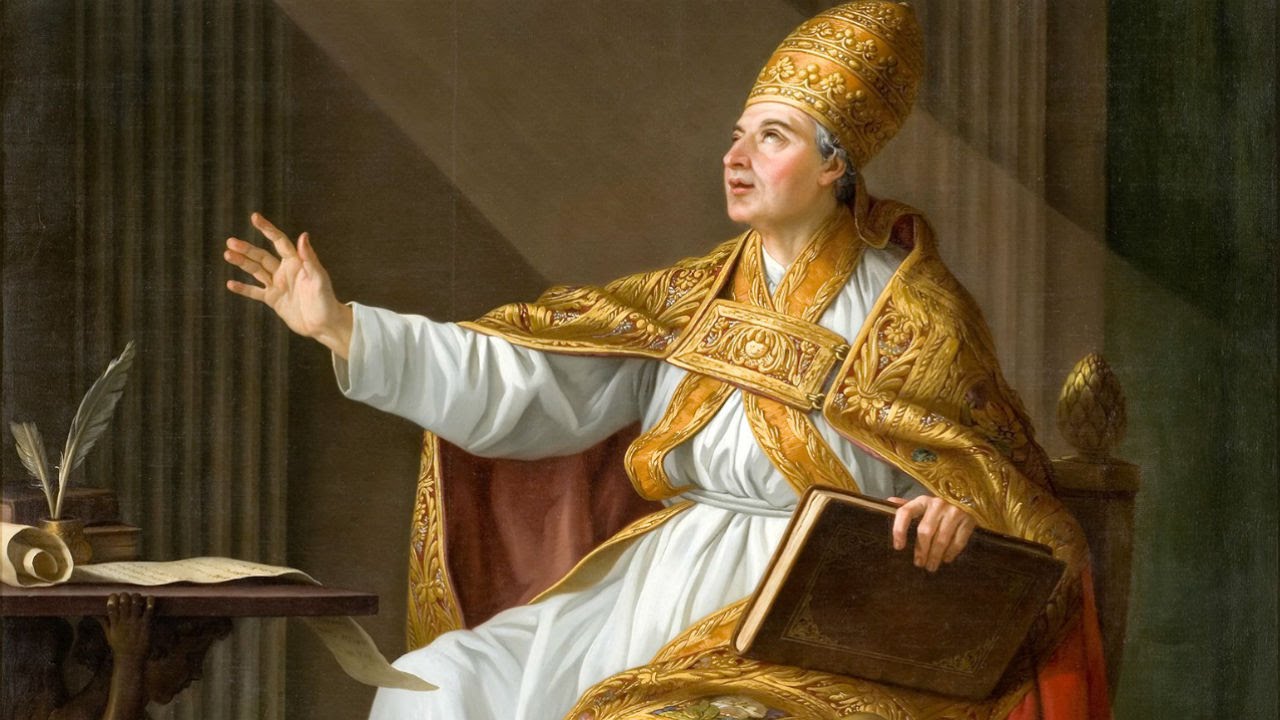
A Great Shepherd, Teacher, Missionary, and Doctor of the Church
Pope Saint Gregory I, known to history as Gregory the Great, was one of the most influential popes and theologians of the early Middle Ages. A gifted administrator, spiritual writer, missionary promoter, and humble servant of God, he guided the Church during a period of political instability, social crisis, and profound cultural change.
He served as Pope from 590 to 604 and is honored as a Doctor of the Church. His writings profoundly influenced Catholic spirituality, pastoral theology, monasticism, preaching, liturgy, and the development of Western Christian civilization.
His liturgical memorial is celebrated on 3 September.


1. Early Life
Gregory was born in Rome around the year 540, into a wealthy and influential Roman Christian family. His father, Gordianus, was a senator and held an important position in the Roman administration. His mother, Saint Silvia, was a woman of deep Christian faith and is herself honored as a saint.
Gregory grew up at a time when the Roman Empire in the West had largely collapsed. Italy was experiencing political instability, wars, poverty, famine, and disease. Rome itself had suffered greatly.
Despite his privileged background, Gregory developed a profound concern for the poor and for the spiritual needs of the Church.
He received an excellent education in grammar, rhetoric, philosophy, and law. His intellectual formation prepared him for a distinguished public career.
2. Gregory as Roman Prefect
As a young man, Gregory entered public life. He eventually became Prefect of Rome, one of the highest civil offices in the city.
The position gave him firsthand experience of administration, justice, poverty, and the suffering of ordinary people.
Although he was successful in public life, Gregory gradually became convinced that worldly honors could not satisfy the deepest desires of the human heart.
After his father’s death, Gregory chose a radically different path.
3. Renouncing Wealth for God
Gregory distributed much of his family wealth to the poor and established monasteries.
He founded six monasteries in Sicily and transformed his family home in Rome into a monastery dedicated to Saint Andrew the Apostle.
There he embraced the monastic life.
Gregory loved prayer, Scripture, silence, contemplation, and the disciplined life of a monk. Yet God would soon call him away from the quiet monastery to serve the wider Church.
His experience of monastic life would remain central to his spirituality throughout his life.
4. Gregory Becomes a Deacon and Papal Representative
Pope Pelagius II later called Gregory to serve the Church in Rome.
Around 579, Gregory was ordained a deacon and sent to Constantinople as a papal representative, or apocrisiarius.
He spent several years there.
During this period, Gregory became deeply engaged in theological questions and developed relationships with important Church leaders. He also continued his monastic discipline.
Eventually, he returned to Rome and became abbot of the monastery of Saint Andrew.
5. The Famous Mission to England
One of the most famous episodes associated with Gregory occurred before he became pope.
According to the traditional account, Gregory once saw young Anglo-Saxon slaves being sold in the Roman marketplace.
He asked who they were.
He was told that they were Angles.
Gregory is traditionally said to have replied with a famous wordplay:
“Not Angles, but angels.”
He reportedly expressed a desire to bring the Gospel to their people.
Whether every detail of this traditional story can be historically verified, Gregory certainly developed a deep concern for the evangelization of England.
When he became pope, he sent Saint Augustine of Canterbury and a group of missionaries to England.
This mission began in 597 and eventually played a decisive role in the Christianization of Anglo-Saxon England.
6. Gregory Becomes Pope
In 590, Rome was suffering from devastating circumstances, including famine and disease.
Pope Pelagius II died during an outbreak of plague.
Gregory was chosen as his successor.
Gregory initially resisted the election. He regarded the papacy not as an honor but as a tremendous spiritual responsibility.
Nevertheless, he eventually accepted.
He became Pope Gregory I.
His papacy lasted from 590 until his death in 604.
7. A Pope Who Served the Poor
Gregory understood the papacy as a ministry of service.
Rome was surrounded by poverty and instability. Gregory organized the Church’s resources to provide food and assistance to the needy.
Church properties were administered in a way that supported the poor, clergy, monasteries, and charitable works.
He regarded the material possessions of the Church not simply as institutional wealth but as resources entrusted to the Church for the service of God’s people.
His concern for the poor was deeply rooted in the Gospel.
For Gregory, Christ was present in the poor, and Christians had a responsibility to serve them.
8. The Pastor of Pastors
Gregory’s understanding of priestly and episcopal ministry is beautifully expressed in his famous work Pastoral Rule (Regula Pastoralis).
Written early in his pontificate, it became one of the most influential manuals of pastoral theology in Christian history.
Gregory explained that a pastor must know both:
- how to teach, and
- how to live what he teaches.
A shepherd cannot effectively lead others toward holiness while neglecting his own spiritual life.
For Gregory, pastoral ministry requires:
- humility,
- wisdom,
- prayer,
- compassion,
- knowledge of Scripture,
- discernment,
- self-discipline,
- courage,
- patience, and
- genuine love for souls.
The priest or bishop must adapt his pastoral approach to the spiritual condition of each person.
A proud person may need correction.
A discouraged person may need encouragement.
A sinner may need both truth and mercy.
A spiritually mature person may need deeper instruction.
Gregory’s pastoral wisdom remains remarkably relevant today.
9. Gregory the Great and the Papacy
Gregory had a profound understanding of the pope’s responsibility.
He did not view papal authority as an opportunity for personal prestige.
Instead, he understood the pope primarily as a servant of the servants of God (servus servorum Dei).
This expression became particularly associated with the papacy.
Gregory believed that ecclesiastical authority must be exercised through humility and service.
True Christian leadership is not domination.
It is sacrificial service.
10. Defender of the Church
Gregory also had to deal with political and military challenges.
The Lombards posed a serious threat to Rome and much of Italy.
The Byzantine imperial administration was often unable to provide adequate protection.
Gregory therefore became involved in diplomacy, negotiations, administration, and practical efforts to protect Rome.
He negotiated with Lombard leaders and worked to secure peace whenever possible.
This meant that Gregory was not simply a spiritual leader. He was also an extraordinarily capable administrator.
11. Evangelization of England
Gregory’s missionary vision was one of the great achievements of his pontificate.
In 597, Augustine and his companions reached England.
Augustine eventually became the first Archbishop of Canterbury.
Gregory encouraged the missionaries to evangelize with prudence rather than unnecessarily destroying local customs.
His approach recognized that Christianization could involve transforming existing cultural practices rather than simply eliminating everything from the previous religious culture.
The mission eventually produced an important Christian tradition in England.
Through this missionary initiative, Gregory helped shape the future of European Christianity.
12. Gregory and Sacred Music
Gregory is traditionally associated with Gregorian chant, the great body of liturgical chant that became central to the Western Church.
The chant is named after him because medieval tradition strongly connected it with Gregory.
Modern scholarship, however, recognizes that the repertoire known as Gregorian chant developed over a much longer period and cannot simply be attributed to Gregory personally.
Nevertheless, Gregory unquestionably had a deep concern for the Church’s liturgical prayer and music.
The association between Gregory and Gregorian chant became an important part of his legacy.
13. A Great Teacher of Scripture
Gregory was an extraordinary interpreter of the Bible.
His writings demonstrate a profound knowledge of Scripture and an ability to apply biblical teaching to everyday Christian life.
Among his important works are:
- Pastoral Rule
- Moralia in Job
- Homilies on the Gospels
- Dialogues
- _Homilies on Ezekiel
- Homilies on the Prophet Ezekiel
- letters and other theological writings
His biblical interpretation often moved between the literal, moral, and spiritual dimensions of Scripture.
He wanted Scripture not merely to be studied but lived.
14. Moralia in Job
One of Gregory’s greatest theological works is Moralia in Job, commonly called Morals on the Book of Job.
It is a massive commentary on the Book of Job.
Gregory uses Job’s story to explore:
- suffering,
- temptation,
- virtue,
- humility,
- pride,
- repentance,
- perseverance,
- spiritual warfare,
- divine providence, and
- the mystery of God’s action.
The work became enormously influential in medieval Christian spirituality.
Gregory saw Scripture as a living word that continually speaks to the human soul.
15. The Dialogues
Gregory’s Dialogues are especially famous for their stories of saints and holy men and women.
The second book is devoted almost entirely to the life of Saint Benedict of Nursia.
Through the Dialogues, Gregory helped spread knowledge of Benedict’s spirituality and contributed significantly to the growth of Benedictine monastic culture.
The work also contains numerous accounts of miracles, visions, conversions, healings, and encounters with the supernatural.
Modern readers should understand the Dialogues within the literary and religious culture of late antiquity, rather than treating every narrative as a modern historical biography.
16. Gregory and Saint Benedict
Gregory regarded Saint Benedict as a model of Christian holiness.
In his account, Benedict was a man who sought God above everything else.
Gregory admired Benedict’s:
- prayer,
- discipline,
- wisdom,
- humility,
- leadership,
- miracles,
- discernment,
- love of God.
The famous Life of Benedict contained in Gregory’s Dialogues became one of the major sources through which Benedict’s spirituality was transmitted to later generations.
17. Gregory’s Teaching on Humility
Humility was at the heart of Gregory’s spirituality.
For Gregory, pride is one of the greatest dangers in spiritual life.
A person may perform good works but become proud because of them.
A preacher may preach about God but secretly seek human admiration.
A religious leader may serve others but become attached to authority.
A learned person may become proud of knowledge.
Gregory constantly warns against such spiritual dangers.
True holiness requires recognizing that every good gift ultimately comes from God.
18. The Seven Deadly Sins and Spiritual Struggle
Gregory played an important role in the development of the Western Christian understanding of the seven deadly sins.
He classified and organized various forms of sinful desire, particularly emphasizing the destructive nature of pride and its relationship to other sins.
His teaching contributed to the later Western tradition concerning:
- Pride
- Envy
- Anger
- Sadness
- Avarice
- Gluttony
- Lust
The exact classification and terminology developed over time, but Gregory’s synthesis became highly influential in medieval Christian moral theology.
19. Gregory’s Understanding of Prayer
For Gregory, prayer is not simply the recitation of words.
Prayer is the movement of the heart toward God.
Christian prayer requires:
- attention,
- humility,
- perseverance,
- repentance,
- love,
- silence,
- trust in God.
Gregory encouraged Christians to allow Scripture to lead them into prayer.
When Scripture is prayerfully meditated upon, it becomes a means through which God transforms the heart.
20. Gregory and the Mystery of Suffering
Gregory lived through war, famine, disease, political instability, and social collapse.
Consequently, his reflections on suffering were not merely theoretical.
He understood suffering as a profound spiritual mystery.
Gregory did not claim that every suffering is directly caused by a particular personal sin.
Instead, he emphasized that trials can become occasions for:
- purification,
- repentance,
- spiritual growth,
- compassion,
- dependence upon God,
- perseverance in faith.
For Gregory, suffering must ultimately be understood in the light of God’s providence and the hope of eternal life.
21. His Famous Teaching on Tears and Repentance
Gregory placed great importance on genuine repentance.
The Christian must not merely regret the consequences of sin.
True repentance means turning the heart back toward God.
Tears, sorrow, confession, humility, and amendment of life can become signs of authentic conversion.
For Gregory, however, repentance must lead to transformation.
Christian sorrow should ultimately open into hope.
22. Gregory’s Vision of the Church
Gregory saw the Church as a community entrusted with a divine mission.
The Church must:
- proclaim the Gospel,
- celebrate the mysteries of Christ,
- teach the truth,
- care for the poor,
- defend the vulnerable,
- form consciences,
- evangelize,
- cultivate holiness.
The Church’s mission is therefore both spiritual and charitable.
Gregory’s own life demonstrated this integration of contemplation and action.
23. Contemplation and Action
One of Gregory’s important spiritual themes is the relationship between contemplation and active service.
The Christian must not choose between loving God and serving one’s neighbor.
Rather, contemplation should lead to charity, and active service should continually return the Christian to God.
Gregory himself embodied this tension.
He loved monastic prayer, yet he spent his papacy dealing with famine, politics, war, administration, pastoral problems, and missionary activity.
His life teaches that holiness can flourish even amid enormous responsibilities.
24. His Final Years
Gregory’s health deteriorated during the final years of his pontificate.
He suffered from chronic illness and physical weakness.
Nevertheless, he continued to write, preach, correspond, administer the Church, and care for the poor.
He died on 12 March 604 in Rome.
He was buried in Saint Peter’s Basilica.
His feast is now celebrated on 3 September, the anniversary traditionally associated with his election as pope.
25. Doctor of the Church
Gregory was declared a Doctor of the Church because of the extraordinary importance of his teaching and writings.
He is traditionally counted among the Four Great Doctors of the Latin Church, together with:
- Saint Ambrose of Milan
- Saint Augustine of Hippo
- Saint Jerome
- Saint Gregory the Great
These four figures exercised enormous influence on Western Christian theology and spirituality.
26. Gregory’s Legacy
Gregory’s influence extends far beyond his own century.
His writings influenced:
- medieval theology,
- monastic spirituality,
- preaching,
- biblical interpretation,
- pastoral theology,
- Christian moral teaching,
- liturgical tradition,
- missionary activity,
- the development of European Christianity.
He was simultaneously:
a monk,
a theologian,
a preacher,
a missionary,
an administrator,
a diplomat,
a bishop,
and a pope.
Yet Gregory considered himself fundamentally a servant.
27. Lessons from the Life of Saint Gregory the Great
1. Leadership must be rooted in humility
Gregory had enormous authority but understood authority as service.
2. Wealth should serve the poor
He used his family’s resources and the Church’s resources to assist those in need.
3. Prayer and action belong together
Gregory combined contemplation with intense pastoral responsibility.
4. Evangelization requires courage
His mission to England demonstrates the importance of bringing the Gospel beyond familiar boundaries.
5. Scripture must transform life
For Gregory, biblical knowledge was not merely intellectual. It was meant to produce conversion.
6. Pastoral ministry requires discernment
Every person has different spiritual needs. The pastor must know when to correct, encourage, comfort, challenge, or remain silent.
7. Suffering can become an encounter with God
Gregory’s life reminds Christians that trials do not have the final word.
8. The Church belongs to Christ
The pope, bishop, priest, and every Christian leader are ultimately servants of Christ and his people.
Saint Gregory the Great and Priests Today
Saint Gregory’s Pastoral Rule has particular importance for priests.
A priest is not merely an administrator, preacher, or sacramental minister. He is a shepherd of souls.
Gregory challenges priests to ask:
- Do I pray before I preach?
- Do I know the people entrusted to my care?
- Do I listen to those who suffer?
- Do I correct with charity?
- Do I teach the truth faithfully?
- Do I care for the poor?
- Do I avoid seeking personal recognition?
- Does my life correspond to my preaching?
- Do I lead people toward Christ rather than toward myself?
Gregory’s answer to the challenge of pastoral ministry can be summarized in one principle:
The shepherd must first belong to Christ before he can faithfully shepherd Christ’s people.
A Prayer through the Intercession of Saint Gregory the Great
O glorious Saint Gregory the Great,
holy shepherd and Doctor of the Church,
you who served Christ with humility,
wisdom, courage, and love,
pray for the Church today.
Obtain for our priests
a heart like the heart of Christ.
Teach them to preach the Gospel faithfully,
to celebrate the Holy Mysteries with reverence,
to care for the poor and suffering,
and to guide souls with patience and compassion.
Pray for our bishops and Church leaders
that they may always exercise authority
as a service of love.
Help missionaries to proclaim Christ courageously.
Help Christians to discover the treasures of Sacred Scripture.
Teach us to overcome pride,
to embrace humility,
and to seek God above all things.
When we experience suffering and uncertainty,
help us to trust in Divine Providence.
Saint Gregory the Great,
faithful servant of Christ and shepherd of souls,
pray for us,
pray for the Church,
and lead us closer to Jesus Christ.
Amen.
Feast Day and Patronage
Saint: Pope Gregory I, Gregory the Great
Born: c. 540, Rome
Died: 12 March 604, Rome
Pope: 590–604
Feast: 3 September
Title: Doctor of the Church
Known for: Pastoral theology, missionary evangelization, biblical interpretation, charity, monastic spirituality, and liturgical tradition
Patron: Musicians, singers, teachers, scholars, and those involved in church music
A thought for today
Saint Gregory the Great teaches us that the greatness of Christian leadership is not found in power or prestige, but in humble service, faithful teaching, compassionate shepherding, and complete dedication to Christ.
Leave a Reply