
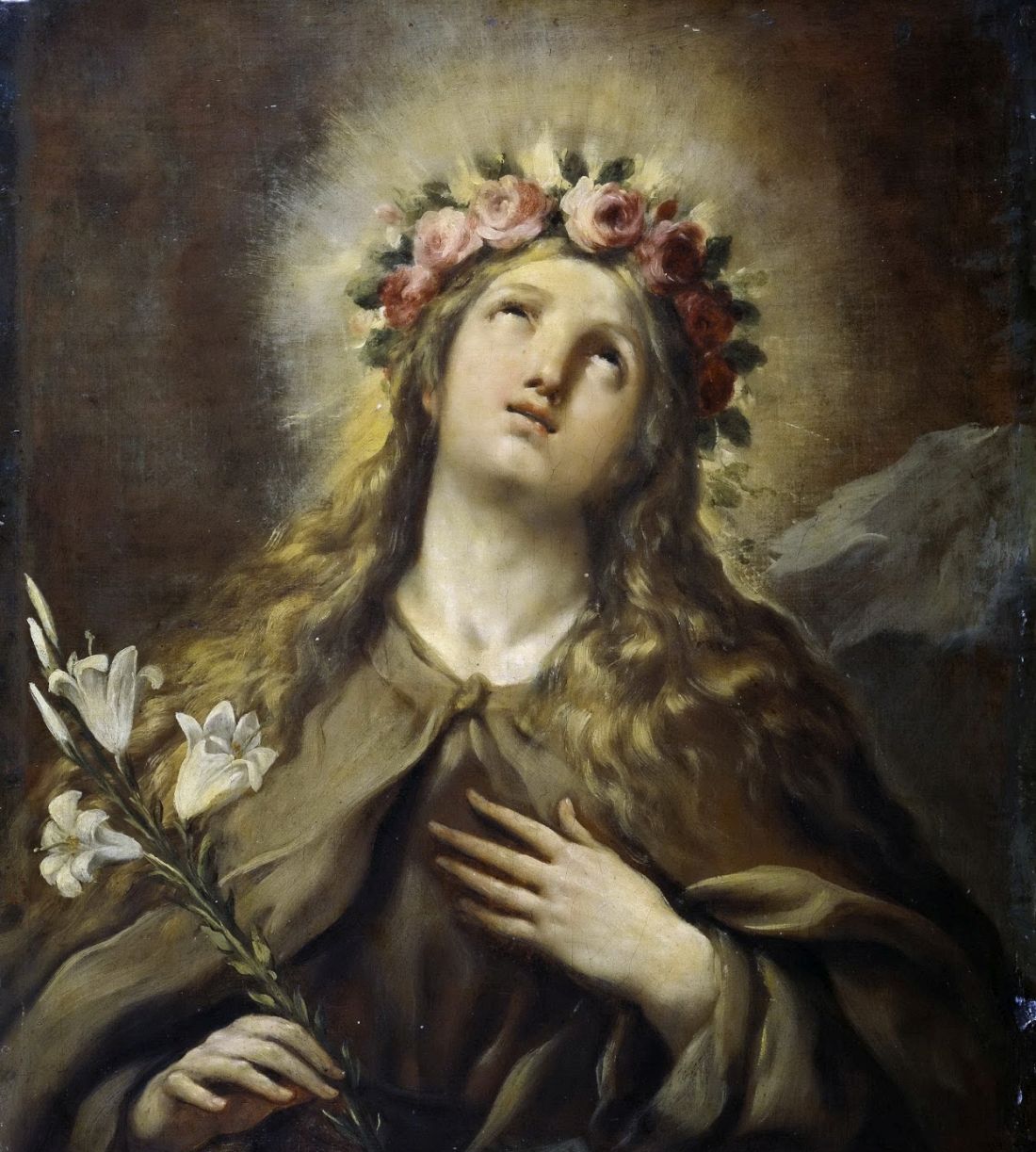
The Hermit Saint, Patroness of Palermo and Protector in Times of Plague
Saint Rosalia of Palermo is one of the most beloved saints of Sicily and is especially venerated as the principal patroness of Palermo. She is remembered as a young noblewoman who renounced wealth and worldly honors to live a life of solitude, prayer, penance, and complete dedication to God.
Her name is closely associated with Monte Pellegrino, the mountain near Palermo where tradition says she lived as a hermit and died. Her intercession became particularly famous during the plague of Palermo in 1624, when the faithful attributed the city’s deliverance from the epidemic to her intercession.
Her feast is celebrated on 4 September.


1. Who Was Saint Rosalia?
Saint Rosalia, affectionately called Santuzza (“little saint”) by the people of Palermo, is traditionally believed to have lived in the 12th century.
According to tradition, she was born in Palermo into a wealthy and noble family. She belonged to a family connected with the Norman rulers of Sicily.
Although she possessed beauty, wealth, social position, and the prospect of a prestigious marriage, Rosalia desired something very different.
She wanted to belong entirely to God.
She therefore rejected the attractions of worldly life and chose a life of solitude and prayer.
2. A Noblewoman Who Chose Poverty
Rosalia’s decision was radical.
She could have enjoyed the privileges associated with her social position, but she chose simplicity and renunciation.
She gave up:
- wealth,
- comfort,
- social prestige,
- marriage prospects,
- worldly ambitions,
- and the security of ordinary life.
Instead, she sought Christ in solitude.
Her life illustrates the Gospel’s call:
“If anyone wishes to come after me, let him deny himself and take up his cross and follow me.”
— Matthew 16:24
Rosalia understood discipleship as a complete gift of herself to God.
3. Her Life as a Hermit
According to tradition, Rosalia withdrew from ordinary society and lived as a hermit.
She spent her days in:
- prayer,
- meditation,
- fasting,
- penance,
- solitude,
- and contemplation of God.
She eventually settled on Monte Pellegrino, a rugged mountain overlooking Palermo.
There she lived in a cave.


The cave associated with her became one of the most important pilgrimage sites dedicated to her.
Tradition holds that she spent the final period of her earthly life there, completely devoted to God.
4. The Inscription Associated with Rosalia
One of the most famous elements of the tradition surrounding Saint Rosalia is an inscription reportedly found near her remains:
“I, Rosalia, daughter of Sinibald, Lord of Roses and Quisquina, have resolved to live in this cave for the love of my Lord Jesus Christ.”
The precise historical circumstances surrounding this inscription are debated, but it became an important part of the tradition of Rosalia’s cult.
The inscription expresses the essence of her spirituality:
“for the love of my Lord Jesus Christ.”
Her entire life was understood as an act of love for Christ.
5. Her Death
The exact date of Rosalia’s death is uncertain.
Tradition places her death sometime in the 12th century, after years of solitude and penance.
She was believed to have died alone in her cave on Monte Pellegrino.
Her earthly life ended in obscurity.
There was no great funeral procession.
There were no political honors.
There was no worldly celebration.
But centuries later, her name would become known throughout Sicily and far beyond.
6. The Rediscovery of Her Relics
For centuries, Rosalia’s location of burial was forgotten.
Then, in 1624, a devastating plague struck Palermo.
According to the traditional account, a woman named Girolama La Gattuta experienced a vision of Rosalia, who indicated where her remains could be found.
Her relics were subsequently discovered on Monte Pellegrino.
The discovery occurred during a time when Palermo was suffering terribly from the plague.
The people began to seek Rosalia’s intercession.
7. Saint Rosalia and the Plague of Palermo
The most famous chapter in Rosalia’s history concerns the plague of 1624.
Palermo was suffering from a devastating epidemic.
According to Catholic tradition, after the discovery and veneration of Rosalia’s relics, the plague began to diminish.
The people attributed the city’s deliverance to her intercession.
This transformed Rosalia into the beloved patroness of Palermo.
Her intercession became associated particularly with protection against:
- plague,
- epidemics,
- contagious diseases,
- and calamities.
The story helped establish one of the most enduring devotional traditions in Sicily.
8. The Famous Procession
The devotion to Rosalia became especially strong through the annual procession in Palermo.
The Festino di Santa Rosalia, celebrated in July, is one of the great religious and cultural celebrations of Palermo.
A magnificent procession carries an enormous artistic triumphal chariot through the city.


The celebration commemorates the city’s deliverance from the plague and expresses the people’s continuing devotion to their patron saint.
The traditional cry associated with the celebration is:
“Viva Palermo e Santa Rosalia!”
“Long live Palermo and Saint Rosalia!”
9. Saint Rosalia’s Relics
Rosalia’s relics are traditionally preserved at the Sanctuary of Saint Rosalia on Monte Pellegrino in Palermo.
The sanctuary is built around the cave associated with her life.


Her relics are displayed for veneration, especially during important celebrations.
The sanctuary has become a major pilgrimage destination.
10. Saint Rosalia in Art
Saint Rosalia is frequently represented wearing the clothing of a hermit or a noblewoman.
Common symbols include:
- a skull, representing penance and mortality;
- a cross, representing Christ;
- a crown, recalling her noble origins and her renunciation of worldly status;
- a cave, recalling her hermit life;
- roses, associated with her name;
- a book, representing prayer and contemplation.
Artists often portray her as a young woman with long hair, holding a cross and sometimes accompanied by a skull.
11. The Meaning of the Name Rosalia
The name Rosalia has traditionally been connected with roses, and roses therefore became one of her recognizable symbols.
The connection between the historical Rosalia and the symbolic rose is not completely clear, but Christian devotion gradually incorporated the rose into her iconography.
The rose can beautifully symbolize:
beauty offered to God,
purity,
sacrifice,
and the fragrance of holiness.
12. Rosalia and the Call to Conversion
The life of Saint Rosalia is fundamentally a story of conversion and renunciation.
She teaches that the human heart cannot find its ultimate happiness in:
- wealth,
- fame,
- beauty,
- social status,
- possessions,
- or worldly success.
These things may have their proper place, but they cannot replace God.
Rosalia chose Christ.
Her life therefore presents a radical question:
What am I willing to surrender in order to belong more completely to God?
13. The Spirituality of Solitude
Rosalia’s hermit life reminds Christians of the importance of silence.
Modern life is filled with:
- noise,
- screens,
- messages,
- entertainment,
- advertisements,
- social media,
- constant activity.
The human heart can easily become so busy that it forgets God.
Saint Rosalia went in the opposite direction.
She entered solitude to listen.
Her cave became a place of prayer.
Her silence became a form of worship.
Her solitude was not an escape from God or reality. It was an attempt to encounter God more deeply.
14. Penance and Holiness
Saint Rosalia is traditionally associated with severe penance.
For her, penance was not an end in itself.
It was an expression of love for Christ and a means of conversion.
Christian penance helps us recognize:
- our dependence upon God,
- the seriousness of sin,
- the need for conversion,
- the value of self-discipline,
- and the importance of eternal life.
Rosalia’s example reminds Christians that holiness requires more than good intentions.
It requires self-denial and perseverance.
15. Saint Rosalia and the Poor
Although Rosalia came from wealth, she rejected a life centered on possessions.
Her example therefore speaks powerfully to Christians living in a materialistic culture.
The question is not simply:
“How much do I possess?”
but:
“How much do my possessions possess me?”
Christian freedom means being able to use material things without allowing them to become idols.
Rosalia teaches the freedom of detachment.
16. A Saint of Hope During Epidemics
The association of Saint Rosalia with the plague has given her particular importance during times of disease and suffering.
The Church’s veneration of saints during epidemics does not mean that Christians abandon medical care.
Rather, prayer and medicine belong together.
Christians can:
- seek appropriate medical treatment,
- protect vulnerable people,
- support healthcare workers,
- care for the sick,
- and pray for God’s mercy.
Saint Rosalia’s story reminds us that even in the darkest circumstances, hope must not disappear.
17. Saint Rosalia and Palermo
Saint Rosalia is inseparable from the spiritual identity of Palermo.
Her image can be found throughout the city.
Churches, chapels, statues, paintings, processions, songs, and popular devotions testify to the depth of her influence.
For the people of Palermo, she is not simply a figure from the past.
She remains a spiritual mother and heavenly intercessor.
18. Historical Questions About Saint Rosalia
It is important to distinguish between tradition and historically established facts.
The earliest documentary evidence for Rosalia’s cult becomes particularly significant in the medieval and early modern periods, while detailed accounts of her life emerged through later traditions.
Some details of her biography—including her exact birth date, family history, and specific circumstances of her life—cannot be independently verified with certainty.
The dramatic rediscovery of her relics in 1624 and the subsequent development of her cult are much better documented historically.
The Church’s devotion to Rosalia therefore rests on a combination of historical tradition, devotional memory, liturgical veneration, and the enduring faith of the Christian community.
19. Saint Rosalia’s Message for Young People
Rosalia was traditionally a young woman when she chose the religious life.
Her story therefore speaks particularly strongly to young people.
The world often tells young people:
“Your value comes from your appearance.”
“Your value comes from your achievements.”
“Your value comes from popularity.”
“Your value comes from wealth.”
Saint Rosalia gives another answer:
Your deepest identity is found in God.
Beauty fades.
Possessions disappear.
Popularity changes.
Human achievements are forgotten.
But love for God has eternal value.
20. Saint Rosalia and Vocations
Rosalia’s life also speaks to those discerning a vocation.
God calls people in different ways.
Some are called to:
- marriage,
- priesthood,
- religious life,
- consecrated life,
- missionary service,
- or dedicated lay apostolate.
Rosalia’s vocation was radical solitude.
Her example teaches that God’s call may require courage and sacrifice.
The important question is not:
“What does the world expect from me?”
but:
“Lord, what do You want me to do with my life?”
21. Lessons from Saint Rosalia
1. Put God above worldly success
Rosalia had wealth and status but chose God.
2. Practice spiritual detachment
Possessions should serve us rather than enslave us.
3. Make time for silence
The soul needs silence to hear God’s voice.
4. Take repentance seriously
Conversion requires both grace and a willing response.
5. Do not lose hope during suffering
The people of Palermo turned to God during the plague.
6. Care for the sick
Faith must express itself in concrete charity.
7. Pray for the protection of others
Rosalia’s devotion reminds us of the importance of intercessory prayer.
8. Seek eternal treasures
Earthly glory passes away; holiness endures.
22. Patroness of Palermo
Saint Rosalia is especially invoked as the principal patroness of Palermo.
Her devotion has spread beyond Sicily, particularly among Sicilian communities throughout the world.
She is also traditionally invoked against plague and infectious diseases.
Her popularity demonstrates how deeply Christian communities identify their spiritual life with particular saints who have accompanied them through periods of suffering.
23. Feast of Saint Rosalia
Feast: 4 September
Principal place of devotion: Palermo, Sicily
Major sanctuary: Monte Pellegrino
Traditional vocation: Hermit
Known as: Santuzza of Palermo
Principal patronage: Palermo; traditionally invoked against plague and epidemics
Symbols: Cave, cross, skull, crown, roses
The great Festino di Santa Rosalia is held annually in Palermo in July, while the liturgical feast of Saint Rosalia is celebrated on 4 September.
24. Prayer to Saint Rosalia
O glorious Saint Rosalia,
faithful servant and loving spouse of Christ,
you who abandoned worldly honors
to seek God in solitude,
pray for us.
Teach us to love Jesus above all earthly things.
Help us to detach ourselves
from whatever separates us from God.
Obtain for us the grace of true repentance,
purity of heart,
perseverance in prayer,
and courage in times of suffering.
You who became the beloved patroness of Palermo
and were invoked during the terrible plague,
intercede for those who are sick,
for those who care for them,
for healthcare workers,
and for all who live in fear and uncertainty.
Protect our families and communities.
Help us to remain faithful to Christ
when trials come.
Saint Rosalia,
hermit of Monte Pellegrino,
lover of Christ,
model of sacrifice and prayer,
pray for us.
May we learn from your life
to seek God above everything
and to desire the treasures of heaven.
Saint Rosalia, pray for us.
Amen.
A Reflection
Saint Rosalia’s life can be summed up in one great movement:
from wealth to poverty,
from society to solitude,
from worldly honor to humility,
from self-denial to holiness,
and from earthly life to eternal union with God.
Her cave on Monte Pellegrino became a symbol of the Christian heart: when the noise of the world is silenced, the soul can discover that Christ alone is enough.
Her message remains especially powerful today:
Seek God above all things, surrender what separates you from Him, and never lose hope in His mercy.
Saint Rosalia of Palermo, pray for us!
Leave a Reply