
Introduction
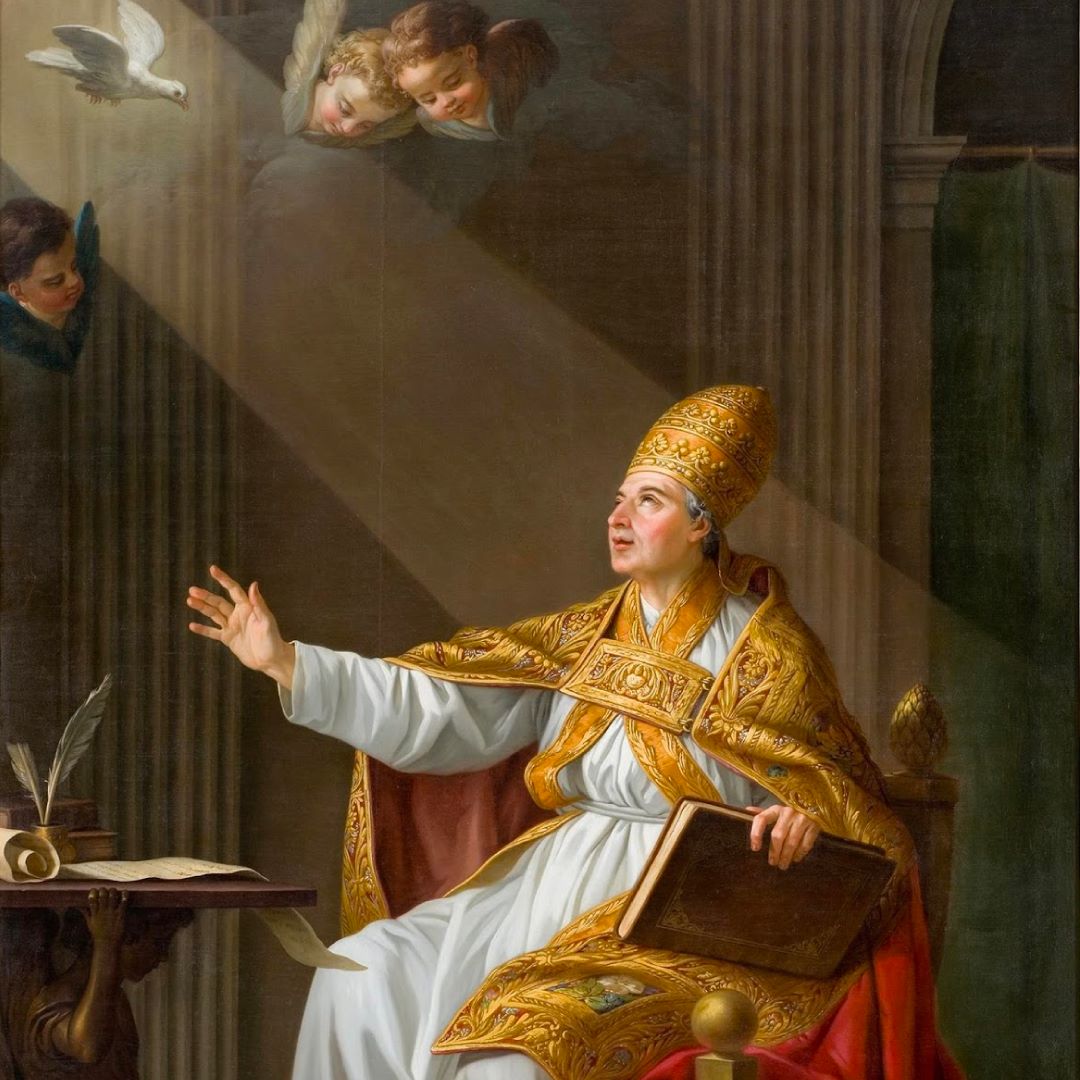
Pope Saint Leo the Great (c. 400–461) was one of the most influential popes in the history of the Catholic Church. Renowned for his profound theological wisdom, courageous leadership, eloquent preaching, and unwavering defence of the Catholic faith, he guided the Church during a period of political instability, theological controversy, and barbarian invasions.
He is remembered especially for his decisive contribution to the Christological teaching of the Church, his famous Tome of Leo, and his historic encounter with Attila the Hun, which helped protect Rome from destruction in 452. His pontificate strengthened the authority of the Bishop of Rome and helped establish a clear understanding of the mystery of Jesus Christ as true God and true man.
The Church honours him as a saint and Doctor of the Church. His life reminds Christians that authentic leadership is not founded on worldly power but on fidelity to Christ, courage in defending the truth, and loving service to God’s people.
1. Early Life and Background
Pope Saint Leo the Great was born around the beginning of the fifth century, probably in Rome or its surrounding region. His father’s name is traditionally given as Quintianus. Although details of his childhood and family background are limited, his later writings reveal that he received an excellent education and developed a profound understanding of Scripture, Christian theology, and the Latin literary tradition.
From an early age, Leo demonstrated remarkable intellectual ability and a deep commitment to the Church. He entered ecclesiastical service and gradually became an important figure in the Roman Christian community.
He served as a deacon of the Church of Rome under Pope Celestine I and Pope Sixtus III. During this period, he became known for his administrative abilities, theological insight, and diplomatic wisdom. He was entrusted with important responsibilities involving Church affairs and relations with civil authorities.
One significant episode in his early career occurred around 440, when he was sent to Gaul to help resolve a political dispute involving the Roman general Aetius and other influential officials. His appointment demonstrated the confidence placed in him by the Church and his reputation as a capable mediator.
While Leo was away on this mission, Pope Sixtus III died. The Roman clergy and people chose Leo as his successor.
2. Election as Pope
In 440, Leo was elected the Bishop of Rome, succeeding Pope Sixtus III. He was consecrated on 29 September 440.
His election came at a difficult moment in the history of the Roman Empire. Political authority was weakening, barbarian groups were entering imperial territories, and theological disagreements were troubling Christian communities.
Leo understood that the papacy was not merely an administrative office. He saw it as a sacred responsibility entrusted to him by Christ for the unity, holiness, and protection of the Church.
In his first sermon as pope, he expressed his sense of humility before the responsibility entrusted to him. He recognized that the greatness of the office did not arise from his personal abilities but from the grace of God.
His pontificate lasted for twenty-one years, until his death in 461. During those years, he became one of the most outstanding leaders of the early Church.
3. A Shepherd Who Strengthened the Church
From the beginning of his pontificate, Leo worked tirelessly to strengthen the spiritual and institutional life of the Church. He believed that the pope had a special responsibility to preserve the unity of Christians, protect the apostolic faith, and guide the faithful towards holiness.
He exercised his pastoral authority with firmness and compassion. He communicated with bishops throughout the Christian world, addressed doctrinal disagreements, corrected abuses, and encouraged proper discipline among clergy and religious communities.
He was particularly concerned about maintaining unity among the local Churches. He understood that disagreements among bishops could weaken Christian witness and create confusion among the faithful.
Leo also defended the authority of the Bishop of Rome as the successor of Saint Peter. He believed that Christ had entrusted Peter with a special responsibility for strengthening the faith of the Church, and that this ministry continued in Peter’s successors.
At the same time, he never regarded ecclesiastical authority as an opportunity for personal glory. For him, authority was a responsibility to serve Christ and His people.
4. Theological Controversies and the Mystery of Christ
One of the greatest challenges during Leo’s pontificate concerned the mystery of the Incarnation and the relationship between the divine and human natures of Jesus Christ.
The Church had already faced several controversies regarding the identity of Jesus. Some theological positions emphasized His divinity in such a way that His true humanity was diminished, while others struggled to explain how His divine and human natures were united.
A particularly serious controversy arose through the teachings associated with Eutyches, an archimandrite in Constantinople. Eutyches opposed the teaching of Nestorius but went too far in the opposite direction, maintaining a position that compromised the full reality of Christ’s human nature.
The Church had to defend the essential truth that Jesus Christ is truly God and truly man.
Pope Leo recognized the seriousness of this controversy. He understood that the question was not simply an academic theological disagreement. It concerned the very foundation of Christian salvation.
If Jesus were not truly human, He could not fully share our human condition. If He were not truly God, He could not be the divine Saviour who brings humanity into communion with God.
Leo therefore dedicated considerable attention to explaining the mystery of Christ with theological clarity.
5. The Famous Tome of Leo
One of the greatest contributions of Pope Saint Leo the Great to Christian theology was his letter to Saint Flavian, Patriarch of Constantinople, written in 449. This important document became known as the Tome of Leo.
The letter explained the Catholic understanding of the two natures of Jesus Christ.
Leo clearly taught that Jesus Christ possesses two complete and distinct natures:
- A divine nature, because He is truly God.
- A human nature, because He truly became man.
These two natures are united in the one divine Person of Jesus Christ. Neither nature is destroyed, confused, or diminished by this union.
Jesus is not partly God and partly man. He is fully God and fully man.
Leo explained that the same Jesus who performed divine miracles was also capable of experiencing genuine human suffering. The same Lord who raised the dead experienced hunger, thirst, exhaustion, and death.
This teaching protected the integrity of the Christian understanding of the Incarnation.
The Tome of Leo became one of the most important theological documents of the early Church and played a decisive role in the Council of Chalcedon.
6. The Council of Chalcedon (451)
The Council of Chalcedon, held in 451, was the fourth Ecumenical Council of the Catholic Church. It became a landmark in the development of Christian Christology.
The council was convened to address the controversies surrounding the person of Jesus Christ and to establish a clear statement of the Church’s faith.
Pope Leo sent his representatives to the council and entrusted them with the responsibility of presenting his teaching. His letter to Flavian, the Tome of Leo, was read before the assembled bishops.
The bishops recognized that Leo’s explanation faithfully expressed the apostolic teaching about Jesus Christ.
According to the traditional account, after hearing the document, the council fathers exclaimed:
“Peter has spoken through Leo!”
This famous acclamation expressed their recognition that Leo’s teaching was in harmony with the faith entrusted to the Apostle Peter.
The Council of Chalcedon solemnly affirmed that Jesus Christ is one and the same Son, perfect in divinity and perfect in humanity, truly God and truly man.
He is consubstantial with the Father according to His divinity and consubstantial with us according to His humanity.
The council further declared that Christ is to be acknowledged in two natures, without confusion, without change, without division, and without separation. The distinction between the natures is not abolished by their union; rather, the properties of each nature are preserved in the one Person and one hypostasis of Christ.
This definition became a foundational expression of Catholic Christological doctrine.
Pope Leo’s contribution to the council remains one of his greatest achievements. His theological clarity helped the Church articulate the mystery of the Incarnation for generations of Christians.
7. Pope Leo and the Authority of Saint Peter
Another important feature of Leo’s pontificate was his profound understanding of the ministry of Saint Peter.
Leo frequently reflected on the Gospel passage in which Jesus says to Peter:
“You are Peter, and on this rock I will build my church.” (Matthew 16:18)
He believed that Peter had received a unique responsibility from Christ to strengthen the faith of the Church.
For Leo, the authority of Peter did not end with the Apostle’s death. It continued through the Bishop of Rome, who occupied the See associated with Peter’s apostolic ministry.
He understood the papacy as a ministry of unity, responsibility, and service.
Leo’s teaching contributed significantly to the development of the Catholic understanding of papal primacy. He believed that the pope was called to protect the faith, preserve ecclesiastical communion, and guide the Church according to the teachings of Christ.
His understanding of authority was deeply spiritual. He saw himself not as the owner of the Church but as a servant entrusted with a sacred responsibility.
8. The Historic Encounter with Attila the Hun (452)
One of the most celebrated episodes in the life of Pope Saint Leo the Great was his encounter with Attila the Hun in 452.
During this period, the Western Roman Empire was experiencing political and military collapse. The Huns, under their powerful leader Attila, had invaded northern Italy and devastated several cities.
Aquileia, Padua, and other important centres suffered destruction. The people of Italy lived in fear as Attila’s forces continued their advance.
Rome itself faced the threat of invasion.
Emperor Valentinian III and the Roman authorities were unable to guarantee the safety of the city. In this desperate situation, Pope Leo undertook a courageous diplomatic mission.
He travelled north with a delegation that included prominent Roman officials and met Attila near the River Mincio, in the vicinity of Mantua.
Leo approached the feared conqueror not with military weapons but with the moral authority of his spiritual office.
He pleaded with Attila to withdraw his forces and spare Italy from further destruction.
Remarkably, Attila agreed to withdraw from Italy.
Historians have discussed several factors behind Attila’s decision, including diplomatic negotiations, political considerations, the difficulties of sustaining his army, and the possibility of receiving tribute. Nevertheless, Leo’s intervention became a powerful symbol of the Church’s role in promoting peace during times of violence.
Later Christian tradition associated the meeting with a miraculous vision in which Attila supposedly saw Saints Peter and Paul standing beside the pope with threatening swords. Although this detail belongs to the traditional account rather than established historical evidence, it illustrates how deeply the encounter impressed the Christian imagination.
Pope Leo’s courage and diplomatic wisdom helped prevent further destruction and earned him lasting admiration.
He demonstrated that spiritual authority could exercise a powerful influence even when political and military institutions were failing.
9. His Courage During the Vandal Invasion of Rome (455)
Three years after his encounter with Attila, Leo faced another terrible crisis.
In 455, the Vandals, led by their king Genseric, approached Rome. The Western Roman Empire was in political turmoil, and the city had little capacity to defend itself.
Once again, Pope Leo went out to meet the invading leader.
He pleaded with Genseric to spare the city from fire, massacre, and unnecessary destruction.
Although Leo could not prevent the capture and plundering of Rome, his intervention helped secure important concessions. Genseric agreed that the city would not be burned and that the people would not be massacred.
The great basilicas of Saint Peter, Saint Paul, and Saint John Lateran were also spared from destruction.
The invasion nevertheless brought enormous suffering. Many inhabitants were taken captive, and the city experienced extensive looting.
Leo responded with pastoral concern. He worked to assist the victims, care for those who had lost their homes, and support those who had been taken captive.
His actions revealed the heart of a true shepherd. He did not abandon his people when danger approached but stood with them in their suffering.
10. A Great Preacher and Teacher
Pope Saint Leo the Great was not only an administrator and defender of doctrine but also an extraordinary preacher.
Nearly one hundred of his sermons have survived. They reveal his profound understanding of Scripture, his ability to communicate theological truths, and his concern for the spiritual growth of ordinary Christians.
His preaching was marked by clarity, dignity, and spiritual depth. He avoided unnecessary complexity and sought to make the mysteries of Christian faith understandable to the faithful.
He regularly preached on the great mysteries of salvation, especially the Incarnation, the Nativity of Christ, the Passion, the Resurrection, and the feasts of the apostles.
His sermons on the Nativity are particularly celebrated.
Leo understood Christmas as the revelation of God’s extraordinary love for humanity. The Son of God entered human history so that humanity might be reconciled with God.
One of his most famous teachings expresses this mystery:
“Christian, remember your dignity.”
This brief exhortation captures an important theme of his spirituality. Through baptism, Christians have become children of God and members of Christ’s Body. Therefore, they must live according to the dignity they have received.
For Leo, Christian life was not simply about avoiding sin. It was about becoming increasingly conformed to Jesus Christ.
He encouraged the faithful to reject sinful habits, practise charity, forgive their enemies, care for the poor, and live in holiness.
11. His Teaching on the Incarnation
The mystery of the Incarnation occupied a central place in Leo’s spirituality.
He believed that the coming of Christ had transformed the meaning and destiny of human life.
The Son of God did not merely appear to be human. He truly assumed human nature and entered into the experiences of ordinary human existence.
Christ experienced hunger, thirst, weariness, sorrow, suffering, and death. Yet He remained fully divine.
This truth was essential to the work of salvation.
Leo frequently emphasized that Christ took upon Himself what belonged to our humanity so that He could heal and redeem it.
His understanding of the Incarnation also gave a profound dignity to the human person.
Human nature was not something to be despised or rejected. It was the very nature that the Son of God had assumed in order to save humanity.
Consequently, every Christian is called to honour the dignity of human life and live in accordance with the grace received through Christ.
12. Prayer, Fasting, and Charity
Pope Leo understood that authentic Christian life required more than theological knowledge and religious observances. It demanded a genuine conversion of heart.
He frequently encouraged the faithful to practise prayer, fasting, and almsgiving.
These three spiritual practices, he believed, were closely connected.
Prayer lifted the heart towards God. Fasting helped believers exercise self-control and detach themselves from excessive worldly desires. Almsgiving transformed faith into practical love for those in need.
Leo was particularly concerned about the poor and suffering people of Rome.
During times of famine, social instability, and economic hardship, he encouraged the faithful to share their resources with those who were struggling.
He believed that the wealth entrusted to Christians was not meant merely for personal comfort but could become an instrument of God’s love.
His pastoral teaching reminds us that a Christian cannot claim to love God while remaining indifferent to the suffering of neighbours.
For Leo, charity was not an optional expression of Christian life. It was an essential responsibility of every disciple.
13. His Contributions to the Liturgy and Church Life
Pope Leo also made important contributions to the liturgical and spiritual life of the Church.
He gave great importance to the celebration of the Eucharist and the liturgical year. He understood the sacred liturgy as the living celebration of the mysteries of Christ and the means through which the faithful participate in the saving work of God.
His sermons reveal how carefully he connected the liturgical celebrations with the spiritual responsibilities of Christians.
He encouraged the faithful to prepare themselves through repentance, prayer, fasting, and works of mercy, especially during the seasons of Advent and Lent.
Leo also worked to strengthen the discipline of the clergy and maintain the proper functioning of the Church’s pastoral structures.
He promoted reverence in worship and encouraged bishops and priests to fulfil their responsibilities faithfully.
His concern for the liturgy was not merely ceremonial. He wanted the faithful to understand that every celebration of the Church should lead them towards a deeper relationship with Jesus Christ.
14. His Writings and Spiritual Legacy
Pope Saint Leo the Great left behind an extraordinary collection of theological and pastoral writings.
His surviving works include approximately 150 letters and nearly 100 sermons.
His letters deal with a wide variety of subjects, including:
- The mystery of the Incarnation.
- The authority and responsibilities of bishops.
- The primacy of the See of Rome.
- The unity of the universal Church.
- The correction of theological errors.
- The administration of ecclesiastical affairs.
- The spiritual formation of Christians.
- The importance of charity and pastoral responsibility.
His sermons are particularly valuable because they reveal his ability to unite profound theology with practical Christian living.
Leo’s writings have continued to influence Catholic theology, particularly in the areas of Christology, ecclesiology, and the understanding of the papal ministry.
His contribution to the Council of Chalcedon remains one of the most important achievements in the history of Christian doctrine.
15. Death and Canonization
Pope Saint Leo the Great died on 10 November 461, after serving the Church for more than twenty-one years.
He was buried near the tomb of Saint Peter in the Vatican Basilica. He was the first pope to be buried within the original Basilica of Saint Peter.
His reputation for holiness and extraordinary leadership continued to grow after his death.
The Church has always honoured him as one of the greatest popes of Christian antiquity.
In 1754, Pope Benedict XIV formally proclaimed Saint Leo the Great a Doctor of the Church.
This title recognizes his exceptional contribution to Christian doctrine and his lasting importance as a teacher of the faith.
His feast is celebrated on 10 November in the Roman Catholic Church.
His relics are preserved in Saint Peter’s Basilica in Vatican City.
16. Why Is Saint Leo Called the Great?
Only a few popes in the history of the Catholic Church have been honoured with the title “the Great.”
Saint Leo received this title because of the extraordinary combination of qualities he demonstrated during his pontificate.
His greatness can be understood through several important contributions:
1. Defender of Christological truth: He clearly explained and defended the Catholic teaching that Jesus Christ is fully God and fully man.
2. Protector of the Church’s unity: He worked tirelessly to preserve communion among bishops and local Churches.
3. Courageous peacemaker: His diplomatic intervention during the invasions of Attila and Genseric demonstrated extraordinary courage and concern for human life.
4. Outstanding theologian: His Tome of Leo and numerous sermons became important contributions to Christian theology.
5. Compassionate pastor: He cared for the poor, suffering, and vulnerable members of his community.
6. Defender of apostolic tradition: He understood his ministry as a responsibility to preserve and transmit the faith received from the apostles.
His greatness was not simply the result of historical achievements. It was rooted in his fidelity to Christ and his commitment to serving the Church.
17. Spiritual Lessons from the Life of Saint Leo the Great
The life of Saint Leo the Great offers several important lessons for Christians today.
1. Defend the truth with courage
Leo did not remain silent when the essential truths of Christianity were threatened. He understood that the truth about Jesus Christ was too important to compromise.
In our own time, Christians are called to remain faithful to the Gospel, even when it becomes difficult or unpopular.
We must defend our faith with conviction, humility, and charity.
2. True greatness is found in service
Although Leo occupied one of the highest positions in the Church, he understood himself as a servant.
He used his authority to protect the faithful, promote peace, and strengthen the Church.
His life reminds us that greatness is not measured by titles, wealth, or influence but by our willingness to serve others.
3. Be courageous in difficult situations
When Rome faced invasion, Leo did not surrender to fear. He approached powerful rulers and pleaded for peace.
His example teaches us to face difficulties with courage, wisdom, and trust in God.
We may not always be able to change every situation, but we can choose to respond with faith and responsibility.
4. Recognize the dignity of every human person
Leo’s teaching on the Incarnation reminds us that human nature has been honoured by the Son of God.
Every human being possesses dignity and deserves respect.
We are called to treat others with compassion, especially the poor, the sick, the vulnerable, and those who are suffering.
5. Unite faith with charity
Leo understood that Christian doctrine must be expressed through Christian living.
Prayer without love becomes empty, and religious observance without compassion loses its true meaning.
Our faith must become visible through forgiveness, generosity, kindness, and service.
6. Remain faithful to Christ
The deepest foundation of Leo’s life was his relationship with Jesus Christ.
He dedicated his intellectual gifts, leadership abilities, and personal courage to the service of the Lord.
His example encourages us to make Christ the centre of our lives.
18. Relevance of Saint Leo the Great for the Church Today
The life of Saint Leo the Great continues to speak powerfully to the modern Church.
We live in a world where religious convictions are often questioned, truth is sometimes treated as relative, and divisions can weaken communities.
Leo reminds the Church of the importance of remaining faithful to the apostolic foundation of Christianity.
His teaching on the Incarnation is especially relevant because it directs our attention towards the true identity of Jesus Christ.
Jesus is not merely a moral teacher, a prophet, or a religious leader. He is the eternal Son of God who became man for our salvation.
Leo also provides an important model of Christian leadership.
Church leaders are called to combine doctrinal fidelity with pastoral compassion. They must defend the truth while remaining attentive to the needs of ordinary people.
His encounter with Attila also offers a lesson for a world troubled by war, violence, and political conflict. Religious leaders have a responsibility to promote peace, protect human dignity, and speak courageously against injustice.
Above all, Saint Leo teaches us that the Church must never lose sight of her mission: to proclaim Jesus Christ, preserve the faith, and bring God’s love to the world.
19. A Personal Reflection
The life of Pope Saint Leo the Great invites us to reflect on the meaning of true Christian greatness.
He lived during a period when the world around him was falling apart. Political structures were collapsing, cities were being destroyed, and people were living in fear. Within the Church, serious theological disagreements threatened Christian unity.
Yet Leo did not allow the difficulties of his time to weaken his faith or diminish his sense of responsibility.
He defended the truth about Jesus Christ, worked for peace, protected his people, and encouraged the faithful to live holy lives.
His life offers a beautiful reminder that God can accomplish extraordinary things through people who are willing to place their gifts entirely at His service.
We may not possess the influence of a pope or the opportunity to change the course of history. Nevertheless, each of us has a responsibility within our families, communities, workplaces, and parishes.
A parent who guides children in faith, a priest who serves his parish with love, a teacher who forms young minds, a nurse who cares for the sick, and an ordinary Christian who stands for truth and justice can all become instruments of God’s grace.
Saint Leo also reminds us that our faith must be centred on Jesus Christ. His defence of the two natures of Christ was not merely an intellectual exercise. It was a proclamation of the wonderful mystery that God became one of us so that we might share in His divine life.
May his example inspire us to remain courageous in faith, compassionate in service, and unwavering in our love for Jesus Christ.
Prayer to Pope Saint Leo the Great
O glorious Pope Saint Leo the Great, faithful shepherd of the Church and courageous defender of the Catholic faith, intercede for us before the throne of God.
You served the Church during a time of confusion, conflict, and uncertainty. Obtain for us the grace to remain steadfast in our faith, especially when we face difficulties, temptations, and challenges.
Help us to know Jesus Christ more deeply, to love Him sincerely, and to proclaim Him courageously through our words and actions.
Pray for the Holy Father, all bishops, priests, religious, and missionaries, that they may faithfully fulfil their responsibilities as shepherds of God’s people.
Inspire us to become instruments of peace, unity, and reconciliation. Teach us to recognize the dignity of every human person and to serve the poor and suffering with generous hearts.
May we never forget our dignity as children of God and always live according to the grace we have received through Jesus Christ.
Saint Leo the Great, pray for us.
Amen.
Liturgical Information
- Name: Pope Saint Leo I the Great
- Title: Pope and Doctor of the Church
- Born: Around 400 AD, traditionally associated with Tuscany
- Elected Pope: 440 AD
- Pontificate: 440–461 AD
- Died: 10 November 461
- Feast Day: 10 November
- Known For: The Tome of Leo, the Council of Chalcedon, the defence of Christological orthodoxy, and his encounter with Attila the Hun.
- Patronage: Not universally assigned a specific patronage.
References and Further Reading
- Pope Benedict XVI, General Audience, 5 March 2008: Saint Leo the Great. Vatican.
- Pope John XXIII, Aeterna Dei Sapientia, 11 November 1961.
- Saint Leo the Great, Letters and Sermons, Nicene and Post-Nicene Fathers, Second Series, Volume XII.
- Acts of the Council of Chalcedon (451).
- The Catholic Encyclopedia, “Pope St. Leo I (The Great).”
- Vatican News, “St. Leo the Great, Pope and Doctor of the Church.”
- Catechism of the Catholic Church, paragraphs 456–483, on the Incarnation.
Recommended online sources:
- Vatican: https://www.vatican.va/content/vatican/en/holy-father/leone-i–magno.html
- Vatican News: https://www.vaticannews.va/en/saints/11/10/st–leo-the-great–pope-and-doctor-of-the-church.html
- New Advent: https://www.newadvent.org/cathen/09154b.htm
- Christian Classics Ethereal Library: https://ccel.org/ccel/schaff/npnf212/npnf212.toc.html
Memorial: 10 November
Pope Saint Leo the Great, pray for us!
Leave a Reply