
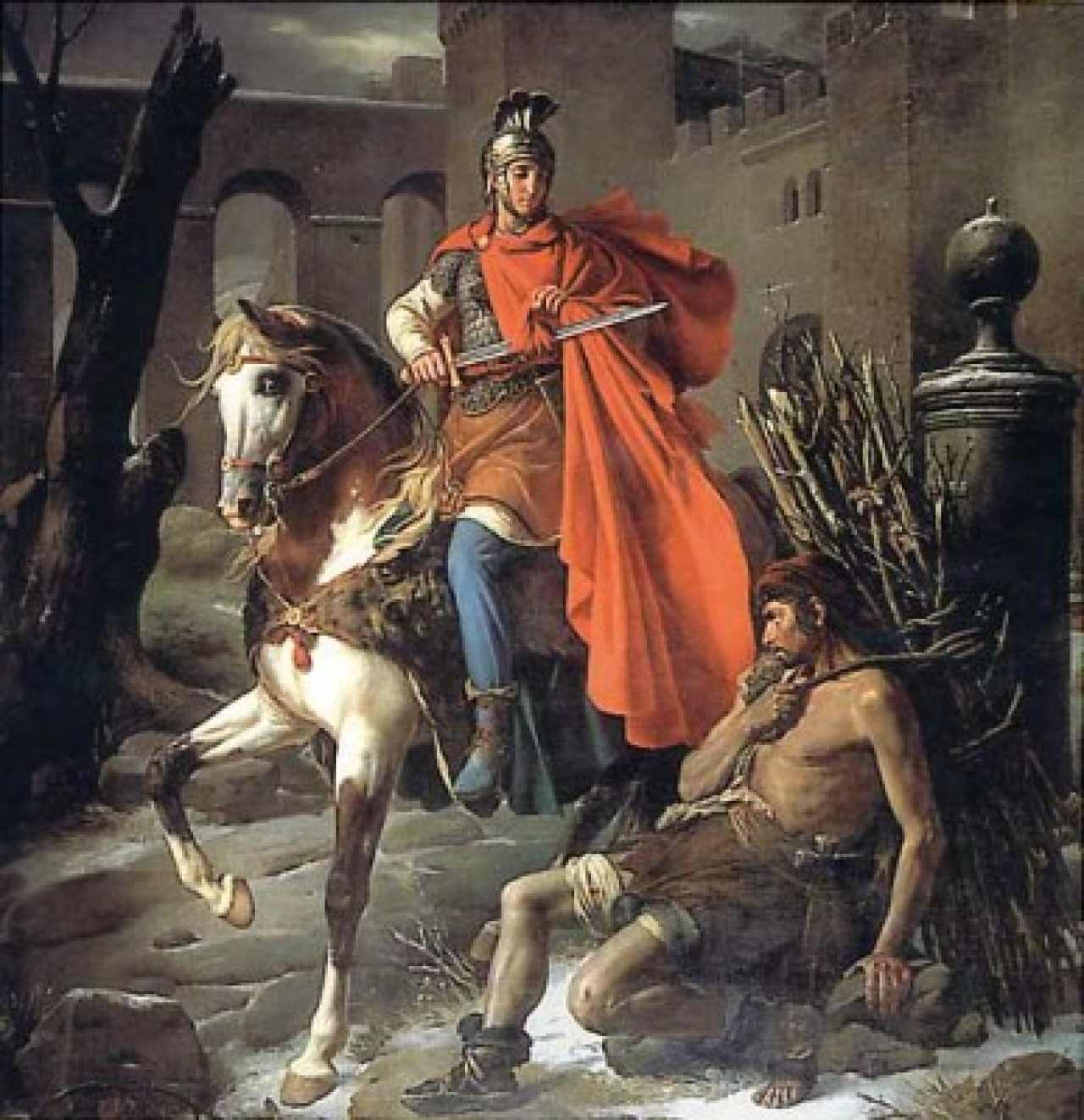
Bishop, Confessor and Father of Western Monasticism
Feast Day: 11 November
Saint Martin of Tours is one of the most beloved saints in the history of the Catholic Church. Remembered for his extraordinary charity, humility, simplicity of life and courageous witness to Christ, he became a model of Christian holiness for generations of believers. Although he was born into a pagan family and initially served as a soldier in the Roman army, Martin discovered that his true calling was not to conquer territories but to serve Christ and care for the poor.
His famous act of sharing his military cloak with a freezing beggar has become one of the most enduring images of Christian charity. Through his life, Saint Martin reminds us that holiness begins when we recognise Christ in those who are suffering and respond to their needs with love.
1. Early Life and Family Background
Saint Martin was born around the year 316 AD in Sabaria, in the Roman province of Pannonia, in present-day Hungary. His father was a Roman military officer, and his family belonged to the pagan tradition of the Roman Empire.
When Martin was still a young child, his family moved to Ticinum, present-day Pavia in Italy. Growing up in a military household, he became familiar with the discipline and responsibilities of Roman soldiers.
Although his parents were not Christians, Martin developed an interest in Christianity from an early age. At approximately ten years old, he became attracted to the Christian faith and sought admission as a catechumen. This was remarkable because Christianity was not yet the dominant religion of the Roman Empire.
Martin desired to dedicate himself entirely to God, but his father’s military profession and the expectations of Roman society led him into military service. At the age of fifteen, he was enrolled in the Roman army and eventually served in the imperial cavalry.
Even while wearing a soldier’s uniform, Martin carried within himself a heart deeply drawn to prayer, simplicity and compassion.
2. The Famous Encounter with the Beggar
The most famous incident in the life of Saint Martin occurred during his military service near the city of Amiens in Gaul, present-day France.
One cold winter day, Martin was approaching the city when he encountered a poor beggar sitting at the roadside. The man was almost naked and trembling from the freezing weather. Many people passed him without offering assistance.
Martin was deeply moved by the man’s suffering. However, he had no money to give him. Wearing his military cloak, he decided to do what he could.
Taking his sword, Martin cut his cloak into two pieces and gave half of it to the beggar. He kept the remaining half for himself.
That night, Martin had a remarkable dream. He saw Jesus Christ wearing the half of the cloak he had given to the beggar. In the vision, Jesus said to the angels:
“Martin, who is still a catechumen, has clothed me with this garment.”
This experience profoundly strengthened Martin’s faith. He understood that his act of kindness towards the poor man was, in reality, an act of love towards Christ Himself.
The incident is closely associated with the words of Jesus in the Gospel:
“Whatever you did for one of the least of these brothers and sisters of mine, you did for me” (Matthew 25:40).
The cloak became a powerful symbol of Christian charity. According to tradition, the remaining portion of Martin’s cloak was preserved as a sacred relic and gave rise to the word capella, from which the English word chapel eventually developed.
Martin’s encounter with the beggar teaches us that we do not need great wealth or extraordinary opportunities to practise charity. Sometimes, holiness begins with sharing what we already possess.
3. Baptism and Decision to Leave the Army
Following his experience with the beggar, Martin became increasingly determined to live according to the teachings of Christ.
He received baptism at approximately eighteen years of age. Although he continued his military service for some time, his heart was no longer attached to military life.
Martin eventually became convinced that his Christian vocation was incompatible with participating in warfare. When the Roman army prepared for another military campaign, he requested permission to leave.
He declared that he was a soldier of Christ and could no longer fight in the service of the emperor.
His decision was courageous, especially during a period when military service was considered an honourable and important responsibility. After facing opposition and difficulties, Martin was eventually released from military service.
He had chosen a different kind of battle: the struggle against sin, selfishness and indifference.
4. Disciple of Saint Hilary of Poitiers
After leaving the army, Martin travelled to various places, seeking a deeper understanding of Christian life.
He became associated with Saint Hilary of Poitiers, one of the great defenders of the Catholic faith against Arianism.
Saint Hilary recognised Martin’s spiritual gifts and welcomed him as a disciple. Under his guidance, Martin grew in theological understanding and developed a deeper commitment to prayer and the service of God.
Martin later returned to his homeland to share the Christian faith with his family. His mother accepted Christianity, while his father remained attached to pagan beliefs.
During this period, Martin also faced religious opposition and persecution. His defence of the true faith brought him into conflict with those who supported Arianism.
Eventually, he returned to Gaul and established a life of prayer and solitude near Poitiers.
5. The Foundation of the Monastery at Ligugé
Around 361 AD, Martin established a monastic community at Ligugé, near Poitiers. It is traditionally regarded as one of the earliest monastic foundations in Gaul.
There, Martin gathered disciples who desired to dedicate their lives to prayer, penance, contemplation and the pursuit of holiness.
The community lived a simple life, away from the distractions of worldly society. They devoted themselves to prayer, Scripture, manual labour and spiritual formation.
Martin’s example attracted many followers. He demonstrated that Christian discipleship required not merely outward religious observances but a complete transformation of the heart.
His monastic community became an important centre of spiritual life and helped lay the foundations for the development of Western monasticism.
6. Election as Bishop of Tours
Martin’s reputation for holiness, wisdom and compassion gradually spread throughout Gaul. People admired his simplicity, generosity and spiritual authority.
Around 371 AD, following the death of the Bishop of Tours, the people desired Martin to become their new bishop. However, Martin had no desire for ecclesiastical honours. He preferred the quiet life of a monk and was reluctant to accept the responsibilities of a bishop.
According to tradition, the people persuaded him to come to Tours by asking him to visit a sick person. When he arrived, the people gathered around him and insisted that he accept the episcopal office.
Despite the opposition of some who considered his humble appearance unsuitable for such an important position, Martin was consecrated Bishop of Tours.
As bishop, he remained faithful to his monastic ideals. He did not abandon his simple lifestyle or become attached to worldly honours. Instead, he understood his episcopal ministry as a call to greater service.
7. The Monastery of Marmoutier
Although Martin became Bishop of Tours, he did not wish to live a comfortable life surrounded by luxury. He established a monastic community at Marmoutier, near Tours, where he could continue his life of prayer and contemplation while fulfilling his pastoral responsibilities.
Marmoutier became an important centre of spiritual formation. Many disciples gathered around Martin, attracted by his holiness and dedication.
The monks lived in simplicity, practising prayer, fasting, silence and manual labour. Their community became a source of missionary activity throughout the surrounding region.
Martin understood that the renewal of society required the renewal of individual hearts. He therefore formed men who would carry the Gospel to villages and communities that had not yet embraced Christianity.
His missionary approach combined preaching with personal witness. He did not merely announce the Gospel through words; he demonstrated it through his kindness, humility and concern for the poor.
8. A Missionary Bishop and Evangeliser
As Bishop of Tours, Martin devoted himself to spreading Christianity throughout the countryside of Gaul.
Many rural communities continued to follow pagan religious practices. Martin travelled from village to village, preaching the Gospel, encouraging people to abandon idolatry and establishing Christian communities.
Tradition and the writings of his biographer, Sulpicius Severus, associate Martin with numerous miraculous events during these missionary journeys. He was remembered for healing the sick, liberating people from spiritual oppression and bringing hope to those who were suffering.
His missionary work was not always welcomed. He sometimes encountered hostility from people who were unwilling to abandon their traditional religious practices.
Nevertheless, Martin continued his mission with courage and perseverance.
He understood that evangelisation required patience. He did not consider people enemies simply because they did not share his faith. His desire was to bring them into a personal relationship with Jesus Christ.
9. A Bishop Who Defended the Poor and Oppressed
One of the most remarkable qualities of Saint Martin was his concern for people who had no power or influence.
Although he occupied an important ecclesiastical position, he never considered himself superior to ordinary people. He was particularly attentive to the poor, prisoners, the sick and those suffering from injustice.
He frequently approached powerful officials and rulers to plead for mercy on behalf of those who were condemned or treated unjustly.
Martin believed that Christian leadership was not about exercising authority for personal benefit. It was about protecting the vulnerable and serving those who could not defend themselves.
His life reflected the teaching of Jesus:
“Whoever wishes to be great among you must be your servant” (Matthew 20:26).
He also demonstrated that a bishop must be close to his people, understand their difficulties and be willing to sacrifice his comfort for their welfare.
10. His Courage Before the Emperor
Saint Martin’s pastoral ministry occasionally brought him into contact with the Roman imperial authorities.
One significant episode involved Emperor Maximus, who had established his authority in the western Roman Empire.
During the controversy surrounding Priscillian and his followers, Martin strongly opposed the use of imperial power to impose religious decisions through executions. He believed that matters of faith should not be settled through violence and that the Church must not become an instrument of political persecution.
Martin approached the emperor and pleaded for mercy. He was particularly distressed by the possibility of Christians being put to death through imperial intervention in religious disputes.
Although the circumstances were complicated and Martin’s efforts did not prevent every injustice, his opposition to the death penalty in this controversy reveals an important aspect of his Christian character.
He understood that defending the truth must never become an excuse for cruelty.
His example reminds Christians that fidelity to the Gospel requires both courage in defending the faith and compassion towards those with whom we disagree.
11. His Humility and Simple Lifestyle
Despite his reputation as a miracle worker and one of the most influential bishops of his time, Martin remained remarkably humble.
He did not seek recognition, wealth or political influence. He continued to value prayer, fasting, silence and simplicity.
He preferred the company of monks and ordinary people to the privileges associated with his episcopal position.
His humility was not a sign of weakness. Rather, it came from his deep awareness that everything he possessed was a gift from God.
Martin understood that the greatness of a Christian is measured not by titles or possessions but by the depth of love and service.
His life offers a powerful challenge to those who seek importance through positions, popularity and material success.
12. His Final Days and Death
Saint Martin spent the final years of his life continuing his pastoral ministry despite his advancing age and physical weakness.
In 397 AD, while visiting a Christian community at Candes, he became seriously ill. Recognising that his earthly journey was approaching its end, he prepared himself spiritually for death.
According to Sulpicius Severus, his disciples were deeply distressed and begged him not to leave them. They wanted their beloved spiritual father to remain with them.
Martin, however, was ready to surrender himself to God’s will.
Tradition preserves his final prayer as an expression of complete trust and abandonment to divine providence:
“Lord, if your people still need me, I do not refuse the work. Your will be done.”
These words beautifully express the spirit of his entire life. Martin had never lived for himself. Even at the moment of death, he was concerned about the spiritual welfare of others.
He died at Candes on 8 November 397 AD, at approximately eighty years of age.
His body was brought to Tours, where he was buried on 11 November. His burial attracted enormous crowds, and his tomb soon became an important centre of Christian pilgrimage.
The Church celebrates his feast on 11 November, the anniversary of his burial.
13. His Influence on the Church
Saint Martin of Tours occupies a special place in the history of Western Christianity.
He was among the earliest non-martyr saints to receive widespread public veneration in the Western Church. Before his time, Christian devotion to saints was particularly associated with those who had died as martyrs for their faith.
Martin demonstrated that a person could also become a saint through a life of extraordinary holiness, charity, prayer and service.
His monasteries influenced the development of Western monasticism, while his missionary activities contributed significantly to the spread of Christianity in Gaul.
His life was recorded by his contemporary and disciple, Sulpicius Severus, whose Life of Saint Martin became one of the most influential early Christian biographies.
Over the centuries, numerous churches, monasteries and institutions were dedicated to him. His devotion spread throughout Europe, and he became especially beloved in France.
14. Patronage and Symbols
Saint Martin is particularly associated with charity, generosity, soldiers, beggars, travellers and those who serve the poor.
He is also regarded as a patron of France and several European communities.
In Christian art, he is commonly represented:
- Wearing the clothing of a Roman soldier.
- Cutting his cloak in half with a sword.
- Sharing his cloak with a poor beggar.
- Wearing the vestments of a bishop.
- Accompanied by a beggar or a horse.
The divided cloak remains his most recognisable symbol. It represents compassion, generosity and the Christian responsibility to recognise Christ in the suffering of others.
15. Spiritual Lessons from the Life of Saint Martin
The life of Saint Martin offers several important lessons for Christians today.
1. Recognise Christ in the Poor
The most famous moment in Martin’s life teaches us that serving the poor is a way of serving Jesus Himself. Every hungry person, homeless individual, abandoned child and suffering neighbour deserves our attention and compassion.
Christian charity is not simply about giving away what we do not need. It is about sharing what we have with those who need it.
2. Holiness Is Greater Than Worldly Success
Martin had the opportunity to enjoy the privileges of military service and later the honour of becoming a bishop. Yet he never allowed worldly recognition to become the centre of his life.
His example reminds us that true greatness comes from holiness, humility and love.
3. Live Your Faith Through Actions
Martin did not limit Christianity to prayers and religious ceremonies. His faith was visible in his everyday decisions.
His generosity towards the beggar was a practical expression of his relationship with Christ.
Our faith, too, must become visible through kindness, forgiveness, honesty and concern for others.
4. Be Courageous in Defending the Truth
Martin stood firmly for his convictions, even when powerful people opposed him. He defended the Christian faith and resisted the use of violence in religious disputes.
His life encourages us to remain faithful to our principles while treating others with dignity and compassion.
5. Remain Humble Even When You Are Given Authority
As a bishop, Martin could have enjoyed an influential and comfortable lifestyle. Instead, he continued to live simply and devoted himself to serving others.
Parents, teachers, priests, religious leaders and public servants can learn from his example. Authority is a responsibility to serve, not an opportunity to dominate.
6. Make Your Life a Gift to Others
Martin’s final prayer expressed his willingness to continue serving God’s people as long as the Lord desired.
His life teaches us that Christian discipleship is a lifelong commitment. We are called to serve God and others until our final breath.
16. Celebrating the Feast of Saint Martin
The feast of Saint Martin of Tours is celebrated on 11 November.
In many European countries, particularly France, Germany, Belgium and the Netherlands, his feast is associated with traditional celebrations, processions and charitable activities.
Children sometimes participate in lantern processions in his honour, remembering his light of generosity and compassion. In certain places, the traditional sharing of food also recalls his spirit of hospitality and concern for the poor.
His feast is an appropriate occasion for Christians to renew their commitment to charity. Parishes, families and Christian communities can celebrate the day by reaching out to the poor, visiting the sick, supporting the needy and sharing their resources with those who are struggling.
The most meaningful way to honour Saint Martin is not merely to remember the story of his cloak but to imitate his generosity.
17. Saint Martin of Tours: A Saint for Our Times
The world today has made extraordinary progress in science, technology, education and communication. Yet poverty, loneliness, inequality and indifference continue to affect millions of people.
Many people are surrounded by material possessions but lack genuine love and human companionship. Some suffer silently because nobody notices their pain. Others are rejected because of their social status, financial difficulties or personal circumstances.
In such a world, Saint Martin of Tours remains an important example of Christian holiness.
His story invites us to ask ourselves some important questions:
- Do I notice the suffering of people around me?
- Am I willing to share my time, talents and resources with those in need?
- Do I recognise Jesus in the poor and abandoned?
- Am I humble in my relationships with others?
- Do I use my position and influence to help people or to serve myself?
The cloak of Saint Martin reminds us that love becomes meaningful when it involves sacrifice.
We may not possess great wealth, but we can share our time. We may not be able to solve every problem, but we can offer encouragement. We may not be able to feed everyone, but we can help someone who is hungry.
The holiness of Saint Martin began with a simple act of kindness towards a stranger. That small act became an extraordinary testimony to the love of Christ.
May his example inspire us to become more generous, compassionate and Christ-centred in our daily lives.
Prayer to Saint Martin of Tours
Heavenly Father, we thank You for the life and witness of Saint Martin of Tours. Through his example of generosity, humility and love, teach us to recognise Your Son Jesus in the poor, the suffering and the abandoned.
Saint Martin, you shared your cloak with a helpless beggar and discovered that you had clothed Christ Himself. Obtain for us a heart that is sensitive to the needs of others. Help us to share what we have, forgive those who hurt us and serve those who need our assistance.
Pray for soldiers, the poor, the homeless, the sick and all those who are suffering. Inspire our priests, religious and community leaders to exercise their responsibilities with humility and compassion.
May we never become indifferent to the suffering of our brothers and sisters. Help us to live our Christian faith through genuine love and generous service.
Saint Martin of Tours, pray for us. Amen.
Saint Martin of Tours, pray for us!
References and Further Reading
1. Sulpicius Severus, The Life of Saint Martin (primary ancient biography, written by his contemporary).
The Life of Saint Martin – New Advent
2. Léon Clugnet, Saint Martin of Tours, The Catholic Encyclopedia (1910).
Catholic Encyclopedia – Saint Martin of Tours
3. EWTN, Saint Martin of Tours.
Saint Martin of Tours – EWTN
4. University of Notre Dame, FaithND, Saint Martin of Tours.
Saint Martin of Tours – FaithND
5. Dickinson College Commentaries, About the Work: Life of Saint Martin.
Sulpicius Severus and the Life of Saint Martin
Leave a Reply