
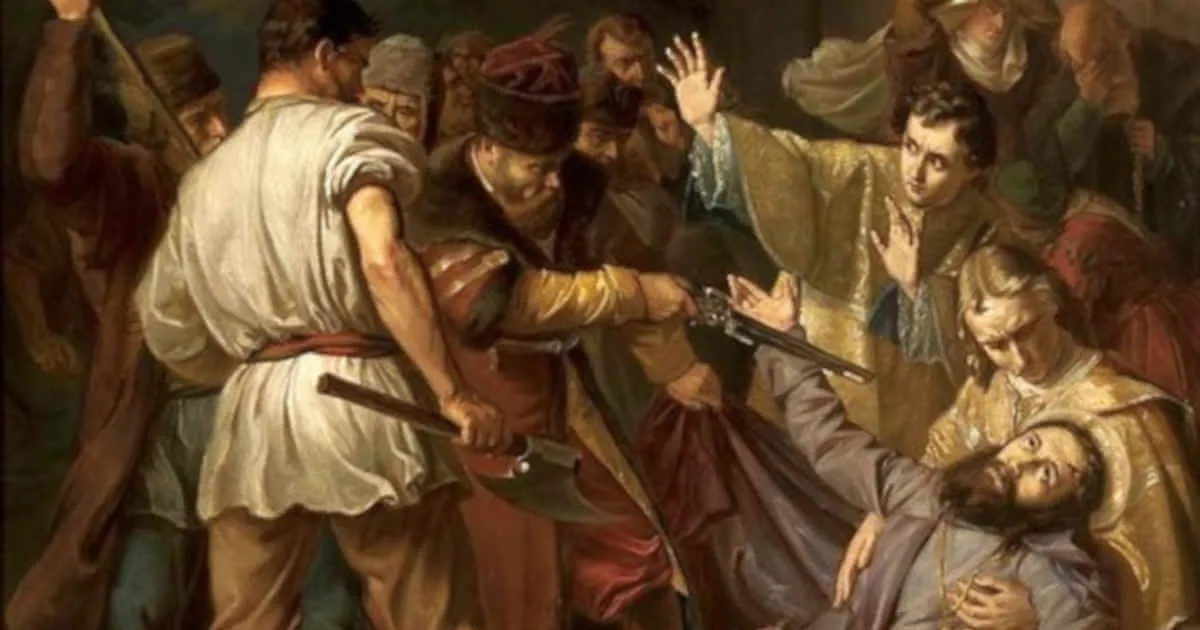
Archbishop of Polotsk, Basilian Monk and Martyr for Christian Unity
Feast Day: 12 November
Saint Josaphat Kuncewycz is one of the most remarkable witnesses to Christian unity in the history of the Catholic Church. A Byzantine-rite Catholic bishop, monk and missionary, he dedicated his entire life to restoring communion among Christians while preserving the rich spiritual and liturgical traditions of the Eastern Church. His commitment to the unity of the Church was so profound that he eventually gave his life for it.
Born into an Eastern Orthodox family in a period of intense religious division, Josaphat became a devoted member of the Catholic Church through the Union of Brest. As a Basilian monk and later Archbishop of Polotsk, he worked tirelessly to strengthen the faith of his people, reform religious life and encourage unity with the See of Rome.
His efforts brought him admiration from many but also fierce opposition from others. On 12 November 1623, he was brutally murdered by an angry mob in Vitebsk. His death made him one of the most celebrated martyrs of Christian unity.
Saint Josaphat reminds us that the unity of Christians is not merely an institutional objective but a spiritual responsibility rooted in the prayer of Jesus: “That they may all be one” (John 17:21).
1. Early Life and Family Background
Saint Josaphat was born as John Kuncewycz around 1580 in Volodymyr, in the region of Volhynia, then part of the Polish-Lithuanian Commonwealth and now in Ukraine.
His parents belonged to the Eastern Orthodox Church and were deeply religious. His father was engaged in commerce and also served as a town councillor. His family gave him a Christian upbringing and encouraged him to participate in the life of the Church.
From childhood, John displayed an unusual interest in prayer and religious instruction. He became particularly attracted to the Byzantine liturgy and the sacred books of the Eastern Christian tradition.
He learned Church Slavonic and developed a deep familiarity with the prayers and liturgical practices of his Church. Even as a young boy, he devoted considerable time to prayer and attending divine services.
One important influence on his spiritual development was his mother’s devotion to the crucified Christ. The suffering and sacrifice of Jesus made a deep impression on the young John and helped shape his understanding of Christian life.
He gradually developed a strong desire to dedicate himself entirely to God.
2. The Historical Background: The Union of Brest
To understand the life and mission of Saint Josaphat, it is important to understand the religious situation of Eastern Europe during his lifetime.
For centuries, Christians in Eastern Europe had followed the Byzantine tradition, with their own liturgy, spirituality, ecclesiastical discipline and theological heritage.
However, divisions between the Eastern and Western Churches had created serious difficulties in Christian relationships. These divisions affected the religious and political life of many communities.
In 1595–1596, several Ruthenian Orthodox bishops entered into communion with the Bishop of Rome through an agreement known as the Union of Brest.
The agreement allowed these Eastern Christians to preserve their Byzantine liturgy, spiritual traditions, Church Slavonic language and other legitimate customs while entering into communion with the Catholic Church.
This gave rise to the Ruthenian Greek Catholic Church, historically associated with the development of the Ukrainian Greek Catholic Church.
John Kuncewycz was deeply attracted to this vision of unity. He believed that Christians could preserve their Eastern spiritual heritage while living in full communion with the universal Church.
This conviction became the central mission of his life.
3. Entering the Basilian Monastery
As a young man, John was sent to Vilnius, present-day capital of Lithuania, to learn the commercial profession. He was apprenticed to a merchant and had the opportunity to establish a successful career.
However, his heart was drawn towards religious life.
In Vilnius, he became acquainted with people who supported the Union of Brest. Among them was Joseph Benjamin Rutsky, who later became an important ecclesiastical leader and a close collaborator in the renewal of Basilian monastic life.
John’s spiritual convictions grew stronger, and he decided to abandon his commercial prospects.
In 1604, he entered the Monastery of the Holy Trinity in Vilnius, belonging to the Order of Saint Basil the Great.
Upon entering religious life, he adopted the name Josaphat.
His decision marked the beginning of a life characterised by prayer, penance, study and apostolic service.
4. A Life of Prayer and Penance
Saint Josaphat became known for his extraordinary dedication to prayer and spiritual discipline.
He followed the Byzantine monastic tradition with great seriousness. He spent long hours in prayer, participated faithfully in the Divine Liturgy and devoted himself to reading Scripture and the writings of the Church Fathers.
His spirituality was deeply centred on the crucified Christ and the mystery of divine mercy.
He practised fasting, penance and personal austerities. His devotion was not intended to attract attention but to discipline his heart and unite himself more closely with Christ.
He also had a special love for the Blessed Virgin Mary and the liturgical traditions of the Eastern Church.
His reputation for holiness gradually spread beyond the monastery. People began visiting him for spiritual guidance, confession and advice.
Josaphat believed that a monk must become a witness to Christ through both prayer and personal holiness.
He did not consider religious life an escape from the problems of the world. Rather, he understood it as a preparation for serving God’s people.
5. Ordination to the Priesthood
Recognising his spiritual gifts and dedication, his superiors entrusted Josaphat with greater responsibilities.
In 1609, he was ordained a Catholic priest of the Byzantine rite.
His priestly ministry was characterised by preaching, hearing confessions, celebrating the Divine Liturgy and providing spiritual guidance.
He did not restrict his pastoral activities to the monastery. He went wherever people needed spiritual assistance.
His preaching emphasised the importance of repentance, the sacraments, prayer and fidelity to the teachings of the Church.
He also encouraged priests and religious to live according to the authentic spirit of their vocation.
His knowledge of the Byzantine liturgical books helped him explain the historical and theological foundations of the Eastern Catholic tradition.
Josaphat became convinced that the renewal of the Church required both spiritual conversion and a deeper understanding of its traditions.
6. A Reformer of Monastic Life
Josaphat gradually became one of the leading figures in the renewal of the Basilian Order.
Together with Joseph Benjamin Rutsky, he worked to strengthen religious discipline, improve monastic formation and encourage greater commitment to prayer and apostolic service.
He served as superior in several monasteries and helped establish a renewed spirit of religious life.
He insisted that monks should be faithful to their vows, disciplined in their spiritual practices and committed to the service of the Church.
His example attracted new vocations, and the Basilian community began to experience significant growth.
Josaphat understood that the renewal of Christian unity could not be achieved merely through discussions and ecclesiastical agreements. It required holy men and women whose lives demonstrated the beauty of the Gospel.
7. Appointment as Bishop and Archbishop
In 1617, Josaphat was consecrated Bishop of Vitebsk, with the right of succession to the Archbishopric of Polotsk.
In 1618, he became Archbishop of Polotsk.
His appointment brought him enormous pastoral responsibilities. He was entrusted with a Church that faced serious internal divisions, religious disagreements and difficulties in ecclesiastical administration.
Josaphat approached his new mission with determination.
He restored churches, encouraged the proper celebration of the Byzantine liturgy, strengthened priestly formation and worked to improve the spiritual life of his clergy.
He also introduced measures to correct abuses and promote discipline among priests and religious.
He wanted his clergy to become examples of holiness and pastoral commitment.
Despite his elevated position, Josaphat continued to live simply, maintaining the prayerful discipline he had developed during his monastic years.
8. His Mission for Christian Unity
The central mission of Saint Josaphat was the restoration of unity among Christians.
He firmly believed that the Church should remain united in faith and communion while respecting the legitimate diversity of its liturgical traditions.
His vision of unity did not involve the abandonment of the Byzantine tradition. On the contrary, he loved the Eastern liturgy and worked to preserve its beauty and integrity.
He celebrated the Byzantine Divine Liturgy, encouraged the use of Eastern liturgical books and defended the spiritual heritage of his people.
He also wrote theological works explaining the historical relationship between the Ruthenian Church and the See of Rome.
His preaching and pastoral activities encouraged many people to embrace communion with the Catholic Church.
However, the religious situation was extremely complicated. Some Orthodox Christians strongly opposed the Union of Brest, while political and ecclesiastical tensions contributed to increasing hostility.
A rival Orthodox hierarchy was established in 1620, intensifying the conflict.
Josaphat found himself at the centre of this controversy.
Although he defended his convictions firmly, his deepest desire was to bring people together in the unity of Christ.
9. Opposition and Growing Hostility
Josaphat’s efforts for unity were not universally accepted.
Some opponents accused him of attempting to destroy the Eastern tradition and impose Latin customs upon the Byzantine Church. These accusations were contrary to his own commitment to preserving the Eastern liturgy.
Religious disagreements became increasingly entangled with political interests, local rivalries and questions of ecclesiastical authority.
His opponents spread accusations against him, and tensions grew in several communities under his pastoral care.
Despite the danger, Josaphat refused to abandon his mission.
He continued visiting churches, preaching and encouraging the faithful.
He understood that a shepherd must remain with his flock, especially during difficult times.
His commitment to unity was not simply an intellectual position. It was a vocation for which he was prepared to sacrifice everything.
According to the Vatican’s account of his life, he expressed his willingness to give his life for the unity of the Church.
10. The Martyrdom of Saint Josaphat
The final chapter of Josaphat’s life unfolded in Vitebsk in November 1623.
Tensions had become increasingly violent. An incident involving a priest who opposed Josaphat’s ecclesiastical authority contributed to a confrontation outside the archbishop’s residence.
A hostile crowd gathered, and the situation rapidly escalated.
On 12 November 1623, the mob broke into the archbishop’s residence.
Josaphat was attacked, struck with weapons, shot and brutally killed. His body was subsequently thrown into the Dvina River.
He was only about forty-three years old.
His death shocked many people, including some who had previously opposed him. The brutal murder of a bishop who had dedicated his life to Christian unity became a powerful testimony to the cost of religious division.
Josaphat did not die on a battlefield or while defending worldly power. He died because of his commitment to the unity of the Church.
His martyrdom became a turning point in the history of Eastern Catholic Christianity.
His remains were eventually recovered and received honourable burial.
The Church came to recognise him as a martyr who had given his life for the unity of Christians.
11. Beatification and Canonisation
Following his death, devotion to Saint Josaphat spread rapidly.
Reports of miracles and extraordinary favours associated with his intercession contributed to the investigation of his cause for sainthood.
Pope Urban VIII initiated an investigation into his life and martyrdom. Witnesses were examined, and his heroic virtues and death were carefully studied.
He was beatified by Pope Urban VIII on 16 May 1643.
More than two centuries later, Pope Pius IX canonised him on 29 June 1867.
He is especially remembered as the first saint of the Eastern Churches to be formally canonised by the Roman Pontiff.
His canonisation was an important moment in the history of the Catholic Church and highlighted the universal significance of his witness.
His liturgical feast is celebrated on 12 November.
12. Spirituality and Legacy
Saint Josaphat’s spirituality was deeply rooted in the Byzantine Christian tradition.
His life reflected a beautiful combination of monastic discipline, Eucharistic devotion, Marian spirituality, theological study and pastoral commitment.
He believed that authentic Christian unity must be founded on truth, prayer, charity and fidelity to Christ.
His legacy continues particularly in the Ukrainian Greek Catholic Church and among the wider Eastern Catholic communities.
He is remembered as a bishop who defended the Eastern liturgical tradition while remaining committed to communion with the universal Church.
His life also reminds us that religious unity cannot be achieved through hatred, coercion or violence. It requires conversion of heart, sincere dialogue, mutual respect and a willingness to seek the truth.
13. Spiritual Lessons from the Life of Saint Josaphat
The life of Saint Josaphat offers several important lessons for Christians today.
1. Pray and Work for Christian Unity
Jesus prayed that His disciples might be one. Saint Josaphat made this prayer the central mission of his life.
His example reminds us that divisions among Christians should never become an excuse for hatred or indifference.
We must pray for unity, promote mutual understanding and work towards reconciliation.
2. Preserve the Beauty of Our Spiritual Traditions
Josaphat loved the Byzantine liturgy and defended the spiritual heritage of his people.
His life teaches us to appreciate the richness of the different liturgical traditions within the Catholic Church.
Unity does not require uniformity. The Church is enriched by the legitimate diversity of its rites, languages, cultures and spiritual expressions.
3. Remain Faithful Even in Difficult Times
Josaphat faced opposition, accusations and threats because of his convictions.
Yet he remained faithful to his mission.
His example encourages us not to abandon our Christian responsibilities when difficulties arise.
4. Leadership Is a Ministry of Service
As Archbishop, Josaphat worked tirelessly for the spiritual welfare of his people.
He understood that the purpose of ecclesiastical authority was to serve God’s people.
His example challenges priests, religious and lay leaders to exercise their responsibilities with humility and dedication.
5. Love Must Overcome Hatred
Josaphat lived during a period of intense religious conflict.
His martyrdom reminds us of the terrible consequences of hatred and intolerance.
Christians are called to defend their convictions without losing their love for others.
6. Be Ready to Give Everything for Christ
Josaphat knew that his commitment to unity could cost him his life. Nevertheless, he refused to abandon his vocation.
His sacrifice reminds us that following Christ sometimes requires courage, perseverance and complete self-giving.
14. Saint Josaphat: A Message for the Church Today
In the modern world, Christians continue to face the challenge of division. Differences in tradition, theology, culture and ecclesiastical discipline sometimes create misunderstandings and conflicts.
The life of Saint Josaphat invites us to rediscover the importance of Christian unity.
The Catholic Church has made ecumenism an important part of its mission, particularly through prayer, dialogue and cooperation with other Christian communities.
The Second Vatican Council’s decree Unitatis Redintegratio teaches the importance of promoting the restoration of unity among all Christians.
Saint Josaphat’s life gives a historical and spiritual witness to this mission.
For Christians in India, especially those belonging to the Eastern Catholic traditions, his example has particular significance. The Syro-Malabar and Syro-Malankara Churches also preserve the rich spiritual and liturgical heritage of the East while remaining in communion with the universal Catholic Church.
His life encourages us to cherish our own traditions while respecting the spiritual heritage of others.
Above all, he reminds us that Christian unity must begin in our hearts, families and communities.
We cannot sincerely pray for unity among Churches while allowing hatred, jealousy and divisions to dominate our personal relationships.
The prayer of Jesus must become our prayer:
“That they may all be one” (John 17:21).
Prayer to Saint Josaphat Kuncewycz
Heavenly Father, we thank You for the life and martyrdom of Saint Josaphat Kuncewycz. Through his powerful witness, teach us to love Your Church and work sincerely for the unity of all Christians.
Saint Josaphat, courageous bishop and martyr, you dedicated your life to bringing Christians together in the love of Christ. Obtain for us the grace to overcome hatred, prejudice, jealousy and division.
Pray for the unity of the Catholic Church and all Christian communities. Bless our Pope, bishops, priests, religious and lay faithful. Help us to preserve the richness of our spiritual traditions while growing together in faith, hope and love.
Pray especially for those who experience religious persecution, discrimination and hostility. Give courage to those who suffer for their faith and inspire us to become instruments of peace and reconciliation.
May we never allow differences to destroy our love for one another. Through your intercession, help us to become faithful witnesses of the Gospel and instruments of Christian unity.
Saint Josaphat Kuncewycz, bishop and martyr, pray for us. Amen.
Saint Josaphat, martyr for Christian unity, pray for us!
References and Further Reading
1. Vatican News – St. Josaphat Kuncewicz, Bishop and Martyr.
Vatican News – Saint Josaphat Kuncewicz
2. Vatican Dicastery for the Causes of Saints – Giosafat Kuncewycz.
Dicastery for the Causes of Saints – Saint Josaphat
3. The Catholic Encyclopedia – St. Josaphat Kuncevyc.
Catholic Encyclopedia – Saint Josaphat Kuncevyc
4. Franciscan Media – Saint Josaphat.
Franciscan Media – Saint of the Day
5. Second Vatican Council – Unitatis Redintegratio: Decree on Ecumenism.
Unitatis Redintegratio – Vatican
6. National Catholic Register – Ukrainian Greek Catholics Observe 400th Anniversary of St. Josaphat Kuncewycz’s Martyrdom.
400th Anniversary of Saint Josaphat’s Martyrdom
Leave a Reply