
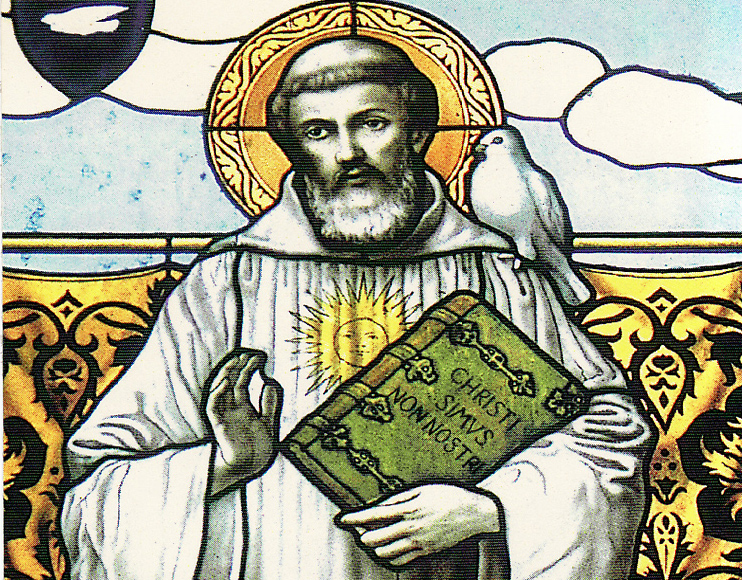
Feast Day: 23 November
Introduction
Saint Columbanus (also known as Saint Columban) was one of the greatest Irish missionaries and monastic founders of the early medieval Church. A man of extraordinary spiritual discipline, courage, learning and missionary zeal, he left his homeland in Ireland and travelled across Europe to proclaim the Gospel, establish monasteries and renew Christian life.
Born in the sixth century, Columbanus became particularly famous for founding the monasteries of Annegray, Luxeuil and Fontaine in present-day France, and the celebrated monastery of Bobbio in northern Italy. His missionary activities contributed significantly to the spread of Irish Christianity throughout continental Europe.
He was not simply a contemplative monk who withdrew from the world. He was a courageous missionary, a spiritual teacher, a prolific writer and a fearless preacher who challenged even kings and powerful leaders when their conduct contradicted Christian morality.
Saint Columbanus reminds us that holiness requires courage, discipline, conversion and an unwavering commitment to the Gospel.
The Roman Catholic Church commemorates him on 23 November.
1. Early Life and Family Background
Saint Columbanus was born around AD 543 in Ireland, traditionally associated with the region of Leinster. His Irish name is often given as Colmán or Columba, while Columbanus is the Latin form by which he became widely known.
He was born during a period when Irish Christianity was flourishing. Ireland had become an important centre of monastic spirituality, biblical learning and missionary activity.
The influence of Saint Patrick and other early Irish missionaries had helped establish Christianity throughout the island. Monasteries became centres of prayer, education, manuscript copying and evangelisation.
From his childhood, Columbanus received a good education. He studied subjects that included grammar, rhetoric, Latin literature and Sacred Scripture.
He was gifted intellectually and possessed a strong desire for knowledge. However, he gradually recognised that worldly education alone could not satisfy the deepest longing of his heart.
He desired to dedicate his entire life to God.
According to the traditional account of his life, Columbanus experienced considerable struggles with worldly temptations. He sought spiritual guidance from a holy woman who encouraged him to leave the distractions of the world and dedicate himself to religious life.
Taking her advice seriously, he decided to embrace monastic life.
2. His Entry into Monastic Life
Columbanus first pursued monastic formation at Cluain Inis (Cleenish Island), under the spiritual guidance of Saint Sinell.
Later, he entered the famous monastery of Bangor in County Down, Ireland, under the leadership of Saint Comgall.
Bangor was one of the most important centres of Irish monasticism during the sixth century. It was renowned for its strict discipline, regular prayer, ascetic practices and intellectual formation.
There Columbanus developed a deep understanding of monastic spirituality.
He devoted himself to prayer, fasting, Scripture, study and manual labour. His life was governed by a strong commitment to obedience and self-discipline.
He eventually became an important teacher within the monastic community.
However, his spiritual ambition extended beyond the boundaries of his homeland. He felt called to carry the Gospel to distant lands where Christianity needed to be strengthened and renewed.
He desired to become a pilgrim for Christ, leaving behind the security of familiar surroundings to serve God wherever he was sent.
3. The Missionary Journey to Continental Europe
Around AD 590 or 591, with the permission of his abbot, Saint Comgall, Columbanus left Ireland accompanied by twelve monks.
This group of missionaries travelled across the sea to continental Europe.
Their journey was an expression of the Irish monastic ideal known as peregrinatio pro Christo — pilgrimage for the love of Christ.
For these monks, leaving their homeland was not simply geographical travel. It was a spiritual sacrifice, an act of detachment from family, property, security and familiar surroundings for the sake of the Gospel.
They travelled through regions of present-day France, where Christianity had already been established but needed renewed spiritual vitality.
Their missionary work was directed towards evangelisation, conversion, monastic renewal and the strengthening of Christian communities.
Columbanus eventually reached the territory of the Burgundian kingdom, where he received permission and support to establish a monastery.
4. The Foundation of the Monastery at Annegray
One of Columbanus’s earliest foundations was at Annegray in the Vosges region of present-day France.
The location was remote and surrounded by forests. It provided an ideal environment for a life of prayer, silence and ascetic discipline.
Columbanus and his companions began their monastic life under difficult conditions.
They cleared the land, constructed simple buildings and organised their community around prayer, work and study.
Their lives were marked by poverty, fasting, silence and obedience.
The monastery gradually attracted men who desired a deeper spiritual life. Some came from Ireland, while others were local inhabitants who had been inspired by the monks’ holiness and discipline.
The growing community soon required a larger establishment.
5. The Foundation of Luxeuil Abbey
Columbanus subsequently established another monastery at Luxeuil, which became his most celebrated foundation in France.
With royal support, he was granted land containing the remains of an ancient Roman settlement. There he established a flourishing monastic community.
Luxeuil became one of the most influential centres of monastic life in western Europe.
The monastery attracted numerous vocations and became renowned for its spiritual discipline, intellectual activity and missionary influence.
Columbanus introduced a rigorous monastic way of life based on prayer, fasting, manual labour, study and obedience.
His monasteries were not merely places of withdrawal from society. They became centres of evangelisation, education, agricultural development and Christian culture.
Monks trained in these communities later established or strengthened other monasteries throughout Europe.
Luxeuil therefore played an important role in the expansion of monastic Christianity during the early Middle Ages.
6. Saint Columbanus and His Monastic Rule
One of the most significant contributions of Saint Columbanus was his monastic rule.
His Regula Monachorum (Rule of the Monks) provided guidance for the spiritual and practical life of monks.
It emphasised several essential virtues:
- Obedience to the superior.
- Poverty and detachment from material possessions.
- Humility in daily life.
- Chastity and purity of heart.
- Silence and recollection.
- Fasting and self-discipline.
- Manual labour.
- Fraternal charity.
- Perseverance in prayer.
Columbanus believed that monastic life required serious commitment. A monk had to discipline his desires, control his words and surrender his personal preferences to the will of God.
He also wrote a penitential, which provided guidance concerning penances for various sins.
His writings reflect the strong ascetic tradition of Irish Christianity, particularly its emphasis on repentance, confession and spiritual accountability.
Although his rule was eventually superseded in many communities by the Rule of Saint Benedict, it played an important role in the development of early medieval monasticism.
7. His Courage in Confronting Kings and Powerful Leaders
Saint Columbanus was not afraid to speak the truth, even when doing so brought him into conflict with powerful people.
During his years at Luxeuil, he became involved in disputes with the royal court of Burgundy.
King Theuderic II had been living an immoral life, and Columbanus strongly criticised the king’s conduct. He particularly objected to the king’s relationships with women outside marriage and the influence of such behaviour on the moral life of the kingdom.
Columbanus believed that Christian leaders had a responsibility to live according to the Gospel. He refused to remain silent simply because the person involved was a king.
His courageous preaching eventually created serious tensions with the royal authorities and certain bishops.
His independence and uncompromising attitude towards moral corruption made him unpopular among influential people.
Eventually, he was arrested and ordered to leave Burgundy.
Even when threatened with expulsion, Columbanus remained firm in his convictions. He believed that the authority of God’s law was greater than the authority of earthly rulers.
His life reminds us of the prophetic responsibility of the Church to proclaim truth and defend Christian morality, regardless of social status or political influence.
8. Exile from France and His Mission in Switzerland
Around AD 610, Columbanus was expelled from Burgundy by royal authorities.
He was taken towards Nantes with the intention of sending him back to Ireland. However, circumstances prevented his immediate return.
Rather than abandoning his missionary vocation, Columbanus continued his journey through continental Europe.
He travelled towards the region of Lake Constance, which lies between present-day Switzerland, Germany and Austria.
There he worked among the Alemanni, a Germanic people who were in need of Christian evangelisation.
He established a missionary community at Bregenz, near Lake Constance.
His missionary activities included preaching, correcting pagan practices and strengthening the Christian faith among the local population.
One of his companions was Saint Gall (Gallus), who later became associated with the famous Abbey of Saint Gall in Switzerland.
According to tradition, Gallus remained behind when Columbanus decided to continue towards Italy because of illness and other circumstances.
The community associated with Saint Gall eventually developed into one of the most important monastic and cultural centres of medieval Europe.
The missionary journey of Columbanus demonstrates how the work of one evangeliser can inspire generations of Christians long after his departure.
9. Missionary Work in Italy
After his missionary activities in the Lake Constance region, Columbanus crossed the Alps and entered northern Italy.
He arrived during a period of religious and political difficulties.
The Lombard kingdom was ruled by King Agilulf, and religious divisions had created tensions within the Church.
Arian Christianity, which denied the full divinity of Jesus Christ, continued to influence certain communities. There was also a serious ecclesiastical dispute connected with the Three Chapters controversy, which had divided parts of the Church in northern Italy.
Columbanus became involved in these theological and ecclesiastical discussions.
He wrote letters to Church authorities, including Pope Boniface IV, expressing his concerns and calling for unity and doctrinal faithfulness.
His correspondence reveals a man deeply concerned about the unity of the Church and the preservation of orthodox Christian teaching.
Although his approach could sometimes be forceful, his commitment to the Catholic faith and ecclesial unity was evident.
10. The Foundation of Bobbio Abbey
Around AD 612–613, King Agilulf granted Columbanus land at Bobbio, in northern Italy, near the River Trebbia.
There he established what would become his final and most famous monastic foundation.
Bobbio was surrounded by mountains and forests, providing an environment suitable for monastic contemplation.
Columbanus restored an old church dedicated to Saint Peter and established a monastery that soon became a major centre of Christian learning and spirituality.
The Abbey of Bobbio eventually became one of the most important monasteries in medieval Italy.
It developed a remarkable library and became famous for its collection of manuscripts.
The monks preserved and copied important religious and classical writings, contributing to the intellectual and spiritual heritage of Europe.
Bobbio’s influence continued long after the death of its founder.
Today, the name of Saint Columbanus remains closely associated with this historic monastery.
11. His Writings and Spiritual Teachings
Saint Columbanus was not only a missionary and monastic founder but also an important Christian writer.
He was among the earliest Irish authors whose substantial Latin writings have survived.
His works provide valuable insight into the spiritual life, theological concerns and monastic discipline of the sixth and seventh centuries.
His principal writings include:
1. The Rule of the Monks (Regula Monachorum)
This work describes the virtues and disciplines expected of those who embrace monastic life. It emphasises obedience, humility, self-denial, prayer and perseverance.
2. The Penitential (Paenitentiale)
This work offers guidance concerning repentance and penance for various sins. It reflects the importance of personal conversion and sacramental reconciliation in the spiritual life of the early Irish Church.
3. His Letters (Epistulae)
His surviving correspondence addresses matters of Church unity, theological disputes, ecclesiastical discipline and the celebration of Easter.
These letters reveal his courage, learning and strong commitment to the Catholic faith.
4. His Sermons (Sermones)
The sermons traditionally associated with Columbanus contain reflections on Christian conversion, humility, prayer, the struggle against sin and the pursuit of holiness.
5. His Poems and Hymns
Several poetic works have been associated with Columbanus, although the authenticity of some is disputed.
His writings demonstrate that he combined a rigorous spiritual life with intellectual ability and a profound knowledge of Scripture.
12. Saint Columbanus and the Unity of the Church
One of the important aspects of Columbanus’s ministry was his concern for the unity of the Church.
During his lifetime, various theological and ecclesiastical disputes threatened Christian communion.
He corresponded with popes and other Church leaders, expressing his views on matters of doctrine and discipline.
He was particularly involved in the controversy concerning the Three Chapters, a complex dispute involving the interpretation of the Council of Chalcedon and the writings of certain theologians.
His correspondence with Pope Boniface IV demonstrates his concern for preserving the unity of the Church while defending what he believed to be the true faith.
Pope Benedict XVI, during his General Audience on 11 June 2008, highlighted Columbanus’s importance in the history of the Church.
The Pope presented him as a courageous missionary and spiritual teacher whose life was marked by asceticism, conversion and detachment from worldly possessions.
His witness continues to remind Christians that the Church must always remain faithful to the Gospel while seeking unity and reconciliation.
13. The Final Days and Death of Saint Columbanus
After establishing the monastery at Bobbio, Columbanus spent his final years in prayer, spiritual direction and monastic leadership.
Although he was advancing in age, his missionary zeal remained strong.
He continued to guide his monks and prepare them for a life of holiness.
According to tradition, he spent some time in a secluded place near the monastery, where he devoted himself to prayer and contemplation.
He died at Bobbio on 23 November AD 615.
His death was deeply mourned by the monastic community.
The monks remembered him as their spiritual father, teacher and founder.
His remains were buried at Bobbio, where his tomb gradually became a place of pilgrimage and veneration.
His successor, Saint Attala, continued the work of the monastery and helped preserve the spiritual legacy of its founder.
The influence of Columbanus extended far beyond his lifetime. His monasteries continued to inspire Christian communities throughout Europe.
14. Veneration and Feast Day of Saint Columbanus
Saint Columbanus is venerated as a saint in the Catholic Church and is particularly honoured in Ireland, France and Italy.
His liturgical commemoration in the Roman Rite is observed on 23 November.
He is remembered as an abbot, missionary and monastic founder.
He is also regarded as one of the great representatives of the Irish missionary movement that helped shape the spiritual and cultural history of medieval Europe.
His influence is especially remembered in:
- Ireland, his homeland.
- France, where he established the monasteries of Annegray and Luxeuil.
- Switzerland, through his missionary work in the Lake Constance region.
- Austria, through his evangelisation at Bregenz.
- Italy, where he founded the celebrated monastery of Bobbio.
His life is an extraordinary example of how faith can transcend geographical boundaries and cultural differences.
15. Spiritual Lessons from the Life of Saint Columbanus
The life of Saint Columbanus offers valuable lessons for Christians, priests, religious and missionaries today.
1. Be Willing to Leave Your Comfort Zone for Christ
Columbanus left Ireland, his homeland, to proclaim the Gospel in distant countries.
He did not know exactly what awaited him. He faced difficult journeys, unfamiliar cultures, political opposition and personal hardships.
Yet he trusted in God’s providence.
His example challenges us to move beyond our comfort zones and respond generously to God’s call.
Sometimes God invites us to serve in places where we may not feel comfortable or where our talents and sacrifices are most needed.
2. Be Faithful to Your Mission
Columbanus faced rejection, expulsion and opposition, but he never abandoned his missionary vocation.
When he was forced to leave Burgundy, he continued his work in Switzerland and Italy.
His life teaches us that difficulties should not necessarily be interpreted as signs that God has abandoned us.
Faithfulness means continuing to serve God even when circumstances become difficult.
3. Speak the Truth with Courage
Columbanus was willing to challenge kings and powerful people when their conduct contradicted Christian morality.
He teaches us that the Gospel cannot be compromised for the sake of popularity, social acceptance or personal security.
Christians are called to defend truth, justice and human dignity with courage and charity.
4. Make Prayer the Foundation of Your Life
Despite his extensive missionary activities, Columbanus remained deeply committed to prayer.
His monasteries were organised around the rhythm of prayer, Scripture, work and contemplation.
His example reminds us that Christian service must always flow from a living relationship with God.
Without prayer, even good works can gradually lose their spiritual purpose.
5. Practise Self-Discipline
Columbanus believed that holiness required discipline.
His monastic rule emphasised fasting, obedience, humility and control over one’s desires.
In our modern world, where distractions are everywhere, his example is particularly relevant.
We need discipline in our prayer life, relationships, use of technology, work and personal responsibilities.
Self-discipline helps us become free to love God and serve others more generously.
6. Work for the Unity of the Church
Columbanus was deeply concerned about doctrinal truth and the unity of the Church.
His correspondence with the popes reveals his desire to preserve the faith and overcome divisions.
His example invites us to avoid unnecessary divisions, pray for Christian unity and remain faithful to the teachings of the Church.
7. Use Knowledge in the Service of God
Columbanus was an educated man who used his intellectual gifts to serve the Church.
His writings, teachings and monasteries contributed to Christian learning.
He reminds us that education should not merely lead to personal success. Knowledge becomes truly valuable when it is used to promote truth, goodness and the dignity of others.
8. Become a Missionary Wherever You Are
Not everyone is called to travel across continents like Columbanus.
However, every Christian is called to share the Gospel.
We can become missionaries in our families, workplaces, parishes, schools and communities.
A life of forgiveness, kindness, honesty and prayer can become a powerful witness to Jesus Christ.
16. The Relevance of Saint Columbanus Today
The life of Saint Columbanus speaks powerfully to the modern Church.
We live in a world marked by rapid social changes, secularisation, materialism, religious indifference and divisions within families and communities.
His example reminds us that genuine Christian renewal begins with personal conversion.
He teaches us that the Church needs people who are deeply rooted in prayer, courageous in proclaiming the Gospel and generous in missionary service.
For priests and religious, his life is a reminder that pastoral ministry requires sacrifice, discipline and fidelity.
For young people, he demonstrates that intellectual gifts, energy and enthusiasm can be placed at the service of God.
For families, he offers an example of detachment from materialism and commitment to spiritual values.
For missionaries, he remains an inspiring model of perseverance and trust in divine providence.
His missionary journey also reminds us that the Gospel belongs to every nation and culture. The Church is called to carry the love of Christ to every corner of the world.
17. Prayer to Saint Columbanus
O glorious Saint Columbanus, courageous missionary and faithful servant of Jesus Christ, we honour you for your extraordinary dedication to the Gospel.
You left your homeland, embraced the hardships of missionary life and travelled across distant lands to proclaim the love of God.
Obtain for us the grace of a strong and unwavering faith. Teach us to trust in God’s providence when we face difficulties, to remain faithful when we encounter opposition and to persevere when the journey becomes challenging.
Pray for all priests, religious, missionaries and those who dedicate their lives to the service of the Church.
Inspire our young people to discover their vocation and generously respond to God’s call.
Help us to overcome selfishness, pride and attachment to worldly possessions. Teach us the importance of prayer, discipline, humility and charity.
Pray especially for the unity of the Church, for the conversion of sinners and for all those who have lost their faith.
May your missionary spirit inspire us to become witnesses of Christ in our families, parishes and communities.
Saint Columbanus, great missionary of Europe and faithful servant of Christ, pray for us.
Amen.
18. Conclusion
Saint Columbanus stands among the great missionary figures of the early Church. From his humble beginnings in Ireland to his missionary foundations in France, Switzerland and Italy, his life was a remarkable journey of faith, sacrifice and evangelisation.
He left behind the security of his homeland because he believed that the Gospel had to be proclaimed wherever people needed to encounter Christ.
His monasteries became centres of prayer, learning, missionary activity and Christian culture. His writings preserved important teachings on monastic discipline, repentance and the spiritual life.
Above all, Columbanus teaches us that holiness demands courage, perseverance and complete dedication to God.
His life reminds us that we are pilgrims on earth, journeying towards our eternal home. Like Columbanus, we are called to leave behind whatever prevents us from following Christ wholeheartedly.
May his example inspire us to become courageous witnesses of the Gospel, faithful servants of the Church and missionaries of God’s love wherever Providence leads us.
Saint Columbanus, pray for us!
References and Further Reading
1. Pope Benedict XVI – General Audience, 11 June 2008: Saint Columban.
2. Dictionary of Irish Biography – Columbanus (Colmán, Columba).
3. The Catholic Encyclopedia – Saint Columbanus.
4. Oxford Classical Dictionary – Michael Lapidge, Columbanus, Abbot of Luxeuil and Bobbio.
5. Jonas of Bobbio – Life of Saint Columbanus and His Disciples (Vita Columbani). An important early biographical source written around the middle of the seventh century.
6. G. S. M. Walker – Sancti Columbani Opera. Dublin Institute for Advanced Studies, 1957.
7. Second Vatican Council – Lumen Gentium, Dogmatic Constitution on the Church.
Historical note: Saint Columbanus’s life is known through his surviving writings and the biography written by Jonas of Bobbio, who gathered information from monks who had known him. Some details of his early life and missionary journeys are based on traditional accounts and remain subjects of historical study.
Saint Columbanus – A beautiful thought for reflection:
We belong to Christ, not to ourselves. Our life, our talents, our possessions and our future must be placed in the hands of God.
Leave a Reply