
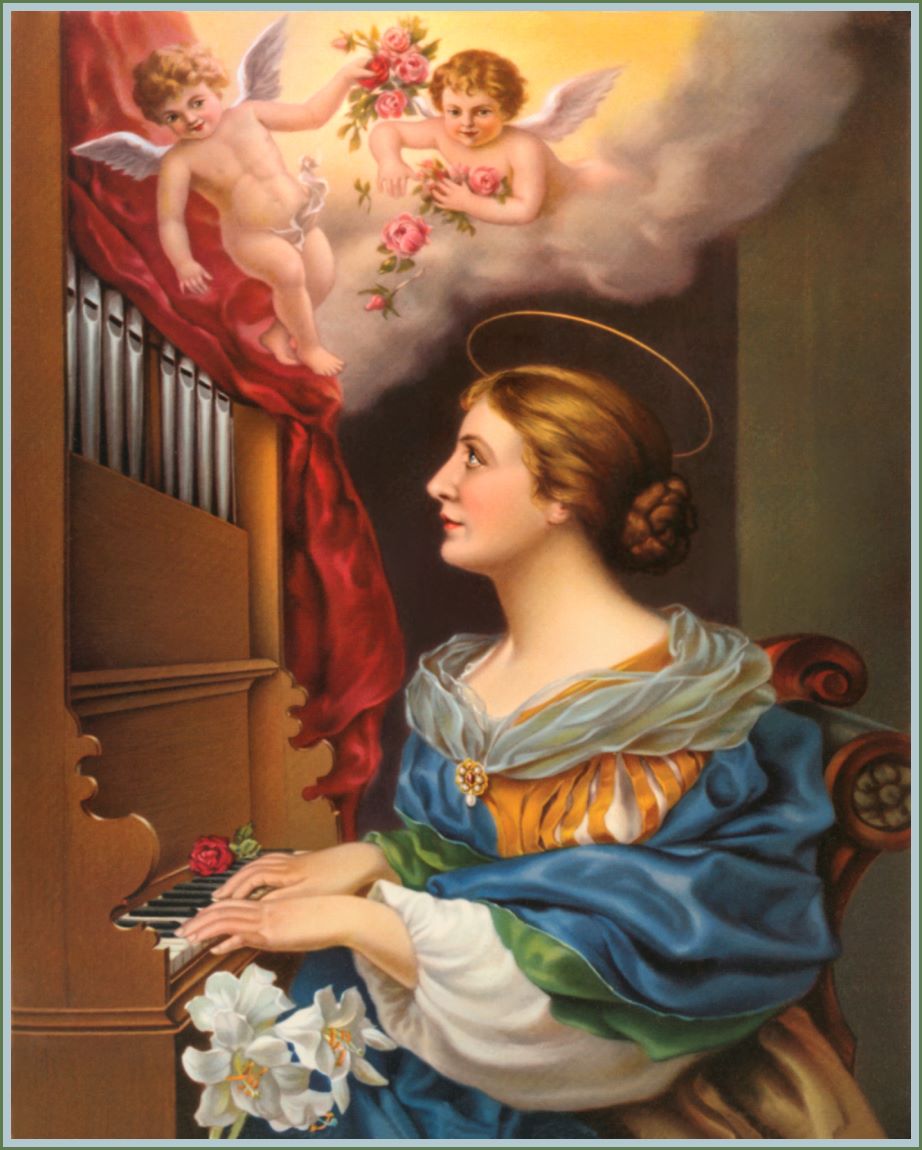
Feast Day: 22 November
Introduction
Saint Cecilia is one of the most beloved and widely venerated martyrs of the Catholic Church. Remembered for her extraordinary faith, purity, courage and devotion to Jesus Christ, she is honoured as the patroness of music, musicians, singers, composers and church choirs. Her feast is celebrated on 22 November.
For centuries, Saint Cecilia has inspired Christians through the beautiful tradition that she sang to God in her heart even while earthly celebrations surrounded her wedding. Her life reminds us that music is not merely an expression of human talent but can become a powerful means of prayer, worship and praise.
Although many details of her life come to us through ancient Christian tradition and later accounts of her martyrdom, her enduring place in the Church’s memory testifies to the profound influence of her witness.
1. Early Life of Saint Cecilia
Saint Cecilia lived in Rome, probably during the third century, when Christians frequently faced persecution under the Roman Empire. According to ancient tradition, she belonged to a wealthy and noble Roman family. She was raised in a Christian household and received a strong formation in the faith.
From her childhood, Cecilia developed a deep love for Jesus Christ. She dedicated her life to God and made a personal commitment to remain a virgin for the sake of the Kingdom of Heaven.
Her devotion was not simply an outward religious practice. She desired to belong entirely to Christ. Even though she lived in a society where wealth, marriage and social status were considered important marks of success, she understood that her greatest treasure was her relationship with God.
Tradition recounts that Cecilia regularly carried the Gospel close to her heart and prayed continually. Her life was centred on prayer, purity and fidelity to Christ.
2. Her Marriage to Valerian
According to the traditional account, Cecilia’s parents arranged her marriage to a young Roman nobleman named Valerian. Although she had already consecrated herself to Christ, she accepted the marriage arrangement while remaining determined to preserve her vow of virginity.
On her wedding day, while music and celebrations filled the surroundings, Cecilia sang silently in her heart to the Lord. The ancient account describes her as singing to God alone, even amid the sounds of the wedding festivities.
This tradition is the principal reason why she became associated with music and musicians.
After the wedding, Cecilia spoke privately with Valerian and explained that she had dedicated her virginity to God. She also told him that an angel of God watched over her.
Valerian was surprised by her words but respected her sincerity. He asked to see the angel. Cecilia explained that he would first have to receive Christian baptism and believe in the one true God.
Valerian agreed and went to meet Pope Urban, who instructed him in the Christian faith and baptised him.
When Valerian returned, according to the traditional account, he saw an angel standing beside Cecilia. The angel placed crowns of roses and lilies upon their heads, symbolising their purity and their dedication to God.
This beautiful story expresses an important Christian truth: authentic love leads people closer to God. Cecilia’s witness helped Valerian discover the Christian faith and embrace a life of holiness.
3. The Conversion of Tiburtius
Valerian had a brother named Tiburtius. When he discovered the transformation that had taken place in his brother’s life, he became curious about the Christian faith.
Cecilia explained the Gospel to him and spoke about Jesus Christ, His death and resurrection, and the promise of eternal life.
Deeply moved by her words and example, Tiburtius also embraced Christianity.
The two brothers became devoted to the service of the Christian community. According to tradition, they helped bury Christians who had been executed during the persecutions.
In the early Church, burying the bodies of martyrs was considered an act of great charity and respect for the dignity of the human person. Christians believed that the bodies of those who had died in Christ would one day share in the resurrection.
Valerian and Tiburtius willingly performed this work, even though they knew that helping persecuted Christians could bring danger upon themselves.
Their charitable activities eventually attracted the attention of Roman authorities.
4. The Martyrdom of Valerian, Tiburtius and Maximus
The Roman authorities eventually arrested Valerian and Tiburtius because of their Christian faith and charitable activities.
They were brought before the prefect, who demanded that they renounce Christianity and offer sacrifices to the Roman gods.
The two brothers courageously refused. They declared that they would rather die than abandon Jesus Christ.
According to the traditional account, they were condemned to death and executed. A Roman official named Maximus, who witnessed their courage and the circumstances surrounding their deaths, was deeply moved. He too embraced Christianity.
Maximus was subsequently arrested and suffered martyrdom for his newly professed faith.
Cecilia received the news of their deaths with profound faith. Rather than being overcome by fear, she continued to proclaim the Gospel and encourage other Christians to remain faithful to Christ.
5. Saint Cecilia’s Courageous Witness
Following the execution of Valerian and Tiburtius, Cecilia was brought before the Roman authorities.
The prefect questioned her about her Christian beliefs and demanded that she abandon Christianity. He also ordered her to offer sacrifices to the pagan gods.
Cecilia firmly refused.
She understood that earthly life was temporary, whereas eternal life with Christ was everlasting. Neither threats nor promises of worldly comfort could persuade her to deny her faith.
Tradition recounts that the authorities attempted to suffocate her in the intense heat of a bath in her own house. However, she survived this attempt.
The prefect then ordered her execution by beheading.
The executioner struck her neck three times with a sword, but he was unable to sever her head completely. According to the ancient account, Cecilia remained alive for three days, during which she continued to encourage the Christians who came to visit her.
She used her final moments to distribute her possessions to the poor and entrusted the Christian community to the care of Pope Urban I.
After three days of suffering, she died peacefully in the Lord.
Although the exact date and circumstances of her martyrdom cannot be established with certainty, the Church has honoured her as a virgin and martyr since ancient times.
6. The Discovery and Veneration of Her Relics
Saint Cecilia’s memory became closely associated with the early Christian community in Rome.
According to historical tradition, her burial place was in the Catacomb of Saint Callixtus along the Appian Way, where several early Christian martyrs and popes were buried.
During the pontificate of Pope Paschal I (817–824), her relics were reportedly discovered and transferred to the Basilica of Saint Cecilia in Trastevere, Rome.
This basilica stands on the site traditionally identified with her family home. It became one of the important centres of devotion to the saint.
Her tomb was opened in 1599 during restoration work at the basilica. According to the testimony of those present, her body appeared remarkably preserved, lying on its side with her head turned and three wounds visible on her neck.
The sculptor Stefano Maderno was inspired by this account and created a famous marble sculpture representing Saint Cecilia in the position in which her body was reportedly discovered.
The sculpture remains one of the most celebrated artistic representations of the saint. It portrays her with her face turned downward and her hands arranged in a symbolic gesture, traditionally interpreted as expressing her faith in the unity of God and the Trinity.
Her relics continue to be venerated in the Basilica of Saint Cecilia in Trastevere.
7. Saint Cecilia: Patroness of Music and Musicians
Saint Cecilia is universally recognised as the patroness of music, musicians, singers, composers, instrumentalists and church choirs.
Her association with music comes primarily from the ancient account of her wedding.
While musical instruments were being played during the wedding celebrations, Cecilia sang silently in her heart to God alone. Her inward song was an expression of her complete dedication to Christ.
The Latin expression associated with this account is Cantantibus organis, Caecilia Domino decantabat in corde suo.
It means that while the instruments were playing, Cecilia sang to the Lord in her heart.
This beautiful tradition gradually connected her name with sacred music. Over the centuries, artists began portraying her with musical instruments, particularly the organ.
Her patronage of musicians became especially prominent during the Renaissance. In 1584, the Academy of Music in Rome was placed under her patronage, further strengthening her association with the musical world.
Today, churches, musical institutions, choirs and musicians throughout the world celebrate her feast.
Why Is Saint Cecilia the Patroness of Music?
Saint Cecilia is not primarily remembered as a musician because she was an accomplished instrumentalist or composer. Rather, her patronage arises from the spiritual meaning of her silent song.
Her life teaches that true music begins in the heart.
A person may sing beautifully with the voice, play an instrument skilfully or compose magnificent melodies. Yet the highest form of music is the praise that rises from a heart united with God.
Saint Cecilia reminds musicians that their talents are gifts from the Creator. Music becomes especially beautiful when it is offered in the service of God and used to inspire faith, hope and love.
8. Saint Cecilia and Sacred Music in the Catholic Church
Music has always occupied an important place in Christian worship. From the earliest centuries, Christians have used hymns, psalms and spiritual songs to express their faith and praise God.
Saint Cecilia represents the spiritual dimension of this musical tradition.
Her example reminds the Church that sacred music should not simply entertain the congregation. It should help people pray, participate in the liturgy and raise their minds and hearts towards God.
The Second Vatican Council, in its Constitution on the Sacred Liturgy, Sacrosanctum Concilium, teaches that sacred music is an important treasure of the universal Church.
It states that sacred music increases the beauty of the liturgy and helps the faithful participate more deeply in divine worship.
Saint Cecilia’s example is particularly meaningful for:
- Choir members who dedicate their voices to the service of the Church.
- Organists and instrumentalists who enrich liturgical celebrations.
- Composers who create hymns and sacred music.
- Music teachers who develop the talents of young people.
- Cantors and choir directors who lead the congregation in prayer.
- Parents who teach their children to praise God through singing.
Her feast is an opportunity to remember all those who use their musical talents to glorify God.
9. The Spiritual Lessons from the Life of Saint Cecilia
The life and martyrdom of Saint Cecilia offer several important lessons for Christians today.
1. Put God Above Everything
Cecilia’s life was centred on her love for Jesus Christ. Even when faced with a marriage arrangement and the expectations of Roman society, she remained faithful to her dedication to God.
Her example reminds us that God must always occupy the first place in our lives.
Our careers, relationships, possessions and achievements are important, but none of them should take the place of our relationship with God.
2. Remain Faithful in Difficult Circumstances
Cecilia did not abandon her faith when confronted with persecution and death.
Her courage teaches us that Christian faithfulness is not measured only by what we profess when life is comfortable. It is also revealed by our willingness to remain faithful during suffering, disappointment and trials.
3. Make Your Heart a Place of Prayer
One of the most beautiful aspects of Cecilia’s story is her silent song to God.
Even when surrounded by worldly celebrations, her heart remained united with the Lord.
We too can pray in the midst of our daily responsibilities. Whether we are working, studying, travelling or caring for our families, we can maintain an inward awareness of God’s presence.
4. Use Your Talents to Glorify God
Cecilia’s association with music reminds us that every talent is a gift from God.
Our abilities should not be used merely for personal recognition or worldly success. They can become instruments of evangelisation, service and love.
A beautiful song offered sincerely to God can touch hearts, strengthen faith and bring consolation to those who suffer.
5. Lead Others Towards Christ
Cecilia’s example helped Valerian and Tiburtius embrace Christianity.
Her life demonstrates the power of personal witness. We do not always need extraordinary words to bring someone closer to God. A life of prayer, kindness, courage and fidelity can itself become a powerful proclamation of the Gospel.
6. Care for the Poor and Vulnerable
According to tradition, Cecilia used her final moments to distribute her possessions to the poor and entrusted the Christian community to the Church.
Her example reminds us that authentic holiness must express itself through charity.
Love for God cannot be separated from love for our brothers and sisters, particularly those who are poor, lonely, sick and forgotten.
7. Look Towards Eternal Life
Cecilia accepted martyrdom rather than renounce Christ.
Her witness reminds us that earthly life is not our final destination. We are created for eternal communion with God.
Christian hope gives us the courage to face suffering and remain faithful to the Gospel.
10. The Basilica of Saint Cecilia in Trastevere
The Basilica of Saint Cecilia in Trastevere is one of the most important places associated with the saint.
Located in the Trastevere neighbourhood of Rome, the church was built over the site traditionally identified as Cecilia’s home.
It preserves her memory and houses her relics beneath the main altar.
The basilica is particularly significant for pilgrims, musicians and devotees who wish to honour the virgin martyr.
The famous sculpture by Stefano Maderno, depicting the saint in the position in which her body was reportedly found, is also preserved there.
For centuries, the basilica has been a place of prayer and pilgrimage, reminding Christians of the courage of the early martyrs.
11. Celebrating the Feast of Saint Cecilia – 22 November
The Catholic Church celebrates the memorial of Saint Cecilia on 22 November.
Her feast is especially important for musicians, choir members, composers, singers and all those involved in sacred music.
On this day, churches and musical communities often organise special Masses, choir performances and musical celebrations in her honour.
It is also an appropriate occasion to pray for:
- All priests and religious who promote sacred music.
- Choir members and church musicians.
- Children and young people learning music.
- Composers of religious hymns and liturgical songs.
- Music teachers and instrumentalists.
- Those who use music to comfort the sick and suffering.
- Those who have lost their ability to sing or enjoy music because of illness or hardship.
The feast of Saint Cecilia invites every Christian to discover the music of the heart: a life of gratitude, prayer, love and praise.
12. Saint Cecilia in Christian Art and Tradition
Saint Cecilia has inspired countless artists, painters, sculptors, poets and composers.
She is traditionally represented with:
- An organ: Symbolising her association with sacred music.
- A palm branch: Representing her martyrdom and victory in Christ.
- Roses and lilies: Symbolising purity, virginity and holiness.
- A sword: Representing the manner of her martyrdom.
- Musical instruments: Expressing her patronage of musicians and singers.
One of the most famous artistic representations of Saint Cecilia is Raphael’s The Ecstasy of Saint Cecilia, painted around 1514–1516. The painting depicts her surrounded by saints, with musical instruments lying broken at her feet and heavenly music symbolised above her.
Her image has become an enduring symbol of the beauty of music offered to God.
13. What Saint Cecilia Teaches Musicians Today
For musicians, Saint Cecilia is much more than a patron saint whose name is celebrated once a year. She is a model of how artistic gifts can become a form of Christian discipleship.
Every singer, instrumentalist and composer can learn from her example.
A musician’s greatest achievement is not necessarily applause, popularity or professional recognition. It is the ability to use music to communicate goodness, beauty, hope and faith.
Church musicians have a particularly important responsibility. Their music helps the faithful enter more deeply into the mystery of the Eucharist and the prayer of the Church.
A choir that sings with devotion can transform a liturgical celebration into a profound experience of communal prayer.
Saint Cecilia reminds us that the most beautiful song is one that comes from a heart filled with love for God.
As we celebrate her feast, may every musician remember that music is a precious gift entrusted to humanity by the Creator.
14. Prayer to Saint Cecilia
O glorious Saint Cecilia, virgin and martyr, faithful servant of Jesus Christ, we honour you as the patroness of music and musicians.
You sang to God in the depths of your heart, even when surrounded by the sounds of the world. Teach us to make our lives a beautiful song of praise to the Lord.
Pray for all singers, musicians, composers, choir members and those who dedicate their talents to sacred music. May they use their gifts not for pride or personal glory, but for the greater glory of God.
Obtain for us the grace to remain faithful to Christ in every circumstance. Help us to be courageous in difficulties, generous towards the poor and steadfast in our Christian faith.
May our hearts always sing with gratitude, our lips proclaim the goodness of God, and our lives reflect the beauty of His love.
Saint Cecilia, glorious martyr and faithful witness of Christ, pray for us.
Amen.
15. Lessons for Our Daily Lives
Saint Cecilia’s life offers a beautiful message for every Christian, whether or not we have musical talents.
We may not all be able to sing or play musical instruments, but each of us can make our life a song of praise to God.
A mother caring for her children, a father working for his family, a student studying diligently, a priest serving his people, a religious living a life of consecration and a person silently enduring suffering can all glorify God through their lives.
The world needs more than beautiful melodies. It needs hearts filled with love, forgiveness, compassion and faith.
Saint Cecilia teaches us that even when the music of the world becomes loud, we must never lose the quiet song of our hearts that belongs to God.
Her martyrdom reminds us that faithfulness to Christ is worth more than every earthly treasure.
May Saint Cecilia inspire us to live beautifully, love generously, pray constantly and remain faithful to Jesus until the end.
May our hearts always sing to the Lord!
References and Further Reading
1. Vatican News – Saint Cecilia, Virgin and Martyr in the Cemetery of Callistus.
2. Vatican City State – 22 November: Saint Cecilia, Virgin and Martyr.
3. The Catholic Encyclopedia – Saint Cecilia.
4. John A. Rice – Saint Cecilia in the Renaissance: The Emergence of a Musical Icon. University of Chicago Press, 2022.
5. Second Vatican Council – Sacrosanctum Concilium, Constitution on the Sacred Liturgy, especially paragraphs 112–121.
6. The Roman Martyrology – Commemoration of Saint Cecilia, Virgin and Martyr, 22 November.
7. The Passio Sanctae Caeciliae – The ancient account of the martyrdom of Saint Cecilia.
Historical note: The Church’s veneration of Saint Cecilia as a virgin and martyr is ancient and well established. However, many details of her biography come from a later hagiographical account, and should be understood as traditional rather than independently verified historical facts.
Leave a Reply