
Introduction
The Solemnity of Our Lord Jesus Christ, King of the Universe, popularly known as the Feast of Christ the King, is one of the most significant celebrations in the liturgical calendar of the Catholic Church. On this day, the Church proclaims Jesus Christ as the supreme King of heaven and earth, the Lord of history, the Redeemer of humanity, and the sovereign ruler of all creation.
This solemnity reminds us that Jesus is not merely a historical figure, a great teacher, or a religious leader. He is the Son of God, the promised Messiah, the King of Kings and Lord of Lords. His kingdom is not founded upon worldly power, political authority, military strength, or material wealth. It is a kingdom of truth, justice, love, peace, mercy, holiness, and eternal life.
The feast invites every Christian to examine his or her relationship with Christ and to ask an important question: Does Jesus truly reign as King in my heart, my family, my relationships, my decisions, and my daily life?
The celebration also brings the liturgical year to its conclusion. As the Church approaches the beginning of a new liturgical year with the First Sunday of Advent, she places before us the final destiny of all creation: everything belongs to Christ, and everything will ultimately find its fulfilment in Him.
1. When Is the Feast of Christ the King Celebrated?
The Solemnity of Our Lord Jesus Christ, King of the Universe, is celebrated on the last Sunday of the liturgical year, immediately before the First Sunday of Advent.
It is therefore a movable solemnity, and its date changes every year.
In the Roman Catholic Church, it is celebrated on the thirty-fourth and final Sunday in Ordinary Time.
The feast concludes the annual liturgical journey of the Church. Throughout the year, Christians celebrate the birth, public ministry, suffering, death, resurrection, ascension, and saving work of Jesus Christ. At the end of this journey, the Church proclaims Him as King of the Universe.
The placement of this solemnity is deeply meaningful. After contemplating the mysteries of Christ’s life and salvation, the faithful are invited to look towards the final coming of Christ in glory, when His kingdom will be fully revealed.
Date in 2026: Sunday, 22 November 2026.
2. The Origin and History of the Feast
The Solemnity of Christ the King was instituted by Pope Pius XI in 1925 through his encyclical Quas Primas, published on 11 December 1925.
The world was experiencing enormous political, social, and spiritual changes following the First World War. Nationalism, secularism, atheistic ideologies, political conflicts, and growing hostility towards Christianity were challenging the place of religion in public life.
Many people were beginning to live as though God had no authority over human society. Political power, economic interests, national ambitions, and human ideologies were increasingly taking the place of moral and spiritual values.
Pope Pius XI recognised the need to remind the world that true peace and authentic social order could not be established without acknowledging the sovereignty of Jesus Christ.
In Quas Primas, the Pope explained that the world would never experience lasting peace unless individuals and nations recognised the kingship of Christ.
He therefore established the Feast of Christ the King to proclaim that Jesus Christ must reign not only in the hearts of individuals but also in families, societies, governments, and nations.
The original date of the feast
When Pope Pius XI instituted the solemnity in 1925, it was assigned to the last Sunday of October, immediately before the Feast of All Saints.
Following the liturgical reforms after the Second Vatican Council, Pope Paul VI revised the celebration in 1969. It was moved to the final Sunday of the liturgical year and given the fuller title:
The Solemnity of Our Lord Jesus Christ, King of the Universe.
This new placement highlighted the universal and eschatological dimension of Christ’s kingship. Jesus is the King who has come into the world, who reigns through His saving work, and who will come again in glory to bring history to its fulfilment.
3. Why Did Pope Pius XI Establish This Feast?
Pope Pius XI established this solemnity for several important reasons.
A. To proclaim the sovereignty of Christ
The Pope wanted the world to understand that Jesus Christ is the true King of humanity. No earthly ruler, government, political ideology, or human institution possesses authority greater than that of God.
Christ’s authority extends over every human person, every nation, every generation, and the entire universe.
B. To oppose secularism and the rejection of God
The early twentieth century witnessed the growth of secularism and ideologies that attempted to exclude God and Christian moral values from public life.
The Pope wanted Christians to recognise that society cannot achieve authentic peace and justice by separating itself completely from God.
C. To promote peace among nations
Pope Pius XI believed that many conflicts originated in pride, greed, selfishness, hatred, and the desire for domination.
He taught that genuine peace would become possible when individuals and nations accepted the teachings of Christ and followed His example of love, justice, forgiveness, and service.
D. To encourage Christians to live under the authority of Christ
The feast was not intended merely to honour Jesus with beautiful prayers and ceremonies. It was meant to transform Christian life.
Every Catholic is called to allow Christ to reign in the heart, conscience, family, workplace, community, and society.
4. The Biblical Foundation of Christ’s Kingship
The kingship of Jesus Christ is deeply rooted in Sacred Scripture. The Bible presents Jesus as the promised Messiah, the Son of David, the Son of God, the King of Israel, and the eternal ruler of the universe.
A. Christ the promised King
2 Samuel 7:12–16
God promises David that his throne and kingdom will be established forever. This covenant prepares the way for the coming of Jesus Christ, the Son of David, whose kingdom will have no end.
Isaiah 9:6–7
The prophet Isaiah announces the coming of a child who will be called Wonderful Counsellor, Mighty God, Everlasting Father, and Prince of Peace. His dominion and peace will have no end.
Daniel 7:13–14
Daniel sees one like a Son of Man coming with the clouds of heaven. He receives dominion, glory, and kingship, and all peoples, nations, and languages serve Him. His dominion is everlasting.
This passage is particularly important for understanding Christ’s universal kingship.
B. Christ is proclaimed King at His birth
Luke 1:32–33
The angel Gabriel announces to Mary that her Son will receive the throne of David and reign over the house of Jacob forever. His kingdom will have no end.
Matthew 2:1–11
The Magi arrive in Jerusalem asking, “Where is the newborn king of the Jews?” They come to worship Him and offer gifts of gold, frankincense, and myrrh.
The gifts are traditionally understood as symbols of Christ’s kingship, divinity, and future suffering.
C. Jesus reveals the nature of His kingdom
John 18:33–37
During His trial before Pontius Pilate, Jesus openly speaks about His kingship.
Pilate asks Him whether He is the King of the Jews. Jesus responds:
“My kingdom does not belong to this world.”
Jesus does not deny that He is King. Rather, He explains that His kingdom does not originate from worldly systems of power.
His kingdom is established through truth, love, sacrifice, and obedience to the Father.
He came into the world to testify to the truth, and everyone who belongs to the truth listens to His voice.
D. Christ’s kingship is revealed on the Cross
Luke 23:35–43
One of the most extraordinary moments in the Gospel is the crucifixion of Jesus.
Above His head, Pilate places an inscription:
“Jesus of Nazareth, the King of the Jews.”
The inscription, intended to identify the condemned man, becomes an unexpected proclamation of His identity.
While the soldiers mock Him, the crowds insult Him, and the religious leaders challenge Him to save Himself, Jesus remains on the Cross.
One of the criminals crucified beside Him recognises His kingship and prays:
“Jesus, remember me when you come into your kingdom.”
Jesus responds with the promise of Paradise.
The good thief recognises what others fail to understand: the crucified Jesus is truly the King.
His throne is the Cross, His crown is made of thorns, and His royal authority is manifested through self-giving love.
E. Christ is the King of the Universe
Colossians 1:15–20
Saint Paul presents one of the most beautiful descriptions of the universal sovereignty of Christ.
Jesus is the image of the invisible God, the firstborn of all creation. Everything in heaven and on earth was created through Him and for Him.
He is before all things, and in Him everything holds together.
This passage reveals that Christ is not simply the King of Christians. He is the Lord of all creation.
Revelation 19:11–16
The Book of Revelation presents Christ as the victorious heavenly King, bearing the title:
“King of kings and Lord of lords.”
His final victory over evil will be complete, and His reign will never end.
5. What Does the Kingship of Jesus Christ Mean?
The kingship of Jesus is different from every form of earthly kingship.
Earthly kings often exercise authority through political power, wealth, armies, influence, and force. Jesus reveals a completely different understanding of kingship.
A. Jesus is the King of Truth
Jesus declares:
“I am the way and the truth and the life.” (John 14:6)
He is not simply a teacher who speaks about truth. He is Truth itself.
His kingdom cannot be built upon lies, corruption, manipulation, dishonesty, or injustice.
When Christ reigns in our hearts, we become people who respect truth, speak honestly, and live with integrity.
B. Jesus is the King of Love
The foundation of Christ’s kingdom is love.
He teaches His disciples to love one another as He has loved them (John 13:34).
His kingship is revealed through compassion for the poor, forgiveness of sinners, healing of the sick, welcoming of children, and concern for the suffering.
Jesus does not rule by making people afraid of Him. He draws people to Himself through love.
C. Jesus is the King of Mercy
Jesus welcomed sinners, forgave those who repented, and offered new beginnings to those who had lost hope.
The story of the Good Thief demonstrates that even at the final moment of life, a sincere heart can turn towards Christ and receive His mercy.
His kingdom is a kingdom of forgiveness and reconciliation.
D. Jesus is the King of Service
At the Last Supper, Jesus washed the feet of His disciples (John 13:1–17).
This was a task normally performed by servants. Yet the Master knelt before His disciples and washed their feet.
He demonstrated that true greatness is found in serving others.
A person who wants to belong to Christ’s kingdom must learn to serve rather than dominate, forgive rather than take revenge, and love rather than seek personal advantage.
E. Jesus is the King of Peace
Christ offers a peace that the world cannot give (John 14:27).
His peace is not simply the absence of conflict. It is the presence of God in the human heart.
When Christ reigns in individuals and families, hatred gives way to forgiveness, anger gives way to patience, and division gives way to reconciliation.
F. Jesus is the King of the Living and the Dead
Christ’s kingship extends beyond earthly existence.
Through His death and resurrection, Jesus has conquered sin and death. He is the Lord of history and the final Judge of humanity.
His kingdom will reach its fullness when He comes again in glory.
6. The Meaning of Christ’s Crown, Throne, and Cross
The traditional images associated with Christ the King contain profound spiritual meanings.
The crown: Jesus is the eternal King. However, His earthly crown was made of thorns. It reminds us that His kingship is inseparable from suffering and sacrifice.
The throne: His throne is the Cross. The Cross, which appeared to be an instrument of defeat, became the instrument of victory over sin and death.
The royal robe: The robe signifies His divine dignity and majesty. Yet the King who wears it humbled Himself and took the form of a servant.
The sceptre: It represents His authority over all creation. His authority is exercised through justice, mercy, truth, and love.
The inscription INRI: These Latin initials stand for Iesus Nazarenus Rex Iudaeorum, meaning “Jesus of Nazareth, King of the Jews.”
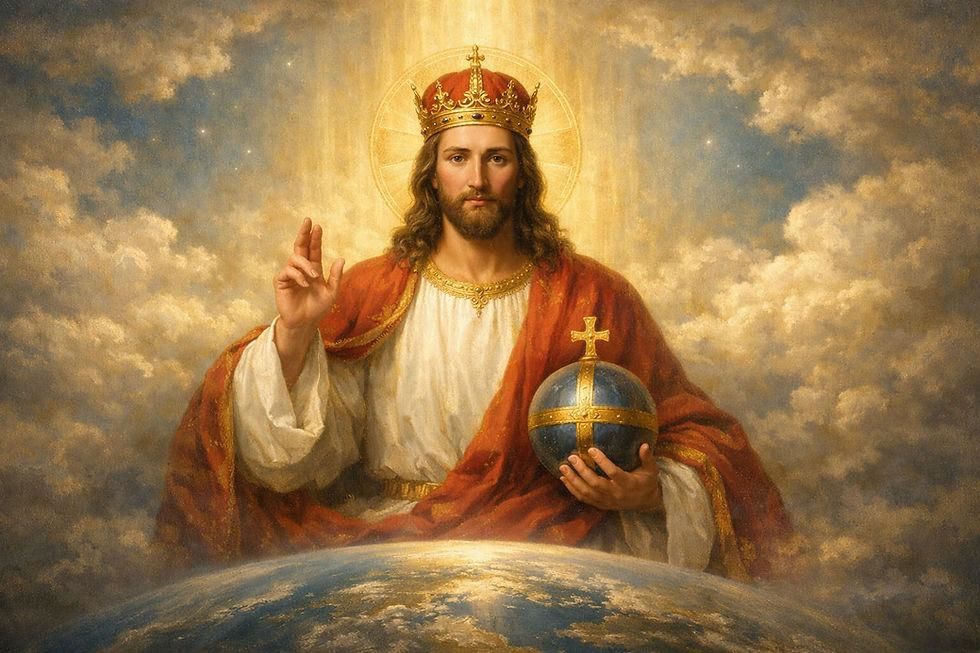
The globe or orb: In Christian art, the globe represents the universe. Christ holds all creation in His sovereign care.
The central message is that the true glory of Christ is revealed not through worldly luxury but through His sacrificial love.
7. The Three Dimensions of Christ’s Kingship
Catholic theology traditionally explains Christ’s saving work through three offices: Prophet, Priest, and King.
A. Christ the Prophet
As Prophet, Jesus reveals the truth of God and announces the Good News of salvation.
He teaches the way of the Kingdom and calls humanity to repentance and faith.
B. Christ the Priest
As High Priest, Jesus offers Himself to the Father for the salvation of humanity.
His sacrifice on Calvary is made sacramentally present in the Eucharist.
He is the mediator between God and humanity.
C. Christ the King
As King, Jesus guides, protects, and governs His people.
He establishes a kingdom of justice, holiness, love, and peace.
These three offices are inseparable. Christ teaches us the truth, saves us through His sacrifice, and leads us towards eternal life.
8. The Kingdom of God: Already Present, Yet Awaiting Fulfilment
One of the most important theological aspects of this solemnity is the relationship between the present kingdom of God and its future fulfilment.
Jesus inaugurated the Kingdom through His incarnation, preaching, miracles, death, and resurrection.
The Kingdom is already present wherever people accept God’s will, live according to the Gospel, practise charity, work for justice, forgive one another, and welcome the presence of God.
However, the Kingdom has not yet reached its complete fulfilment.
Sin, suffering, injustice, death, and evil continue to affect human life. Christians therefore pray:
“Your kingdom come, your will be done, on earth as it is in heaven.” (Matthew 6:10)
This prayer expresses both hope and responsibility.
We look forward to the final coming of Christ, but we are also called to make the values of His Kingdom visible in the world today.
9. Christ the King and the Last Judgement
The Gospel of the Solemnity of Christ the King in Year A is Matthew 25:31–46, the parable of the Last Judgement.
Jesus describes the Son of Man coming in glory, accompanied by angels, and sitting upon His glorious throne.
All nations will be gathered before Him. He will separate people as a shepherd separates sheep from goats.
The King will welcome those on His right:
“Come, you that are blessed by my Father, inherit the kingdom prepared for you from the foundation of the world.”
Why are they welcomed?
Because they fed the hungry, gave drink to the thirsty, welcomed strangers, clothed the naked, cared for the sick, and visited prisoners.
The righteous are surprised and ask when they performed these acts for the King.
Jesus gives one of the most important teachings of the Gospel:
“Truly I tell you, just as you did it to one of the least of these who are members of my family, you did it to me.” (Matthew 25:40)
This passage reveals the practical meaning of Christ’s kingship.
Jesus identifies Himself with the poor, the hungry, the sick, the imprisoned, the stranger, and the suffering.
The surprising face of the King
The King whom we worship in the Eucharist is the same King whom we encounter in the suffering members of humanity.
We cannot genuinely honour Christ in the sanctuary while deliberately ignoring Him in the poor.
We cannot celebrate Christ the King while humiliating our workers, neglecting elderly parents, refusing to forgive family members, or showing indifference to those who suffer.
The Gospel teaches that our love for Christ must become visible through our love for our neighbours.
This is why the Solemnity of Christ the King is also a powerful reminder of Christian charity and social responsibility.
10. The Three-Year Liturgical Cycle: Readings for Christ the King
The Church follows a three-year cycle of Sunday readings: Year A, Year B, and Year C. Each year presents a different dimension of Christ’s kingship.
Year A – Christ the King and the Last Judgement
2026, 2029, 2032
- First Reading: Ezekiel 34:11–12, 15–17
- Responsorial Psalm: Psalm 23
- Second Reading: 1 Corinthians 15:20–26, 28
- Gospel: Matthew 25:31–46
Central message: Christ is the Good Shepherd and the universal Judge. He identifies Himself with the poor and the suffering. Our final judgement will reveal the authenticity of our love.
Year B – Christ the King of Truth
2024, 2027, 2030
- First Reading: Daniel 7:13–14
- Responsorial Psalm: Psalm 93
- Second Reading: Revelation 1:5–8
- Gospel: John 18:33–37
Central message: Jesus stands before Pilate and reveals that His kingdom does not belong to this world. He is the eternal King who came to testify to the truth.
Year C – Christ the King of the Universe
2025, 2028, 2031
- First Reading: 2 Samuel 5:1–3
- Responsorial Psalm: Psalm 122
- Second Reading: Colossians 1:12–20
- Gospel: Luke 23:35–43
Central message: Jesus is the King of all creation. His kingship is revealed on the Cross, and He promises Paradise to the repentant criminal.
The three cycles offer complementary perspectives: Christ the Judge, Christ the King of Truth, and Christ the Universal King. Section 3+2
The special message of the 2026 celebration
On 22 November 2026, the Church celebrates the solemnity according to Year A.
The readings invite us to contemplate Jesus as the Good Shepherd who searches for the lost, the risen Lord who conquers death, and the King who judges humanity according to love.
The first reading from Ezekiel 34 speaks of God searching for His scattered sheep, bringing back the strayed, binding up the injured, and healing the sick.
Psalm 23 presents the Lord as the Good Shepherd.
Saint Paul reminds us that Christ has conquered death and will bring all things under His authority.
The Gospel of Matthew 25 places before us the Last Judgement and the importance of loving Christ in the least of our brothers and sisters. USCCB+1
11. The Liturgy of the Solemnity
The Church celebrates this day with the dignity and solemnity appropriate to a feast of the Lord.
Liturgical rank
It is a Solemnity, the highest rank of liturgical celebration.
It is celebrated with:
- The Gloria.
- The Creed.
- Proper readings for the solemnity.
- The solemnity’s proper prayers and preface.
- White or gold liturgical vestments.
- Solemn singing and appropriate ceremonial expressions.
Liturgical colour
The liturgical colour is white, symbolising the glory, purity, holiness, and triumph of Christ.
Gold may also be used where permitted by liturgical custom.
The Preface of Christ the King
The Roman Missal provides a special preface for this solemnity, known as the Preface of Christ, King of the Universe.
It beautifully summarises the nature of His kingdom:
- A kingdom of truth and life.
- A kingdom of holiness and grace.
- A kingdom of justice, love, and peace.
The preface proclaims that Christ offered Himself on the altar of the Cross as a spotless sacrifice to bring humanity peace and accomplish the mystery of redemption.
These six characteristics are among the most beautiful expressions of the meaning of this solemnity.
The Eucharist and the kingship of Christ
The Eucharist is particularly meaningful on this day.
The King of the Universe becomes present under the humble appearances of bread and wine. The One before whom every knee shall bow gives Himself as food for His people.
At the Eucharistic celebration, the faithful encounter Christ, the eternal King, who reigns through His self-giving love.
12. The Relationship Between Christ the King and the Eucharist
The Solemnity of Christ the King has a profound connection with Eucharistic devotion.
Jesus is the King who gives Himself completely to humanity.
At the Last Supper, He instituted the Eucharist and gave His Body and Blood for the salvation of the world.
On Calvary, He offered Himself as the perfect sacrifice. In the Eucharist, this one sacrifice is made present sacramentally.
The Eucharistic Lord is not a distant King who rules from an inaccessible palace. He is Emmanuel, God with us, who remains with His people.
The celebration of Christ the King therefore offers an opportunity for:
- Eucharistic adoration.
- Solemn Benediction.
- Eucharistic processions, where pastorally appropriate.
- Renewal of personal and family consecration to Christ.
- Reconciliation and renewed commitment to Christian living.
The Eucharistic King invites us to become people who offer themselves in love and service.
13. The Enthronement of the Sacred Heart of Jesus in Families
One traditional way of expressing Christ’s kingship is through the enthronement of the Sacred Heart of Jesus in the home.
The Sacred Heart represents the personal love of Jesus for humanity. Enthroning an image of the Sacred Heart in a home is a public and family expression of the desire to place Christ at the centre of family life.
This practice is closely connected with the devotion encouraged by Pope Pius XI in Quas Primas, which refers to the consecration of families and societies to the Sacred Heart.
Families may celebrate the day by:
- Placing an image of the Sacred Heart of Jesus in a prominent place.
- Gathering together for family prayer.
- Reading a passage from the Gospel.
- Renewing their consecration to the Sacred Heart.
- Asking forgiveness and reconciling with one another.
- Praying for the sick, the poor, and those experiencing difficulties.
- Making a practical commitment to help someone in need.
The most important enthronement is not simply placing an image on a wall. It is allowing Jesus to occupy the central place in the life of the family.
14. The Consecration of the Human Race to Christ the King
An important traditional devotion associated with this solemnity is the Act of Dedication of the Human Race to Jesus Christ the King, also known as the Act of Consecration to Christ the King.
Pope Pius XI originally directed that this dedication be renewed annually on the feast he instituted.
The prayer expresses the desire that individuals, families, societies, and nations recognise the sovereignty of Christ.
It acknowledges Jesus as Lord and Redeemer and asks Him to reign over human hearts and the entire world.
The traditional prayer begins:
“Most sweet Jesus, Redeemer of the human race, look down upon us humbly prostrate before Thy altar.”
The prayer asks Christ to reign in the hearts of individuals, in families, and throughout society.
It also asks that those who have wandered away from Him may return to His loving embrace.
This devotion remains a meaningful way for Catholics to renew their commitment to Christ’s kingship.
15. How Can We Make Jesus the King of Our Lives?
The Solemnity of Christ the King is not simply an invitation to honour Jesus with words. It is a call to surrender our lives to Him.
A. Make Jesus the King of your heart
Allow Jesus to govern your thoughts, desires, emotions, and decisions.
Do not allow hatred, jealousy, pride, greed, resentment, or selfishness to become the rulers of your heart.
B. Make Jesus the King of your family
A Christian family should be a place where the love of Christ is experienced.
Pray together, forgive one another, respect each other, and support the members of the family who are struggling.
C. Make Jesus the King of your relationships
Allow the teachings of Christ to influence the way you speak and behave towards others.
Be patient with difficult people, forgive those who hurt you, and avoid words that destroy the dignity of others.
D. Make Jesus the King of your workplace
Honesty, justice, responsibility, and respect should characterise the life of a Christian.
Do not sacrifice your conscience for money, position, popularity, or personal advantage.
E. Make Jesus the King of your suffering
When illness, disappointment, failure, or uncertainty enters your life, do not abandon your faith.
The Cross teaches us that suffering does not have the final word. Christ, who passed through suffering and death, leads us towards resurrection.
F. Make Jesus the King of your priorities
Give God the first place in your life.
Do not allow wealth, career, entertainment, social status, or material possessions to become more important than your relationship with God.
G. Make Jesus the King of your service
Recognise Christ in the poor, the lonely, the sick, the elderly, and those who are forgotten by society.
A Christian who truly honours Christ the King must become a person of compassion.
16. How Is the Feast Celebrated in Catholic Parishes?
Catholic communities around the world celebrate this solemnity through liturgical and devotional activities.
Some common practices include:
- Solemn celebration of the Holy Mass.
- Special homilies on the kingship of Christ.
- Eucharistic adoration and Benediction.
- Renewal of the consecration of families to the Sacred Heart of Jesus.
- Recitation of the Act of Consecration to Christ the King.
- Eucharistic processions, where customary.
- Special prayers for peace among nations and for world leaders.
- Charitable activities for the poor and the marginalised.
- Family prayer and reflection on the Gospel.
- Renewal of baptismal promises and commitment to Christian discipleship, where appropriate.
In many parishes, the day is also an occasion to organise Eucharistic celebrations, prayer gatherings, and charitable initiatives.
A special invitation to Catholic families
Families can make this solemnity a meaningful spiritual celebration by gathering around the family altar, reading Matthew 25:31–46, praying the Lord’s Prayer, and renewing their commitment to follow Jesus.
Children can be encouraged to understand that Jesus is their King because He loves them, protects them, forgives them, and teaches them to love others.
The family can conclude the celebration by deciding to perform an act of kindness for someone in need.
17. Christ the King in the Life of the Catholic Church
The Solemnity of Christ the King has a message that extends beyond individual spirituality.
It reminds the Church of her mission in the world.
The Church must proclaim Christ
The Church exists to announce Jesus Christ and make His saving presence known to all people.
She must never replace the Gospel with worldly ambitions, political interests, or the pursuit of power.
Christians must defend human dignity
If Christ is King, every human person possesses dignity because every person is created in the image and likeness of God.
The poor, the weak, the unborn, the elderly, the sick, refugees, and those who are rejected by society deserve respect and protection.
Christians must work for justice and peace
Christians are called to contribute to a society built on truth, justice, compassion, reconciliation, and respect for human life.
Religious freedom and the public witness of faith
The celebration also reminds Catholics that faith should not be confined merely to private feelings. Christians have the right and responsibility to bear witness to the Gospel in public life, while respecting the dignity and religious freedom of others.
The Church must proclaim Christ through faithful witness, loving service, and the truth of the Gospel.
18. The Feast of Christ the King and the End of the Liturgical Year
The placement of this solemnity at the end of the liturgical year is particularly significant.
The liturgical year begins with Advent, when the Church prepares to celebrate the first coming of Jesus Christ at Christmas and looks forward to His second coming in glory.
Throughout the year, we accompany Jesus through His birth, ministry, miracles, teachings, suffering, death, resurrection, and ascension.
At the end of this journey, the Church celebrates Him as King of the Universe.
It is a proclamation that the entire history of salvation finds its fulfilment in Christ.
The feast also directs our attention towards the end of human history, when Christ will return in glory, evil will be defeated, the dead will be raised, and God’s kingdom will be fully revealed.
The next Sunday begins Advent, and the Church starts the liturgical journey once again.
Thus, Christ the King is both a conclusion and a new beginning.
It reminds us that our lives are moving towards an eternal destiny: communion with God in His everlasting Kingdom.
19. Important Bible Verses for the Solemnity of Christ the King
The following passages are especially appropriate for personal meditation, parish prayer, and homily preparation.
| Bible reference | Central message |
|---|---|
| Psalm 24:7–10 | The Lord is the King of glory |
| Isaiah 9:6–7 | The promised King and Prince of Peace |
| Daniel 7:13–14 | The everlasting dominion of the Son of Man |
| Luke 1:32–33 | His kingdom will have no end |
| Matthew 2:1–11 | The Magi worship the newborn King |
| Matthew 6:10 | Your kingdom come |
| Matthew 25:31–46 | The King and the Last Judgement |
| John 14:6 | Christ is the Way, Truth, and Life |
| John 18:33–37 | Jesus before Pilate |
| Colossians 1:15–20 | Christ, the King of all creation |
| Philippians 2:5–11 | Every knee shall bow before Jesus |
| Revelation 1:5–8 | Jesus, ruler of the kings of the earth |
| Revelation 19:11–16 | King of kings and Lord of lords |
| Revelation 22:12–13 | Christ, the Alpha and the Omega |
20. A Beautiful Spiritual Reflection: Who Is Sitting on the Throne of Your Heart?
The Solemnity of Christ the King invites us to examine our personal relationship with Jesus.
Every human heart has a throne. Something or someone occupies the central place in our lives.
For some people, it is money. For others, it is career, ambition, popularity, pleasure, power, or personal pride.
Sometimes even fear, anger, jealousy, and unforgiveness become rulers of the human heart.
We may attend Holy Mass every Sunday, receive the Eucharist, pray the Rosary, and participate in religious activities. Yet we must honestly ask ourselves whether Jesus truly governs our daily decisions.
It is easy to proclaim Jesus as King in the church. It is more difficult to recognise Him as King when we are asked to forgive someone who has hurt us, help someone who cannot repay us, speak the truth when it is inconvenient, or sacrifice our comfort for another person.
Consider the image of Jesus standing before Pilate.
Pilate represents worldly power. Jesus appears powerless, humiliated, and condemned. Yet the apparent weakness of Jesus reveals the greatest power of all: the power of sacrificial love.
The world often measures greatness through the ability to control others. Jesus measures greatness through the willingness to serve others.
The world considers forgiveness a weakness. Jesus reveals forgiveness as divine strength.
The world seeks victory through domination. Jesus conquers through love.
The world fears death. Jesus transforms death into the doorway to resurrection.
Therefore, celebrating Christ the King means allowing His way of life to become our way of life.
Let us ask ourselves:
- Is Jesus the King of my thoughts and words?
- Is He the King of my family?
- Is He the King of my marriage and relationships?
- Is He the King of my money and possessions?
- Is He the King of my decisions?
- Is He the King of my suffering and difficulties?
- Do I recognise Him in the poor and the suffering?
- Am I preparing myself to stand before Him at the final judgement?
The most beautiful gift we can offer Christ on this solemnity is not merely a ceremony, a candle, or a beautiful hymn. It is a heart that genuinely belongs to Him.
Let us surrender our lives to Jesus and pray:
Jesus Christ, King of the Universe, reign in my heart, reign in my family, reign in my home, reign in my work, reign in my joys and sorrows. May Your kingdom of truth, justice, love, holiness, and peace become visible in my life.
21. Prayer to Christ the King
O Lord Jesus Christ, King of the Universe, we adore You and acknowledge You as the Lord of our lives.
You are the King of kings and the Lord of lords. Your kingdom has no end, and Your love has no limits.
Reign in our hearts and remove everything that separates us from You. Free us from pride, selfishness, hatred, jealousy, fear, and sin.
Reign in our families. Bless our parents, children, spouses, and loved ones. Heal broken relationships, restore peace in troubled homes, and strengthen families experiencing difficulties.
Reign in our Church. Bless the Holy Father, bishops, priests, religious, and all the faithful. May we become courageous witnesses of Your Gospel.
Reign in our nations and among all peoples. Bring peace where there is war, justice where there is oppression, hope where there is despair, and reconciliation where there is hatred.
Remember the poor, the sick, the lonely, the abandoned, and all those who suffer. May we recognise Your presence in them and serve them with love.
Lord Jesus, when we face difficulties, remain our strength. When we fall into sin, lift us through Your mercy. When we lose hope, remind us of Your promises.
May Your kingdom of truth, life, holiness, grace, justice, love, and peace reign throughout the world.
May we one day share in Your eternal Kingdom, where You live and reign forever and ever.
Amen.
22. Short Prayer of Consecration to Christ the King
Lord Jesus Christ, my King and my Saviour, I surrender my life to You.
Be the King of my heart, my thoughts, my words, my family, and my future.
Rule over my decisions and guide my steps. Take away everything that does not belong to You.
May I always live according to Your Gospel and recognise Your presence in every person I meet.
Jesus, be the centre of my life, the strength of my soul, and the hope of my future.
May Your Kingdom come, and may Your will be done in my life.
Jesus Christ, King of the Universe, reign in me forever. Amen.
23. Hymns and Catholic Devotions Associated with Christ the King
Some traditional hymns and prayers are especially appropriate for this solemnity.
Traditional Latin hymns:
- Christus Vincit – Christ Conquers.
- Te Deum – A hymn of thanksgiving and praise.
- Adoro Te Devote – A Eucharistic hymn by Saint Thomas Aquinas.
- Lauda Sion – A hymn in honour of the Most Holy Eucharist.
Popular English hymns:
- To Jesus Christ, Our Sovereign King.
- Crown Him with Many Crowns.
- Rejoice, the Lord Is King.
- Jesus Shall Reign Where’er the Sun.
- The King of Love My Shepherd Is.
These hymns highlight Christ’s sovereignty, victory, love, and eternal reign.
24. Frequently Asked Questions About Christ the King
1. Who instituted the Feast of Christ the King?
Pope Pius XI instituted the feast in 1925 through his encyclical Quas Primas.
2. Why is the Feast of Christ the King celebrated on the last Sunday of the liturgical year?
It concludes the liturgical year by proclaiming Jesus as the King of the Universe and the fulfilment of human history. It also directs our attention towards His second coming.
3. What is the official name of the feast?
The official name in the Roman Rite is the Solemnity of Our Lord Jesus Christ, King of the Universe.
4. Why was the feast moved from October to November?
Originally, it was celebrated on the last Sunday of October. Following the liturgical reform of 1969, it was moved to the final Sunday of the liturgical year to emphasise Christ’s universal kingship and His final victory at the end of history.
5. What is the liturgical colour for Christ the King?
White, symbolising Christ’s glory, holiness, and triumph. Gold may also be used.
6. Is Christ the King a solemnity or an ordinary feast?
It is a solemnity, the highest category of liturgical celebration.
7. What does Jesus mean when He says, “My kingdom does not belong to this world”?
He does not mean that His kingdom has nothing to do with earthly life. He means that His kingdom does not originate from worldly systems of power, violence, and domination. It is founded upon truth, love, justice, and God’s saving power.
8. What is the significance of the Cross in the Feast of Christ the King?
The Cross is the throne of Christ. Jesus reveals His kingship through self-sacrifice, forgiveness, obedience, and love. His apparent defeat becomes His victory over sin and death.
9. What is the connection between Christ the King and the Sacred Heart of Jesus?
The Sacred Heart reveals Christ’s personal and unconditional love. Consecrating ourselves and our families to His Sacred Heart is a traditional way of acknowledging His loving kingship over our lives.
10. What is the main message of the Feast of Christ the King?
Jesus Christ must reign in our hearts and lives. We are called to build His kingdom through love, forgiveness, justice, holiness, mercy, and service.
11. Is the Feast of Christ the King a Holy Day of Obligation?
It falls on a Sunday, which is already a day on which Catholics are ordinarily obliged to participate in Mass. The solemnity does not create an additional separate Holy Day of Obligation.
12. When is Christ the King Sunday in 2026?
It is celebrated on Sunday, 22 November 2026.
Conclusion: Let Christ Reign Forever!
The Solemnity of Our Lord Jesus Christ, King of the Universe, is a powerful proclamation of faith and hope.
It reminds us that earthly kingdoms rise and fall, governments change, wealth disappears, and human power is temporary. But the Kingdom of Christ is eternal.
Jesus is the King who came not to be served but to serve. He is the King who washed the feet of His disciples, welcomed sinners, healed the sick, forgave His enemies, and gave His life on the Cross.
His crown was made of thorns, His throne was the Cross, and His victory was love.
As we celebrate this solemnity, let us not be satisfied with merely calling Jesus our King. Let us allow Him to reign in every aspect of our lives.
May our homes become places of peace, our families become schools of love, our parishes become communities of service, and our societies become reflections of God’s Kingdom.
Let us proclaim with faith and joy:
Christ conquers! Christ reigns! Christ rules forever!
Vivat Christus Rex! Long live Christ the King!
References and Further Reading
Official Church documents
- Pope Pius XI, Quas Primas (1925), Encyclical on the Feast of the Kingship of Our Lord Jesus Christ. Read the complete encyclical at the Vatican website.
- Catechism of the Catholic Church, paragraphs 440–451: Christ the Son of God; 668–682: Christ’s reign and glorious return; 678–679: Christ the Judge; 2816–2821: Thy Kingdom Come.
- Second Vatican Council, Lumen Gentium, especially paragraphs 5 and 36, on the Kingdom of God and the participation of the faithful in Christ’s kingly mission.
- General Instruction of the Roman Missal, concerning the liturgical celebration of solemnities.
- Roman Missal, Preface of Our Lord Jesus Christ, King of the Universe.
Biblical references
- Daniel 7:13–14
- Luke 1:32–33
- John 18:33–37
- Matthew 25:31–46
- Luke 23:35–43
- Colossians 1:15–20
- Philippians 2:5–11
- Revelation 19:11–16
Further reading
- United States Conference of Catholic Bishops – Christ the King.
- Vatican – Homiletic Directory.
- Catholic Mass Readings – Christ the King, 2026.
- USCCB – Christ the King Lectionary Guide.
Article prepared for Catholic devotional and educational publication. Scripture references and liturgical explanations are based on Catholic Church teaching and the Roman Rite.
Leave a Reply