
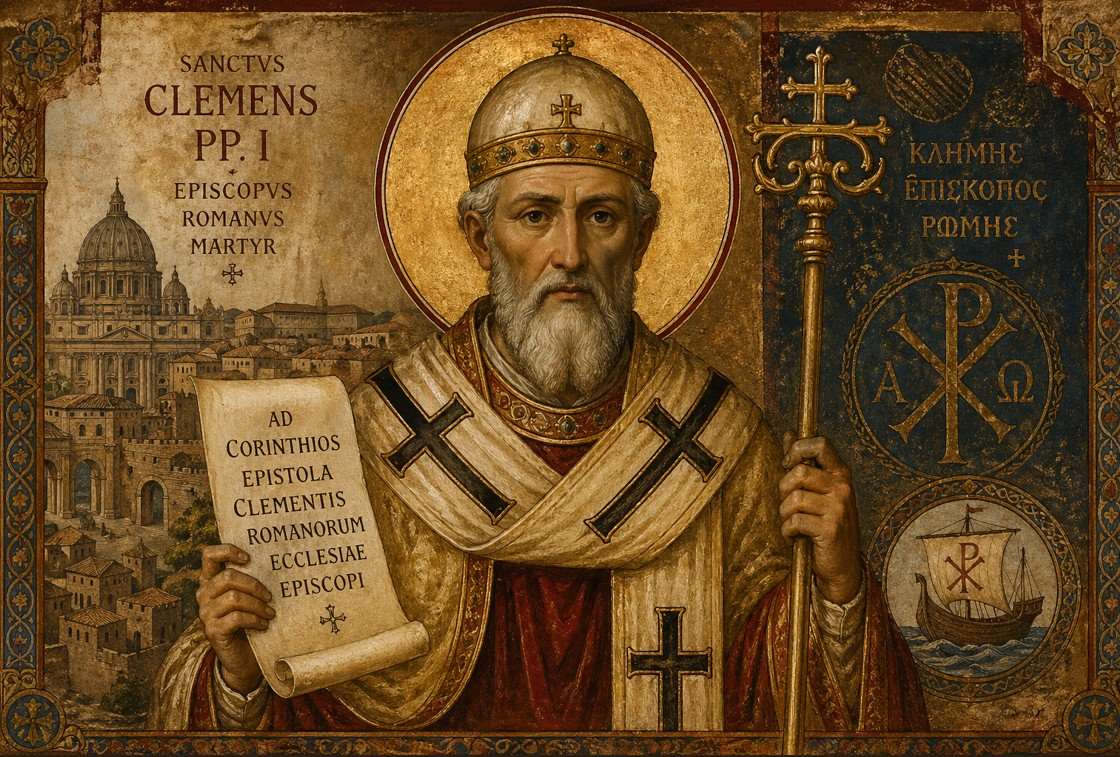
Feast Day: 23 November
Saint Clement I, also known as Pope Clement I, was one of the earliest successors of Saint Peter and is traditionally regarded as the fourth Pope of the Catholic Church. He belonged to the generation of Christians who lived close to the time of the Apostles and played an important role in preserving the unity, faith, and apostolic traditions of the early Church.
Remembered as a courageous shepherd, wise teacher, and faithful witness to Christ, Saint Clement is particularly associated with his famous Letter to the Corinthians, one of the earliest surviving Christian writings outside the New Testament. His life reminds us that the Church is built upon apostolic faith, humble service, and steadfast fidelity to Jesus Christ.
1. Early Life and Background
Very little is known with certainty about the early life of Saint Clement. He lived during the first century, when Christianity was still a young and often persecuted faith.
According to early Christian tradition, Clement was closely connected with the Apostles and may have known Saint Peter and Saint Paul. Saint Paul mentions a fellow worker named Clement in his Letter to the Philippians:
“Yes, and I ask you also, my loyal companion, help these women, for they have struggled beside me in the work of the gospel, together with Clement and the rest of my co-workers, whose names are in the book of life.” (Philippians 4:3)
Some ancient traditions identify this Clement with Pope Clement I, although the identification cannot be established with certainty.
His closeness to the apostolic generation gave him a special place in the memory of the early Church.
2. Pope of the Early Church
Saint Clement I is traditionally counted as the fourth Pope, following Saint Peter, Saint Linus, and Saint Anacletus (Cletus). His pontificate is generally dated to approximately AD 88–99, although ancient sources differ regarding the precise chronology.
He served as Bishop of Rome at a time when Christian communities were growing throughout the Roman Empire. The Church was still establishing its structures of leadership, worship, discipline, and teaching.
Clement understood that the unity of the Church was essential to its mission. He encouraged Christians to remain faithful to the teachings received from the Apostles and to respect the responsibilities of those entrusted with spiritual leadership.
His pastoral concern extended beyond Rome, demonstrating that the early Bishop of Rome was already exercising an important ministry of communion among Christian communities.
3. The Letter to the Corinthians
One of the greatest contributions of Saint Clement to Christian history is his letter to the Church of Corinth, commonly known as First Clement.
The letter was written around the end of the first century, traditionally dated approximately AD 96. It is addressed to the Christians of Corinth, where serious divisions had arisen within the community.
Some members had rebelled against their legitimate presbyters, creating confusion and disturbing the peace of the Church.
Clement wrote with fatherly concern, urging the Corinthians to abandon jealousy, pride, rivalry, and division. He reminded them of the virtues of humility, obedience, charity, and mutual forgiveness.
He referred to the examples of Abraham, Moses, David, and other biblical figures, showing how faithfulness and humility are essential qualities of God’s people.
The letter also contains an important reflection on apostolic succession. Clement explains that the Apostles appointed leaders in the Christian communities and made provision for their successors so that the ministry entrusted to them would continue.
This teaching became an important witness to the Church’s understanding of apostolic continuity and ecclesiastical authority.
First Clement is particularly valuable because it provides a glimpse into the beliefs, organization, and spiritual life of Christians at the end of the first century.
4. His Teaching on Church Unity and Apostolic Succession
Saint Clement’s letter is particularly significant because it demonstrates how seriously the early Christians regarded the unity of the Church.
He taught that divisions, jealousy, and personal ambition could destroy the spiritual life of a Christian community. He encouraged believers to imitate Christ, who humbled Himself and served others.
Clement also emphasized that Church leadership was not simply a matter of personal ambition. It was a sacred ministry received through the apostolic tradition.
He reminded the Corinthians that those entrusted with pastoral responsibility should serve faithfully, while the faithful should maintain respect, peace, and communion.
His teaching provides an important historical witness to the development of the Catholic understanding of apostolic succession and the ministry of the Church.
5. His Teaching on Humility and Charity
One of the most beautiful themes in the writings of Saint Clement is Christian humility.
He repeatedly encouraged believers to avoid pride, envy, anger, and selfish ambition. He presented Jesus Christ as the perfect example of humility and obedience.
For Clement, genuine Christian greatness was not measured by authority, wealth, or social position but by love, service, and faithfulness to God.
He also emphasized the importance of helping the poor, caring for the weak, forgiving one another, and living in harmony.
His message remains especially relevant today. Families, parishes, religious communities, and the universal Church can flourish only when their members place love and unity above personal interests.
6. His Martyrdom and the Tradition of the Anchor
The exact circumstances of Saint Clement’s death are uncertain. However, Christian tradition venerates him as a martyr.
According to a later account of his martyrdom, Clement was exiled to the Crimea during the persecution under Emperor Trajan. There, he continued preaching the Gospel and strengthening persecuted Christians.
The account relates that many people were converted through his ministry. Eventually, the emperor ordered him to be thrown into the sea with an iron anchor tied around his neck.
Although this account comes from a later hagiographical tradition and cannot be verified historically, it became deeply influential in Christian devotion.
The anchor consequently became the principal symbol associated with Saint Clement.
The anchor is a beautiful Christian symbol of hope, steadfastness, and faithfulness. It reminds us of the words of the Letter to the Hebrews:
“We have this hope, a sure and steadfast anchor of the soul.” (Hebrews 6:19)
The image of Saint Clement dying with an anchor became a powerful reminder that a Christian’s hope is firmly rooted in Jesus Christ.
7. His Relics and the Basilica of Saint Clement
Saint Clement is closely associated with the ancient Basilica of Saint Clement in Rome, one of the most historically significant churches in the city.
According to tradition, in the ninth century, Saint Cyril discovered relics believed to belong to Saint Clement in the Crimea. These relics were subsequently brought to Rome and deposited in the Basilica of Saint Clement.
The basilica preserves the memory of the early Christian community and provides a remarkable glimpse into the history of Christianity in Rome.
It stands as a lasting testimony to the faith of the first generations of Christians and their commitment to preserving the Gospel.
8. Saint Clement in the Roman Canon
Saint Clement has a special place in the liturgical tradition of the Catholic Church.
His name is mentioned in Eucharistic Prayer I, traditionally known as the Roman Canon, alongside several other early martyrs and saints.
This inclusion is particularly meaningful because it connects Catholics celebrating the Eucharist today with the faith of the earliest Christian generations.
Whenever the Church remembers Saint Clement during the Eucharistic celebration, she recalls the witness of those who faithfully served Christ and helped preserve the apostolic faith.
9. Spiritual Lessons from the Life of Saint Clement
The life and writings of Saint Clement offer several important lessons for Christians today.
1. Preserve the unity of the Church.
Saint Clement reminds us that divisions and jealousy weaken Christian communities. We must work for reconciliation, forgiveness, and unity.
2. Remain faithful to apostolic teaching.
Our Christian faith is not something we invent according to personal preferences. We receive it from Christ through the Apostles and the living tradition of the Church.
3. Practise humility.
True greatness comes from serving others. Pride destroys relationships, while humility builds communion.
4. Respect spiritual leadership.
Saint Clement teaches us to appreciate the sacred responsibility of those entrusted with guiding God’s people and to pray for the holiness of priests, bishops, and the Pope.
5. Stand firm in faith during difficulties.
The tradition of his martyrdom reminds us that Christian faithfulness must remain strong even in suffering and persecution.
6. Make charity the foundation of Christian life.
Faith must be expressed through practical love, especially towards the poor, the suffering, and those who are neglected.
10. Why Saint Clement Matters to the Catholic Church Today
Saint Clement is important not only because he was one of the earliest Popes but also because his writings provide a valuable connection between the apostolic age and the developing Church.
He lived when the memories of the Apostles were still fresh. His letter demonstrates that the early Christians already understood the importance of apostolic teaching, ordained ministry, ecclesiastical authority, and unity among Christian communities.
His example reminds the Church that leadership must always be exercised in the spirit of Christ.
In a world often marked by division, competition, pride, and conflict, Saint Clement’s message remains deeply relevant:
- Unity is more important than personal ambition.
- Humility is greater than pride.
- Service is greater than authority.
- Faithfulness is more valuable than worldly recognition.
- Love is the foundation of Christian communion.
His life invites every Christian to become a builder of unity within the family, parish, religious community, and the universal Church.
Prayer to Saint Clement I
O glorious Saint Clement, faithful shepherd of the early Church and courageous witness to Jesus Christ, intercede for us before the throne of God.
You served the Church with wisdom, humility, and apostolic zeal. Teach us to remain faithful to the teachings of Christ and to preserve the unity of His Church.
Pray for our Holy Father, the Pope, all bishops, priests, religious, and lay faithful. Obtain for us the grace to overcome pride, jealousy, anger, and divisions in our families and communities.
When we face difficulties, help us to remain firm in faith and steadfast in hope. May our lives be rooted in Jesus Christ, the true anchor of our souls.
Saint Clement, pray for us, that we may live in humility, grow in charity, and remain faithful to Christ until the end.
Through Christ our Lord. Amen.
Liturgical Reflection for the Feast of Saint Clement I – 23 November
The feast of Saint Clement I invites us to reflect on the responsibility of preserving the unity and apostolic faith of the Church.
Clement lived at a time when the Christian community was still young and facing many challenges. Yet he understood that the Church could not fulfil her mission if Christians allowed jealousy, pride, and division to overcome their love for one another.
His letter to the Corinthians remains a powerful reminder that the Church is not built upon individual ambition but upon the grace of God, the teachings of Christ, and the apostolic faith.
As we celebrate his feast, we are invited to examine our own relationships. Do we promote peace in our families? Do we encourage unity in our parishes? Do we respect one another despite differences? Are we willing to forgive those who hurt us?
Saint Clement teaches us that holiness is expressed not only through prayer and worship but also through humility, obedience, charity, and concern for the unity of God’s people.
May his example inspire us to become instruments of peace and communion in the Church and in the world.
May Saint Clement I, Pope and Martyr, intercede for the Church and obtain for us the grace of steadfast faith, Christian unity, and humble service. Amen.
References and Further Reading
- The Holy Bible – Philippians 4:3; Hebrews 6:19.
- The First Epistle of Clement to the Corinthians (First Clement), especially Chapters 1–3, 21, 42–44, 46, and 49–50.
- Eusebius of Caesarea, Ecclesiastical History, Book III, Chapters 15–16.
- Saint Jerome, On Illustrious Men, Chapter 15.
- John Chapman, “Pope St. Clement I,” The Catholic Encyclopedia. Read the Catholic Encyclopedia article.
- Alban Butler, Butler’s Lives of the Saints, November 23, Saint Clement, Pope and Martyr. Read the account of Saint Clement.
Leave a Reply