
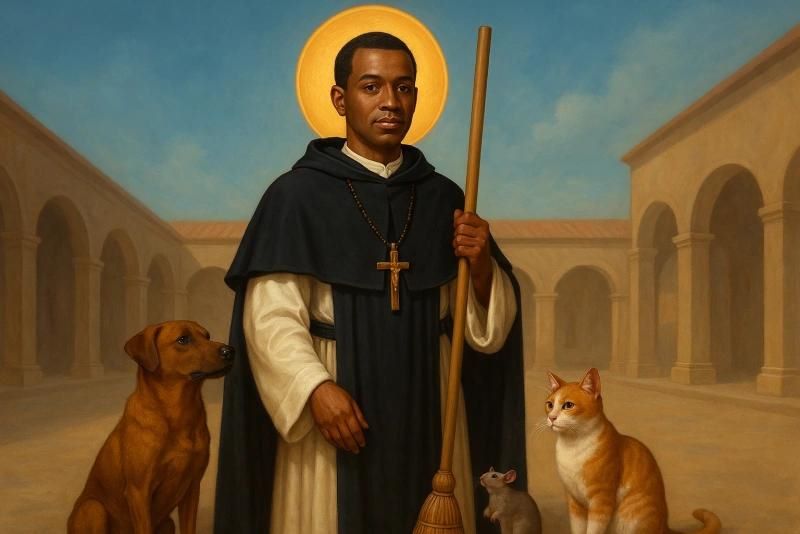
Saint Martin de Porres – Feast Day: November 3
Patron of the poor, the sick, racial harmony, and those who serve others with humility.
Introduction
Saint Martin de Porres is one of the most beloved saints in the history of the Catholic Church, remembered for his extraordinary humility, deep devotion to Christ, compassion for the poor, and tireless service to the sick and suffering. Known as the Saint of the Broom, he is especially admired for his willingness to perform the humblest tasks with love and for his conviction that every human person deserves dignity and respect.
Born in Lima, Peru, during the sixteenth century, Martin experienced poverty, racial discrimination, and social exclusion from an early age. Despite these difficulties, he developed an extraordinary love for God and neighbour. As a Dominican religious brother, he devoted his life to caring for the sick, feeding the hungry, helping the abandoned, and serving those whom society often neglected.
His life was marked by remarkable spiritual gifts, including mystical experiences, extraordinary charity, and a profound relationship with animals. Yet Martin never sought recognition or honour. He considered himself the servant of all and found his greatest joy in serving Christ through the poorest members of society.
Canonised in 1962 by Pope John XXIII, Saint Martin de Porres became the first Black American saint. His life continues to inspire Christians throughout the world, especially those committed to charity, social justice, racial reconciliation, and humble service.
His feast is celebrated on 3 November.
1. Birth and Family Background
Martin de Porres was born on 9 December 1579 in Lima, the capital of the Spanish Viceroyalty of Peru. His father was Juan de Porres, a Spanish nobleman, and his mother was Ana Velázquez, a formerly enslaved woman of African descent, born in Panama.
Martin was born into a society deeply divided by racial and social distinctions. His parents were not married, and his mixed ancestry placed him in a disadvantaged position within the rigid social structure of colonial Peru.
He had a younger sister named Juana. His father eventually acknowledged his children and assumed responsibility for their upbringing, although he was frequently absent because of his official duties.
Martin’s early childhood was marked by financial difficulties and social uncertainty. His mother worked hard to provide for her children, and the family experienced the hardships associated with poverty and discrimination.
From an early age, Martin demonstrated a gentle disposition, compassion for those in need, and a deep religious sensitivity. He was particularly attentive to the suffering of poor people and developed a desire to help those who were sick or abandoned.
The circumstances of his birth and childhood did not determine the greatness of his spiritual life. Rather, the difficulties he experienced helped him develop a compassionate heart that recognised the dignity of every person.
2. Early Life and the Discovery of His Vocation
Martin grew up in Lima, where he received a basic education and learned practical skills. As a young boy, he showed a particular interest in medicine and the treatment of illness.
He became an apprentice to a barber-surgeon, learning how to cut hair, dress wounds, prepare medicines, and assist the sick. During this period, barber-surgeons often performed minor medical procedures and provided basic healthcare.
This training became an important part of his future ministry. The skills he acquired enabled him to care for people who could not afford medical treatment.
Martin gradually understood that his desire to serve the sick was not merely a professional interest but a spiritual calling. He wished to dedicate his life to God through the service of others.
His early experiences taught him an important lesson: love becomes meaningful when it is translated into practical acts of compassion.
For Martin, helping a wounded person, feeding a hungry child, or caring for someone suffering from illness became a way of encountering Christ.
3. Entrance into the Dominican Order
At the age of fifteen, Martin approached the Dominican Convent of the Holy Rosary in Lima. He wished to dedicate himself to religious life and serve God within the Dominican community.
However, because of the racial and social restrictions of the period, he was initially accepted only as a donado, a lay associate who performed household duties and manual work without full religious status.
Martin willingly accepted this humble position. He did not insist upon receiving recognition or a higher place within the community. Instead, he considered every opportunity to serve as a blessing.
He performed various tasks, including cleaning, cooking, washing, gardening, and caring for the sick.
He was particularly devoted to sweeping the convent. His willingness to perform this ordinary task with extraordinary love eventually earned him the popular title, the Saint of the Broom.
Martin’s humility was not a sign of weakness or a lack of dignity. It was an expression of his conviction that no service performed out of love for God is insignificant.
His life reflected the teaching of Jesus:
“Whoever wishes to be great among you must be your servant.” (Matthew 20:26)
4. His Profession as a Dominican Brother
Martin’s dedication, holiness, and extraordinary charity gradually became evident to the Dominican community.
Recognising his virtues and spiritual maturity, the superiors allowed him to make his religious profession as a Dominican lay brother in 1603.
He committed himself to a life of poverty, chastity, and obedience according to the Dominican vocation.
As a religious brother, Martin continued performing humble duties while also exercising his medical skills and serving the poor.
He became increasingly known for his generosity and extraordinary concern for those who suffered. His room was often transformed into a place of refuge for sick and impoverished people.
He cared for people regardless of their social position, race, nationality, or religious background.
For Martin, every person was worthy of love because every human being was created in the image of God.
His life became a practical expression of the Christian understanding of universal brotherhood.
5. A Life Dedicated to the Poor and the Sick
One of the most remarkable characteristics of Saint Martin de Porres was his extraordinary commitment to charitable service.
He recognised the suffering of the poor and responded with practical generosity. He treated wounds, prepared medicines, distributed food, and offered shelter to those who had nowhere else to go.
He established an infirmary within the Dominican convent and worked tirelessly to care for people who were sick.
His charitable activities extended beyond the convent. He assisted poor families, supported abandoned children, and helped people who were unable to afford medical treatment.
Tradition relates that he even arranged for some of the sick to be accommodated in his own room when the infirmary was full.
His generosity sometimes placed him in difficult situations because he gave away resources that were intended for the community. Yet his concern for the suffering was so profound that he could not remain indifferent to their needs.
Martin understood that charity was not simply an occasional act of kindness. It was a way of life.
He saw the face of Christ in every suffering person and believed that serving the poor was a direct expression of love for Jesus.
His life brings to mind the words of Christ:
“Whatever you did for one of the least of these brothers and sisters of mine, you did for me.” (Matthew 25:40)
6. His Extraordinary Humility
Saint Martin’s humility was one of the most admired aspects of his spirituality.
Although his holiness became widely recognised, he never sought praise or distinction. He remained content with the simplest duties and accepted correction without resentment.
He was known for sweeping floors, washing clothes, cleaning rooms, and performing the most ordinary household tasks.
He considered himself unworthy of honour and believed that his greatest privilege was to serve God.
One traditional account relates that when the convent faced financial difficulties, Martin offered himself to be sold into slavery so that the community might obtain the necessary resources. His superior was deeply moved and refused the offer.
Whether understood as a historical episode or as an expression of his traditional biography, the story illustrates the extraordinary generosity associated with his life.
Martin’s humility was rooted in his deep understanding of God’s love. He knew that everything he possessed was a gift and that his life had meaning only when offered in service to others.
He reminds us that holiness is not measured by the position we occupy but by the love with which we fulfil our responsibilities.
7. His Love for Animals and All Creation
Another beautiful aspect of Saint Martin’s life was his extraordinary kindness towards animals.
He believed that every creature was part of God’s creation and deserved care and compassion. His love extended not only to human beings but also to animals, including those that were commonly regarded as troublesome or unwanted.
Traditional accounts describe how Martin cared for stray dogs, cats, and other animals. He was especially attentive to hungry and injured creatures.
One popular story relates that he helped resolve a problem involving rats in the Dominican convent. Rather than allowing the animals to be killed, he is said to have gathered them and arranged for them to be fed elsewhere.
His remarkable relationship with animals became an important part of the popular memory of his holiness. Stories of animals peacefully gathering around him, particularly mice, cats, and dogs, became common in religious paintings and devotional literature.
His love for animals reflected a spirituality that recognised God’s goodness throughout creation.
Saint Martin reminds us that Christian compassion should not be limited to people who can repay our kindness. It should extend to every living creature entrusted to our care.
8. His Deep Life of Prayer
Behind Martin’s extraordinary charitable activities was a profound life of prayer.
He understood that service without a living relationship with God could gradually become an empty activity. Therefore, he devoted long hours to prayer, meditation, and contemplation.
He frequently spent nights in prayer before the Blessed Sacrament. His devotion to the Holy Eucharist was particularly intense, and he regarded the presence of Jesus in the Eucharist as the source of his spiritual strength.
The Holy Rosary also occupied an important place in his devotional life. He prayed frequently and meditated upon the mysteries of Christ’s life.
Traditional biographies describe extraordinary mystical experiences associated with Martin, including visions, ecstasies, and moments of supernatural contemplation.
He was also known for practising fasting, penance, and personal mortification. These practices were not undertaken to attract attention but arose from his desire to grow in holiness and unite himself more closely with Christ.
His prayer life and charitable activities were inseparable. The more deeply he encountered Christ in prayer, the more generously he served Christ in the poor.
For Martin, the Eucharistic Lord whom he adored in the chapel was the same Lord whom he encountered in the sick, the hungry, and the abandoned.
9. Extraordinary Gifts and Miracles
The life of Saint Martin de Porres is surrounded by numerous accounts of extraordinary spiritual gifts and miraculous events.
His contemporaries and later biographers attributed several remarkable phenomena to his intercession and spiritual life.
Among the traditional accounts are reports of:
- Healing the sick: Many people believed that Martin obtained extraordinary cures through his prayers and compassionate care.
- Bilocation: He was traditionally reported to have appeared in different places at the same time to assist people in need.
- Levitation: Some accounts describe him being lifted from the ground during intense moments of prayer.
- Mystical visions: He was believed to have received extraordinary spiritual experiences during contemplation.
- Communication with animals: His unusual gentleness towards animals became associated with stories of supernatural harmony between him and the creatures he cared for.
- Miraculous multiplication of food: Stories describe occasions when the food distributed to the poor seemed insufficient but was nevertheless enough to feed those who came seeking help.
These accounts became an important part of the devotion surrounding him. They should be understood within the context of traditional hagiographical literature, rather than treated as independently established historical facts.
The greatest miracle of Martin’s life, however, was the extraordinary transformation of his heart through God’s grace.
He lived in a society divided by race, wealth, and social position, yet he loved people without discrimination. He encountered human suffering every day and responded with practical compassion.
His holiness was not merely expressed through extraordinary phenomena but through a lifetime of ordinary acts of love.
10. His Concern for Children and the Abandoned
Saint Martin possessed a particular tenderness towards children, especially those who had been abandoned, orphaned, or left without proper care.
Having experienced poverty and social discrimination during his childhood, he understood the difficulties faced by vulnerable children.
He used his influence, relationships, and organisational abilities to obtain financial assistance for those who needed support.
He helped establish charitable institutions for orphaned and abandoned children in Lima and worked to ensure that they received food, shelter, and medical attention.
His charitable work was not limited to temporary assistance. He wanted to create opportunities for the poor to live with dignity and security.
He also helped young women from impoverished families by arranging financial assistance for their future.
His activities demonstrated that authentic charity must be concerned not only with immediate suffering but also with the long-term welfare of those who are vulnerable.
Martin’s example is particularly relevant today, when millions of children throughout the world continue to experience abandonment, hunger, exploitation, and lack of educational opportunities.
He challenges Christians to become protectors of children and to recognise their responsibility towards those who cannot defend themselves.
11. A Bridge Between Races and Social Classes
Saint Martin de Porres lived during a period when colonial society was deeply marked by racial discrimination and social inequality.
His own experience of exclusion made him especially sensitive to the suffering of others.
Despite the prejudice he encountered, he did not respond with hatred or bitterness. Instead, he created a life of service that crossed the boundaries imposed by society.
He cared for Spanish nobles, Indigenous Peruvians, people of African descent, enslaved persons, and the poor. He did not allow racial identity or social position to determine the value of a human being.
People from different backgrounds approached him because they recognised his goodness and trusted his compassion.
His life became a powerful witness to the Christian truth that all human beings possess equal dignity before God.
Pope John XXIII, during Martin’s canonisation in 1962, presented him as an outstanding example of charity and Christian humility. The Pope highlighted the way Martin’s virtues transcended the social divisions of his time.
Martin’s example remains particularly important in a world where racism, discrimination, hatred, and social exclusion continue to wound human relationships.
He reminds the Church that the Gospel cannot be separated from the defence of human dignity.
True Christian holiness requires us to recognise Christ in every person, regardless of colour, nationality, language, social status, or economic condition.
12. His Final Years and Death
As Martin grew older, his reputation for holiness and charity spread throughout Lima.
People from different parts of society came to seek his prayers, spiritual advice, and assistance. Even prominent members of the community respected his wisdom and goodness.
Despite this growing recognition, Martin remained deeply humble. He continued his religious duties and cared for the sick with the same dedication that had characterised his younger years.
During his final illness in 1639, he reportedly predicted the time of his death.
He died on 3 November 1639, at the age of fifty-nine, in the Dominican convent in Lima.
His death caused profound sorrow throughout the city. People from different social classes gathered to honour him, and his funeral became a remarkable public expression of affection and respect.
According to historical accounts, prominent civil and religious leaders participated in his funeral ceremonies.
The people of Lima had already come to regard him as a saint because of his extraordinary life of charity, prayer, and humility.
His mortal remains were buried in the Dominican convent of the Holy Rosary, where devotion to him continued to grow.
13. Beatification and Canonisation
The reputation for holiness surrounding Martin de Porres spread rapidly after his death. Reports of favours and miraculous healings attributed to his intercession encouraged the faithful to seek his official recognition by the Church.
His cause for beatification eventually progressed, and Pope Gregory XVI beatified him on 29 October 1837.
His canonisation took place on 6 May 1962, when Pope John XXIII solemnly declared him a saint in Saint Peter’s Basilica in Rome.
Canonisation details: Dicastery for the Causes of Saints, Holy See.
San Martín de Porres: Vida, Milagros y Legado del Santo Peruano
During the canonisation ceremony, Pope John XXIII praised Martin’s extraordinary charity and humility. He presented him as a model of Christian life whose example could inspire the faithful to practise genuine love of neighbour.
Martin became the first Black American saint canonised by the Catholic Church. His canonisation was particularly significant for the Church in Latin America and for Catholics throughout the world who saw in his life a powerful witness to the universal nature of Christian holiness.
His liturgical memorial is celebrated on 3 November.
14. Patronage and Devotion
Saint Martin de Porres is especially venerated as a patron of:
- The poor and the abandoned.
- People of mixed racial heritage.
- Racial harmony and social justice.
- Those working in healthcare and medical professions.
- Barbers and hairdressers.
- Orphans and abandoned children.
- Those who care for animals.
- People seeking healing and assistance in difficult circumstances.
His devotion has spread throughout Latin America, the United States, Europe, Africa, and many other parts of the world.
Churches, schools, hospitals, charitable organisations, and religious institutions have been dedicated to his name.
His popularity is particularly significant among those who seek to combine their Christian faith with practical service to the poor and marginalised.
15. Spiritual Lessons from the Life of Saint Martin de Porres
The life of Saint Martin de Porres offers profound lessons for Christians in every age.
1. No Service Is Too Humble
Martin never considered any honest task beneath his dignity. Sweeping floors, washing clothes, cleaning rooms, and caring for the sick were all opportunities to express his love for God.
His life reminds us that holiness does not depend upon the importance of our position or the recognition we receive.
A mother caring for her children, a worker performing ordinary duties, a priest serving a small community, or a person quietly helping a neighbour can all become instruments of God’s love.
What matters is the love with which we perform our responsibilities.
2. Love Must Be Without Discrimination
Martin cared for everyone without considering race, social class, or wealth.
He refused to allow the divisions of society to determine whom he should love.
His life challenges us to examine our own attitudes towards people who are different from us. Do we treat everyone with equal dignity? Do we show kindness only to those who are familiar, influential, or useful to us?
Christian charity cannot be selective. Every human person deserves respect because every person is created in the image of God.
3. Humility Is the Foundation of Holiness
Martin’s humility was not an occasional virtue but the foundation of his entire life.
He did not seek positions of authority or public admiration. He was content to remain unnoticed while performing his duties faithfully.
His example teaches us that true greatness is found in service rather than superiority.
The Christian who wishes to grow in holiness must learn to surrender pride, accept correction, and recognise that every good gift comes from God.
4. Prayer and Service Must Go Together
Martin spent long hours in prayer, but his spirituality never became separated from the needs of others.
His devotion to the Eucharist strengthened his commitment to the poor and suffering.
This is an important lesson for every Christian. Prayer should transform our attitudes and actions. If our prayers do not make us more compassionate, patient, generous, and forgiving, we must examine the quality of our relationship with God.
The Eucharist invites us to become what we receive: people who live in self-giving love.
5. Suffering Can Become a Source of Compassion
Martin experienced poverty, rejection, and racial discrimination during his early life.
Yet he did not allow these experiences to make him bitter. Instead, they helped him understand the suffering of others.
His life reminds us that our painful experiences can become opportunities to develop greater sensitivity towards those who are struggling.
A person who has experienced loneliness can understand the lonely. Someone who has experienced poverty can recognise the needs of the poor. Someone who has suffered rejection can become an instrument of welcome and acceptance.
God’s grace can transform our wounds into sources of compassion.
6. Care for the Poor Is an Essential Christian Duty
Martin did not limit his concern for the poor to words or occasional acts of generosity.
He organised assistance, distributed food, cared for the sick, and supported abandoned children.
His life reminds us that Christian charity must be practical.
We cannot claim to love Christ while remaining indifferent to hunger, sickness, homelessness, and injustice.
Every Christian is called to discover concrete ways of serving those in need.
7. Respect for Every Creature
Martin’s kindness towards animals reflects a broader Christian responsibility to care for God’s creation.
Human beings have received the responsibility of stewardship, not exploitation.
His example encourages us to practise kindness towards animals and to treat the natural world with respect and responsibility.
16. Prayer to Saint Martin de Porres
Heavenly Father,
You filled the heart of Saint Martin de Porres with extraordinary love, humility, and compassion. Through his example, You showed us that true greatness is found in serving others and that every human person is precious in Your sight.
Through the intercession of Saint Martin, grant us the grace to grow in humility and charity. Teach us to recognise the face of Jesus in the poor, the sick, the abandoned, and those who are rejected by society.
Help us to overcome pride, selfishness, prejudice, and discrimination. Give us generous hearts that are always ready to share our blessings with those who are in need.
Bless all doctors, nurses, healthcare workers, caregivers, and those who dedicate their lives to the service of the sick. Protect orphaned children, poor families, and all those who experience loneliness and abandonment.
May Saint Martin’s example inspire us to serve without expecting recognition, forgive without resentment, and love without discrimination.
Through Christ our Lord.
Amen.
Saint Martin de Porres, humble servant of God and apostle of charity, pray for us!
17. A Personal Reflection: Becoming Servants of Love
The life of Saint Martin de Porres invites us to reconsider our understanding of greatness.
The world often measures greatness through wealth, authority, education, popularity, and social recognition. People frequently desire positions that bring honour and avoid responsibilities that appear insignificant.
Martin’s life presents an entirely different understanding of greatness.
He became a saint not because he occupied an important position in society but because he allowed God’s love to transform every aspect of his life. He discovered holiness in sweeping floors, washing clothes, caring for the sick, feeding the hungry, and comforting the abandoned.
His broom became a symbol of a spirituality that found God in the ordinary duties of everyday life.
There is something especially beautiful about his willingness to serve people who were rejected by others. He did not ask whether a person deserved his kindness or whether that person belonged to his social group. He simply saw someone in need and responded with love.
This is the challenge of the Gospel.
We may not have the opportunity to perform extraordinary miracles, but we can perform countless small acts of kindness. We can visit someone who is sick, listen to a lonely person, help a poor family, forgive someone who has hurt us, and treat every person with dignity.
Perhaps the greatest lesson of Saint Martin is that holiness begins when we stop asking, “What can I gain?” and begin asking, “Whom can I serve?”
May his life inspire us to become humble instruments of God’s love. May we discover Christ in the Eucharist and recognise Him in the suffering faces of our brothers and sisters.
Saint Martin de Porres, teach us to serve with humility, love without discrimination, and find our greatest joy in doing the will of God. Amen.
References and Further Reading
1. Vatican News – Saint Martin de Porres, Dominican. A biographical account of his childhood, Dominican vocation, charitable service, and spirituality.
https://www.vaticannews.va/en/saints/11/03/st–martin-de-porres–dominican.html
2. Dicastery for the Causes of Saints – Martin de Porres. Official information about his beatification, canonisation, and liturgical memorial.
https://www.causesanti.va/it/santi-e-beati/martino-de-porres.html
3. Pope John XXIII – Homily at the Canonisation of Saint Martin de Porres, 6 May 1962. An important primary ecclesiastical source for understanding the Church’s recognition of his holiness.
https://www.crossroadsinitiative.com/media/articles/st-martin-de-porres/
4. Dominican Friars – A Novena to Saint Martin de Porres. Includes a biographical introduction and devotional material about his life and spirituality.
https://dominicanfriars.org/wp-content/uploads/2020/07/saint_martin_novena.pdf
5. University of Notre Dame – FaithND: Saint Martin de Porres. A biographical account highlighting his vocation, charity, and commitment to the poor.
https://faith.nd.edu/saint/st-martin-de-porres/
6. Victoria and Albert Museum – St Martin de Porres. Historical and cultural discussion of his life, reputation, and artistic representation.
https://www.vam.ac.uk/blog/sanctus-ignotum/st-martin-de-porres
7. Augustine Thompson, O.P. – Dominican Brothers: Conversi, Lay, and Cooperator Friars. New Priory Press, 2017. A scholarly study of the history and vocation of Dominican lay brothers, including the historical context of Martin’s religious life.
8. The Roman Martyrology – 3 November. Liturgical commemoration of Saint Martin de Porres.
9. The Liturgy of the Hours – Office of Readings, 3 November. Liturgical material for the memorial of Saint Martin de Porres.
Leave a Reply