
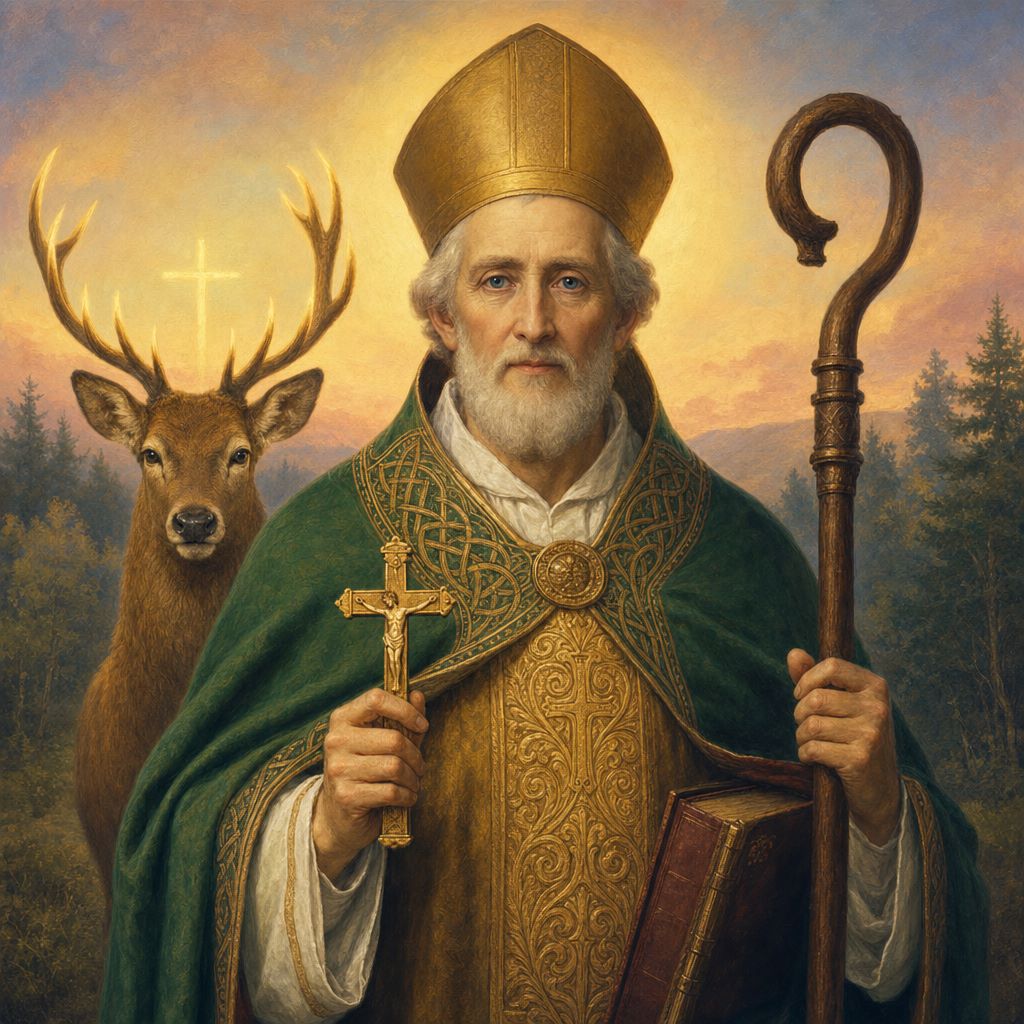
Feast Day: 3 November
Introduction
Saint Hubert of Liège (c. 656–727) was a bishop, missionary, and evangelist remembered as the Apostle of the Ardennes. His life is particularly associated with a remarkable conversion from a worldly existence devoted to hunting and aristocratic pleasures to a life of prayer, sacrifice, and service to God.
He is traditionally honoured as the patron saint of hunters, forest workers, mathematicians, opticians, and those who care for animals. His conversion story, especially the famous vision of a crucifix appearing between the antlers of a stag, has made him one of the most recognisable saints in Christian tradition.
The story of Saint Hubert reminds us that God’s grace can reach a person even in the midst of worldly pursuits and transform an ordinary life into an extraordinary witness of faith.
1. Early Life and Noble Background
Saint Hubert was born around 656, traditionally believed to have belonged to a noble family connected with the Frankish aristocracy. He lived during a period when Christianity was gradually becoming firmly established throughout the regions of present-day Belgium, France, Germany, and the Netherlands.
As a young nobleman, Hubert enjoyed the privileges of his social position. He was particularly passionate about hunting, an activity associated with aristocratic life at that time. Historical traditions describe him as an energetic and enthusiastic hunter who spent much of his time pursuing game in the forests.
Although he possessed intelligence, courage, and leadership abilities, his early life was largely directed towards worldly pleasures and ambitions. His later conversion would reveal that even a person deeply attached to earthly interests could become a devoted servant of God.
2. The Miraculous Vision of the Stag
The most famous episode in the life of Saint Hubert concerns a hunting expedition that completely changed his spiritual direction.
According to traditional accounts, Hubert was hunting on Good Friday, when Christians were expected to observe the day with prayer, fasting, and remembrance of the Passion of Christ. While others were attending to their religious obligations, Hubert continued his favourite pastime.
During the hunt, he encountered an extraordinary stag. As he pursued the animal, it suddenly turned towards him. Between its antlers, Hubert saw a radiant crucifix.
A heavenly voice addressed him, calling him to turn away from his worldly life and seek salvation. The message invited him to change his priorities and dedicate himself to God.
Hubert was deeply shaken by this supernatural experience. He recognised that his life needed a radical transformation. The encounter awakened his conscience and led him to abandon his former way of life.
This vision became the defining moment of his spiritual journey. The stag with the crucifix between its antlers subsequently became the principal symbol associated with Saint Hubert in Christian art.
3. Conversion and Spiritual Formation
Following his conversion, Hubert sought the guidance of Saint Lambert of Maastricht, a courageous bishop who was widely respected for his holiness and missionary work.
Hubert placed himself under Lambert’s spiritual direction and gradually embraced a life of discipline, prayer, and Christian service. He withdrew from the attractions of court life and devoted himself to learning the teachings of the Church.
His conversion was not merely an emotional experience. It involved a genuine change of heart and a new understanding of his responsibilities before God.
Under Saint Lambert’s guidance, Hubert grew in holiness and prepared himself for the priesthood. He eventually received ordination and became one of Lambert’s closest collaborators.
Tradition also associates Hubert with a period of retreat and spiritual preparation at the monastery of Stavelot.
4. Becoming Bishop of Maastricht
Around 705, following the martyrdom of Saint Lambert, Hubert succeeded him as Bishop of Maastricht.
The death of Lambert had left the Christian community deeply affected. Hubert accepted the responsibility of continuing his predecessor’s pastoral and missionary work.
As bishop, he demonstrated remarkable dedication to the spiritual welfare of his people. He distributed his episcopal revenues to the poor, practised fasting and prayer, and devoted himself to preaching the Gospel.
He understood that episcopal ministry was not a position of worldly honour but a sacred responsibility to guide souls towards Christ.
His life as a bishop was marked by simplicity, generosity, courage, and missionary commitment.
5. The Transfer of Saint Lambert’s Relics to Liège
One of the most important achievements of Saint Hubert was the transfer of the relics of Saint Lambert from Maastricht to Liège.
Around 717–718, Hubert arranged for the solemn translation of Lambert’s remains to the place where the martyr had been killed.
A church was established there in honour of Saint Lambert, and the Christian community gradually developed around this important religious centre.
Liège eventually became the episcopal seat, replacing Maastricht, and grew into one of the most significant centres of Christianity in the region.
Saint Hubert is therefore remembered not only as a missionary bishop but also as an important figure in the religious and historical development of Liège. He is traditionally regarded as the founder and first bishop of the Diocese of Liège. New Advent+1
6. Missionary Work in the Ardennes
Saint Hubert was particularly devoted to evangelising the people living in the forests and remote settlements of the Ardennes.
Christianity had not yet become firmly established in every part of the region. Various pagan customs and forms of idol worship continued to exist, especially in isolated communities.
Hubert travelled extensively to bring the Christian message to these people. His missionary work required courage, patience, and perseverance.
He preached the Gospel, encouraged the abandonment of pagan practices, established Christian communities, and strengthened the faith of those who had already embraced Christianity.
His missionary activities extended into the Ardennes, Brabant, and neighbouring territories.
Because of this apostolic commitment, he became known as the Apostle of the Ardennes.
7. His Final Years and Death
After many years of devoted pastoral and missionary service, Saint Hubert continued his work until the end of his life.
According to traditional accounts, he received a revelation concerning his approaching death while visiting Tervueren (historically called Fura).
He preached a final sermon to the people and soon became seriously ill.
Saint Hubert died on 30 May, around the year 727 or 728, at Tervueren, near present-day Brussels in Belgium.
Tradition recounts that he died while reciting the Lord’s Prayer, a fitting conclusion to the life of a bishop who had dedicated himself to prayer and the service of God.
His remains were initially buried in Liège. In 825, his relics were solemnly transferred to the Benedictine monastery of Andage in the Ardennes. The monastery subsequently became known as the Abbey of Saint-Hubert, and the surrounding settlement also took his name. New Advent+2
8. The Historical Significance of the Stag Vision
The story of the stag with a crucifix between its antlers is central to the popular devotion surrounding Saint Hubert. However, it is important to distinguish historical evidence from later devotional tradition.
The earliest biography of Saint Hubert, written relatively soon after his death, provides limited information about his life and does not contain the famous stag vision. The conversion story developed in later accounts and appears to have been influenced by the similar legend of Saint Eustace.
Nevertheless, the story became an enduring expression of Hubert’s spiritual transformation. Christian artists frequently portrayed him kneeling before a magnificent stag bearing a luminous cross between its antlers.
The image communicates a profound spiritual truth: God can interrupt our ordinary pursuits and invite us to discover a higher purpose.
Whether encountered through a dramatic experience or through the quiet movement of grace, conversion begins when a person becomes willing to listen to God’s call. wehd.com+2
9. Veneration and Patronage
Saint Hubert became widely venerated throughout Europe, particularly in Belgium, France, Germany, and Luxembourg.
His relics attracted numerous pilgrims to the Abbey of Saint-Hubert in the Ardennes. The monastery became an important centre of religious devotion and pilgrimage.
He is traditionally invoked as the patron saint of:
- Hunters and hunting communities.
- Foresters and forest workers.
- People who work with animals.
- Those seeking protection against rabies and dog bites.
His association with hunters is closely connected with the traditional account of his conversion during a hunting expedition.
Over the centuries, the blessing of animals and hunting-related celebrations became associated with his feast in various European communities.
Saint Hubert’s patronage also reminds Christians that all creation belongs to God and that human beings have a responsibility to treat animals and the natural world with respect and care.
10. Spiritual Lessons from the Life of Saint Hubert
1. No one is beyond the reach of God’s grace.
Hubert’s conversion reminds us that God can touch even a heart deeply attached to worldly pleasures. No person should ever consider himself too far away from God to return to Him.
2. Conversion requires a change of life.
A genuine encounter with God should lead to a transformation of our attitudes, priorities, and actions. Hubert did not simply admire the experience of his vision; he changed the direction of his entire life.
3. Spiritual guidance is important.
Hubert placed himself under the direction of Saint Lambert. His example teaches us the value of spiritual accompaniment, humility, and obedience in the journey towards holiness.
4. Leadership is a responsibility of service.
As bishop, Hubert used his position to serve the poor, preach the Gospel, and strengthen the Christian community. True Christian leadership is measured not by authority or prestige but by love and service.
5. We must care for God’s creation.
His traditional association with hunters and forests invites us to reflect on our responsibility towards animals and the natural environment. Creation is a gift entrusted to humanity, not something to be exploited selfishly.
6. Every life has a higher purpose.
Hubert once devoted himself to the pleasures of earthly life. Through God’s grace, he discovered a greater purpose in proclaiming the Gospel. His life encourages us to ask whether our daily activities are leading us closer to God.
11. The Feast of Saint Hubert – 3 November
The Catholic Church celebrates the feast of Saint Hubert on 3 November. This date is traditionally associated with the translation of his relics and the growth of his public veneration.
In several European countries, particularly Belgium, Luxembourg, France, and Germany, his feast is celebrated with special devotion.
Traditional celebrations include the blessing of animals, gatherings of hunters and forest workers, and prayers for the protection of animals and those who work in forests.
His feast provides an opportunity to reflect on conversion, missionary commitment, and responsible stewardship of God’s creation.
12. Prayer to Saint Hubert
Saint Hubert, faithful servant of God and Apostle of the Ardennes, you experienced the transforming power of God’s grace and dedicated your life to proclaiming the Gospel.
Pray for us, that we may turn away from worldly distractions and discover the true purpose of our lives. Obtain for us the grace of conversion, courage in our Christian responsibilities, and generosity towards those in need.
Teach us to respect God’s creation and care for all living creatures. May we listen attentively to God’s voice and respond faithfully whenever He calls us.
Saint Hubert, pray for us. Amen.
Conclusion
The life of Saint Hubert of Liège is a beautiful testimony to the transforming power of divine grace. From a nobleman passionate about hunting, he became a humble bishop and courageous missionary who dedicated his life to the salvation of souls.
His famous vision of the stag carrying a cross remains a powerful symbol of conversion and spiritual awakening. It reminds us that God can enter our lives unexpectedly and invite us to follow a new path.
Saint Hubert teaches us that holiness is not determined by our past but by our willingness to respond to God’s grace in the present. His journey encourages every Christian to leave behind whatever separates us from God and to embrace a life of faith, love, and service.
May the example of Saint Hubert inspire us to recognise God’s call in our daily lives and to follow Christ with renewed commitment.
References and Further Reading
1. C. F. Wemyss Brown, “St. Hubert,” The Catholic Encyclopedia, Volume VII, 1910.
https://www.newadvent.org/cathen/07507a.htm
2. Butler’s Lives of the Saints, November 3 – Saint Hubert, Bishop of Liège.
3. Hippolyte Delehaye, “Saint Hubert,” The Reader’s Biographical Encyclopaedia, 1922.
https://wehd.com/bios/Saint_Hubert.html
4. Connaître la Wallonie, “Hubert (Saint)” – Historical biography and regional history.
https://connaitrelawallonie.wallonie.be/wallons-marquants/dictionnaire-des-wallons/hubert-saint
5. Basilique Saint-Hubert, Historical information about the Abbey and Basilica of Saint-Hubert.
https://basilique-sainthubert.be/la-basilique/
Leave a Reply