
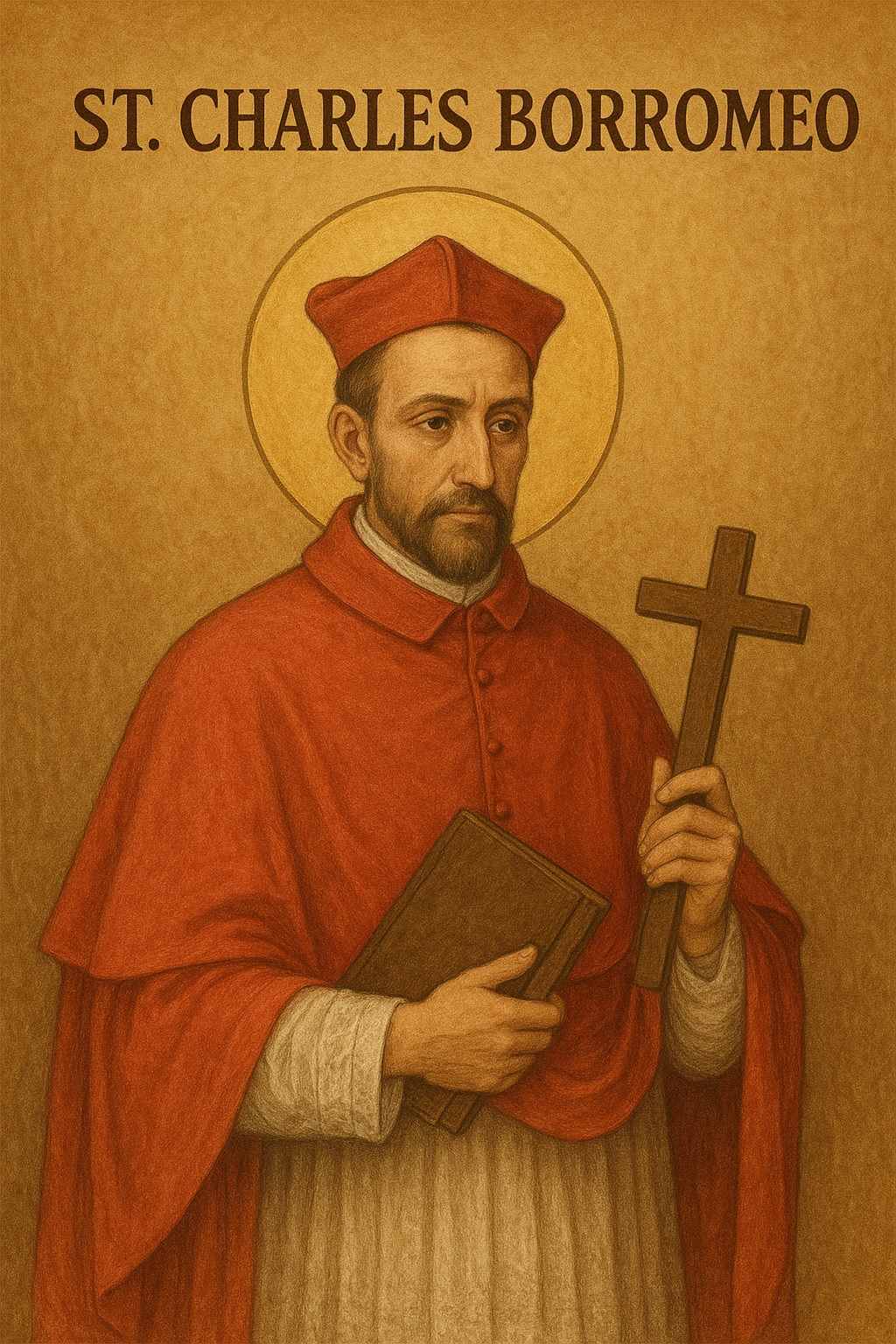
Feast Day: November 4
Saint Charles Borromeo (1538–1584) was one of the most influential Catholic reformers of the sixteenth century. A cardinal, archbishop, and tireless servant of the Church, he dedicated his life to the renewal of the clergy, the reform of ecclesiastical institutions, the education of the faithful, and the spiritual care of the poor and suffering. Living during the turbulent years of the Protestant Reformation and the Catholic Counter-Reformation, he became a shining example of holiness, pastoral charity, discipline, and unwavering devotion to Christ.
Remembered especially for his leadership in implementing the reforms of the Council of Trent, Saint Charles demonstrated that genuine renewal in the Church must begin with personal holiness and a sincere commitment to the Gospel. His life remains an enduring inspiration for bishops, priests, seminarians, catechists, and all those entrusted with the spiritual care of others.
1. Early Life and Family Background
Charles Borromeo was born on October 2, 1538, at the Castle of Arona, near Lake Maggiore in northern Italy. He belonged to the distinguished and wealthy Borromeo family, one of the prominent aristocratic families of the region. His father was Count Gilbert Borromeo, and his mother was Margaret de’ Medici, the sister of Pope Pius IV’s mother.
From his childhood, Charles displayed a serious disposition and a deep inclination towards religious life. Although he was born into a family of considerable wealth and influence, he was attracted more to prayer, study, and service than to worldly pleasures.
At the age of twelve, he received the tonsure and began preparing for a life dedicated to the Church. His family entrusted him with certain ecclesiastical revenues traditionally associated with his position, but Charles insisted that the income belonging to the Church should be used for charitable and religious purposes.
He studied at the University of Pavia, where he pursued civil and canon law. Although he was not naturally gifted with an exceptionally quick intellect or impressive public speaking abilities, he compensated through diligence, perseverance, and disciplined study. He eventually earned a doctorate in both civil and canon law in 1559.
His years of education prepared him for the significant responsibilities that would soon come his way.
2. Appointment as Cardinal and Archbishop
In 1559, Cardinal Giovanni Angelo Medici was elected Pope Pius IV. Charles’s maternal uncle had now become the Supreme Pontiff, and this brought significant changes to his life.
In 1560, at only twenty-one years of age, Charles was summoned to Rome and appointed a cardinal. He was also entrusted with several important ecclesiastical responsibilities, including the administration of the Archdiocese of Milan.
Despite his youth, Charles approached his responsibilities with remarkable seriousness. He worked extensively in the administration of the Church, participated in important diplomatic and ecclesiastical affairs, and assisted the Pope in matters concerning the universal Church.
He was particularly influential in the continuation of the Council of Trent, which had been suspended for several years. The council was finally reconvened in 1562 and completed its work in December 1563.
During this period, Charles gradually recognized that the renewal of the Church required more than administrative decisions and theological declarations. It demanded a profound transformation of the lives of bishops, priests, religious, and ordinary Christians.
Although he initially lived amid the privileges and comforts associated with his position, his spiritual outlook gradually became more austere and deeply centred on Christ.
3. The Influence of the Council of Trent
The Council of Trent (1545–1563) was one of the most important events in the history of the Catholic Church. It addressed doctrinal controversies, clarified Catholic teaching, and introduced reforms intended to renew ecclesiastical discipline and pastoral life.
Saint Charles Borromeo played an important role in implementing the council’s decisions.
He understood that the reforms of the council would remain ineffective unless they were translated into practical changes in the everyday life of the Church.
Among his major concerns were:
- Ensuring that bishops resided in their dioceses and fulfilled their pastoral responsibilities.
- Improving the spiritual and intellectual formation of priests.
- Establishing seminaries for the proper education of future priests.
- Reforming religious communities and ecclesiastical institutions.
- Promoting regular preaching and sound catechetical instruction.
- Strengthening the administration of the sacraments.
- Encouraging personal holiness among clergy and laity.
Charles believed that bishops must be shepherds rather than merely administrators. They should know their people, visit their parishes, preach the Gospel, correct abuses, and care for those entrusted to them.
His commitment to these principles would become especially evident when he took personal responsibility for the Archdiocese of Milan.
4. Archbishop of Milan: A Shepherd Among His People
In 1564, Charles Borromeo was ordained a priest. In the same year, he was consecrated bishop and formally assumed the pastoral responsibility of the Archdiocese of Milan.
Milan was one of the largest and most important dioceses in Europe. It contained numerous parishes, religious communities, charitable institutions, and educational establishments. However, the diocese also suffered from serious problems, including inadequate priestly formation, insufficient pastoral care, clerical abuses, and widespread religious ignorance.
Charles approached these challenges with determination.
He reorganized diocesan administration, established structures for regular pastoral supervision, and introduced reforms in the lives of priests and religious communities. He insisted that priests should live according to their vocation, celebrate the sacraments reverently, preach faithfully, and dedicate themselves to the spiritual welfare of their people.
He personally visited parishes, including remote communities in mountainous regions. These visits were not merely formal inspections. He wanted to understand the real conditions of his people and identify their spiritual and material needs.
He established seminaries and improved institutions for priestly formation. His efforts contributed significantly to the development of the modern Catholic seminary system.
He also promoted the teaching of Christian doctrine through schools of Christian doctrine, helping children and adults understand the fundamental truths of the Catholic faith.
For Charles, the renewal of the Church began with the formation of holy and well-prepared ministers.
5. A Life of Prayer, Penance, and Simplicity
Although Charles occupied one of the highest positions in the Church, he gradually embraced a life of extraordinary simplicity and self-discipline.
He reduced his personal comforts, practised fasting, spent long hours in prayer, and maintained a demanding spiritual routine. He understood that the authority of a bishop must be supported by personal holiness.
His household was reorganized to reflect the dignity of his ecclesiastical vocation rather than the luxury of aristocratic life. He discouraged unnecessary extravagance and directed resources towards charitable works.
His spirituality was deeply Eucharistic. He celebrated the Holy Mass with profound reverence and encouraged priests and faithful to approach the Eucharist with devotion.
He also had a special love for the Passion of Christ. Meditation on the suffering and sacrifice of Jesus strengthened his commitment to a life of service.
Charles believed that a shepherd could not lead others towards holiness without first seeking holiness himself.
6. His Love for the Poor and the Sick
One of the most remarkable characteristics of Saint Charles Borromeo was his extraordinary concern for the poor.
He understood that pastoral responsibility extended beyond preaching and administering the sacraments. It also required practical love and solidarity with those who suffered.
He established charitable institutions, supported hospitals, helped poor families, and provided assistance to those who were unable to meet their basic needs.
He personally distributed food and resources to the needy. During periods of famine and economic hardship, he mobilized the resources of the Church to provide relief.
He did not consider charity an optional activity for Christians. Rather, he saw it as an essential expression of the Gospel.
For him, the poor were not merely recipients of assistance; they were brothers and sisters in Christ, deserving of respect, compassion, and dignity.
His charitable activities became especially extraordinary during the plague that devastated Milan in 1576.
7. The Plague of Milan: A Shepherd Who Never Abandoned His Flock
In 1576, a terrible outbreak of plague struck Milan. The disease spread rapidly, causing widespread suffering and death. Many wealthy citizens and public officials fled the city in an attempt to save themselves.
Saint Charles, however, remained with his people.
He understood that the faithful needed spiritual guidance and practical assistance during this terrifying period. He organized relief efforts, provided food for the hungry, arranged care for the sick, and supported families who had lost their loved ones.
He visited the infected, comforted the dying, encouraged the frightened, and ensured that the sacraments were made available to those who needed them.
He also organized public prayers and processions, placing the suffering city under the protection of God.
When ordinary resources were insufficient, he used his personal wealth and ecclesiastical resources to support the needy. He even arranged for additional shelters and facilities to accommodate those who had been displaced.
His response to the plague revealed the depth of his pastoral charity. He did not abandon his people when they needed him most.
His courageous service became one of the defining moments of his life.
Saint Charles demonstrated that a true shepherd remains close to his flock, especially during moments of danger, suffering, and uncertainty.
8. His Commitment to Priestly Formation and Religious Renewal
Saint Charles Borromeo recognized that the spiritual health of the Church depended greatly on the quality of its priests.
He therefore devoted considerable attention to priestly education and formation.
He established seminaries where candidates for the priesthood could receive systematic intellectual, spiritual, and pastoral preparation. He insisted that future priests should be formed not merely as scholars but as men of prayer, discipline, and pastoral charity.
He also encouraged regular spiritual retreats, continuing education, and accountability among the clergy.
His reforms extended to religious communities. He sought to renew their original spirit of prayer, poverty, obedience, and dedication to their particular charisms.
He was particularly concerned about the proper celebration of the liturgy, the dignity of churches, and the reverent administration of the sacraments.
His commitment to reform was sometimes met with resistance. Certain individuals and institutions were unwilling to accept his strict standards. Nevertheless, he remained firm, believing that the spiritual welfare of the Church was more important than personal popularity.
9. The Oblates of Saint Ambrose
Among the institutions associated with Saint Charles was the Congregation of the Oblates of Saint Ambrose, founded in Milan in 1578.
The congregation was established to promote a more dedicated form of diocesan priestly life and service. Its members committed themselves to the service of the archbishop and the pastoral needs of the diocese.
They were particularly involved in preaching, catechesis, pastoral assistance, and the renewal of Christian life.
The congregation reflected Charles’s conviction that the Church needed priests who were spiritually committed, properly formed, and willing to serve wherever they were needed.
The Oblates became an important instrument in carrying forward his programme of ecclesiastical renewal.
10. Opposition and the Attempt on His Life
The reforms introduced by Saint Charles were not welcomed by everyone.
His insistence on discipline and accountability brought him into conflict with certain religious and secular interests. Some people resented his efforts to correct abuses and restore proper ecclesiastical discipline.
One particularly dramatic incident occurred in 1569.
While Charles was praying in the chapel of his residence, an assassin belonging to a group opposed to his reforms fired a weapon at him. The shot struck him, but he survived.
He attributed his preservation to God’s protection and continued his pastoral mission without allowing fear to weaken his commitment.
The incident revealed the seriousness of the opposition he faced. Yet Charles remained convinced that the Church could not be renewed without courage, sacrifice, and fidelity to the truth.
11. His Spirituality and Devotion to the Eucharist
Saint Charles possessed a profound love for the Holy Eucharist.
He regarded the Mass as the central act of Christian worship and insisted that it should be celebrated with reverence, dignity, and devotion.
He encouraged frequent reception of the sacraments and promoted Eucharistic devotion among the faithful.
He also understood the importance of religious education in helping people appreciate the mysteries of the Catholic faith.
His spirituality was rooted in the conviction that Christian life must be centred on Jesus Christ. Prayer, penance, sacramental life, and charity were not separate activities but interconnected expressions of a living relationship with God.
He also had a deep devotion to the Blessed Virgin Mary and encouraged Marian prayer among the faithful.
His devotion to Mary was closely connected with his love for Christ and his desire to imitate the humility and obedience of the Mother of God.
12. His Final Days and Death
The extraordinary demands of his pastoral responsibilities gradually affected Charles’s health.
He undertook frequent journeys, maintained a demanding schedule of prayer and administration, and often neglected his physical needs in order to serve others.
In October 1584, while returning from a pastoral visit, he became seriously ill.
He travelled to Milan, where his condition continued to deteriorate. Despite medical attention, his strength gradually failed.
On November 3, 1584, Saint Charles Borromeo died at the age of forty-six.
His death deeply affected the people of Milan and the wider Catholic Church. The faithful remembered him as a devoted shepherd who had given his life in the service of Christ and His Church.
His body was buried in Milan Cathedral, where his tomb became a place of devotion and pilgrimage.
13. Canonization and Recognition
The reputation for holiness of Saint Charles Borromeo spread rapidly after his death.
Pope Paul V canonized him on November 1, 1610, declaring him a saint of the Catholic Church.
His feast is celebrated on November 4.
He is especially honoured as a patron of bishops, catechists, seminarians, spiritual directors, and those involved in priestly formation.
His life continues to be studied as an outstanding example of the Catholic Church’s renewal following the Council of Trent.
He is also remembered as one of the great pastoral bishops in the history of Christianity.
14. The Spiritual Legacy of Saint Charles Borromeo
The life of Saint Charles Borromeo offers several important lessons for Christians today.
1. Personal Holiness Must Come Before Reform
Charles understood that genuine reform cannot be achieved through rules and regulations alone. The renewal of the Church begins with the conversion of hearts.
Every Christian, especially those entrusted with leadership, must first seek holiness in personal life.
2. A True Shepherd Never Abandons His People
During the plague of Milan, Charles remained beside his suffering people when many others had fled.
His example reminds bishops, priests, and pastoral ministers that their vocation is fundamentally one of service. The shepherd must remain close to the flock, particularly during difficult moments.
3. Education Is Essential for Faith
Charles devoted himself to catechesis, seminaries, and the intellectual formation of priests.
He understood that faith must be properly taught, explained, and nurtured. A well-formed Christian community is better prepared to face the challenges of every generation.
4. Charity Must Be Practical
His love for the poor was expressed through concrete action. He did not merely speak about compassion; he organized relief, distributed resources, and personally cared for those in need.
His example reminds us that Christian love must become visible through our actions.
5. Prayer and Discipline Strengthen Christian Life
Charles maintained a demanding life of prayer and penance despite his enormous responsibilities.
His example teaches us that a meaningful Christian life requires discipline, perseverance, and a deep relationship with God.
6. Leadership Is a Responsibility, Not a Privilege
Although he belonged to a wealthy family and held a prestigious ecclesiastical position, Charles gradually abandoned worldly comforts and embraced a life of service.
He reminds us that every position of authority is an opportunity to serve others rather than to seek personal recognition.
15. Saint Charles Borromeo and the Church Today
The example of Saint Charles Borromeo remains especially relevant in the contemporary Church.
The Church continues to face challenges involving evangelization, priestly formation, religious education, pastoral renewal, and the spiritual needs of families and communities.
His life reminds us that renewal must be rooted in the Gospel and sustained by prayer, sound teaching, sacramental life, and practical charity.
For bishops and priests, he offers a model of pastoral responsibility and personal holiness. For seminarians, he presents an example of disciplined preparation and complete dedication to the priesthood. For catechists and teachers, he demonstrates the importance of transmitting the faith faithfully. For ordinary Christians, he offers an invitation to live the Gospel with sincerity and generosity.
His life also reminds us that holiness is not reserved for those who live apart from the world. It can flourish in the midst of administrative responsibilities, difficult decisions, opposition, suffering, and demanding service.
The extraordinary holiness of Charles Borromeo was expressed through ordinary pastoral responsibilities carried out with extraordinary love.
16. A Prayer to Saint Charles Borromeo
Saint Charles Borromeo, faithful shepherd of the Church, pray for us.
You who dedicated your life to the service of Christ and His people, teach us to love the Church with sincerity, to remain faithful to our Christian vocation, and to serve others with humility and generosity.
Pray especially for our bishops, priests, seminarians, and all those entrusted with pastoral responsibilities. May they imitate your courage, wisdom, discipline, and compassion.
Intercede for those who are sick, poor, lonely, and abandoned. Help us recognize Christ in those who suffer and give us the generosity to serve them with love.
May our lives be renewed through prayer, the Holy Eucharist, and the grace of the Holy Spirit. Obtain for us the courage to remain faithful to Jesus even in times of difficulty.
Saint Charles Borromeo, pray for us. Amen.
17. Conclusion
Saint Charles Borromeo stands among the great saints and reformers of the Catholic Church. His life was a powerful testimony to the transforming power of faith, prayer, discipline, and pastoral charity.
He possessed wealth but chose simplicity, held authority but embraced service, faced opposition but remained courageous, and encountered suffering but never abandoned his people.
His witness teaches us that the greatness of a Christian leader is measured not by position, recognition, or worldly success, but by the depth of love with which he serves God and others.
As we celebrate his feast on November 4, may we ask for his intercession and seek to imitate his spirit of humility, dedication, and selfless service.
May Saint Charles Borromeo inspire every Christian, especially those called to priestly and pastoral ministry, to become faithful shepherds after the heart of Jesus Christ.
References and Further Reading
1. Catholic Encyclopedia, “St. Charles Borromeo.”
https://www.newadvent.org/cathen/03619a.htm
2. Vatican News, “St. Charles Borromeo, Archbishop of Milan and Cardinal.”
https://www.vaticannews.va/en/saints/11/04/st–charles-borromeo–archbishop-of-milan-and-cardinal.html
3. Saint Charles Borromeo Seminary, “Who Was St. Charles Borromeo?”
https://www.scs.edu/who-was-st-charles-borromeo/
4. Giussano, G. P. The Life of St. Charles Borromeo. Originally published in 1610.
5. Council of Trent (1545–1563), Decrees and Canons.
6. Butler, Alban. Butler’s Lives of the Saints. November 4: Saint Charles Borromeo.
Leave a Reply