
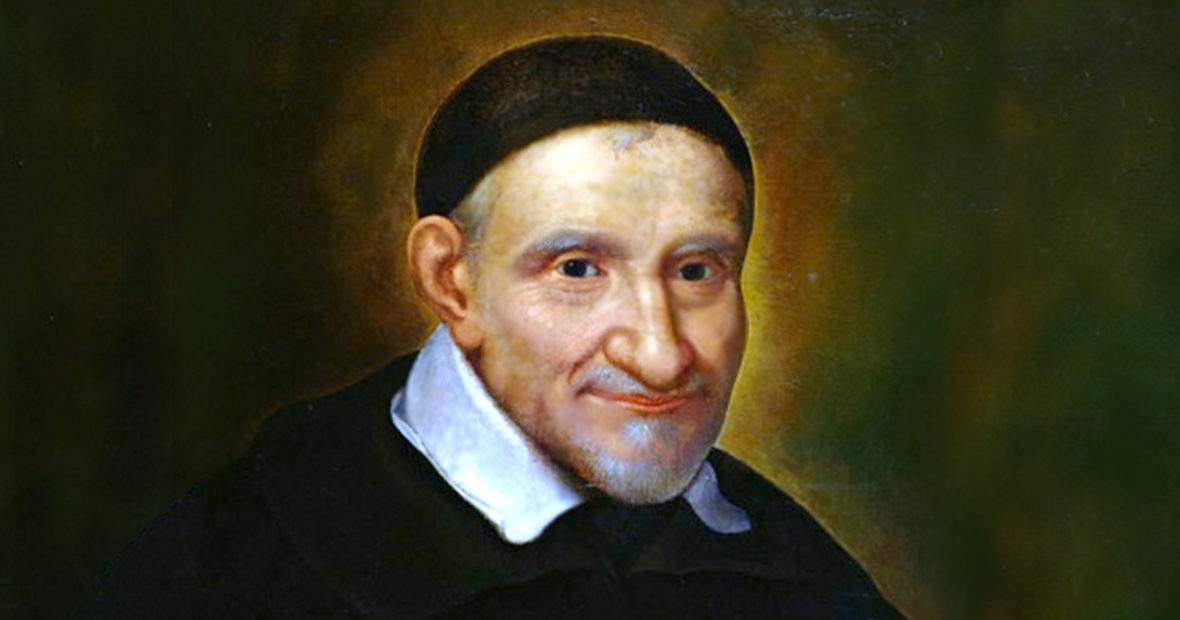
Feast Day: September 27
Born: April 24, 1581, Pouy, Gascony, France
Died: September 27, 1660, Paris, France
Canonized: June 16, 1737, by Pope Clement XII
Patron Saint: Charitable works, charities, volunteers, prisoners, and the poor
Saint Vincent de Paul stands among the great saints of Christian charity. A seventeenth-century French priest, he transformed his experience of the priesthood into a lifelong mission of serving the poor, educating clergy, caring for prisoners, organizing charitable works, and forming communities dedicated to the Gospel. His feast is celebrated on September 27. (New Advent)
His life reminds the Church that charity is not merely an occasional act of generosity. For Vincent, love of the poor was inseparable from love of Jesus Christ. Pope Francis, reflecting on Vincent’s charism, described how Vincent came to encounter Christ the Good Shepherd in the poor and eventually referred to the poor as “our lords and masters.” (Vatican)


Early Life
Vincent was born on April 24, 1581, in the village of Pouy in Gascony, France, into a poor farming family. His parents worked hard to provide for their children, and Vincent grew up familiar with the difficulties experienced by ordinary rural families.
As a young man, Vincent pursued education and eventually studied theology at Toulouse. He was ordained a priest in 1600. At first, his ambitions were not yet focused on the extraordinary service to the poor for which he would later become famous. His early priesthood included work among wealthier families and the pursuit of ecclesiastical advancement. (New Advent)
But God’s providence gradually led him in another direction.
A Captive and a Priest Transformed
One of the most dramatic episodes in Vincent’s early life occurred in 1605. While travelling by sea from Marseilles, he was captured by pirates and taken to Tunis. He was sold into slavery and remained in captivity for approximately two years before escaping with his master in 1607. (New Advent)
This extraordinary experience deeply marked Vincent. He had personally experienced poverty, insecurity, suffering and the loss of freedom. His later ministry would bring him into close contact with people who were similarly forgotten or oppressed.
After returning to France, Vincent continued his studies and ecclesiastical work. His spiritual journey, however, was changing. He increasingly understood that priesthood was not a path to personal prestige but a vocation to serve Christ and His people.
The Turning Point of His Priesthood
Vincent’s ministry among the poor became especially significant in the years around 1617.
While serving the Gondi family, he became increasingly aware of the spiritual and material poverty of rural people. He saw people who lacked adequate catechesis and priests who were sometimes insufficiently prepared for their pastoral responsibilities.
In 1617, Vincent preached a mission at Folleville that produced an extraordinary response. Large numbers of people came to confession, so many that additional priests were needed to assist. Vincent recognized that there was an enormous need for sound preaching, catechesis and sacramental ministry among the rural poor. (Loyola Press)
This experience helped shape the mission that would occupy the remainder of his life.
Vincent began to see clearly that evangelization and charity belong together. The poor needed food and material assistance, but they also needed the Gospel, the sacraments, education and human dignity.
The Confraternities of Charity
In 1617 Vincent helped establish the Confraternities of Charity, groups organized to care systematically for sick and impoverished people.
Rather than leaving charity to occasional acts of generosity, Vincent encouraged organized and sustained service.
This was characteristic of his approach. He wanted compassion to become practical.
A hungry person needed food.
A sick person needed care.
A prisoner needed dignity.
A child needed education.
A person far from God needed evangelization.
A priest needed formation.
For Vincent, all these needs could become opportunities to encounter Christ.
The charitable movement he initiated eventually became an important part of the Vincentian tradition. (SVdP National Council Canada)
The Congregation of the Mission
In 1625 Vincent founded the Congregation of the Mission, commonly known as the Vincentians or Lazarists.
The congregation was established especially for evangelization among the rural poor and for the formation of priests. Its members sought to imitate Christ the Good Shepherd through preaching, missions, spiritual formation and practical service. (Loyola Press)
Vincent understood that the renewal of the Church required the formation of good priests.
A priest who truly knows Christ can lead people to Christ.
Therefore, Vincent organized retreats and conferences for clergy and worked tirelessly for priestly formation. His concern for the spiritual life of priests became one of his lasting contributions to the Church.
Service to Prisoners and the Forgotten
Vincent’s charity extended even to people whom society often ignored.
He served as chaplain to galley slaves and became deeply concerned about their terrible conditions. His compassion was not restricted to people who were socially respectable or personally attractive.
He saw human beings created in the image of God.
This is one of the most challenging aspects of Vincent’s spirituality. Christian charity cannot be limited to people who can repay us or those whom society considers worthy.
The Gospel calls Christians to recognize Christ in those who suffer.
Saint Vincent and Saint Louise de Marillac
One of the most important collaborations in Vincent’s life was his relationship with Saint Louise de Marillac.
Together they worked to organize charitable service and eventually founded the Daughters of Charity in 1633. (SVdP National Council Canada)
The Daughters of Charity developed an extraordinary apostolate among the sick, poor, abandoned children and other people in need.
Their vocation demonstrated something Vincent understood profoundly: charity requires both a loving heart and organized action.
Love must become visible.
Vincent and the Poor
At the heart of Vincent’s spirituality was his conviction that Christ is encountered in the poor.
Pope Francis emphasized this dimension of Vincent’s life in his 2017 message to the Vincentian Family. He recalled how Vincent encountered Jesus the Good Shepherd in people who were suffering and came to understand the poor as people deserving profound respect and service. (Vatican)
Vincent’s famous description of the poor as “our lords and masters” expresses this spirituality beautifully. (Vatican)
This does not mean romanticizing poverty. Rather, it means recognizing the dignity of every person and allowing the suffering of another person to disturb our hearts enough that we actually respond.
Charity Joined to Justice
Saint Vincent’s charity was practical and organized.
He did not simply encourage people to feel sorry for the poor. He sought ways to respond to concrete needs through communities, institutions, education, priestly formation and sustained assistance.
This aspect of Vincent’s legacy remains particularly important. Charity is not simply an emotion. Genuine Christian love asks:
What does this person need?
How can I help?
How can this suffering be alleviated?
How can dignity be restored?
Vincent’s approach therefore combined compassion with responsibility.
A Spirituality of Humility
Vincent repeatedly emphasized humility.
Despite becoming an influential priest and founder, he remained deeply conscious of his dependence upon God’s grace.
His spirituality can be summarized through several virtues:
- Humility – recognizing that everything comes from God.
- Charity – loving Christ through service of others.
- Simplicity – living without unnecessary complication or self-display.
- Gentleness – treating suffering people with patience and respect.
- Zeal – working tirelessly for the salvation and dignity of others.
- Practical wisdom – turning good intentions into effective action.
These virtues made his charity sustainable rather than merely sentimental.
His Love for the Church
Vincent was not simply a social reformer. He was first and foremost a Catholic priest.
His concern for the poor came from his faith in Christ.
He preached the Gospel, encouraged frequent and worthy reception of the sacraments, promoted priestly formation and founded religious communities for evangelization and charity.
For Vincent, the corporal and spiritual works of mercy belonged together.
The poor needed bread, but they also needed hope.
They needed medicine, but they also needed human companionship.
They needed material assistance, but they also needed to know that they were loved by God.
His Final Years
Vincent continued his apostolic work well into old age.
He remained active in directing his communities and charitable initiatives despite declining strength. His life had become almost entirely consumed by the service of God and neighbor.
He died in Paris on September 27, 1660, at the age of 79. (SVdP National Council Canada)
His reputation for holiness quickly spread. He was beatified in 1729 and canonized by Pope Clement XII on June 16, 1737. (Catholic Online)
In 1883, Pope Leo XIII declared him the special patron of charitable associations. (SVdP New Zealand)
The Society of Saint Vincent de Paul
The influence of Saint Vincent continued long after his death.
In 1833, almost two centuries after Vincent’s death, Blessed Frédéric Ozanam and several companions founded the Society of Saint Vincent de Paul in Paris.
The Society took Vincent as its patron and sought to express his spirit through personal service to people experiencing poverty and hardship. (SVdP New Zealand)
Today, the Vincentian tradition includes numerous congregations, organizations and charitable movements throughout the world.
The name of Saint Vincent de Paul has therefore become associated with organized Christian charity across many countries.
Saint Vincent de Paul and Kerala
The Vincentian spirit has also had a particular connection with the Church in Kerala.
The Vincentian Congregation, a Syro-Malabar clerical society of pontifical right, traces its origins to Father Varkey Kattarath, who founded the congregation at Thottakom in Kerala on November 20, 1904. The congregation chose Saint Vincent de Paul as its father and patron and emphasizes evangelization, particularly among the poor. (Vincentian Congregation)
Thus, the charism of Saint Vincent continues to inspire priests and religious communities in India, including the Syro-Malabar Church.
Lessons from Saint Vincent de Paul for Today
1. See Christ in the poor
Saint Vincent teaches us not merely to look at people who suffer but to see Christ in them.
When we encounter the hungry, homeless, sick, abandoned or lonely, we encounter an opportunity to express the love of Jesus.
2. Charity must become action
It is easy to say, “I will pray for you.”
Prayer is essential, but Vincent reminds us that whenever we can help, we should allow prayer to lead to concrete action.
3. Serve without seeking recognition
True charity does not depend upon applause.
The Christian serves because Christ served first.
4. The Church needs well-formed priests
Vincent understood that priestly holiness and formation have an enormous influence on the spiritual life of the faithful.
His work reminds priests that preaching, confession, catechesis and personal holiness are essential dimensions of pastoral ministry.
5. Organize compassion
Good intentions are important, but organized charity can reach many more people.
Vincent transformed compassion into communities, institutions and apostolic structures that continued beyond his lifetime.
6. Never consider anyone unworthy of love
Vincent served prisoners, the sick, the poor and people whom society often overlooked.
The Gospel does not establish a category of people whom Christians are permitted to ignore.
Saint Vincent de Paul and the Eucharistic Heart of Charity
For a Catholic understanding of Vincent’s spirituality, charity ultimately flows from Christ.
The Eucharist reveals Christ giving Himself completely for humanity.
The person who receives Christ in the Eucharist is called to become an instrument of Christ’s love in the world.
Saint Vincent’s life gives a practical expression to this Eucharistic spirituality: having received Christ, we are sent to recognize and serve Christ in others.
This is why Vincentian charity is more than humanitarian assistance. It is an expression of Christian discipleship.
A Saint for Our Time
Saint Vincent de Paul lived in seventeenth-century France, but the fundamental problems he encountered remain familiar: poverty, loneliness, inadequate education, hunger, sickness, abandonment and spiritual neglect.
His response was neither indifference nor despair.
He prayed.
He organized.
He formed people.
He preached.
He founded communities.
He served.
And he continued serving until the end of his life.
Pope Francis has emphasized that the Vincentian charism remains relevant because Vincent’s encounter with Christ in the poor continues to challenge Christians today. (Vatican)
The question Saint Vincent leaves before every Christian is simple:
When I see a person suffering, do I see a problem—or do I see a person whom Christ is asking me to love?
Conclusion
Saint Vincent de Paul was a priest who allowed the Gospel to move from his heart into his hands.
He did not merely preach about compassion. He organized it.
He did not merely speak about the dignity of the poor. He served them.
He did not merely call priests to holiness. He worked for their formation.
He did not merely encourage charity. He built communities capable of sustaining it.
His life demonstrates that holiness is not separated from ordinary human suffering. On the contrary, holiness becomes visible when Christians allow the love of Christ to reach the hungry, the sick, the imprisoned, the abandoned and the forgotten.
Saint Vincent teaches us that every act of genuine charity can become an encounter with Jesus Christ.
May his intercession inspire priests, religious, families, charitable workers, volunteers and every Christian to recognize Christ in those who suffer and to respond with generous love.
“Love the poor. Honour them, my children, as you would honour Christ himself.”
— attributed to Saint Vincent de Paul and preserved in the Vincentian tradition. (SVdP New Zealand)
Prayer to Saint Vincent de Paul
Saint Vincent de Paul, apostle of charity and servant of the poor,
pray for us.
Teach us to recognize Jesus in every person who suffers.
Give us compassionate hearts that are not indifferent to the needs of others.
Help us to serve the poor with humility, patience and love.
Obtain for us the grace to use our gifts and resources for the glory of God
and the good of our brothers and sisters.
Pray for the sick, the homeless, the hungry, the abandoned and the lonely.
Pray for prisoners and those who have no one to care for them.
Pray for priests, religious and all who dedicate their lives to charity.
May we never pass by suffering without compassion
and never see a person in need without remembering Christ.
Saint Vincent de Paul,
pray for us and teach us to love Christ in the poor.
Amen.
Sources: Catholic Encyclopedia; Vatican, Message to the Vincentian Family on the Fourth Centenary of the Charism; Society of Saint Vincent de Paul; Catholic Church in France; Loyola Press. (New Advent)
Leave a Reply