
Introduction
The Feast of All Saints, celebrated every year on November 1 in the Latin Catholic Church, is one of the most beautiful celebrations in the liturgical calendar. On this solemnity, the Church honours all the saints in heaven: those officially canonised by the Church and the countless holy men and women whose names are known only to God.
This feast reminds us that holiness is not reserved for a few extraordinary individuals. Every Christian is called to become a saint by following Jesus Christ, living the Gospel, practising charity, and remaining faithful to God in the ordinary circumstances of daily life.
The Feast of All Saints directs our attention towards heaven, strengthens our hope in eternal life, and reminds us that the Church is united across heaven and earth. The saints are not distant figures of the past; they are our brothers and sisters in Christ who encourage us by their example and intercede for us through their prayers.
1. What Is the Feast of All Saints?
The Feast of All Saints, also known as All Saints’ Day or the Solemnity of All Saints, is a celebration in honour of all those who have attained the glory of heaven.
The Catholic Church recognises many saints through the process of canonisation. However, the number of those who have reached heaven is far greater than the number of officially canonised saints. Countless people have lived lives of faith, love, sacrifice, forgiveness, and holiness without ever receiving public recognition.
This solemnity honours all of them.
The feast celebrates the fulfilment of God’s saving work in the lives of His people. It proclaims that God’s grace can transform ordinary human beings into witnesses of extraordinary love. The saints reveal what happens when people allow Christ to live and work in them.
The Catechism of the Catholic Church teaches that the saints in heaven continually intercede for the Church and that their communion with Christ strengthens the entire Church (CCC 956).
The Feast of All Saints is therefore both a celebration of those who have reached heaven and an invitation to those still journeying towards it.
2. Biblical Foundations of the Feast
Although the Bible does not prescribe a specific annual Feast of All Saints, the celebration is deeply rooted in Scripture.
A Great Multitude Before the Throne of God
One of the most important biblical passages associated with this solemnity is Revelation 7:9–14:
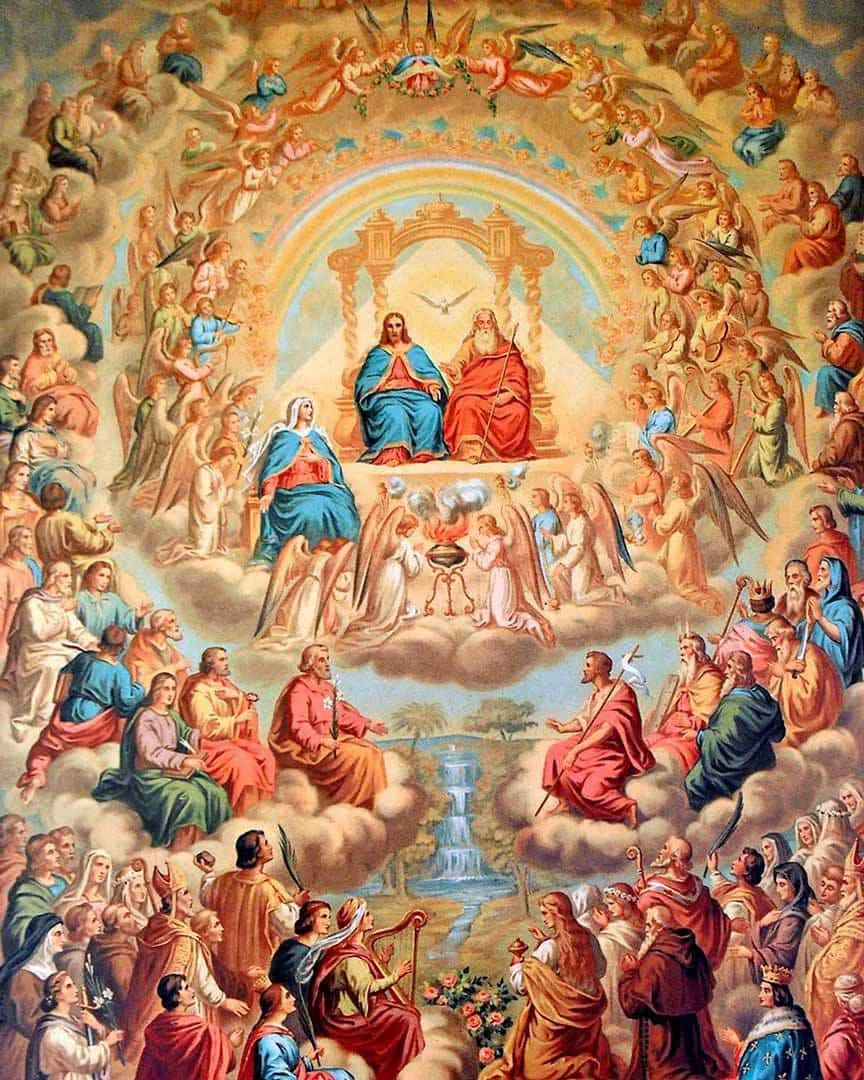
“After this I looked, and there was a great multitude that no one could count, from every nation, from all tribes and peoples and languages, standing before the throne and before the Lamb.”
This vision presents the saints as a countless multitude gathered before God. They come from every nation, culture, language, and people. Their unity is not based on earthly status or social position but on their salvation through the Lamb.
The passage offers a powerful message of hope: heaven is not the exclusive possession of one nation or group. God’s saving grace reaches people from every corner of the world.
The saints have passed through suffering and trials, yet they now stand before God in glory. Their lives testify that faithfulness to Christ leads towards eternal life.
The Call to Holiness
In Matthew 5:1–12, Jesus proclaims the Beatitudes during the Sermon on the Mount. This Gospel is traditionally proclaimed at Mass on the Solemnity of All Saints in the Roman Rite.
Jesus declares blessed those who are poor in spirit, those who mourn, the meek, those who hunger and thirst for righteousness, the merciful, the pure in heart, and the peacemakers.
These words describe the spiritual character of the saints.
The saints are not necessarily those who enjoyed comfortable lives or received universal admiration. They are those who learned to trust God, forgive their enemies, seek justice, show mercy, and remain faithful even in suffering.
The Beatitudes reveal that the values of God’s Kingdom often differ from the values of the world. While the world frequently celebrates power, wealth, fame, and success, Jesus blesses humility, mercy, purity of heart, and a hunger for righteousness.
The saints are those who have allowed these values to shape their lives.
The Universal Call to Holiness
In Matthew 5:48, Jesus says:
“Be perfect, therefore, as your heavenly Father is perfect.”
This command is not an invitation to achieve human perfection through personal effort alone. It is a call to grow in the fullness of love through God’s grace.
Similarly, 1 Peter 1:15–16 calls believers to be holy in all their conduct, reflecting God’s holiness.
Saint Paul also reminds the Christians at Thessalonica that God’s will for them includes their sanctification (1 Thessalonians 4:3).
These passages establish an essential truth: holiness is not an optional vocation for a select few. Every Christian is called to become holy according to God’s plan.
The Heavenly Jerusalem
Hebrews 12:22–24 speaks of the heavenly Jerusalem and the assembly of the firstborn enrolled in heaven. It presents the Christian life as a journey towards a heavenly community in which God’s people are gathered in His presence.
The Feast of All Saints celebrates this heavenly assembly and reminds us that our earthly pilgrimage is directed towards communion with God.
3. The History and Development of All Saints’ Day
The celebration of all the saints developed gradually during the early centuries of Christianity.
The Early Christian Veneration of Martyrs
From the earliest centuries, Christians honoured the martyrs who had given their lives for Christ. Their anniversaries were remembered through prayer and the celebration of the Eucharist, often near the places where they were buried.
The martyrs were regarded as powerful witnesses to the truth of the Gospel. Their courage demonstrated that fidelity to Christ was more precious than earthly life.
As Christianity spread, the number of recognised martyrs increased. Eventually, the Church also began to honour holy bishops, monks, virgins, confessors, and other faithful disciples who had lived lives of exceptional holiness without dying as martyrs.
A common celebration became increasingly appropriate because the saints could not all be commemorated individually.
The Influence of Pope Boniface IV
An important milestone occurred in the early seventh century. Pope Boniface IV consecrated the ancient Roman Pantheon as a Christian church dedicated to the Virgin Mary and all the martyrs, traditionally dated to May 13, 609 or 610, depending on the historical chronology used.
This dedication helped establish a significant public commemoration of Mary and the martyrs in Rome.
However, it is important to distinguish this earlier observance from the later establishment of November 1 as the date of the universal celebration.
Pope Gregory III and November 1
During the eighth century, Pope Gregory III dedicated a chapel in St Peter’s Basilica in Rome in honour of the Saviour, the Blessed Virgin Mary, the apostles, martyrs, confessors, and all the just who had died throughout the world.
His action is associated with the growing observance of a feast honouring all the saints.
By the ninth century, November 1 had become an established date for the celebration in important parts of the Western Church. Pope Gregory IV promoted the observance more widely during the ninth century, traditionally around 835, with the support of Emperor Louis the Pious.
Over time, the feast became firmly established throughout the Latin Church.
The Feast in the Universal Church Today
Today, the Solemnity of All Saints is celebrated on November 1 in the Latin Catholic Church. It is also observed by many other Christian communities, although dates and liturgical customs vary.
In the Roman Catholic calendar, All Saints’ Day is a solemnity, the highest rank of liturgical celebration. It honours the entire company of the saints and celebrates the hope of sharing eternal life with God.
In countries where it is a holy day of obligation, Catholics are required to participate in Mass, subject to the applicable ecclesiastical norms and legitimate dispensations. Whether it is a holy day of obligation depends on the particular country and the decisions of the competent ecclesiastical authority.
4. Why Does the Church Honour All the Saints?
The Church honours the saints for several important reasons.
The Saints Glorify God
The holiness of the saints is ultimately the work of God’s grace. Their lives demonstrate the transforming power of the Holy Spirit.
When the Church honours a saint, she does not place that person above God. Rather, she glorifies God for what He has accomplished in that person’s life.
The saints are living testimonies to the truth that God’s grace can overcome sin, selfishness, fear, and weakness.
The Saints Are Examples for Us
The saints show us how to live the Gospel in concrete circumstances.
Saint Francis of Assisi teaches us simplicity and love for creation. Saint Teresa of Calcutta reminds us of the dignity of the poor. Saint Thérèse of Lisieux reveals the holiness of small acts of love. Saint Thomas More witnesses to the importance of conscience and fidelity to God.
The saints lived in different centuries, cultures, professions, and circumstances. Yet they were united by their love for Christ.
Their lives encourage us to recognise that holiness can be lived in families, parishes, workplaces, schools, hospitals, religious communities, and every other setting in which people encounter one another.
The Saints Intercede for Us
Catholics believe that those who have died in Christ and now share the glory of heaven remain united with the Church.
The saints pray for us and accompany us spiritually through their intercession. This belief does not diminish the unique role of Jesus Christ, who alone is the one mediator between God and humanity in the order of salvation. Rather, the intercession of the saints participates in Christ’s mediation and depends entirely upon Him.
The Catechism of the Catholic Church explains this communion in CCC 956.
When we ask a saint to pray for us, we are asking a member of Christ’s Body who is alive in God to join us in prayer.
The Saints Strengthen Our Hope
The saints remind us that eternal life is a real promise of God.
Their earthly lives were not free from hardship. Many experienced rejection, illness, persecution, loneliness, uncertainty, and sorrow. Nevertheless, they persevered in faith.
Their final victory encourages us to remain faithful during our own trials. The Feast of All Saints proclaims that suffering, sin, and death do not have the final word. Christ has conquered death, and those who belong to Him are called to share His glory.
5. The Communion of Saints
One of the most important teachings associated with the Feast of All Saints is the Catholic doctrine of the Communion of Saints.
The Apostles’ Creed professes belief in “the communion of saints.” This communion refers to the spiritual union of all those who belong to Christ.
The Church understands this communion in three closely connected dimensions:
- The faithful on earth, who are still journeying towards the fullness of God’s Kingdom.
- The faithful who have died and are undergoing purification, traditionally called the souls in purgatory.
- The saints in heaven, who already share the joy of God’s presence.
The Catechism explains this teaching in CCC 954.
Although these members of the Church experience different conditions, they remain united in Christ. Their communion is founded upon the grace of God and the saving work of Jesus.
The Feast of All Saints focuses especially on those who have attained heavenly glory. The following day, November 2, the Church commemorates all the faithful departed and prays particularly for those who are being purified on their way to the fullness of heaven.
Together, these observances express the Church’s faith that death does not destroy the bonds of love established in Christ.
6. The Meaning of the Beatitudes on All Saints’ Day
The Gospel of the Beatitudes offers a spiritual portrait of the saints. It also gives us a practical guide for our own journey towards holiness.
Blessed Are the Poor in Spirit
The poor in spirit recognise their need for God. They do not depend entirely on their own achievements, wealth, or abilities. They approach the Lord with humility and trust.
The saints knew that holiness was not something they could claim as a personal accomplishment. They relied upon God’s mercy and grace.
To become poor in spirit is to acknowledge that everything good in our lives is ultimately a gift.
Blessed Are Those Who Mourn
The saints understand sorrow, but they do not surrender to despair. They grieve for personal losses, the suffering of others, the sins of the world, and the distance between humanity and God’s perfect love.
Their sorrow becomes a source of compassion. Rather than turning away from suffering, they allow it to open their hearts to those who are wounded.
Blessed Are the Meek
Meekness is not weakness. It is strength governed by humility, patience, and love.
The saints often possessed remarkable courage, yet they did not need to dominate others. They knew how to correct without humiliating, serve without seeking praise, and endure injustice without abandoning their commitment to truth.
Blessed Are Those Who Hunger and Thirst for Righteousness
The saints longed for God’s will to be accomplished in their lives and in society.
They sought justice, defended the vulnerable, challenged wrongdoing, and worked to establish relationships marked by truth and integrity.
Their holiness was not limited to private prayer. It inspired them to act for the good of others.
Blessed Are the Merciful
Mercy is one of the clearest signs of holiness.
The saints knew their own need for forgiveness and therefore learned to show compassion towards others. They forgave enemies, welcomed sinners, cared for the sick, and reached out to those whom society rejected.
A merciful heart does not deny wrongdoing. Rather, it seeks the restoration and healing of the person who has sinned.
Blessed Are the Pure in Heart
Purity of heart means seeking God with sincerity and allowing our desires, intentions, and actions to be transformed by His grace.
The saints were not necessarily free from temptation or inner struggle. Their holiness often grew through repentance, prayer, and the repeated decision to choose God’s will over selfish desires.
Blessed Are the Peacemakers
The saints worked to reconcile people with God and with one another.
They built bridges across divisions, healed conflicts, defended human dignity, and encouraged forgiveness. Their peace was not mere avoidance of disagreement but a commitment to truth, justice, and charity.
Blessed Are Those Who Are Persecuted for Righteousness
Many saints suffered because they remained faithful to Christ and His Gospel.
Some were imprisoned or killed. Others endured ridicule, rejection, or misunderstanding. Their witness teaches us that following Jesus may demand courage and sacrifice.
The Beatitudes therefore reveal that sainthood is not measured by worldly success. It is measured by a life increasingly conformed to the heart of Christ.
7. How Is All Saints’ Day Celebrated?
The Church celebrates the Solemnity of All Saints primarily through the liturgy.
The Celebration of Holy Mass
The Eucharist is the centre of the celebration. Through the readings, prayers, hymns, and Eucharistic celebration, the faithful give thanks to God for the saints and renew their hope of sharing eternal life with Him.
In the Roman Rite, the principal readings for the solemnity are:
- First Reading: Revelation 7:2–4, 9–14
- Responsorial Psalm: Psalm 24:1–6
- Second Reading: 1 John 3:1–3
- Gospel: Matthew 5:1–12a
These readings proclaim the glory of heaven, the dignity of God’s children, and the call to holiness expressed in the Beatitudes.
Prayer and Veneration of the Saints
Catholics may pray the Litany of the Saints, invoke particular saints, or reflect on the lives of holy men and women who inspire them.
Some families and parishes organise special prayers, catechetical programmes, processions, or devotional gatherings. Practices vary according to local customs and ecclesiastical traditions.
Remembering the Witness of Holy People
All Saints’ Day is an opportunity to revisit the stories of the saints and discover what their lives can teach us.
Parents and teachers can introduce children to saints whose experiences speak to their own lives. Young people can learn from saints who struggled with questions of vocation, friendship, courage, and faith. Families can choose a saint whose example they wish to follow during the coming year.
The purpose is not merely to collect stories about holy people. It is to allow their witness to inspire a deeper relationship with Christ.
8. All Saints’ Day and All Souls’ Day: What Is the Difference?
All Saints’ Day and All Souls’ Day are celebrated on consecutive days, but they have distinct emphases.
All Saints’ Day — November 1
The Church celebrates all those who have attained the glory of heaven. The feast is a joyful celebration of holiness, eternal life, and the communion of saints.
All Souls’ Day — November 2
The Church commemorates all the faithful departed and offers prayers for those who have died and are undergoing purification. The faithful are especially encouraged to pray for the dead and offer the Eucharist for them.
The two celebrations are closely connected. All Saints’ Day looks towards the glory of those who have reached heaven, while All Souls’ Day expresses the Church’s prayerful solidarity with the faithful departed.
Both proclaim the Christian conviction that death does not separate those who belong to Christ from the love of God.
9. Is All Saints’ Day the Same as Halloween?
All Saints’ Day and Halloween are historically connected through the calendar, but they are not the same celebration.
The word Halloween comes from the expression “All Hallows’ Eve,” meaning the evening before All Saints’ Day. November 1 became the feast of All Saints in the Western Church, and October 31 came to be known as its vigil.
Over the centuries, Halloween developed a variety of customs, some religious and others secular or commercial. Modern celebrations differ widely from place to place.
For Catholics, the central purpose of All Saints’ Day is to honour those who share God’s glory and to renew our commitment to Christian holiness. Halloween customs should be evaluated according to their meaning and compatibility with Christian faith and charity.
The connection between the dates provides an opportunity for families and parishes to recover the Christian significance of the season by teaching children about the saints, the resurrection, and the hope of eternal life.
10. The Feast of All Saints in the Syro-Malabar Church
The Syro-Malabar Church is an Eastern Catholic Church of the Saint Thomas Christian tradition, rooted especially in Kerala, India. It shares the Catholic faith in the communion of saints, the veneration of holy men and women, and the hope of eternal life.
The Syro-Malabar Church has its own liturgical tradition, rooted in the East Syriac heritage. Its liturgical calendar and celebrations should be understood within this tradition rather than simply assumed to be identical in every detail to the Latin Rite.
Catholics of the Syro-Malabar Church can celebrate the universal significance of All Saints by giving thanks for the saints of the universal Church and remembering the holy witnesses who have nourished the faith of the Saint Thomas Christian community.
Saint Thomas the Apostle, Saint Alphonsa, Saint Kuriakose Elias Chavara, Saint Euphrasia, Saint Mariam Thresia, Saint Devasahayam Pillai, and other saints connected with the wider Indian Catholic experience offer examples of faithfulness, prayer, service, and sacrifice.
Their lives remind Christians in Kerala that holiness can flourish within the family, parish, religious community, educational institution, hospital, and every setting where the Gospel is lived.
For the precise liturgical observance, readings, and any particular obligation in a Syro-Malabar eparchy, the faithful should consult the official calendar and directions of their own Church authorities.
11. Saints from Every Walk of Life
One of the most encouraging messages of All Saints’ Day is the diversity of those whom God calls to holiness.
Saints in Family Life
Saints Louis and Zélie Martin, the parents of Saint Thérèse of Lisieux, remind us that holiness can grow within marriage and family life.
Parents become holy through patient love, faithful commitment, prayer, forgiveness, and the daily sacrifices involved in caring for their children.
A home becomes a place of holiness when family members learn to respect one another, pray together, forgive one another, and recognise Christ in the vulnerable.
Saints Among the Poor
Saint Vincent de Paul dedicated his life to serving the poor and organising works of charity. Saint Teresa of Calcutta served people who were abandoned, sick, and dying.
Their lives show that the poor are not merely recipients of assistance. They are persons of profound dignity who deserve love, respect, and practical care.
All Saints’ Day challenges us to see Christ in those who are overlooked by society.
Saints in Religious Life
Saint Benedict, Saint Francis of Assisi, Saint Teresa of Ávila, and many others show how prayer, community, sacrifice, and fidelity can transform human life.
Their examples remind religious men and women that consecrated life is not simply about external observances. It is about belonging entirely to God and serving His people with generous hearts.
Saints Among Young People
Saint Dominic Savio, Saint Maria Goretti, Saint Carlo Acutis, and other young saints and blesseds demonstrate that holiness is not restricted to old age.
Young people can become holy through friendship with Jesus, respect for others, purity of heart, generosity, courage, and faithful use of their gifts.
Their witness challenges the idea that holiness must be postponed until later in life.
Saints in Ordinary Work
Saint Joseph, Saint Isidore the Farmer, and many other saints reveal the holiness of ordinary labour.
Work becomes a path towards holiness when it is performed honestly, responsibly, and with love. A teacher preparing a lesson, a nurse caring for a patient, a farmer cultivating the land, a parent preparing a meal, and a worker fulfilling daily duties can all offer their efforts to God.
The saints remind us that no sincere act of love is insignificant in God’s sight.
12. Can Ordinary People Become Saints?
Yes. The Feast of All Saints proclaims that every Christian is called to holiness.
Not everyone is called to become a priest, religious sister, missionary, or founder of a religious congregation. Not everyone will perform miracles or be recognised publicly for extraordinary deeds.
But every Christian is called to love God with all their heart and to love their neighbour as themselves.
Holiness begins with ordinary decisions:
- Choosing honesty when dishonesty seems easier.
- Forgiving someone who has hurt us.
- Caring for a sick family member patiently.
- Refusing to participate in gossip or injustice.
- Remaining faithful to prayer during difficult times.
- Helping someone in need without expecting recognition.
- Admitting our sins and returning to God through repentance.
- Performing our daily responsibilities with love.
- Treating every person with dignity and respect.
- Trusting God even when the future remains uncertain.
These acts may appear small, but they become paths of holiness when they are rooted in love for God.
The saints were not all born with extraordinary courage or perfect understanding. Many struggled with weaknesses, fears, temptations, and failures. Their holiness grew as they repeatedly responded to God’s grace.
Sainthood is not the achievement of people who never struggled. It is the fruit of a life that continually turns towards God.
13. What Prevents Us from Becoming Holy?
Several attitudes can hinder our journey towards holiness.
Pride
Pride makes us believe that we do not need God or that we are superior to others. The saints teach us humility and the importance of recognising our dependence upon grace.
Unforgiveness
Harbouring resentment can close our hearts to God’s healing. Forgiveness may require time, prayer, and wise boundaries, especially after serious harm. Nevertheless, the Christian is called to seek freedom from hatred and to desire the good of others.
Attachment to Worldly Success
Wealth, achievement, recognition, and comfort are not necessarily wrong. They become obstacles when they take the place of God or lead us to disregard others.
The saints teach us to use earthly gifts responsibly while keeping our hearts directed towards eternal life.
Discouragement
Some people believe they cannot become holy because of past sins, repeated failures, or personal weaknesses.
The saints remind us that God’s mercy is greater than our failures. The sacrament of Reconciliation offers forgiveness and renewal, while prayer and the Eucharist strengthen us to continue our journey.
Indifference to Others
Holiness cannot be separated from charity. A person may practise outward religious observances while neglecting the suffering of those nearby.
The lives of the saints challenge us to make our love for God visible through concrete acts of mercy, justice, and service.
14. How Can We Celebrate All Saints’ Day Personally?
The feast can become a meaningful spiritual turning point when we respond to it with practical decisions.
Choose a Saint as a Spiritual Companion
Read the life of a saint whose experience speaks to your present circumstances. Reflect on the virtues that shaped that person’s relationship with God.
Rather than trying to imitate every detail of the saint’s life, identify one virtue you can practise more faithfully.
Read and Pray with the Beatitudes
Spend time with Matthew 5:1–12. Ask yourself which Beatitude challenges you most deeply.
Perhaps you need greater humility, a more merciful heart, a stronger commitment to justice, or greater courage in following Christ.
Allow the Gospel to become a guide for your daily decisions.
Receive the Sacraments Worthily
Participate in Holy Mass and, where needed, approach the sacrament of Reconciliation. The Christian life is sustained by God’s grace, not by personal determination alone.
The Eucharist unites us with Christ and strengthens us to live as members of His Body.
Practise a Hidden Act of Charity
Perform an act of kindness without telling anyone. Help a person who cannot repay you. Visit someone who is lonely. Offer practical support to a family in difficulty.
Hidden acts of love help us grow in the humility and generosity that characterise the saints.
Pray for the Grace to Persevere
Holiness is a lifelong journey. There will be days of consolation and days of spiritual dryness, moments of success and moments of failure.
Ask God for the grace to begin again whenever you fall and to remain faithful in both joyful and difficult circumstances.
15. The Saints Are Our Companions on the Journey
The saints are not merely historical figures whose names appear in calendars or whose statues stand in churches. They are members of the living Body of Christ.
Their lives remind us that the Gospel can be lived in every age and culture. Their intercession assures us that the Church’s communion extends beyond the visible boundaries of earthly life.
When we celebrate All Saints’ Day, we look towards heaven without turning away from our responsibilities on earth.
The saints encourage us to become more patient, more compassionate, more courageous, and more faithful. They remind us that the purpose of the Christian life is not merely to avoid sin or fulfil religious obligations. It is to become increasingly united with Jesus Christ.
Every Christian vocation can become a path towards this union. Married couples, parents, children, priests, religious, consecrated persons, single people, teachers, workers, and those who care for the sick can all respond to God’s call to holiness.
The saints invite us to ask a simple but life-changing question: What is God asking me to change so that I may love Him and my neighbour more faithfully?
16. The Ultimate Goal: Eternal Life with God
The Feast of All Saints directs our hearts towards the ultimate purpose of human life: communion with God in heaven.
Christian hope is not merely the desire for a better future or freedom from suffering. It is the hope of seeing God and sharing His life forever.
First John 3:2 teaches that when Christ is revealed, we shall be like Him, for we shall see Him as He is. This promise gives meaning to our efforts to grow in holiness.
Our earthly life is important, but it is not the whole story. Our suffering, sacrifices, acts of charity, and struggles to remain faithful acquire their deepest meaning in the light of eternal life.
The saints have reached the goal towards which the whole Church is journeying. Their joy encourages us to persevere, and their example reminds us that God’s grace can lead us beyond our limitations.
The Feast of All Saints is therefore a celebration of hope. It proclaims that holiness is possible, that grace is powerful, and that God desires to gather His children into the fullness of His love.
Conclusion
The Feast of All Saints is a celebration of God’s grace at work in human lives. It honours the countless men and women who have reached the glory of heaven and invites us to follow their example.
Through the Beatitudes, the Church presents the path of holiness: humility, mercy, purity of heart, peacemaking, hunger for righteousness, and faithfulness amid suffering.
The saints came from different cultures, families, professions, and historical periods. Some were famous; many were unknown to the world. Some lived in monasteries, while others raised families, worked in ordinary occupations, served the poor, or witnessed to Christ in times of persecution.
What united them was their response to God’s grace and their growing love for Jesus Christ.
As we celebrate this solemnity, let us thank God for the saints, ask for their intercession, and renew our own commitment to holiness. Let us remember that heaven is not merely a distant idea but the destination towards which we are called.
May the example of the saints inspire us to live each day with greater faith, hope, and charity, until we too may share in the eternal joy of God’s Kingdom.
A Feast-Day Meditation
Take a moment to imagine the countless multitude standing before the throne of God: people from every nation and language, people who suffered, people who served quietly, people who forgave, people who persevered when life was difficult, and people who trusted God even when they could not understand His ways.
Among them are saints whose names we know and countless others whose holiness was never publicly recognised.
Their lives remind us that God sees what the world often overlooks. He sees the tears shed in secret, the sacrifices made out of love, the prayers offered in times of darkness, and the good deeds performed without recognition.
Perhaps you sometimes feel that your life is too ordinary to become holy. Perhaps you are burdened by your weaknesses, troubled by your past, or discouraged by the slow pace of your spiritual growth.
The Feast of All Saints offers you a message of hope: do not give up on the grace of God.
You do not need to perform extraordinary deeds every day. You need to learn to love more faithfully, forgive more sincerely, pray more trustingly, and serve more generously. Begin where you are, with the people God has placed in your life and the responsibilities entrusted to you.
Holiness grows through a thousand small acts of love offered to God.
Today, ask yourself: What is the one thing I can do to become more like Jesus?
Perhaps it is to forgive someone, return to prayer, reconcile with a family member, care for a neglected person, or surrender a worry that has taken away your peace.
Take that step with faith.
The saints are witnesses that God’s grace can transform an ordinary life into a beautiful testimony of His love. May their example inspire us to walk faithfully towards heaven, trusting that the God who calls us to holiness will also give us the grace we need to pursue it.
Prayer for the Feast of All Saints
Heavenly Father, source of all holiness, we thank You for the countless saints who now rejoice in Your eternal presence. Through their lives, You have shown us the beauty of Your grace and the transforming power of Your love.
Thank You for the saints who inspire us by their courage, humility, purity, compassion, and faithfulness. Thank You also for the hidden saints whose names are known only to You, whose quiet sacrifices and acts of love have made the world more beautiful.
Through the intercession of all the saints, strengthen us in our Christian journey. Give us humble hearts, forgiving spirits, generous hands, and the courage to remain faithful to Your Gospel. When we fall, help us rise again through Your mercy. When we suffer, sustain us with hope. When we are tempted to give up, remind us of the eternal joy You have prepared for those who love You.
May we recognise Jesus in the people we meet, especially the poor, the lonely, the sick, and the forgotten. Teach us to seek holiness not through pride or worldly recognition but through sincere love and faithful service.
May the example and prayers of all the saints guide us towards deeper communion with Your Son, Jesus Christ, until the day we join the heavenly multitude in praising You forever.
We ask this through Christ our Lord. Amen.
All you holy men and women, saints of God, pray for us.
References and Further Reading
Biblical References
- Revelation 7:2–14 — The great multitude standing before the throne of God.
- Matthew 5:1–12 — The Beatitudes.
- Matthew 5:48 — The call to perfection in the Father’s love.
- 1 John 3:1–3 — The children of God and the hope of seeing Him.
- Hebrews 12:22–24 — The heavenly Jerusalem and the assembly of the faithful.
- 1 Thessalonians 4:3 — The call to sanctification.
- 1 Peter 1:15–16 — The call to holiness.
Catechism of the Catholic Church
- Catechism of the Catholic Church, paragraph 946 onwards: The Communion of Saints
- CCC 956 — The intercession of the saints.
- CCC 954 — The three states of the Church.
- CCC 828 — The Church’s recognition of the holiness of her members.
- CCC 2012–2016 — The universal call to holiness and the perfection of charity.
Official Catholic Resources
- The Holy See — Vatican
- United States Conference of Catholic Bishops — All Saints
- The Catholic Encyclopedia — All Saints’ Day, New Advent
Suggested Further Reading
- Lumen Gentium, Chapter V: The Universal Call to Holiness in the Church.
- Lumen Gentium, Chapter VII: The Eschatological Nature of the Pilgrim Church and Its Union with the Church in Heaven.
- Gaudete et Exsultate by Pope Francis: On the Call to Holiness in Today’s World.
Leave a Reply