
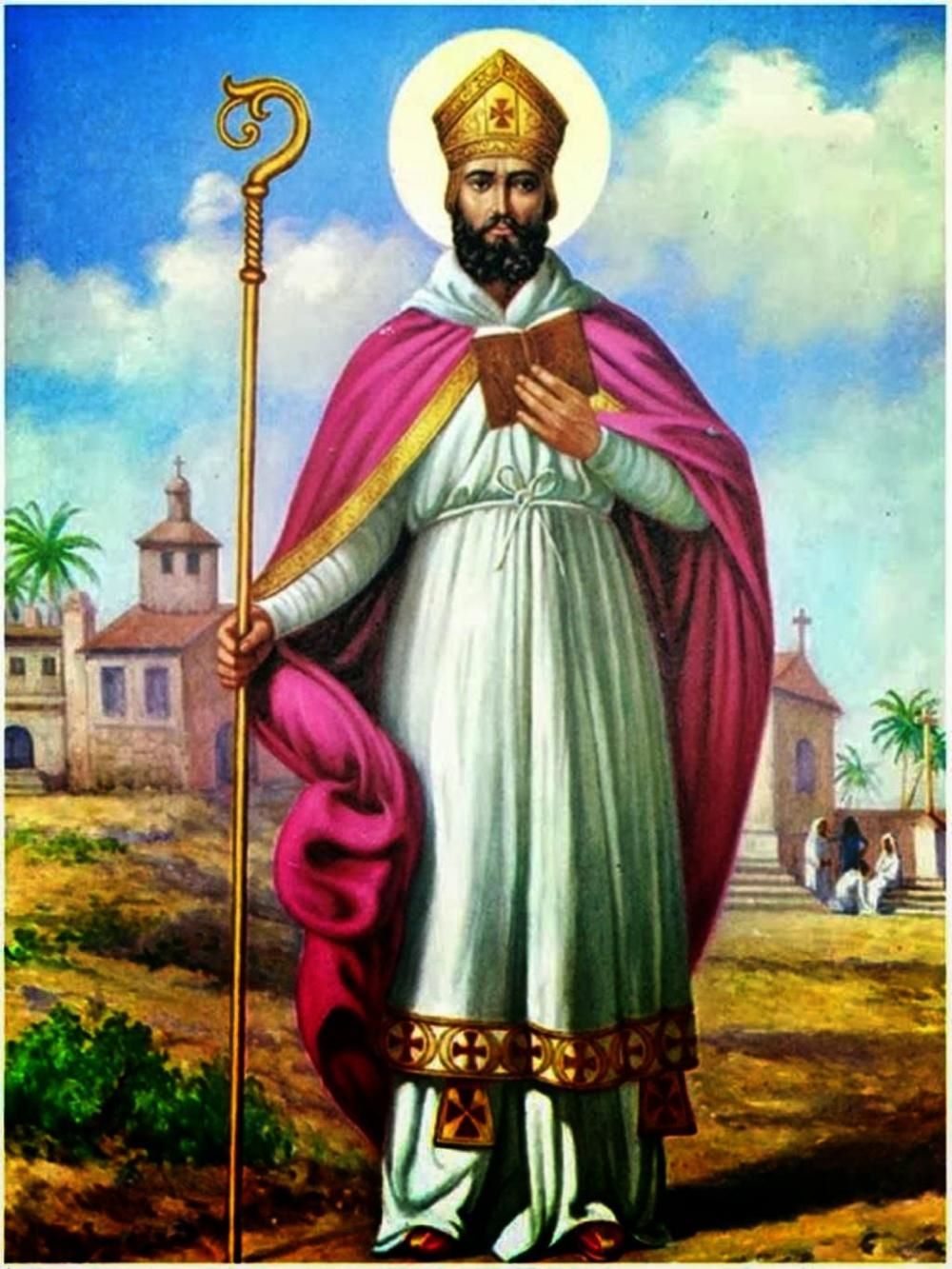
Bishop, Martyr, and Great Witness to the Unity of the Church
Feast Day: September 16
Born: c. 210, Carthage, North Africa
Died: September 14, 258
Canonized: Honored as a martyr and saint from the early Church
Titles: Bishop of Carthage, Father of the Church, Martyr
Patron: North African Christians; invoked especially in connection with bishops, clergy, and the unity of the Church
Saint Cyprian of Carthage was one of the most important bishops and Christian writers of the third century. A gifted teacher, courageous pastor, prolific writer, and martyr, he lived during a period when the Church in North Africa faced persecution, internal division, and difficult questions about forgiveness and reconciliation.
His life and writings offer a powerful testimony to the importance of Christ, the Church, the sacraments, unity, charity, prayer, and courageous Christian witness.


1. Who Was Saint Cyprian?
Thascius Caecilius Cyprianus, commonly known as Saint Cyprian of Carthage, was born around the beginning of the third century in the city of Carthage in Roman North Africa.
Carthage was one of the great cities of the ancient Mediterranean world and became an important centre of Christianity.
Cyprian came from a wealthy and educated pagan family. He received an excellent education and became a successful teacher of rhetoric and an advocate.
For many years he lived according to the values and ambitions of the Roman world.
But eventually, his life changed completely.
He encountered Christianity.
2. His Conversion to Christianity
Cyprian was introduced to Christianity by Caecilius, a Christian priest whose name Cyprian later adopted.
The witness of Christian charity, especially the generosity of Christians toward the poor, deeply impressed him.
Cyprian began studying Sacred Scripture and Christian teaching.
His conversion was not merely an intellectual decision. He gradually came to understand Christianity as a completely new way of life.
He recognized that following Christ required a radical transformation.
He began giving away much of his wealth to the poor and dedicating himself to Christian prayer and study.
His writings later revealed the depth of his biblical knowledge and his conviction that Christian faith must produce a transformed life.
3. From Convert to Priest
Cyprian’s spiritual gifts soon became evident.
He was ordained a priest and became increasingly involved in the life of the Church at Carthage.
Only a few years after his conversion, he was elected Bishop of Carthage, probably in 248 or 249.
His election came at a challenging moment.
The Church was experiencing persecution, disagreements, and pastoral difficulties.
Cyprian understood his episcopal ministry as a responsibility to care for Christ’s flock.
4. Bishop of Carthage
As bishop, Cyprian became one of the principal leaders of the Christian community in North Africa.
He preached, wrote letters, instructed clergy and laity, cared for the poor, and dealt with difficult questions affecting the Church.
His episcopate was marked by two major challenges:
- Persecution
- The question of Christians who had abandoned the faith during persecution
These questions would occupy much of his pastoral ministry.
5. The Decian Persecution
In 250, the Roman Emperor Decius initiated a widespread persecution.
Christians were required to demonstrate loyalty to the Roman religious order, and many were pressured to sacrifice according to the imperial requirements.
Some Christians remained faithful and suffered imprisonment, torture, or death.
Others, frightened by persecution, compromised their faith.
These Christians later became known as the lapsi, meaning those who had “fallen away.”
Cyprian himself withdrew temporarily from Carthage during the persecution so that he could continue guiding the Church through letters.
This decision was controversial.
Some accused him of abandoning his people.
Cyprian argued that remaining alive enabled him to continue exercising his pastoral responsibility.
From his place of hiding, he continued to communicate with clergy and faithful.
6. The Problem of the Lapsed
When persecution subsided, an extremely difficult pastoral question emerged.
What should happen to Christians who had denied their faith?
Should they automatically be readmitted to Communion?
Should they be permanently excluded?
Or should there be some form of repentance and reconciliation?
Cyprian argued for a balanced pastoral approach.
Those who had fallen away needed genuine repentance, but the Church should not close the door to those sincerely seeking reconciliation.
This issue became one of the most important controversies of his episcopate.
7. God’s Mercy and the Sacrament of Reconciliation
Cyprian’s approach demonstrates an important Catholic principle:
The Church must take sin seriously while never denying God’s mercy to the repentant sinner.
He emphasized repentance, confession, penance, and reconciliation.
The Church was not to become either:
- excessively harsh, refusing forgiveness to sincere penitents, or
- excessively permissive, treating serious apostasy as though it did not matter.
For Cyprian, reconciliation required genuine conversion.
This has an enduring pastoral lesson.
The Church proclaims both:
“Turn away from sin”
and
“Return to the mercy of God.”
8. Saint Cyprian and Church Unity
One of Cyprian’s most famous theological concerns was the unity of the Church.
His treatise ** De Unitate Ecclesiae (On the Unity of the Church)** is among his most important works.
Cyprian strongly emphasized that Christians are not isolated individuals.
They belong to the Church.
Christ founded one Church, and Christians are called to live in communion with one another.
For Cyprian, division among Christians was a serious wound to the Body of Christ.
9. “No One Can Have God as Father Who Does Not Have the Church as Mother”
Cyprian is traditionally associated with the famous statement:
“He can no longer have God for his Father who has not the Church for his mother.”
This statement comes from his discussion of Church unity.
It reflects Cyprian’s conviction that Christianity cannot be reduced to a private relationship between an individual and God.
Faith is ecclesial.
Christians receive the faith through the Church, celebrate the sacraments in the Church, hear the Word of God in the Church, and live as members of Christ’s Body.
His statement should be understood within the theological context of his treatise and his concern about schism.
10. The Church as the Body of Christ
Cyprian’s ecclesiology is profoundly Christ-centered.
The Church is not merely a human organization.
She is united to Christ.
The unity of Christians therefore has theological importance.
When Christians divide themselves through hatred, pride, or schism, they damage the visible communion that Christ desires among His disciples.
Cyprian’s writings therefore repeatedly call Christians back to:
- charity,
- humility,
- obedience,
- reconciliation,
- communion,
- peace.
11. “Where the Bishop Is, There Is the Church”
Cyprian placed considerable emphasis on the unity of each local Church around its bishop.
For him, the bishop had a central pastoral responsibility for maintaining communion.
This does not mean that the bishop replaces Christ.
Rather, the bishop serves the unity of the local Christian community as a successor within the apostolic Church.
Cyprian’s episcopal theology became highly influential in the development of Catholic teaching concerning the Church and episcopal ministry.
12. Saint Cyprian on the Eucharist
Cyprian had a deep Eucharistic spirituality.
For him, the Eucharist was intimately connected with Christ’s sacrifice and with the unity of the Church.
The Eucharist is not simply an individual devotional experience.
Those who receive the one Bread are called to become one body in Christ.
This gives the Eucharist a profound ecclesial dimension.
We receive the Body of Christ so that we may live as the Body of Christ.
This is particularly relevant to parish life today.
If we come to the Eucharistic altar while refusing forgiveness, nurturing hatred, or deliberately creating division, our lives contradict the unity that the Eucharist signifies.
13. Cyprian and the Lord’s Prayer
Another important work of Cyprian is his ** De Dominica Oratione — On the Lord’s Prayer**.
He reflects on the prayer that Jesus taught His disciples:
“Our Father…”
Cyprian emphasizes the word “Our.”
We do not pray:
“My Father” in isolation.
We pray:
“Our Father.”
This means Christian prayer has an inherently communal character.
The person praying is part of a family.
The Lord’s Prayer therefore becomes a school of Christian unity.
14. “Give Us This Day Our Daily Bread”
Cyprian also connected the Lord’s Prayer with the Eucharist.
The petition:
“Give us this day our daily bread”
was understood by Cyprian not only in relation to ordinary nourishment but also within the Eucharistic life of the Church.
His Eucharistic interpretation reflects the ancient Christian understanding of Christ as the true Bread of Life.
For Catholics today, this connection between the Lord’s Prayer and the Eucharist remains spiritually rich.
Every day we depend upon God.
Every Sunday we gather around the Eucharistic table.
15. Charity Toward the Poor
Cyprian was not only a theologian.
He was deeply concerned about the poor.
His treatise ** De Opere et Eleemosynis (On Works and Alms)** emphasizes Christian generosity.
He taught that Christians must not become attached to wealth while ignoring people in need.
For Cyprian, almsgiving was an expression of Christian conversion.
The Christian who has received God’s mercy should become merciful toward others.
16. The Plague of Cyprian
During Cyprian’s episcopate, a devastating epidemic spread through the Roman Empire.
It became associated in later history with the name “Plague of Cyprian.”
The epidemic caused enormous suffering.
Cyprian encouraged Christians not to respond with fear alone but with charity.
Christians were called to care for the sick, including people who were not Christians.
This was an extraordinary testimony to Christian love in a time of widespread suffering.
17. Christians Caring for Everyone
Cyprian’s pastoral teaching during the epidemic illustrates something fundamental about Catholic charity.
Christian love cannot be restricted only to people who belong to our own group.
The suffering person is our neighbour.
The Christian sees the suffering person not as an inconvenience but as someone created in God’s image.
Cyprian therefore connected Christian faith with concrete acts of mercy.
18. Persecution Returns
After the persecution under Decius, another period of persecution occurred under Emperor Valerian.
Initially, the authorities focused particularly on Christian clergy.
Cyprian was ordered to cease Christian worship and religious activities.
He was eventually arrested.
This time, he did not flee.
He was prepared to give his life for Christ.
19. The Trial of Saint Cyprian
Cyprian was brought before the Roman authorities in Carthage.
He was ordered to renounce Christianity and comply with the imperial command.
He refused.
He remained faithful to Christ.
The authorities sentenced him to death.
According to the ancient account of his martyrdom, Cyprian responded with remarkable courage.
20. His Martyrdom
Saint Cyprian was beheaded on September 14, 258.
His martyrdom was witnessed by members of his Christian community.
The Church immediately remembered him as a martyr.
His death demonstrated the consistency of his life:
He had taught Christians to remain faithful to Christ.
When persecution came to him personally, he remained faithful.
His martyrdom therefore became the final testimony of his episcopal ministry.
21. Why Is His Feast Celebrated on September 16?
Cyprian died on September 14.
The Church commemorates him liturgically on September 16, together with Saint Cornelius, Pope and martyr.
Saint Cornelius died in 253 and was an important contemporary of Cyprian during the controversy over the lapsed.
The two saints are therefore remembered together as witnesses to Christ during the persecutions of the third century.
22. Saint Cyprian and Saint Cornelius
The relationship between Cyprian and Pope Cornelius was particularly significant.
Both dealt with questions surrounding Christian unity and the reconciliation of those who had fallen away during persecution.
Their correspondence illustrates the difficulties faced by the early Church.
It also reveals something important about Catholic history:
The early Christians took questions of unity, reconciliation, penance, and Church authority extremely seriously.
These were not abstract theological debates.
They concerned real people who had suffered persecution and were seeking their way back into Christian communion.
23. Cyprian as a Father of the Church
Saint Cyprian is honored as one of the important Fathers of the Church.
His writings provide valuable evidence concerning the faith and pastoral practice of Christians in the third century.
His works discuss:
- Church unity
- bishops
- Eucharist
- Baptism
- prayer
- charity
- martyrdom
- penance
- reconciliation
- Christian morality
His writings are therefore important both spiritually and historically.
24. Major Works of Saint Cyprian
Among the works associated with Saint Cyprian are:
On the Unity of the Church
A major reflection on ecclesial unity and the dangers of schism.
On the Lord’s Prayer
A spiritual commentary on the Our Father.
On Mortality
A reflection on Christian attitudes toward death during the plague.
On Works and Alms
A teaching on generosity and care for the poor.
To Donatus
A description of his conversion and transformation.
On the Lapsed
A discussion of Christians who abandoned their faith during persecution.
On the Exhortation to Martyrdom
An encouragement to Christians facing persecution.
On the Good of Patience
A meditation on Christian patience.
On Virginity
A reflection on consecrated virginity and Christian holiness.
These writings make Cyprian one of the most valuable witnesses to third-century North African Christianity.
25. Saint Cyprian’s Spirituality of Martyrdom
For Cyprian, martyrdom was not a search for death.
It was the consequence of faithfulness to Christ when obedience to God came into conflict with demands that required Christians to abandon their faith.
His courage was rooted in Christ.
The Christian martyr does not trust merely in human strength.
The martyr trusts in God’s grace.
Cyprian himself eventually experienced the reality about which he had preached.
26. Lessons from Saint Cyprian
1. Conversion changes the direction of life
Cyprian moved from a worldly career to Christian discipleship.
2. Christian faith requires charity
His concern for the poor demonstrates that faith must become action.
3. The Church needs unity
Division weakens Christian witness.
4. Mercy and truth belong together
The Church must take sin seriously while welcoming genuine repentance.
5. The Eucharist creates communion
The Eucharistic celebration calls Christians to live in unity.
6. Prayer is communal
The words “Our Father” remind us that Christian life is never merely individual.
7. Christians must care for the suffering
Cyprian’s ministry during the epidemic remains a powerful example of Christian charity.
8. Faithfulness may require courage
His martyrdom reminds Christians that following Christ sometimes demands sacrifice.
27. Saint Cyprian and Parish Life Today
Saint Cyprian’s message can be applied directly to parish communities.
A parish can have beautiful liturgies, excellent programs, and active ministries, but Christian unity must remain at the heart of everything.
Cyprian challenges us to ask:
Do we receive Communion while refusing communion with our brothers and sisters?
Do we pray “Our Father” while treating others as enemies?
Do we receive the Eucharist and then ignore those who are suffering?
Do we seek reconciliation when relationships are wounded?
These questions make Cyprian’s third-century writings surprisingly relevant to twenty-first-century Christian communities.
28. Saint Cyprian’s Message for Priests
For priests and bishops, Cyprian offers a particularly powerful example.
He understood pastoral ministry as a responsibility for souls.
He taught, encouraged, corrected, reconciled, defended, and accompanied his people.
He did not consider ecclesial leadership merely an office.
It was a vocation of service.
His life reminds clergy that pastoral authority must always be directed toward:
Christ, truth, mercy, communion, and the salvation of souls.
29. A Powerful Spiritual Theme: “One Church, One Eucharist, One People”
The spirituality of Saint Cyprian can be summarized around the relationship between:
Christ → Eucharist → Church → Unity → Charity.
We belong to Christ.
Christ gathers us into His Church.
The Church celebrates the Eucharist.
The Eucharist unites us as one Body.
That unity must become visible through charity.
This is one of the most enduring contributions of Saint Cyprian’s theology.
30. Prayer Through the Intercession of Saint Cyprian
Saint Cyprian of Carthage,
faithful bishop and courageous martyr of Christ,
you abandoned the emptiness of worldly life
and discovered the treasure of the Gospel.
Pray for us,
that we may know Jesus Christ more deeply
and follow Him with an undivided heart.
Teach us to love the Church,
to value Christian unity,
and to work for reconciliation whenever division arises.
Help us to approach the Holy Eucharist
with sincere faith and love.
Obtain for us a compassionate heart
toward the poor, the sick, the lonely,
and all those who suffer.
Pray for priests and bishops,
that they may serve God’s people
with wisdom, humility, courage, and love.
When we experience trials,
obtain for us the grace of perseverance.
When we are tempted to abandon our faith,
help us to remember the faithfulness of Christ.
And when our earthly journey comes to an end,
may we remain faithful to Jesus
and enter into the joy of eternal life.
Saint Cyprian of Carthage,
bishop and martyr, pray for us.
Amen.
Conclusion
Saint Cyprian of Carthage lived during a turbulent period of Christian history, but his fundamental message remains remarkably simple:
Remain faithful to Christ.
Remain united in His Church.
Receive His grace.
Practice charity.
Seek reconciliation.
And persevere to the end.
He began as a wealthy and accomplished pagan intellectual. Through the grace of conversion, he became a priest, bishop, pastor, theologian, defender of Church unity, servant of the poor, and finally a martyr.
His blood became the final seal of his preaching.
Saint Cyprian reminds every Christian that faith is not merely something we profess with our lips. It is a life of communion, charity, sacrifice, and fidelity to Jesus Christ.
Saint Cyprian of Carthage, great Father of the Church and courageous martyr, pray for us!
Leave a Reply