
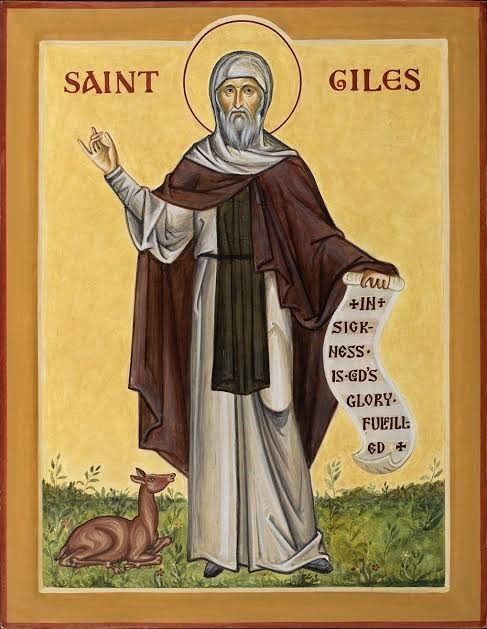
Saint Giles, also known as Giles the Hermit or Aegidius, is one of the most beloved saints of the early medieval Church. Remembered especially for his life of solitude, prayer, humility and charity, he became one of the Fourteen Holy Helpers, a group of saints traditionally invoked together for protection and healing.
His feast is celebrated on 1 September. Saint Giles is particularly associated with the protection of the poor, the sick, the disabled, the mentally afflicted, and people suffering from physical and spiritual troubles. He is also traditionally regarded as the patron saint of forests, hermits, hunters, beggars, and those suffering from epilepsy or mental illness.
His life combines historical tradition with medieval legend, but behind the legends stands a powerful Christian ideal: a person who withdrew from the world not because he hated humanity, but because he wanted to belong completely to God and serve others through prayer and compassion.


1. Who Was Saint Giles?
Saint Giles was probably a seventh-century Christian hermit associated with southern France. His Latin name is Aegidius, while in French he is called Gilles and in English Giles.
According to tradition, Giles was born in Athens, Greece, into a wealthy Christian family. From his childhood he showed a strong inclination toward prayer and charity. Rather than seeking worldly honours and wealth, he gave away his possessions and devoted himself to a life of prayer and asceticism.
Eventually, he left his homeland and travelled westward. He is traditionally said to have reached Gaul, the region corresponding roughly to modern France.
There he sought a life of solitude.
His reputation for holiness, however, made complete solitude impossible. People began to discover him, seek his prayers and ask for healing. His personal desire for hiddenness gradually became a ministry to the suffering.
2. Saint Giles and the Deer


The most famous story connected with Saint Giles concerns a deer or hind.
According to medieval tradition, Giles lived for many years as a hermit in a forest. There he survived on a simple diet and spent much of his time in prayer.
A wild hind became his companion and regularly came to him. Giles cared for the animal, and it became closely associated with him.
One day, hunters pursued the deer. The frightened animal fled toward Giles, seeking refuge near the hermit’s dwelling.
Giles tried to protect it.
An arrow or hunting weapon intended for the deer struck Giles instead, wounding him. The injury, according to tradition, left him permanently disabled.
The hunters were astonished to discover the hermit protecting the animal.
The story became a symbol of Giles’s compassion. He was willing to suffer himself rather than allow a helpless creature to be harmed.
The deer consequently became the most recognizable symbol of Saint Giles.
3. A Saint Who Protected the Weak
The story of the deer is more than a charming legend.
It captures something central to the Christian understanding of holiness.
Saint Giles became associated with those who could not defend themselves.
The deer was vulnerable. Giles became its protector.
In the same spirit, he became a protector of the poor, the sick and the marginalized.
This is one reason why his devotion became particularly strong among ordinary medieval Christians.
People who felt forgotten or helpless could turn to Saint Giles and ask for his intercession.
4. Saint Giles and King Wamba
One of the most famous legends concerning Saint Giles connects him with King Wamba, traditionally identified as a Visigothic king.
According to the story, King Wamba was hunting in the forest when he encountered Giles.
The king was impressed by the hermit’s holiness and eventually learned about his way of life.
The king offered Giles assistance and encouraged him to establish a religious community.
Giles initially preferred solitude, but eventually a monastery grew around his place of prayer.
The traditional story associates this monastery with Saint-Gilles in southern France, which became an important pilgrimage centre.
5. The Foundation of Saint-Gilles
Saint Giles eventually became associated with the monastery of Saint-Gilles-du-Gard, near Nîmes in southern France.
The shrine dedicated to him became one of the important pilgrimage destinations of medieval Europe.
Pilgrims travelled long distances to pray at his tomb and seek his intercession.
The popularity of Saint Giles spread far beyond France.
Churches, monasteries, chapels and hospitals were placed under his patronage throughout Europe.
His name became especially prominent in France, England, Germany, Belgium, Austria, Hungary, Poland and other parts of Europe.
6. Saint Giles and the Fourteen Holy Helpers


Saint Giles is traditionally counted among the Fourteen Holy Helpers.
The Fourteen Holy Helpers were saints who became especially popular in medieval devotion, particularly in regions of Germany and neighbouring countries.
They were invoked collectively because different saints were associated with particular illnesses, dangers or needs.
Saint Giles was especially invoked against:
- epilepsy,
- mental and neurological afflictions,
- physical disability,
- illness,
- fear,
- poverty,
- and dangers affecting vulnerable people.
The devotion to the Fourteen Holy Helpers became particularly important during periods of plague and widespread disease.
7. Patron Saint of Epilepsy
Saint Giles became one of the traditional patron saints of people suffering from epilepsy and seizure disorders.
Medieval Christians sometimes called epilepsy the “disease of Saint Giles” because of the saint’s reputation as an intercessor for those afflicted by such conditions.
It is important, however, to distinguish historical devotion from modern medicine.
The Church’s traditional invocation of Saint Giles is a spiritual practice. It should never be understood as a substitute for medical diagnosis or treatment.
For Christians, praying to Saint Giles means asking God, through the saint’s intercession, for healing, strength, peace and perseverance.
8. His Life of Solitude
Saint Giles represents the ancient Christian tradition of eremitical spirituality.
The hermit does not simply run away from society.
The purpose of solitude is to seek God with an undivided heart.
In the silence of the wilderness, Giles devoted himself to:
- prayer,
- fasting,
- contemplation,
- penance,
- simplicity,
- Scripture,
- and trust in Divine Providence.
His life reminds Christians that prayer does not require impressive surroundings.
A forest, a cave, a small room or a quiet corner can become a place of encounter with God.
9. Giles and Christian Simplicity
Saint Giles had little interest in worldly wealth.
Tradition portrays him as a man who deliberately embraced poverty.
His life therefore presents a strong contrast to a culture that often measures success by possessions, influence and social recognition.
For Giles, true wealth was found in God.
His spirituality can be summarized in a simple principle:
Possess less, pray more, trust God more deeply, and serve the vulnerable.
10. Saint Giles and Charity
Although Giles sought solitude, his holiness was never merely private.
People came to him because they believed that he could help them.
The saint responded with compassion.
This is an important lesson.
Christian holiness is not measured simply by how much one prays alone.
True prayer should gradually produce:
greater love, greater humility and greater compassion.
The person who truly encounters God cannot remain indifferent to suffering.
11. His Monastic Community
As his reputation spread, disciples gathered around Giles.
A community developed around him, eventually becoming associated with the monastery of Saint-Gilles.
This illustrates an interesting pattern in the history of Christian monasticism.
Many monasteries began with individuals who wanted nothing more than to live quietly with God.
People eventually came to them for spiritual guidance.
A small hermitage became a community.
A community became a monastery.
A monastery became a centre of prayer, charity and pilgrimage.
12. Saint Giles as a Model for Priests and Religious
Saint Giles offers several lessons particularly relevant to priests and religious.
1. Interior prayer comes first
Public ministry must be rooted in personal communion with God.
2. Simplicity protects the heart
A complicated life can easily become spiritually distracting.
3. Compassion is essential
The holiness of Giles was expressed through concern for the vulnerable.
4. Humility attracts people
Giles did not seek fame. His reputation grew because of his holiness.
5. God can transform hidden lives
A hermit living in obscurity eventually became one of Europe’s most popular saints.
13. Saint Giles and Animals
Saint Giles is particularly interesting because of his association with the natural world.
The deer in his legend represents a creature that sought refuge with a compassionate human being.
The tradition therefore presents Giles as someone who lived in harmony with God’s creation.
His story can inspire Christians today to develop a deeper respect for:
- animals,
- forests,
- nature,
- creation,
- and the responsibility entrusted to humanity by God.
This does not mean that Saint Giles was primarily an environmental activist in the modern sense. Rather, his traditional image reminds us that Christian spirituality has always recognized creation as God’s gift.
14. Symbols of Saint Giles
Saint Giles is usually represented with several distinctive symbols.
🦌 The Deer
The deer is his most famous symbol and recalls the story of the hind that sought refuge with him.
🏹 The Arrow
An arrow may appear in representations of Giles because of the hunting story in which he was wounded while protecting the deer.
📖 The Book
A book represents prayer, Scripture and the spiritual wisdom associated with his life.
🪵 The Staff
As a hermit and abbot, Giles is often shown carrying a staff.
⛪ The Monastery
Sometimes a monastery is represented in the background, recalling his association with Saint-Gilles.
👤 The Hermit’s Habit
His clothing emphasizes his identity as an ascetic and hermit.
15. Saint Giles in Christian Art


Artists generally portray Saint Giles as an elderly or mature hermit.
He may appear:
- standing beside a deer,
- holding a book,
- carrying a staff,
- with an arrow wound,
- wearing a monastic habit,
- or accompanied by angels.
The deer makes Saint Giles particularly easy to identify in medieval churches and works of art.
16. Saint Giles and Pilgrimage
The shrine at Saint-Gilles became an important destination for medieval pilgrims.
Saint-Gilles was situated near major routes leading toward Santiago de Compostela, making it particularly significant for pilgrims travelling across Europe.
Pilgrimage contributed greatly to the spread of devotion to Saint Giles.
Travellers carried his devotion with them to their home countries, and new churches and chapels were dedicated to him.
Thus a hermit who desired obscurity became a saint whose name travelled across Europe.
17. Saint Giles and the Poor
One of the most beautiful aspects of his traditional patronage is his connection with the poor and marginalized.
In medieval society, people suffering from illness or disability could easily become isolated.
Saint Giles became a spiritual friend of such people.
His message remains relevant today.
Every society has people who are easily forgotten:
- the elderly,
- people with disabilities,
- the homeless,
- the mentally distressed,
- the chronically ill,
- refugees,
- prisoners,
- abandoned children,
- and those who have no social influence.
Saint Giles reminds Christians:
The dignity of a person does not depend on health, wealth, intelligence or social status.
18. Historical Facts and Legends
It is useful to distinguish what can be historically established from what belongs to later tradition.
The historical Saint Giles appears to have been an early medieval holy man associated with southern France and the monastery of Saint-Gilles.
However, many details of his biography were developed through medieval hagiographical traditions.
Stories about:
- his birth in Athens,
- his encounter with King Wamba,
- the miraculous deer,
- his arrow wound,
- and various miraculous healings
belong largely to traditional accounts rather than securely documented contemporary history.
This does not make the spiritual tradition meaningless.
Rather, it means that Saint Giles should be approached with both faith and historical honesty.
19. The Spiritual Meaning of His Legends
The legends surrounding Saint Giles communicate several enduring Christian truths.
The deer teaches compassion.
The strong should protect the weak.
The arrow teaches sacrifice.
Love sometimes requires suffering for another.
The forest teaches silence.
God can be encountered away from noise and distraction.
The hermitage teaches simplicity.
A person does not need possessions to live a meaningful life.
His healing ministry teaches mercy.
Those who suffer should never be forgotten.
20. Lessons from Saint Giles for Christians Today
1. Make space for silence
Modern life is filled with noise.
Saint Giles reminds us of the importance of quiet prayer.
2. Protect the vulnerable
Christianity cannot be indifferent to those who suffer.
3. Do not seek recognition
Giles sought God rather than publicity.
4. Trust Divine Providence
His life was built upon radical dependence on God.
5. Let prayer produce compassion
Prayer should make our hearts more sensitive to the suffering of others.
6. Respect creation
His traditional association with the deer encourages reverence for God’s creatures.
7. Remember the forgotten
The people society ignores may be precisely those whom Christ asks us to notice.
21. Saint Giles and the Gospel
Although Saint Giles lived centuries after the New Testament period, his life beautifully reflects several Gospel teachings.
Jesus says:
“Blessed are the merciful, for they will be shown mercy.”
— Matthew 5:7
Saint Giles is remembered as a man of mercy.
Jesus also says:
“Whatever you did for one of the least of these brothers and sisters of mine, you did for me.”
— Matthew 25:40
The traditional image of Giles protecting a helpless deer and caring for suffering people reflects this Gospel vision.
22. His Death
According to tradition, Saint Giles lived to an advanced age and died in the late seventh or early eighth century, traditionally around 724.
He was buried at the monastery associated with him at Saint-Gilles.
His tomb became a place of pilgrimage.
After his death, devotion to him continued to grow, eventually spreading throughout Europe.
23. Feast Day of Saint Giles
The liturgical memorial of Saint Giles is traditionally celebrated on:
1 September
He is especially honoured in places where churches, monasteries and communities have been dedicated to him.
His feast provides an opportunity to reflect upon:
- prayer,
- solitude,
- charity,
- protection of the vulnerable,
- healing,
- and trust in God.
24. Patronage of Saint Giles
Saint Giles is traditionally invoked as patron of:
- Hermits
- Forests
- Hunters
- The poor
- Begging people
- People with disabilities
- People suffering from epilepsy
- People experiencing mental afflictions
- Those seeking healing
- Those suffering from fear and illness
- People seeking protection
His patronage varies somewhat according to local traditions.
25. Prayer to Saint Giles
Prayer to Saint Giles
O glorious Saint Giles,
faithful servant of God and compassionate protector of the weak,
you who chose the silence of the wilderness
to seek the Lord with an undivided heart,
pray for us.
Teach us to love God above all earthly things,
to value simplicity rather than riches,
and to seek holiness rather than human praise.
You who protected the helpless deer,
teach us to defend those who are vulnerable
and to care for every creature entrusted to us by God.
Merciful Saint Giles,
intercede for the sick, the suffering,
the poor, the lonely and the forgotten.
Bring before the throne of God
all those who seek healing and consolation.
Pray especially for those who suffer from serious illness,
for those who live with disability or weakness,
and for those burdened by fear, anxiety and sorrow.
Obtain for us the grace of patience in suffering,
courage in difficulties,
perseverance in prayer,
and complete trust in Divine Providence.
Help us to imitate your humility,
your charity, your spirit of prayer
and your love for God.
Saint Giles,
faithful hermit and friend of those who suffer,
pray for us.
Amen.
26. A Short Prayer for the Feast of Saint Giles
Saint Giles, servant of God and protector of the suffering, pray for us.
Help us to live with a pure heart,
to pray with perseverance,
to care for the weak,
to protect the vulnerable,
and to remain faithful to Christ in every trial.
Obtain for us healing where we need healing,
strength where we are weak,
hope where we are discouraged,
and peace where we are troubled.
May we never forget those who are suffering or forgotten.
Through your intercession,
may our lives become instruments of God’s mercy.
Saint Giles, pray for us
and lead us closer to Jesus Christ.
Amen.
27. A Final Reflection
Saint Giles began his Christian journey by seeking God in solitude. Yet his solitude did not lead him away from compassion. On the contrary, it made him more sensitive to suffering.
This is perhaps the most important lesson of his life.
The closer we come to God, the more deeply we should care for His creatures.
Saint Giles protected a frightened animal. He welcomed those who sought his prayers. He lived simply. He embraced sacrifice. He became a refuge for people who felt helpless.
His life therefore speaks powerfully to our own age.
We live in a world filled with noise, competition, anxiety and loneliness. Saint Giles invites us to recover silence, simplicity, prayer and compassion.
He reminds us that holiness does not necessarily begin with extraordinary achievements.
Sometimes it begins with a quiet decision:
to seek God, to love the vulnerable, and to remain faithful when nobody is watching.
On his feast day, we can ask through his intercession:
“Lord, make my heart a place of refuge for those who are suffering, just as Saint Giles became a refuge for the helpless.”
Saint Giles, pray for us.
Leave a Reply