
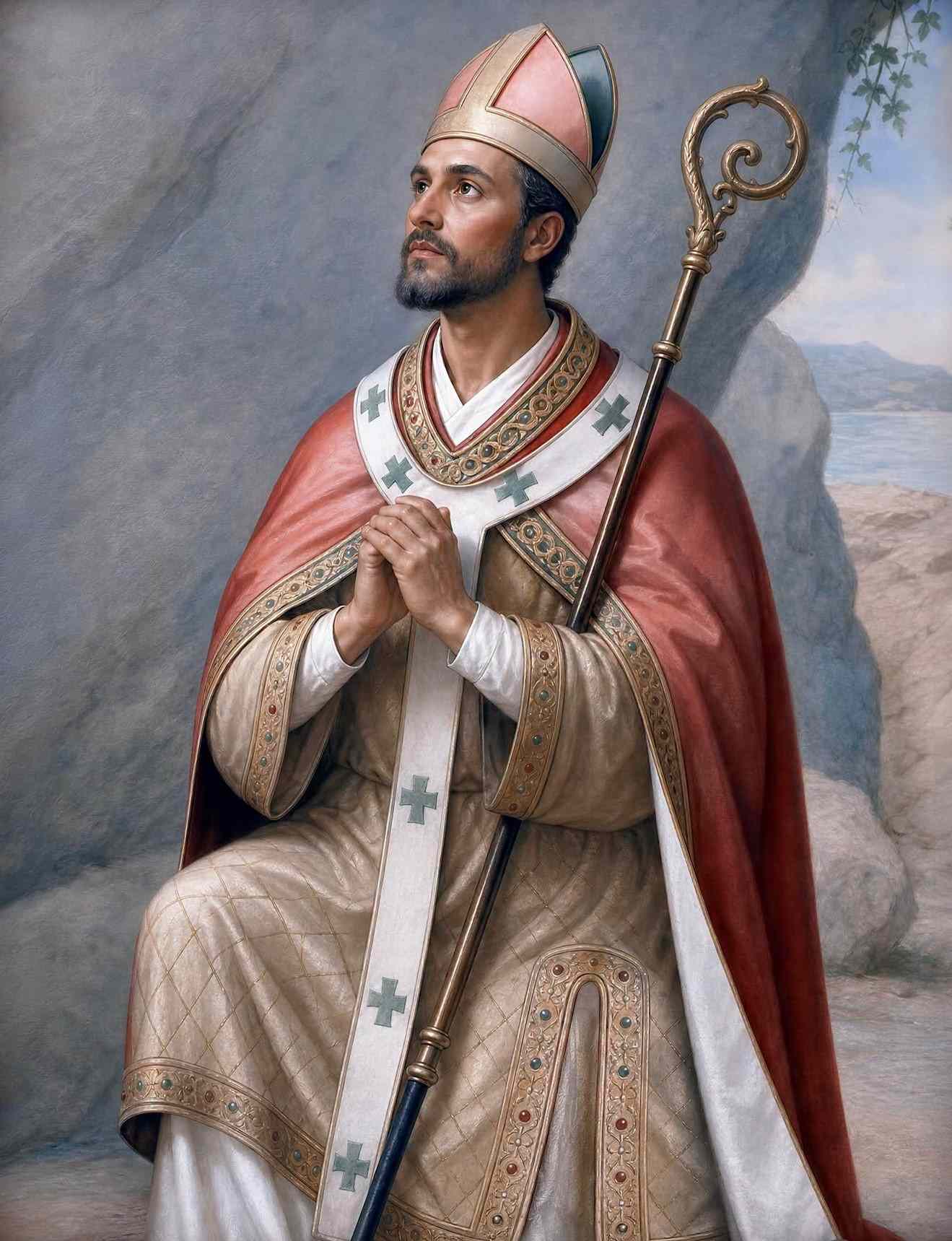
Feast Day: November 17
Saint Gregory Thaumaturgus, also known as Saint Gregory the Wonderworker, was one of the most remarkable bishops and miracle workers of the early Church. Born into a pagan family in the third century, he became a devoted follower of Jesus Christ, a distinguished disciple of the great theologian Origen, and an influential bishop who brought countless people to Christianity.
His name, Gregory Thaumaturgus, means “Gregory the Wonderworker.” He received this title because of the extraordinary miracles traditionally attributed to him and his remarkable success in spreading the Christian faith.
His life is a powerful testimony to the transforming grace of God, the importance of Christian education, the courage of pastoral leadership, and the power of faith-filled prayer.
Early Life and Family Background
Saint Gregory was born around the year 213 in Neocaesarea, in the region of Pontus in Asia Minor, present-day Turkey. His original name was Theodore, meaning “gift of God.”
He was born into a distinguished pagan family. His parents belonged to the upper social class and wanted their children to receive a good education and enjoy a successful future.
Gregory received an excellent education, studying literature, philosophy, rhetoric, and law. His intelligence and desire for knowledge became evident at an early age.
When Gregory was still young, his father died. This experience profoundly affected his family. Along with his brother Athenodorus, Gregory continued his education and eventually travelled towards Caesarea in Palestine.
Their original intention was to continue their studies in Beirut, which was famous for its school of law. However, God’s providence had a different plan for their lives.
His Encounter with Origen
While staying in Caesarea, Gregory and his brother became acquainted with the famous Christian teacher Origen.
Origen was one of the most influential Christian scholars and biblical interpreters of the early Church. His knowledge of Scripture, philosophical understanding, and dedication to Christian teaching attracted many students.
Gregory was deeply impressed by Origen’s wisdom and intellectual abilities. What began as an ordinary meeting with a respected teacher gradually became a life-changing spiritual experience.
Instead of continuing towards Beirut to study law, Gregory and his brother decided to remain in Caesarea and become disciples of Origen.
For several years, they studied philosophy, theology, Sacred Scripture, and Christian doctrine under his guidance.
Origen taught his students to search for truth with sincerity and to understand the Christian faith through prayer, intellectual discipline, and careful study of the Scriptures.
Gregory gradually discovered that the knowledge of God was far more important than worldly recognition or professional success.
Through Origen’s instruction, he embraced Christianity and received baptism. His brother Athenodorus also became a Christian.
This encounter transformed Gregory’s entire life. The young man who had originally dreamed of becoming a successful lawyer now desired to dedicate himself to the service of Christ.
His Farewell Address to Origen
After completing his studies, Gregory decided to return to his homeland. Before leaving, he delivered a beautiful farewell speech in honour of his teacher Origen.
This work is known as the Panegyric to Origen or Address of Thanksgiving to Origen.
It is one of the most valuable surviving accounts of Christian education in the third century. In it, Gregory expressed his profound gratitude to his teacher for guiding him towards Christian truth.
He described how Origen encouraged his students to examine different philosophical ideas, search for truth, study the Scriptures, and develop a genuine love for wisdom.
Gregory’s address reveals not only his intellectual abilities but also his humility and appreciation for spiritual guidance.
His relationship with Origen reminds us of the importance of good teachers and spiritual mentors in the life of the Church.
A teacher who leads a student towards Christ gives something far greater than academic knowledge: the gift of a transformed life.
His Election as Bishop of Neocaesarea
After returning to Neocaesarea, Gregory intended to practise law and establish himself professionally.
However, God’s plan was different.
The Christian community in Neocaesarea was very small. According to ancient tradition, there were only seventeen Christians in the entire city.
The Christian community recognized Gregory’s holiness, wisdom, and leadership qualities. He was eventually chosen to become their bishop.
He initially hesitated because he considered himself unworthy of such a great responsibility. Nevertheless, he accepted the calling and devoted his life to the spiritual welfare of his people.
His election marked the beginning of an extraordinary pastoral ministry.
Gregory did not seek power, wealth, or personal recognition. He understood that the office of bishop was a responsibility to serve God’s people and proclaim the Gospel.
He began preaching, teaching Christian doctrine, visiting people, and encouraging the small community to remain faithful to Jesus Christ.
His pastoral work gradually attracted the attention of many people, including those who had never heard the Gospel.
The Wonderworker: His Extraordinary Miracles
Saint Gregory became famous for the extraordinary miracles associated with his ministry.
Tradition records that he performed remarkable signs through the power of God. These included healing the sick, overcoming natural obstacles, and protecting people from danger.
One of the best-known traditions concerns a large mountain that obstructed the construction of a church. According to the account preserved in the ancient biography written by Saint Gregory of Nyssa, Gregory prayed to God, and the mountain moved sufficiently to make room for the church.
Another tradition recounts that he prayed during a dangerous flood and that the waters were miraculously restrained.
These stories contributed to his reputation as a wonderworker.
However, the greatest miracle associated with his life was not the movement of mountains or the stopping of floods. It was the transformation of an entire community through the proclamation of the Gospel.
The miracles attributed to him were understood as signs pointing people towards the power and goodness of God.
His life teaches us that holiness is not measured merely by extraordinary supernatural experiences but by a heart completely surrendered to God’s will.
The Conversion of an Entire City
One of the most remarkable accounts concerning Saint Gregory is the extraordinary growth of Christianity in Neocaesarea.
When he became bishop, the Christian community was traditionally said to consist of only seventeen people.
Through years of preaching, prayer, personal holiness, and pastoral dedication, Christianity gradually spread throughout the region.
Many people who had previously worshipped pagan gods began accepting Jesus Christ.
Gregory understood that evangelization required patience, wisdom, and personal witness. He did not limit his ministry to preaching from the church. He became involved in the lives of ordinary people and offered guidance whenever they needed help.
He was respected for his wisdom and was frequently approached to settle disputes and offer counsel.
According to the traditional account recorded by Saint Gregory of Nyssa, when Gregory Thaumaturgus died, only seventeen unbelievers remained in Neocaesarea.
Whether understood as a historical figure or a traditional expression of his extraordinary missionary success, this account reveals the lasting impact of his ministry.
The city that once had only seventeen Christians had become a flourishing Christian community.
His life demonstrates how one person, completely committed to Christ, can become an instrument of transformation for an entire society.
His Courage During the Persecution of Christians
Saint Gregory lived during a period when Christians frequently faced persecution from the Roman authorities.
One of the most difficult periods came during the persecution under Emperor Decius, around 250 AD.
Christians were pressured to participate in pagan sacrifices and demonstrate loyalty to the Roman gods. Those who refused could face imprisonment, torture, or death.
Gregory understood the danger facing his community. As a responsible shepherd, he advised his people to seek safety rather than expose themselves unnecessarily to persecution.
He himself withdrew temporarily with his deacon to a place of safety.
This was not an act of cowardice. He wanted to preserve the lives of his people and ensure that the Christian community could continue its mission.
When the persecution subsided, he returned to Neocaesarea and resumed his pastoral responsibilities.
His leadership teaches us that courage does not always mean confronting danger without preparation. True pastoral courage includes wisdom, responsibility, and concern for the lives entrusted to our care.
His Ministry During War and Natural Calamities
Gregory’s pastoral ministry was not limited to spiritual teaching. He also cared deeply for people suffering from social and natural disasters.
During his episcopate, the region of Pontus experienced invasions, violence, and widespread suffering.
The Gothic raids during the 250s brought destruction and hardship to many communities.
People were displaced, families were separated, and many lost their possessions.
Gregory responded with pastoral concern and helped his community navigate these difficult circumstances.
He also addressed questions of Christian conduct during times of crisis. His Canonical Epistle contains important guidance concerning Christians who had been involved in wrongdoing during the invasions and those who needed reconciliation with the Church.
This document is historically significant because it reveals the pastoral wisdom of an early Christian bishop who understood the need to combine justice with mercy.
He knew that people could fail during moments of fear and suffering, but he also believed in the possibility of repentance and restoration.
His example reminds us that the Church must remain close to people during times of war, disaster, illness, and uncertainty.
His Teaching on the Holy Trinity
Saint Gregory was also an important figure in the theological development of the early Church.
He defended the Christian understanding of the Father, the Son, and the Holy Spirit.
His surviving theological writings reveal his commitment to the mystery of the Holy Trinity and the importance of preserving the true Christian faith.
A confession of faith associated with his name expresses the eternal relationship between the Father, the Son, and the Holy Spirit.
An ancient tradition, preserved by Saint Gregory of Nyssa, relates that Gregory received a vision in which the Blessed Virgin Mary and Saint John the Apostle appeared to him. Saint John is said to have communicated a profound explanation of the mystery of the Trinity.
The historical details and authorship of the creed associated with this tradition have been discussed by scholars. Nevertheless, the story reflects the importance attached to Gregory’s Trinitarian teaching in the ancient Church.
He lived before the Council of Nicaea in 325, but his theological contribution helped prepare the way for the Church’s later doctrinal clarifications.
His Participation in the Synod of Antioch
Gregory also participated in important ecclesiastical discussions during his lifetime.
Around 264–265 AD, he was associated with the Synod of Antioch, which addressed the teachings of Paul of Samosata, Bishop of Antioch.
Paul’s teachings concerning the nature of Christ created serious theological controversy.
Gregory supported the Church’s efforts to defend the authentic Christian understanding of Jesus Christ.
His involvement demonstrates that his influence extended beyond his own diocese. He was recognized as a respected bishop and theological leader in the wider Christian community.
He understood that preserving the truth of the Gospel was an essential responsibility of the Church.
His Spiritual Writings
Although only a limited number of Gregory’s writings have survived, they reveal his intellectual depth and pastoral concern.
Some of the important works associated with him include:
1. Address of Thanksgiving to Origen
This is his famous farewell address to his teacher. It describes his intellectual and spiritual formation under Origen and offers valuable insight into early Christian education.
2. The Canonical Epistle
This important pastoral document deals with the responsibilities of Christians during the Gothic invasions and offers guidance concerning repentance, discipline, and reconciliation.
3. Declaration of Faith
A confession of faith associated with Gregory expresses the Christian understanding of the Father, the Son, and the Holy Spirit. Its precise historical authorship has been debated.
4. Paraphrase of Ecclesiastes
This work presents a literary and interpretative treatment of the biblical Book of Ecclesiastes, demonstrating Gregory’s interest in Scripture.
5. On the Passible and Impassible in God
This theological work addresses questions concerning divine nature and the suffering of Christ. It reflects the intellectual challenges faced by early Christian apologists.
His writings remain valuable for understanding the theological and pastoral life of the third-century Church.
His Death and Lasting Legacy
Saint Gregory Thaumaturgus died around 270–275 AD in Neocaesarea.
He left behind a Christian community that had grown remarkably under his leadership.
His reputation for holiness and miracles continued after his death. His life was later celebrated by Saint Gregory of Nyssa, who composed an important account of his virtues and extraordinary deeds.
His influence spread throughout the Eastern and Western Churches, and he became one of the most beloved bishops of the early Christian centuries.
The Church remembers him as a great evangelizer, theologian, pastor, and miracle worker.
His feast is celebrated on November 17.
Lessons from the Life of Saint Gregory Thaumaturgus
The life of Saint Gregory offers several valuable lessons for Christians today.
1. Be Open to God’s Unexpected Plans
Gregory originally intended to become a lawyer. Yet his encounter with Origen changed the direction of his life. He discovered a greater purpose in serving Christ.
We may have our own plans, ambitions, and dreams, but God sometimes leads us in unexpected directions. True happiness comes from discovering and accepting His will.
2. One Person Can Make a Great Difference
Gregory began his ministry with a very small Christian community. Through dedication and perseverance, he helped establish a flourishing Church.
We should never underestimate the influence of one faithful Christian. A sincere witness can transform families, parishes, communities, and even entire societies.
3. Use Knowledge to Serve God
Gregory was highly educated and intellectually gifted. He did not use his abilities merely to gain recognition or worldly success. He placed his knowledge at the service of the Gospel.
Education becomes truly meaningful when it helps us understand truth, serve others, and grow in holiness.
4. Be a Shepherd Who Cares for People
Gregory remained close to his people during persecution, war, and suffering. He understood that a Christian leader must be compassionate and responsible.
His example is especially inspiring for priests, religious, catechists, and all those entrusted with the care of others.
5. Faith Requires Courage and Wisdom
Gregory guided his community through difficult periods without abandoning his responsibilities. He teaches us to remain faithful to Christ even when circumstances become challenging.
6. Holiness Is the Greatest Miracle
The extraordinary miracles associated with Gregory are inspiring, but the transformation of Neocaesarea remains the most powerful testimony of his life.
The greatest miracle is a human heart transformed by the grace of God.
Prayer to Saint Gregory Thaumaturgus
Heavenly Father,
You called Saint Gregory Thaumaturgus to become a faithful shepherd and a powerful witness to the Gospel. Through his preaching, holiness, and extraordinary faith, many people came to know and love Jesus Christ.
Through his intercession, strengthen our faith and help us trust in Your divine providence.
Lord, when we face difficulties that seem impossible to overcome, grant us courage and confidence in Your power. Move the mountains of fear, anxiety, discouragement, and doubt that stand in our way.
Bless our families, our workplaces, our parishes, and our communities. Guide our priests and religious in their mission of evangelization. Inspire teachers and students to seek wisdom and truth.
May we use our talents and knowledge for Your glory and become instruments of Your love wherever we go.
Through Christ our Lord.
Amen.
Saint Gregory Thaumaturgus, pray for us!
Further Reading and References
- Pope Benedict XVI, General Audience: Saint Gregory Thaumaturgus, November 17, 2010, Vatican.
- Saint Gregory of Nyssa, Life of Gregory Thaumaturgus.
- Saint Gregory Thaumaturgus, Address of Thanksgiving to Origen.
- Saint Gregory Thaumaturgus, Canonical Epistle.
- The Catholic Encyclopedia, “St. Gregory of Neocaesarea.”
- Ante-Nicene Fathers, Volume VI: Works of Gregory Thaumaturgus.
Saint Gregory Thaumaturgus – Feast Day: November 17
Saint Gregory reminds us that God can accomplish extraordinary things through an ordinary person who is willing to surrender completely to His will. From a young student searching for knowledge to a bishop who transformed an entire city, his life reveals the power of divine grace working through human faithfulness.
May Saint Gregory inspire us to become courageous witnesses of Christ, faithful servants of the Church, and instruments of God’s transforming love.
Saint Gregory Thaumaturgus, pray for us!
Historical reference: The principal biographical details are drawn from Vatican News and the ancient account by Saint Gregory of Nyssa. Some miracle narratives belong to the traditional account of his life. Vatican News+3
Leave a Reply