
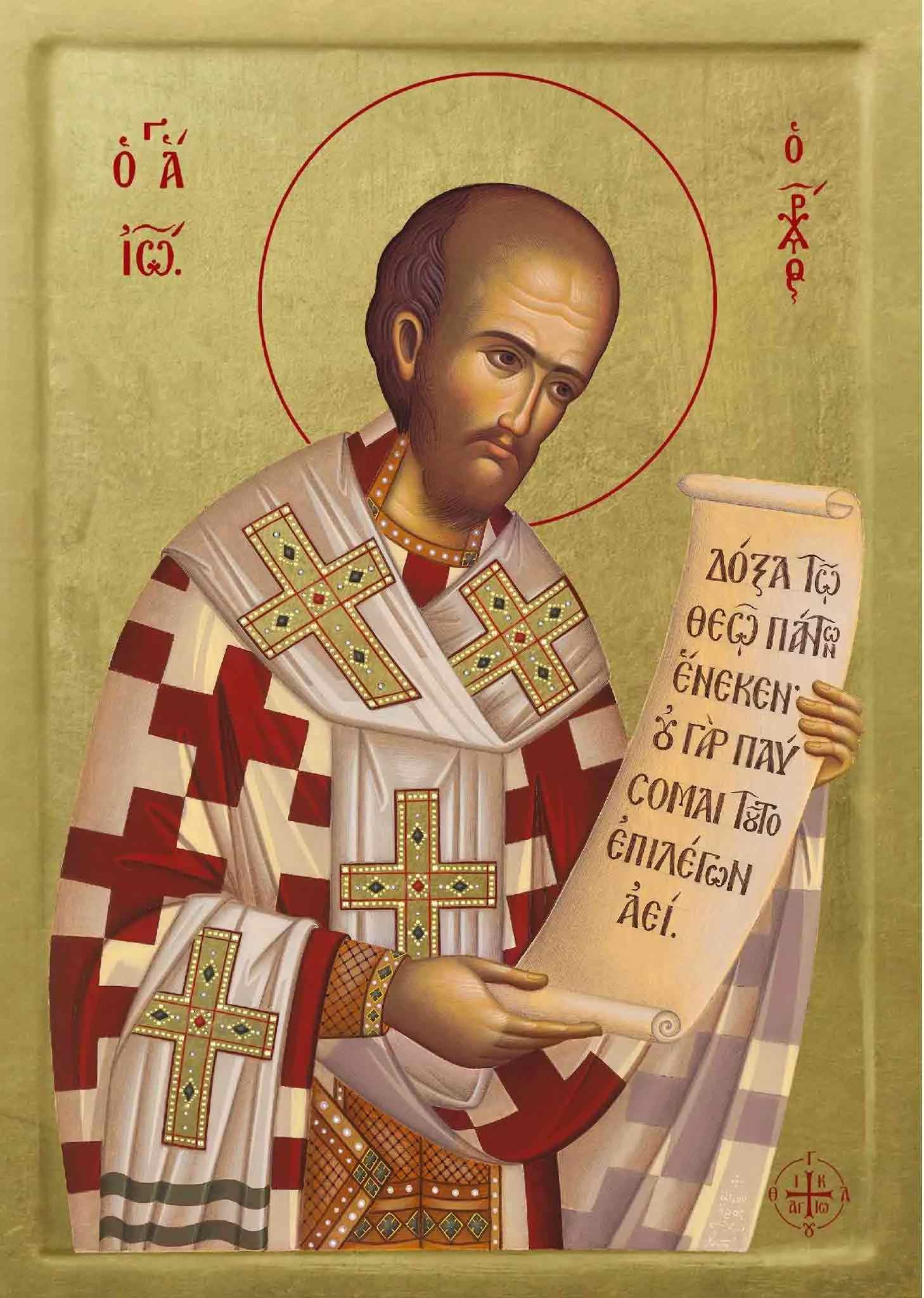
Bishop of Constantinople, Doctor of the Church, and Golden-Mouthed Preacher
Feast Day: September 13
Saint John Chrysostom (c. 347–407) was one of the greatest preachers and teachers of the early Church. His extraordinary eloquence earned him the name “Chrysostom,” meaning “Golden-Mouthed.” He became Archbishop of Constantinople and courageously defended the Gospel, cared for the poor, challenged corruption, and called Christians to conversion of heart.
His life was marked by prayer, Scripture, pastoral zeal, courage, suffering, and fidelity to Christ. He remains one of the most influential Fathers of the Church, particularly in the Eastern Christian tradition.


Early Life
John was born around 347 in Antioch, one of the great cities of the Roman Empire and an important centre of Christianity. His father, Secundus, was a government official who died while John was still young. His mother, Saint Anthusa, was a devout Christian who raised him in the faith.
John received an excellent education, studying rhetoric and classical literature under the famous pagan rhetorician Libanius. He possessed extraordinary intellectual ability and a natural gift for public speaking.
Although he could have pursued a successful career in law or public administration, John gradually felt himself drawn toward a life dedicated entirely to God.
A Call to the Ascetic Life
John became increasingly attracted to prayer, Scripture, fasting, and ascetic discipline. After the death of his mother, he embraced a more radical life of Christian asceticism.
He spent several years living an austere life, dedicating himself to prayer and biblical study. His severe ascetic practices, however, affected his health, and eventually he returned to Antioch.
There he was ordained a deacon in 381 and a priest in 386 by Bishop Flavian of Antioch.
It was as a priest that John’s extraordinary preaching ministry truly began.
The Golden-Mouthed Preacher
John quickly became famous for his homilies.
He preached directly, passionately, and practically. He did not merely explain biblical passages; he challenged his listeners to live the Gospel.
His sermons addressed:
- prayer and Scripture,
- repentance,
- the Eucharist,
- marriage and family life,
- care for the poor,
- Christian morality,
- humility,
- forgiveness,
- wealth and social injustice,
- the dangers of greed,
- and the need for authentic Christian conversion.
His preaching was so powerful that enormous crowds gathered to hear him.
He became known as Chrysostom, the “Golden-Mouthed.”
Yet his eloquence was not simply a gift for admiration. John believed that a preacher had a sacred responsibility to tell the truth, even when the truth was uncomfortable.
His Love for the Poor
One of the strongest themes in John’s preaching was the Christian responsibility toward the poor.
He repeatedly warned wealthy Christians against accumulating possessions while ignoring people who were hungry, homeless, or suffering.
For John, love of Christ could never be separated from love of one’s neighbour.
He challenged Christians to recognize Christ in those who suffer and insisted that material possessions carry a moral responsibility.
His teaching remains remarkably relevant in a world where enormous wealth and severe poverty can exist side by side.
Archbishop of Constantinople
In 398, John was unexpectedly chosen as Archbishop of Constantinople, the capital of the Eastern Roman Empire.
The position was prestigious and politically powerful, but John did not approach it as an opportunity for personal advancement.
Instead, he immediately began reforming the clergy and administration of the Church.
He encouraged a simpler lifestyle among clergy, opposed abuses, promoted care for the poor, and directed Church resources toward charitable works.
His determination to reform the Church soon brought him powerful enemies.
Courage Before Power
John Chrysostom was not afraid to confront people in positions of authority.
He believed that the Gospel applied equally to emperors, officials, clergy, wealthy people, and ordinary Christians.
His preaching against luxury, greed, injustice, and moral corruption made him increasingly unpopular among influential members of society.
His relationship with Empress Eudoxia, wife of Emperor Arcadius, became particularly hostile.
John criticized extravagant behaviour and defended those who were being treated unjustly. His opponents eventually succeeded in having him removed from Constantinople.
Exile and Suffering
John was exiled several times.
The first exile was brief because an earthquake struck Constantinople, and the frightened people demanded his return.
But the conflict continued.
In 404, John was definitively banished from Constantinople.
He was sent into exile in increasingly remote and difficult places. Despite poor health and harsh conditions, he continued to encourage Christians through letters and pastoral care.
He did not abandon his mission.
Even in exile, he remained a shepherd.
“Glory Be to God for All Things”
John’s final journey was extremely difficult.
While being forcibly transported toward a more distant place of exile, his health deteriorated badly.
He died on September 14, 407, at Comana in Pontus.
According to tradition, his final words were:
“Glory be to God for all things.”
These words beautifully summarize his spirituality.
John had experienced success and opposition, honour and humiliation, freedom and exile. Yet he remained convinced that God was faithful.
His Relics
John’s remains were eventually transferred to Constantinople.
Centuries later, his relics were taken to Rome, where they are venerated in the Basilica of Saint Peter.
In 2004, Pope John Paul II returned part of the relics of Saint John Chrysostom to the Ecumenical Patriarch of Constantinople, a gesture of friendship and reconciliation between Eastern and Western Christians.
Doctor of the Church
Saint John Chrysostom is honoured as one of the great Doctors of the Church.
His writings include extensive biblical commentaries, homilies, letters, moral teachings, and pastoral works.
He is especially admired for his interpretation of Scripture.
For John, the Bible was not merely a historical document. It was the living Word of God that demanded a response from every Christian.
He constantly brought Scripture into the practical circumstances of everyday life.
Saint John Chrysostom and the Eucharist
John had a profound love for the Holy Eucharist.
His Eucharistic preaching emphasized the real presence of Christ and the transforming power of Holy Communion.
The Divine Liturgy of Saint John Chrysostom, widely celebrated in Byzantine Catholic and Eastern Orthodox Churches, is traditionally associated with him. Although the liturgy developed over time and cannot simply be understood as a text personally composed by John in its present form, his name remains inseparably connected with it.
The Byzantine Catholic Churches continue to celebrate this Divine Liturgy as one of their principal Eucharistic forms.
A Teacher of Repentance
For John Chrysostom, Christianity was not merely about belonging to a religious community. It was about transformation.
He constantly called people to repentance.
But repentance for John was not simply feeling guilty. It meant turning back toward God and allowing grace to transform one’s life.
He encouraged sinners never to despair of God’s mercy.
His pastoral approach combined truth and mercy:
- sin must be taken seriously;
- injustice must be confronted;
- repentance must be genuine;
- but God’s mercy is always greater than human failure.
His Teaching on Prayer
Prayer was central to John’s spirituality.
He regarded prayer not as an occasional religious activity but as the foundation of Christian life.
For him, the Christian should learn to turn the heart toward God throughout the day—in moments of joy, suffering, temptation, work, and uncertainty.
He also strongly emphasized the importance of Sacred Scripture.
A Christian who never reads or listens attentively to God’s Word, he argued, deprives himself of an essential source of spiritual nourishment.
His Teaching on Family Life
John Chrysostom also offered extensive pastoral teaching on marriage and family life.
He regarded the Christian home as a place where faith should be lived concretely.
Parents have the responsibility of forming their children not merely through words but through example.
The family should become a small Christian community characterized by:
- prayer,
- forgiveness,
- mutual respect,
- sacrifice,
- patience,
- charity,
- and love for Christ.
His teaching is particularly valuable for families seeking to make faith part of everyday life rather than something restricted to Sunday worship.
His Concern for Christian Authenticity
One of John’s greatest challenges to Christians was the danger of hypocrisy.
He warned against people who could appear religious while remaining indifferent to suffering.
Attending worship, receiving the sacraments, praying, and possessing religious knowledge must produce a transformation in the way we treat other people.
For John Chrysostom, authentic Christianity must be visible in charity, justice, forgiveness, humility, and service.
Saint John Chrysostom and Scripture
John Chrysostom was especially famous for his preaching on the writings of Saint Paul.
His Homilies on Romans, Homilies on Matthew, Homilies on John, Homilies on First and Second Corinthians, and many other biblical works became important sources for Christian theology and spirituality.
His biblical interpretation combined careful attention to the text with practical pastoral application.
He wanted his listeners not simply to understand Scripture but to put it into practice.
His Famous Spiritual Legacy
Among the themes repeatedly found in his writings are:
Christ must be at the centre of life.
Prayer must become a way of life.
The poor must never be forgotten.
Wealth must be used responsibly.
Repentance must lead to transformation.
The Eucharist demands a life of charity.
The Christian must speak truth with courage.
Suffering can become an offering to God.
No Christian should despair of God’s mercy.
Lessons from Saint John Chrysostom
1. Speak the truth with courage
John did not change his preaching simply because powerful people disliked his message.
His life reminds us that Christian leadership sometimes requires courage.
2. Put faith into action
John rejected a Christianity that remained only in words.
Our faith must become visible in our treatment of others.
3. Care for the poor
His preaching repeatedly reminds Christians that possessions are gifts entrusted to us by God.
The poor are not strangers to Christian life; they are our brothers and sisters.
4. Read Sacred Scripture
John’s life demonstrates the enormous importance of knowing the Word of God.
The Bible should not remain closed on our shelves. It should become part of our prayer and daily life.
5. Never despair
John experienced rejection, exile, suffering, and physical weakness.
Yet he remained faithful.
His final words—“Glory be to God for all things”—express a profound Christian confidence in God’s providence.
Saint John Chrysostom and the Priesthood
For priests and pastoral ministers, John Chrysostom remains an extraordinary model.
He understood preaching as a sacred responsibility.
A priest is not called merely to entertain people or to say what they want to hear. The priest must proclaim Christ, explain God’s Word, call people to conversion, defend truth, encourage the suffering, and serve the poor.
John’s life therefore offers a powerful reminder:
The preacher must first allow the Word of God to transform his own life.
Only then can his preaching become truly fruitful.
Patronage
Saint John Chrysostom is particularly associated with preachers, orators, teachers, and speakers.
He is also one of the principal Fathers of the Church and a major figure in the Christian tradition of biblical preaching.
Prayer to Saint John Chrysostom
O glorious Saint John Chrysostom,
faithful servant of Christ and fearless preacher of the Gospel,
you loved the Word of God and proclaimed it with courage.
Obtain for us the grace to listen attentively to God’s Word
and to put it into practice in our daily lives.
Teach us to love prayer,
to approach the Holy Eucharist with reverence,
to care for the poor and suffering,
and to remain faithful to Christ in times of difficulty.
Help priests and preachers to proclaim the Gospel
with truth, wisdom, humility, and courage.
When we experience rejection, suffering, or uncertainty,
teach us to trust in God’s providence
and to say with you:
“Glory be to God for all things.”
Saint John Chrysostom,
pray for us. Amen.
Conclusion
Saint John Chrysostom was more than a brilliant speaker. He was a shepherd who believed that the Gospel must transform society and the human heart.
He preached Christ with extraordinary eloquence, defended the poor, challenged corruption, called sinners to repentance, encouraged families, taught the faith, and remained faithful even when his fidelity led to exile.
His golden voice has been silent for more than sixteen centuries, but his message remains alive.
In an age filled with noise, Saint John Chrysostom reminds us to listen to the Word of God.
In an age of inequality, he reminds us to see Christ in the poor.
In an age of superficial faith, he calls us to authentic conversion.
And in moments of suffering, his final words continue to speak with remarkable power:
“Glory be to God for all things.”
Leave a Reply