
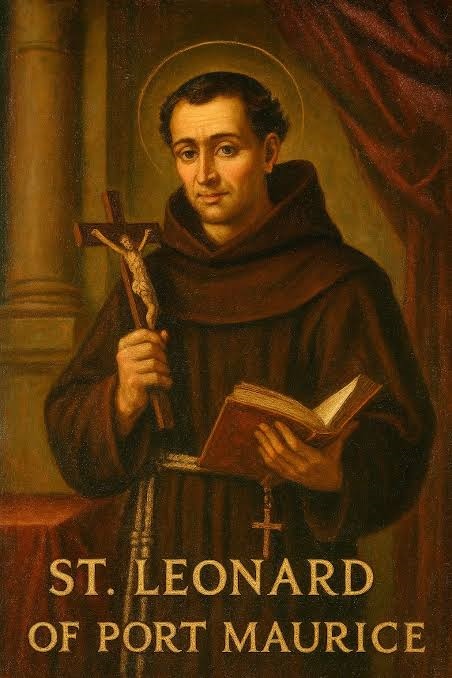
The Great Missionary of the Way of the Cross
Feast Day: 26 November
Saint Leonard of Port Maurice (1676–1751) was an Italian Franciscan priest, preacher, missionary, and one of the most influential Catholic missionaries of the eighteenth century. He is especially remembered for his extraordinary devotion to the Passion of Jesus Christ, his promotion of the Stations of the Cross, and his tireless preaching of missions that inspired countless people to conversion and holiness.
Known for his powerful sermons, deep humility, austere life, and burning love for souls, Saint Leonard devoted himself entirely to bringing people closer to God. His life reminds Christians that the Cross of Christ is not merely a symbol of suffering but the greatest expression of God’s love and the path to eternal life.
1. Early Life and Family
Saint Leonard was born on 20 December 1676 in Porto Maurizio, a coastal town in Liguria, Italy, which today forms part of the city of Imperia. His baptismal name was Paul Jerome Casanova.
He was born into a Christian family. His father, Domenico Casanova, was a ship’s captain, and his mother was Anna Maria Benza. From childhood, Leonard displayed a gentle character, a spirit of prayer, and a deep attraction to the things of God.
After receiving his early education, he went to Rome to pursue higher studies. He attended the Roman College, where he distinguished himself through his intellectual ability and religious devotion.
Although he had opportunities to pursue a successful career in the world, his heart was increasingly drawn towards religious life.
2. His Entrance into the Franciscan Order
In 1697, at the age of twenty-one, Paul Jerome entered the Reformed Franciscan Order of the Strict Observance at the Convent of Saint Bonaventure in Rome.
He received the religious name Leonard.
His decision to embrace Franciscan life was inspired by the example of Saint Francis of Assisi, particularly his poverty, humility, simplicity, and love for Christ crucified.
Leonard embraced religious discipline with great seriousness. He devoted himself to prayer, study, penance, and contemplation. He desired to become a missionary and dedicate his entire life to the salvation of souls.
He was ordained a priest in 1702.
3. Illness and the Transformation of His Mission
After his ordination, Leonard hoped to become a missionary in China. However, serious health difficulties interrupted his plans.
He suffered from a persistent illness, particularly involving his lungs, and was sent to the Franciscan monastery at Porto Maurizio to recover.
His recovery was gradual, and he came to understand that God was calling him to a different kind of missionary apostolate.
Rather than travelling to distant lands, he would bring the Gospel to the people of Italy.
This change became one of the most fruitful developments of his life. He eventually became one of the greatest popular missionaries of his time.
4. A Missionary to His Own People
Although Leonard had dreamed of preaching the Gospel in China, Divine Providence opened another missionary field before him: the towns and villages of Italy.
He began preaching missions in Tuscany and gradually became famous throughout Italy for his extraordinary preaching.
His sermons attracted enormous crowds. Churches were often too small to accommodate the people who came to hear him, so he frequently preached in public squares and open fields.
His preaching was marked by:
- A deep love for Jesus Christ crucified.
- A powerful call to repentance and conversion.
- A strong emphasis on Confession and the Sacrament of the Eucharist.
- Encouragement to return to prayer and Christian living.
- A reminder of the reality of heaven, hell, death, and judgment.
- A special devotion to the Blessed Virgin Mary.
He did not preach merely to impress people with his eloquence. His greatest desire was to bring sinners back to God and help Christians live according to the Gospel.
He travelled extensively throughout Italy, preaching parish missions, retreats, Lenten sermons, and spiritual exercises. His missionary apostolate continued for more than forty years.
Saint Alphonsus Liguori greatly admired him and regarded him as one of the greatest missionaries of his age.
5. The Great Apostle of the Stations of the Cross
One of the greatest contributions of Saint Leonard was his extraordinary promotion of the devotion to the Stations of the Cross.
He understood that contemplating the sufferings of Jesus could awaken faith, inspire repentance, and deepen Christian love.
He encouraged people to meditate on the fourteen stations, following the journey of Jesus from His condemnation to His burial.
He personally established more than 500 sets of Stations of the Cross throughout Italy. Historical accounts commonly give the number as 571.
His most famous achievement was the establishment of the Stations of the Cross inside the Roman Colosseum in 1750, during the Holy Year proclaimed by Pope Benedict XIV.
The Colosseum was traditionally associated with the martyrdom of early Christians. By establishing the Stations there, Saint Leonard helped restore its religious significance as a place of Christian remembrance and prayer.
The devotion became a powerful instrument of evangelisation.
Through his preaching and missionary work, countless people discovered the spiritual richness of meditating on the Passion of Christ.
Today, when Catholics pray the Stations of the Cross, particularly during Lent and on Fridays, they participate in a devotion whose spread was greatly encouraged by Saint Leonard.
6. His Love for the Holy Eucharist
Saint Leonard possessed a profound love for the Blessed Sacrament.
He encouraged frequent participation in Holy Mass, reverent reception of Holy Communion, and prayer before the Eucharistic Lord.
He believed that the Eucharist was the greatest treasure entrusted to the Church and the spiritual nourishment of every Christian.
He also promoted perpetual Eucharistic adoration and encouraged the faithful to spend time in the presence of Jesus.
One of his important spiritual writings was Il Tesoro Nascosto, meaning The Hidden Treasure, a work devoted to the Holy Mass.
For Saint Leonard, the Mass was not simply a religious ceremony but the living memorial of Christ’s sacrifice on Calvary.
His Eucharistic spirituality teaches us that the more deeply we understand the sacrifice of Jesus, the more sincerely we should participate in the Holy Eucharist.
7. Devotion to the Sacred Heart of Jesus and the Immaculate Conception
Saint Leonard also had a special devotion to the Sacred Heart of Jesus.
He encouraged Christians to contemplate the love of Christ, especially the love revealed through His pierced Heart on the Cross.
He wanted people to understand that God’s mercy is greater than human sin and that Christ continually invites sinners to return to Him.
He was also an enthusiastic promoter of the Immaculate Conception of the Blessed Virgin Mary.
Long before the dogma was solemnly defined by Pope Pius IX in 1854, Saint Leonard strongly defended and promoted this privilege of Mary.
He prayed and worked for the universal recognition of the Immaculate Conception, convinced that the Mother of God had been preserved from original sin from the first moment of her conception by the merits of Jesus Christ.
His Marian devotion was always centred on Christ. He saw Mary as the perfect example of holiness, obedience, and complete surrender to God’s will.
8. The Monastery of Incontro
In 1710, Saint Leonard founded a Franciscan retreat house at Incontro, near Florence.
He wanted his fellow missionaries to have a place where they could withdraw from their apostolic activities, renew their spiritual strength, and dedicate themselves to prayer and penance.
He understood that successful missionary work must flow from a deep relationship with God.
For him, preaching without prayer would eventually become empty words. A missionary must first encounter Christ personally before inviting others to encounter Him.
His own life reflected this conviction. Despite his demanding missionary journeys, he remained faithful to prayer, meditation, fasting, and religious discipline.
9. His Mission in Corsica
In 1744, Pope Benedict XIV entrusted Saint Leonard with a special mission in Corsica.
At that time, the island was experiencing serious political and social conflicts. The divisions among its people had created an atmosphere of hostility and instability.
The Pope hoped that Leonard’s preaching and spiritual influence would help restore peace and reconciliation.
Saint Leonard accepted this difficult assignment and spent several months preaching on the island.
Although his mission faced considerable challenges, he continued to encourage reconciliation, Christian charity, and peace.
His experience in Corsica demonstrated that the Gospel must enter not only individual hearts but also families, communities, and societies wounded by divisions.
10. His Spiritual Writings
Saint Leonard was not only a great preacher but also a spiritual writer.
His writings reveal his profound understanding of Christian life and his concern for the spiritual growth of ordinary people.
Among his important works are:
1. The Hidden Treasure (Il Tesoro Nascosto)
A spiritual work explaining the immeasurable value of the Holy Sacrifice of the Mass.
2. The Way of the Cross (Via Sacra)
A work promoting meditation on the Passion and Death of Jesus Christ and helping the faithful understand and practise the Stations of the Cross.
3. Sermons and Spiritual Instructions
His sermons addressed repentance, conversion, prayer, Christian morality, the sacraments, and eternal life.
4. Letters and Spiritual Counsels
His correspondence contains practical advice for people seeking to grow in holiness and overcome spiritual difficulties.
His writings continued to nourish Catholic spirituality long after his death.
11. His Final Days and Death
After more than four decades of tireless missionary activity, Saint Leonard’s health gradually deteriorated.
He had spent his life travelling, preaching, fasting, praying, and performing severe penances. His physical strength was almost completely exhausted.
In November 1751, while he was preaching in the region of Bologna, Pope Benedict XIV summoned him to Rome.
The Pope had great respect for Leonard and wished him to return to the Eternal City.
Obedient to the Pope’s request, Leonard began his final journey to Rome. He arrived at the Franciscan monastery of Saint Bonaventure on the Palatine Hill on 26 November 1751.
That same night, at approximately eleven o’clock, he died peacefully in the monastery.
He was seventy-four years old.
His death marked the end of an extraordinary missionary life, but his spiritual influence continued to spread throughout the Catholic Church.
12. Beatification and Canonization
The Church officially recognised the holiness of Saint Leonard and his extraordinary contribution to evangelisation.
- 19 June 1796: Pope Pius VI beatified him.
- 29 June 1867: Pope Pius IX canonized him.
- 26 November: His feast is celebrated in the Franciscan calendar and in many Catholic calendars.
He is particularly remembered as a patron of parish missions, preachers, and missionaries.
His body is preserved in the church of San Bonaventura al Palatino in Rome.
13. Lessons from the Life of Saint Leonard
The life of Saint Leonard of Port Maurice offers several important lessons for Christians today.
1. Be a missionary wherever God places you.
Leonard wanted to preach in China, but God called him to evangelise Italy. He teaches us that we do not need to travel to distant countries to become missionaries. Our families, parishes, workplaces, and communities are also missionary fields.
2. Never underestimate the power of the Cross.
The Cross is the greatest expression of God’s love. By contemplating the Passion of Jesus, we learn forgiveness, patience, humility, sacrifice, and unconditional love.
3. Preaching must lead people to conversion.
Christian preaching is not merely the communication of religious knowledge. It must help people encounter Jesus, repent of their sins, and transform their lives.
4. Prayer must sustain our apostolate.
Saint Leonard understood that missionary activity must be rooted in prayer. Without a personal relationship with God, our spiritual activities can lose their depth and meaning.
5. The Eucharist must remain at the centre of Christian life.
His devotion to the Holy Mass reminds us that Jesus Christ is truly present in the Eucharist. Every Catholic should approach the altar with faith, love, reverence, and gratitude.
6. Do not become discouraged when your plans change.
Leonard’s dream of becoming a missionary in China was never fulfilled. Yet his missionary work in Italy touched thousands of lives. His story reminds us that God’s plans can be different from our expectations, but His grace can make our lives fruitful in unexpected ways.
14. Saint Leonard of Port Maurice and the Stations of the Cross Today
The devotion to the Stations of the Cross remains one of the most beloved Catholic devotions, especially during Lent.
It invites us to walk spiritually with Jesus through His suffering and death.
The fourteen stations remind us of:
- The condemnation of Jesus.
- His acceptance of the Cross.
- His falls beneath its weight.
- His encounter with His Mother.
- The help of Simon of Cyrene.
- The compassion of Veronica.
- His meeting with the women of Jerusalem.
- His crucifixion and death.
- His burial in the tomb.
Saint Leonard reminds us that the Passion of Christ should never become merely a familiar religious story. It must touch our hearts and transform our lives.
When we meditate on the Cross, we recognise the seriousness of sin, the greatness of God’s mercy, and the depth of Christ’s love.
Prayer to Saint Leonard of Port Maurice
O glorious Saint Leonard of Port Maurice, faithful servant of God and zealous missionary of the Gospel, you devoted your entire life to preaching the love of Jesus Christ and leading souls towards salvation.
You had a special love for the Cross of Jesus and tirelessly promoted the devotion to the Stations of the Cross.
Pray for us that we may never become indifferent to the suffering and sacrifice of our Saviour.
Obtain for us the grace of true repentance, sincere Confession, devotion to the Holy Eucharist, and perseverance in prayer.
Inspire priests, missionaries, religious, and all those entrusted with proclaiming the Gospel to serve the Church with courage, humility, and apostolic zeal.
Pray for families experiencing difficulties, for sinners seeking forgiveness, for those who have abandoned their faith, and for all who are searching for peace and meaning in life.
May we learn from your example to accept God’s will even when our plans do not succeed, trusting that He can make everything fruitful for His glory.
Saint Leonard of Port Maurice, great apostle of the Way of the Cross, pray for us.
Amen.
Prayer for Priests and Missionaries
Heavenly Father, through the intercession of Saint Leonard of Port Maurice, bless all priests, missionaries, preachers, catechists, and religious who dedicate their lives to proclaiming the Gospel.
Fill them with the fire of the Holy Spirit. Give them the wisdom to teach, the courage to proclaim the truth, the humility to serve, and the holiness to become living witnesses of Christ.
Strengthen those who experience discouragement, loneliness, illness, and difficulties in their ministry.
May their preaching bring sinners back to Your mercy, strengthen families in faith, and lead many souls to the eternal joy of heaven.
Through Christ our Lord.
Amen.
Scripture Readings for Reflection
The following biblical passages beautifully reflect the spirituality and missionary spirit of Saint Leonard:
- 1 Corinthians 1:18 – The message of the Cross is the power of God.
- Luke 9:23 – Taking up our cross daily and following Jesus.
- Matthew 28:19–20 – The missionary command of Jesus.
- Romans 10:14–15 – The importance of those who proclaim the Gospel.
- John 6:51 – Jesus, the living Bread from heaven.
- Philippians 2:5–11 – The humility and self-emptying of Christ.
- Galatians 6:14 – Boasting in the Cross of our Lord Jesus Christ.
Conclusion: A Life Dedicated to the Cross of Christ
Saint Leonard of Port Maurice was a man whose entire existence was centred on Jesus Christ crucified. He wanted every person to understand the immeasurable love of God revealed through the Cross.
He did not allow physical illness, disappointments, exhausting journeys, or difficult missionary assignments to extinguish his missionary zeal.
His life reminds us that holiness is not measured by worldly achievements but by our faithfulness to God’s calling.
His dream of becoming a missionary in China was never fulfilled, but he became a missionary to thousands of people in his own country. Through his preaching, spiritual writings, Eucharistic devotion, and promotion of the Stations of the Cross, he left a lasting contribution to Catholic spirituality.
May Saint Leonard inspire us to love the Cross, cherish the Holy Eucharist, return to God through sincere repentance, and become missionaries of Christ in our everyday lives.
Saint Leonard of Port Maurice, Apostle of the Stations of the Cross, pray for us!
References and Further Reading
- Catholic Encyclopedia, “St. Leonard of Port Maurice.” Read biography.
- Order of Friars Minor, “Saint Leonard of Port Maurice.” Franciscan biography.
- Loyola Press, “Saint Leonard of Port Maurice.” Saint’s life and spirituality.
- Capuchin Franciscan Resources, “Saint Leonard of Port Maurice.” Biography and writings.
Leave a Reply