
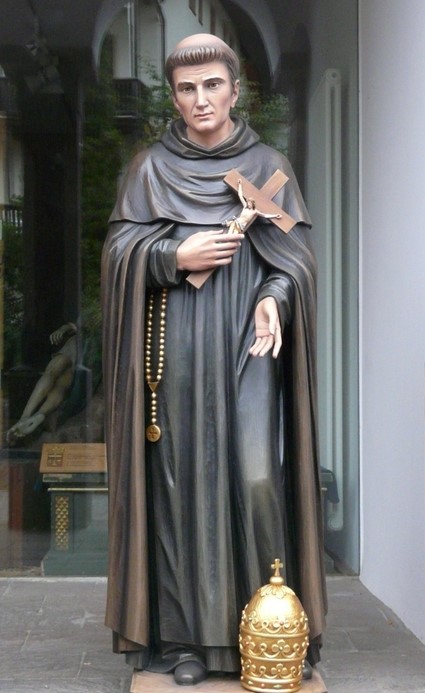
Feast Day: August 23
Saint Philip Benizi was a remarkable 13th-century Italian saint, priest, religious superior, preacher, and peacemaker. He is remembered especially for his profound humility, his deep devotion to the Blessed Virgin Mary, and his tireless efforts to strengthen the Order of Servants of Mary, commonly known as the Servites.
Although he was highly respected for his wisdom and holiness, Saint Philip never sought honor or recognition. Tradition remembers him as a man who was even considered for the papacy but, out of humility, withdrew and hid himself rather than accept such a position. His life teaches Christians that true greatness is found not in power, status, or recognition, but in loving service to God and others.
Early Life
Philip Benizi was born on August 15, 1233, in Florence, Italy, into a wealthy and respected family. His parents were devoted Christians and provided him with a good education.
According to a cherished tradition, even as a child Philip showed signs of special grace and devotion. He was known for his kindness, prayerfulness, and concern for others. As he grew older, he pursued serious studies and eventually became trained in medicine and philosophy.
Philip was intelligent and successful, and he could easily have chosen a comfortable and prestigious life. Yet his heart longed for something more. Beneath his achievements was a deep desire to know and serve God.
A Call to the Servants of Mary
During Philip’s lifetime, a relatively new religious community was growing in Italy: the Order of Servants of Mary, or the Servites. The order had been founded by a group of men from Florence who desired to dedicate their lives completely to God through a special devotion to the Blessed Virgin Mary.
Philip felt drawn to this community.
However, his humility was so great that he initially entered the order without revealing the full extent of his education and abilities. He desired simply to live as a humble servant.
He embraced the religious life wholeheartedly, dedicating himself to:
- Prayer and contemplation
- Poverty and simplicity
- Service to others
- Devotion to the Blessed Virgin Mary
- Study and preaching
- Works of charity
Eventually, his gifts became known, and he was ordained a priest.
A Powerful Preacher
Saint Philip became one of the most effective preachers of his time. He traveled through many parts of Italy, preaching the Gospel and calling people to conversion.
His preaching was not merely intellectual or eloquent. It came from a heart deeply united with God.
He spoke about:
- Repentance and conversion
- The mercy of God
- The love of Christ
- Christian charity
- Peace and reconciliation
- Devotion to the Blessed Virgin Mary
Many people were touched by his words and example.
Philip understood that preaching the Gospel required more than beautiful sermons. A preacher’s life itself had to become a testimony to Christ. His humility, simplicity, and concern for the poor gave credibility to his message.
General of the Servite Order
In 1267, Philip Benizi was chosen as the Prior General of the Order of Servants of Mary.
This was a challenging responsibility. The Servite Order was still relatively young and needed wise leadership. Under Philip’s guidance, the community grew and became more firmly established.
He traveled extensively, visiting religious communities, encouraging the members, resolving difficulties, and strengthening the spirit of the order.
Saint Philip helped the Servites understand their vocation as servants—servants of Christ, servants of Mary, and servants of humanity.
He did not lead through pride or authority alone. Instead, he led through personal example.
For Philip, leadership meant service.
His life reflected the words of Jesus:
“Whoever wishes to be great among you must be your servant.”
— Matthew 20:26
A Saint Who Loved Humility
One of the most beautiful characteristics of Saint Philip Benizi was his extraordinary humility.
Despite his education, wisdom, and leadership, he never considered himself important.
A famous tradition tells us that after the death of Pope Clement IV in 1268, Philip’s name was reportedly considered by some as a possible candidate for the papacy. When he learned that people were speaking about him, he withdrew into hiding.
Whether remembered as history or cherished tradition, the story beautifully expresses the spirit for which Saint Philip became famous: he did not seek positions of honor.
He desired only to serve God.
This is a powerful lesson for the modern world, where people are often tempted to seek recognition, popularity, influence, and success.
Saint Philip reminds us that holiness does not consist in being noticed.
Sometimes the greatest servants of God are those who are willing to remain hidden.
A Peacemaker in a Divided World
Thirteenth-century Italy was marked by political conflicts and divisions. Cities and families were often divided by rivalry, violence, and political struggles.
Saint Philip worked tirelessly to bring peace.
He traveled to troubled places, encouraged reconciliation, and tried to heal divisions between opposing groups.
He understood that peace is not simply the absence of conflict. True peace begins in the human heart.
A person who has peace with God can become an instrument of peace for others.
The life of Saint Philip therefore reminds us of the words of Jesus:
“Blessed are the peacemakers, for they will be called children of God.”
— Matthew 5:9
In a world still marked by war, division, hatred, and misunderstanding, his example remains deeply relevant.
His Compassion for the Poor
Saint Philip’s holiness was expressed not only in prayer and preaching but also in compassion.
He cared deeply for the poor, the sick, and those who were suffering.
Although he had been born into a wealthy family and could have lived comfortably, he chose a life of simplicity.
He saw Christ in those who were neglected and forgotten.
His example reminds Christians that love for God must naturally lead to love for our neighbor.
Prayer without compassion can become empty.
True devotion should make us more generous, more patient, and more willing to serve others.
The Story of Saint Peregrine Laziosi
One of the most famous events associated with Saint Philip Benizi concerns Saint Peregrine Laziosi, who later became a Servite saint.
According to tradition, Peregrine was a young man from Forlì who strongly opposed the Church. During a public disturbance, he became involved in an attack against Saint Philip.
Philip was struck and humiliated.
Instead of responding with anger or seeking revenge, Philip reacted with patience and forgiveness.
His response deeply affected Peregrine.
The young man later repented, underwent a conversion, and eventually joined the Servite Order.
Peregrine went on to become known as Saint Peregrine Laziosi, one of the most beloved Servite saints.
This story demonstrates the transforming power of forgiveness.
Anger may create more anger.
Violence may create more violence.
But mercy has the power to change hearts.
Saint Philip’s response reflects the teaching of Jesus:
“Love your enemies and pray for those who persecute you.”
— Matthew 5:44
His Love for the Blessed Virgin Mary
As a member and leader of the Servants of Mary, Saint Philip had a profound devotion to the Blessed Virgin.
For him, devotion to Mary was not merely the recitation of prayers. It meant following her example.
Mary called herself the servant of the Lord:
“Behold, I am the servant of the Lord.”
— Luke 1:38
Saint Philip sought to live with the same spirit of surrender.
To love Mary meant:
- To imitate her humility.
- To obey God’s will.
- To remain faithful in times of suffering.
- To stand close to Christ.
- To serve others with love.
The Servite tradition particularly reflects upon Mary standing faithfully at the foot of the Cross.
Saint Philip encouraged his brothers to see Mary not only as a glorious Queen in heaven but also as the faithful Mother who remained with Jesus during His suffering.
The Death of Saint Philip
Saint Philip Benizi spent the final years of his life continuing to serve the Church and his religious community.
His health eventually weakened after years of travel, work, prayer, and service.
He died on August 22, 1285, in Todi, Italy, at the age of fifty-two.
The Church celebrates his feast on August 23.
After his death, devotion to him continued to grow. The Servite Order remembered him as one of its greatest leaders and as a model of humble service.
Saint Philip Benizi was canonized a saint by Pope Clement X in 1671.
The Spiritual Legacy of Saint Philip Benizi
The life of Saint Philip Benizi continues to speak powerfully to Christians today.
1. True Greatness Is Found in Service
The world often measures greatness through wealth, power, popularity, and achievement.
Jesus teaches us something very different.
Saint Philip understood that the greatest person is the one who is willing to serve.
2. Humility Opens the Heart to God
Philip possessed intelligence, education, influence, and leadership ability. Yet he did not allow these gifts to make him proud.
He recognized that every gift comes from God.
Humility does not mean denying our talents.
It means using them for God’s glory rather than our own.
3. Forgiveness Can Transform Lives
His encounter with the young Peregrine reminds us that forgiveness is not weakness.
It is one of the greatest forms of spiritual strength.
A forgiving heart can sometimes accomplish what arguments and punishment cannot.
4. Christians Are Called to Be Peacemakers
Saint Philip lived in a divided society and worked to bring reconciliation.
His example challenges us to ask:
Do I bring peace into my family, community, parish, and workplace—or do I increase division?
Every Christian is called to become an instrument of God’s peace.
5. Devotion to Mary Should Lead Us to Christ
Saint Philip’s love for Mary helped him become a more faithful disciple of Jesus.
Authentic Marian devotion always leads us toward Christ.
Like Mary, we are called to say:
“Let it be done to me according to your word.”
A Message for Today
The story of Saint Philip Benizi is particularly meaningful in an age when people often compete for attention and recognition.
He teaches us the beauty of a hidden life.
He reminds us that we do not have to become famous to become holy.
A mother caring lovingly for her children, a father working honestly for his family, a priest faithfully serving his parish, a religious living quietly in prayer, a young person choosing kindness instead of cruelty—all can become saints.
God does not measure us by the number of people who know our name.
He looks at the love within our hearts.
Saint Philip Benizi chose the path of humility, and through that humility, he became a great saint of the Church.
His life can be summarized in one simple message:
The one who humbly serves God and others is never insignificant in the Kingdom of God.
Prayer to Saint Philip Benizi
O glorious Saint Philip Benizi,
faithful servant of Christ
and devoted son of the Blessed Virgin Mary,
you chose the path of humility
when the world offered you honor and recognition.
Teach us to seek not our own glory
but the glory of God.
Help us to serve others
with generosity and love,
to forgive those who hurt us,
and to become instruments of peace
in our families and communities.
Through your example,
teach us to love the Blessed Virgin Mary
and to follow her humble obedience to God’s will.
Obtain for us the grace
to remain faithful to Christ
in every circumstance of life.
Saint Philip Benizi, humble servant and peacemaker, pray for us.
Amen.
Leave a Reply