
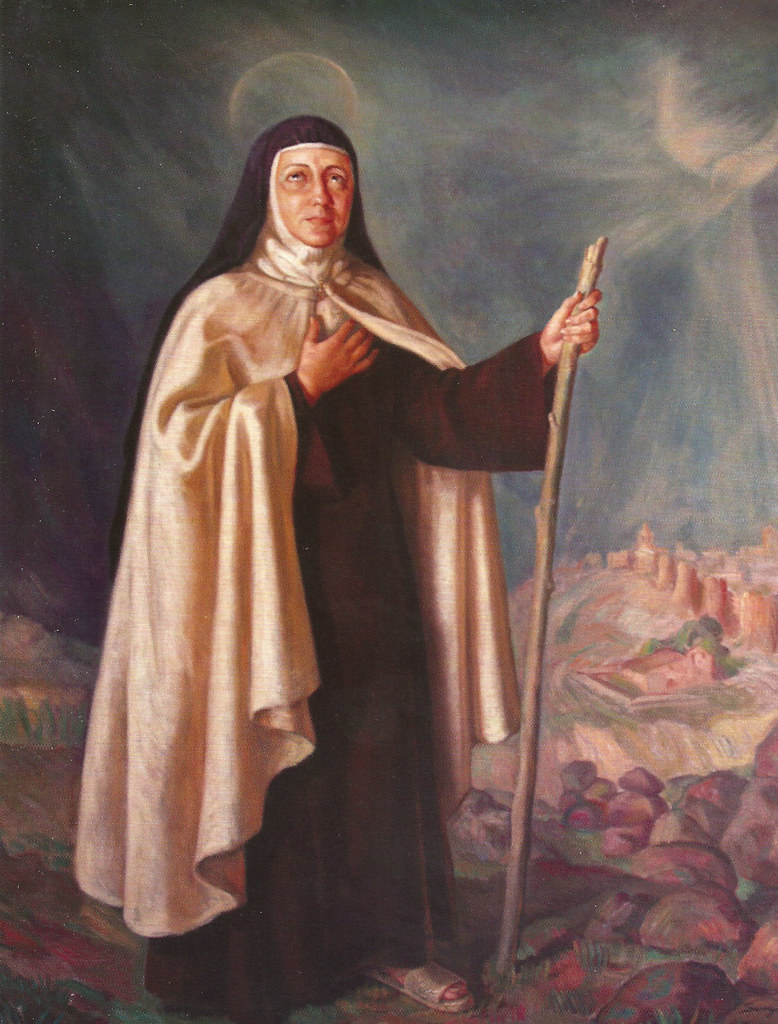
Saint Teresa of Ávila (1515–1582) was one of the greatest mystics, spiritual writers, and reformers in the history of the Catholic Church. A Carmelite nun of extraordinary faith, courage, and wisdom, she dedicated her life to seeking God through prayer and leading others towards a deeper relationship with Jesus Christ. Her teachings on contemplative prayer, spiritual growth, humility, and divine love continue to inspire Christians throughout the world.
In 1970, Pope Saint Paul VI proclaimed her a Doctor of the Church, recognising the enduring significance of her spiritual wisdom. She was the first woman to receive this title. Her most celebrated works, including The Interior Castle, The Way of Perfection, and The Book of Her Life, remain foundational texts in Catholic spirituality.
At the heart of her teaching is a simple yet profound conviction: prayer is a loving friendship with God, and the ultimate purpose of the spiritual life is union with Him.
1. Early Life and Childhood
Teresa Sánchez de Cepeda y Ahumada was born on 28 March 1515 in Ávila, a historic city in Castile, Spain. She grew up in a deeply religious family. Her father, Alonso Sánchez de Cepeda, valued Christian devotion, while her mother, Beatriz de Ahumada, nurtured her early interest in the lives of the saints.
From childhood, Teresa displayed a remarkable imagination and an intense desire for holiness. She was fascinated by stories of Christian martyrs who had given their lives for Christ. Together with her brother Rodrigo, she once attempted to travel to lands occupied by the Moors, hoping to die as a martyr for the Christian faith. Their journey was interrupted by a relative who brought them home.
This childhood adventure revealed Teresa’s passionate religious imagination and her desire to give herself completely to God. As she grew older, however, she also experienced the ordinary attractions, friendships, and emotional struggles of adolescence.
When Teresa was about fourteen, her mother died. Deeply affected by this loss, she turned to the Blessed Virgin Mary and asked her to become her mother. This personal devotion to Our Lady remained an important part of her spiritual life.
Teresa’s early years remind us that holiness is not necessarily the result of a life without struggles. It develops through the gradual discovery of God’s presence, the purification of our desires, and the willingness to respond to His call.
2. Her Entrance into Religious Life
In 1535, Teresa entered the Carmelite Monastery of the Incarnation in Ávila, despite her father’s initial opposition. She made her religious profession in 1537.
Teresa hoped that religious life would bring her closer to God, but her early years in the convent were marked by physical illness, spiritual difficulties, and periods of uncertainty. She struggled to maintain recollection in prayer and sometimes found herself distracted by conversations and social relationships.
Later, Teresa would speak openly about these difficulties in her autobiography. She recognised that, for many years, her heart was divided between her desire for God and her attachment to worldly comforts.
Her honesty makes her an especially relatable spiritual teacher. She understood that a sincere desire for holiness does not automatically eliminate weakness, distraction, or inconsistency. The spiritual journey requires perseverance, self-knowledge, and a willingness to begin again.
A decisive moment in her conversion came when she contemplated an image of the wounded Christ. The sight deeply moved her and helped her recognise the greatness of Jesus’ love and the need for a more complete response to Him.
Teresa gradually came to understand that prayer was not simply a religious obligation. It was an invitation to enter into a living relationship with Jesus Christ and to allow His love to transform her entire life.
3. Mystical Experiences and the Gift of Prayer
Saint Teresa became famous for her profound experiences of contemplative prayer. She described moments of deep interior peace, an intense awareness of God’s presence, spiritual illumination, and overwhelming love for Christ.
Teresa did not regard mystical experiences as personal achievements or reasons for pride. She understood them as gifts of divine grace. She also insisted that extraordinary experiences must be discerned carefully and evaluated according to their spiritual fruits.
The Transverberation of Her Heart
One of Teresa’s most famous mystical experiences is known as the Transverberation of the Heart. In her autobiography, she describes a vision of an angel who pierced her heart with a fiery spear. She experienced this as both painful and deeply filled with divine love.
This experience became the subject of Gian Lorenzo Bernini’s celebrated sculpture, The Ecstasy of Saint Teresa, in Rome.
For Teresa, the experience symbolised the profound transformation of the human heart through God’s love. It was not an invitation to pursue extraordinary spiritual sensations but a call to greater fidelity, humility, and self-giving.
She understood that authentic prayer must lead to a more loving and virtuous life. Visions, consolations, and mystical experiences are not the ultimate purpose of Christian spirituality. The real evidence of spiritual growth is an increasing love for God and neighbour.
Prayer as Friendship with God
One of Teresa’s most enduring teachings is her understanding of prayer as friendship with God.
In The Book of Her Life, Chapter 8, she describes mental prayer as spending time with someone whom we know loves us. This understanding transformed prayer from a formal religious exercise into a personal encounter with the living Christ.
For Teresa, prayer involved speaking honestly to Jesus, listening to Him, contemplating His humanity, and remaining in His presence even when words were unnecessary.
She encouraged Christians to approach Jesus with their joys, fears, failures, and hopes. He is not a distant God who is indifferent to human struggles, but the loving Lord who invites every person into communion with Him.
Teresa also understood that prayer is not always accompanied by consolation. There may be times when the mind wanders, the heart feels dry, and God seems distant. During such periods, she encouraged perseverance. Faithfulness in prayer is itself an expression of love.
4. The Interior Castle: Teresa’s Vision of the Soul
Saint Teresa’s most celebrated spiritual work is The Interior Castle, written in 1577. In this masterpiece, she compares the human soul to a magnificent castle made of crystal or diamond, containing seven dwelling places or mansions. At the centre of the castle dwells God, who invites the soul into an ever-deeper relationship with Him.
This image expresses Teresa’s conviction that every human person possesses an interior life of extraordinary spiritual dignity. The soul is created for communion with God, but sin, pride, fear, distraction, and excessive attachment to worldly things can prevent us from recognising His presence.
Teresa invites us to enter within ourselves, not to become self-centred, but to discover the God who dwells within the soul through grace.
The Seven Mansions of the Soul
The First Mansions: Awakening to God
The spiritual journey begins when a person recognises the dignity of the soul and becomes aware of the need for conversion. Prayer, self-knowledge, humility, and the rejection of sin are essential. The soul begins to understand that its ultimate purpose is greater than worldly success or pleasure.
The Second Mansions: Perseverance in Prayer
The soul begins to recognise God’s invitation more clearly, but distractions, temptations, and competing desires remain. Teresa emphasises perseverance, the practice of virtue, and the courage to continue praying even when progress seems slow.
The Third Mansions: Growth in Virtue
At this stage, the soul becomes more disciplined and committed to Christian living. However, there is a danger of relying too much on personal achievements or expecting God to reward every effort with spiritual consolation. Teresa calls for humility, trust, and a deeper surrender to divine providence.
The Fourth Mansions: The Beginning of Deeper Contemplation
Prayer increasingly becomes a receptive openness to God’s action. Teresa distinguishes the efforts we make in prayer from the deeper contemplative gifts that God freely grants. The soul learns to receive His presence with simplicity, gratitude, and love.
The Fifth Mansions: Transformation in Love
Teresa uses the image of a silkworm becoming a butterfly to describe the transformation of the soul. Through God’s grace, the person grows in union with Him, and love becomes increasingly evident in daily life. Self-centredness gradually gives way to generosity, humility, and fidelity.
The Sixth Mansions: Purification and Deep Union
This stage may involve intense spiritual longing, suffering, interior trials, and extraordinary mystical experiences. Teresa teaches that the soul must remain faithful to Christ through every difficulty, growing in patience, detachment, and trust.
The Seventh Mansions: Spiritual Marriage
The final mansions represent profound union with God. Teresa describes an interior life shaped by the indwelling Trinity and a mature love that seeks God’s glory above all things. This union does not remove a person from ordinary responsibilities. Rather, it produces greater love, service, and commitment to the Church.
The seven mansions should not be understood as a rigid timetable through which every Christian passes in precisely the same way. They are Teresa’s way of describing the different dimensions of spiritual growth under the action of divine grace.
The central message of The Interior Castle is that the purpose of prayer is not merely to receive blessings from God, but to be transformed by His love.
5. The Reform of the Carmelite Order
Teresa’s spiritual vision extended beyond her personal life of contemplation. She believed that authentic prayer should lead to renewal in the Church and greater fidelity to the Gospel.
During the sixteenth century, she became convinced that Carmelite religious life needed reform. She desired communities marked by deeper prayer, simplicity, poverty, fraternity, and wholehearted dedication to Christ.
In 1562, she founded the Monastery of Saint Joseph in Ávila, beginning the reform that would develop into the Discalced Carmelite movement. The term discalced refers to the practice of wearing simple footwear or going barefoot as a sign of austerity.
Her reform encountered considerable opposition. Establishing new convents required negotiations, financial arrangements, extensive travel, and the courage to face criticism. Despite poor health and the restrictions placed on women in her time, Teresa persevered.
She eventually established numerous reformed Carmelite communities throughout Spain. Her life demonstrated that contemplative prayer and practical responsibility are not opposing realities. A person deeply united with God can also be courageous, organised, intelligent, and effective in service to others.
Saint John of the Cross and the Carmelite Reform
An important collaborator in Teresa’s reform was Saint John of the Cross, a Carmelite priest and mystic. They shared a desire to renew Carmelite life through prayer, poverty, contemplation, and fidelity to Christ.
With John’s assistance, the reform extended to the male branch of the Carmelite Order. Their work encountered resistance, and John himself endured imprisonment.
Teresa’s relationship with John demonstrates the importance of spiritual friendship and collaboration in the Church. Their common mission was not centred on personal recognition but on helping people discover the transforming power of prayer.
6. The Major Writings of Saint Teresa of Ávila
Teresa’s books emerged from her personal experiences of prayer and her desire to guide others towards holiness. Her writings combine theological insight, psychological understanding, practical wisdom, and a deeply personal love for Jesus Christ.
The Book of Her Life
The Book of Her Life is Teresa’s spiritual autobiography. It describes her childhood, religious vocation, struggles in prayer, mystical experiences, and gradual conversion. The work is a testimony to God’s mercy and the power of grace in a human life.
It also provides valuable insight into her understanding of prayer, spiritual discernment, and the difficulties that accompany the pursuit of holiness.
The Way of Perfection
The Way of Perfection was written primarily for Teresa’s Carmelite sisters. It explains the virtues necessary for a life of prayer, with particular emphasis on detachment, humility, fraternal love, and the Lord’s Prayer.
Teresa believed that prayer cannot be separated from the way we live. A person who wishes to grow in contemplation must also cultivate charity, forgiveness, patience, and simplicity of heart.
The Interior Castle
The Interior Castle is Teresa’s spiritual masterpiece. Through the image of seven mansions, she explains the soul’s journey towards deeper union with God.
The book teaches that spiritual maturity involves the purification of the heart, a growing awareness of God’s presence, and an increasingly generous response to His love.
The Book of the Foundations
The Book of the Foundations recounts the establishment of Teresa’s reformed Carmelite convents. It reveals her perseverance, practical judgment, humour, and confidence in divine providence.
Her letters and other writings are equally valuable, showing how she combined profound spiritual wisdom with concern for everyday responsibilities and the practical needs of the people around her.
Together, these works establish Teresa as one of the most important teachers of Christian prayer and mystical theology.
7. The Essential Teachings of Saint Teresa’s Spirituality
Jesus Christ Must Be at the Centre of Prayer
Teresa’s contemplation was firmly centred on Jesus Christ, especially His humanity, Passion, and love. She encouraged Christians to remain close to Jesus in the Gospels and to contemplate Him as a living friend.
For her, the humanity of Christ was not an obstacle to contemplation but an essential path into the mystery of divine love. When prayer becomes difficult, the Christian can return to the life of Jesus and remain with Him in faith.
Humility Is the Foundation of Holiness
Teresa considered humility indispensable for spiritual growth. Without humility, prayer can become an occasion for pride, self-deception, or the desire to appear holy before others.
True humility means recognising the truth about ourselves before God: our limitations, our sins, our gifts, and our dependence on grace.
Humility does not mean despising ourselves. It means accepting ourselves honestly and allowing God’s mercy to lead us towards conversion.
Detachment Creates Spiritual Freedom
Teresa taught that excessive attachment to possessions, reputation, approval, comfort, and personal ambitions can hinder spiritual growth.
Detachment does not require rejecting family relationships, responsible work, or legitimate human joys. Rather, it means loving created things in the right order and refusing to allow them to take the place of God.
A detached heart is free to love more generously because it does not demand that everything conform to its own desires.
Fraternal Love Is the Test of Prayer
Teresa understood that it is possible to speak beautifully about prayer while treating others without patience or compassion.
Authentic prayer should make a person more understanding, forgiving, truthful, and generous. The way we treat family members, fellow religious, parishioners, colleagues, and those who disagree with us reveals much about the authenticity of our spiritual life.
For Teresa, love of God and love of neighbour are inseparable.
Union with God Must Lead to Service
Contemplation was never an excuse for Teresa to escape responsibility. She travelled extensively, established convents, wrote letters, addressed practical problems, and guided her communities.
Her life demonstrates that the closer a Christian comes to God, the more that person should desire to fulfil God’s will in everyday life.
Prayer is not an escape from the world. It is a source of strength for serving the world with greater love.
8. Suffering, Spiritual Dryness, and Perseverance
Teresa experienced prolonged illness, physical pain, misunderstanding, opposition, and periods when prayer was difficult. She did not interpret every trial as evidence that God had abandoned her.
Instead, she learned to persevere without demanding immediate consolation.
Her spirituality is particularly helpful for those who feel that their prayers remain unanswered. A person may pray faithfully for healing, employment, family reconciliation, or relief from financial difficulties and yet continue to experience uncertainty.
Teresa reminds us that prayer is not a transaction in which we offer prayers in exchange for the immediate fulfilment of our wishes. It is a relationship in which we learn to trust God even when we do not understand His ways.
This does not mean that suffering should be sought for its own sake or that people should remain in harmful circumstances. Rather, difficulties can be faced with faith, courage, appropriate help, and confidence in God’s presence.
Teresa’s life teaches us that spiritual maturity often grows quietly through perseverance, humility, and the willingness to begin again.
9. Saint Teresa of Ávila and the Catholic Church
Teresa’s influence extended far beyond Spain. Her writings became foundational works of Catholic spirituality, and her reform helped shape the history of the Carmelite Order.
She was beatified by Pope Paul V in 1614 and canonised by Pope Gregory XV in 1622.
On 27 September 1970, Pope Saint Paul VI proclaimed her a Doctor of the Church. She was the first woman to receive this title, recognising the depth and enduring value of her spiritual teaching. She is also known as Saint Teresa of Jesus.
Her liturgical feast is celebrated on 15 October.
Teresa’s significance is not limited to contemplative religious communities. Her teaching speaks to priests, seminarians, consecrated persons, parents, teachers, young people, and everyone who desires a deeper relationship with God.
Her life demonstrates that spiritual wisdom is not dependent upon worldly recognition or social position. A person who sincerely seeks God, perseveres in prayer, and allows grace to shape daily life can become a powerful witness to divine love.
The Church continues to value her writings as a guide to contemplative prayer, spiritual discernment, and the pursuit of holiness.
10. Lessons from Saint Teresa of Ávila for Our Lives Today
Saint Teresa’s spirituality is remarkably relevant in a world filled with distractions, constant communication, professional pressure, and anxiety. Her teaching invites us to rediscover the importance of silence, prayer, and interior freedom.
Make time for personal prayer. Even a short period of quiet prayer each day can help us become more attentive to God’s presence.
Remain faithful when prayer becomes difficult. Do not abandon prayer simply because you feel distracted, tired, or spiritually dry.
Practise humility. Acknowledge your mistakes, accept correction, and remain open to God’s grace.
Examine your relationships. Ask whether your prayer is making you more patient, compassionate, and forgiving.
Accept your limitations. Trust in God without pretending that you can control every circumstance.
Serve faithfully. Carry out your responsibilities with love, whether they involve family, work, parish ministry, or care for the poor.
Persevere in hope. Spiritual growth is a lifelong journey, and setbacks need not be the end of the journey.
Above all, Teresa encourages us to seek God not merely for what He can give us, but because He is God and the deepest desire of the human heart finds its fulfilment in Him.
11. Famous Spiritual Sayings Associated with Saint Teresa of Ávila
The following sayings are widely associated with Teresa’s spirituality. English translations and wording may vary between editions.
- “Let nothing disturb you, let nothing frighten you. All things are passing; God never changes.”
- “Patience obtains all things.”
- “God alone suffices.”
- “It is love alone that gives worth to all things.”
- “The important thing is not to think much but to love much.”
These sayings express central themes of her teaching: trust in God’s unchanging goodness, perseverance, love, and the primacy of the heart’s response to Him. The familiar words “Let nothing disturb you” come from her poem traditionally known as Nada te turbe.
12. Prayer Through the Intercession of Saint Teresa of Ávila
O God, our loving Father, You inspired Saint Teresa of Ávila to seek You with an undivided heart and to lead many souls towards a deeper life of prayer. Through her example and intercession, teach us to recognise Your presence within us and to remain faithful to You in every circumstance.
Lord Jesus, grant us the grace to speak with You as a friend, to contemplate Your love, and to surrender our fears and anxieties into Your hands. When we experience distractions, dryness, suffering, or discouragement, help us persevere in prayer and trust in Your mercy.
Free our hearts from pride, selfishness, and unhealthy attachments. Teach us humility, patience, courage, and generous love. May our prayer transform our relationships and inspire us to serve Your Church and our brothers and sisters with joy.
Holy Spirit, guide us into the depths of our hearts, where You invite us to discover the living presence of the Most Holy Trinity. May we grow daily in holiness and become faithful witnesses to the love of Christ.
Saint Teresa of Ávila, Doctor of the Church and teacher of prayer, intercede for us and help us seek God above all things.
We ask this through Christ our Lord. Amen.
Conclusion: Entering the Interior Castle
The life of Saint Teresa of Ávila reveals the extraordinary possibilities of a soul that allows God to work within it. She was a woman of courage, intelligence, humour, perseverance, and profound contemplative love. Her journey was marked by struggle, conversion, mystical experiences, and tireless service to the Church.
Her Interior Castle remains an invitation to every Christian: do not remain outside the door of your spiritual life. Enter within, seek God in prayer, and allow His grace to transform you.
The purpose of the spiritual journey is not simply to become more knowledgeable about God, but to become more deeply united with Him in love.
Teresa’s life reminds us that a heart surrendered to God can remain faithful amid suffering, courageous amid opposition, and generous amid the demands of daily life.
May Saint Teresa of Ávila intercede for us, that we may discover the beauty of contemplative prayer, grow in holiness, and become instruments of Christ’s love in the world.
References
- Teresa of Ávila. The Book of Her Life, especially Chapter 8, on mental prayer and friendship with God.
- Teresa of Ávila. The Way of Perfection. Translated editions of her spiritual work.
- Teresa of Ávila. The Interior Castle. Translated editions of her spiritual masterpiece.
- Teresa of Ávila. The Book of the Foundations. Translated editions of her account of the Carmelite reform.
- Pope Benedict XVI. “Saint Teresa of Ávila.” General Audience, 2 February 2011. Vatican website: https://www.vatican.va/content/benedict-xvi/en/audiences/2011/documents/hf_ben-xvi_aud_20110202.html
- Pope Paul VI. Multiformis Sapientia Dei. Apostolic Letter proclaiming Saint Teresa of Jesus a Doctor of the Church, 27 September 1970. Vatican website: https://www.vatican.va/content/paul-vi/en/apost_letters/documents/hf_p-vi_apl_19700927_multiformis-sapientia.html
Leave a Reply