
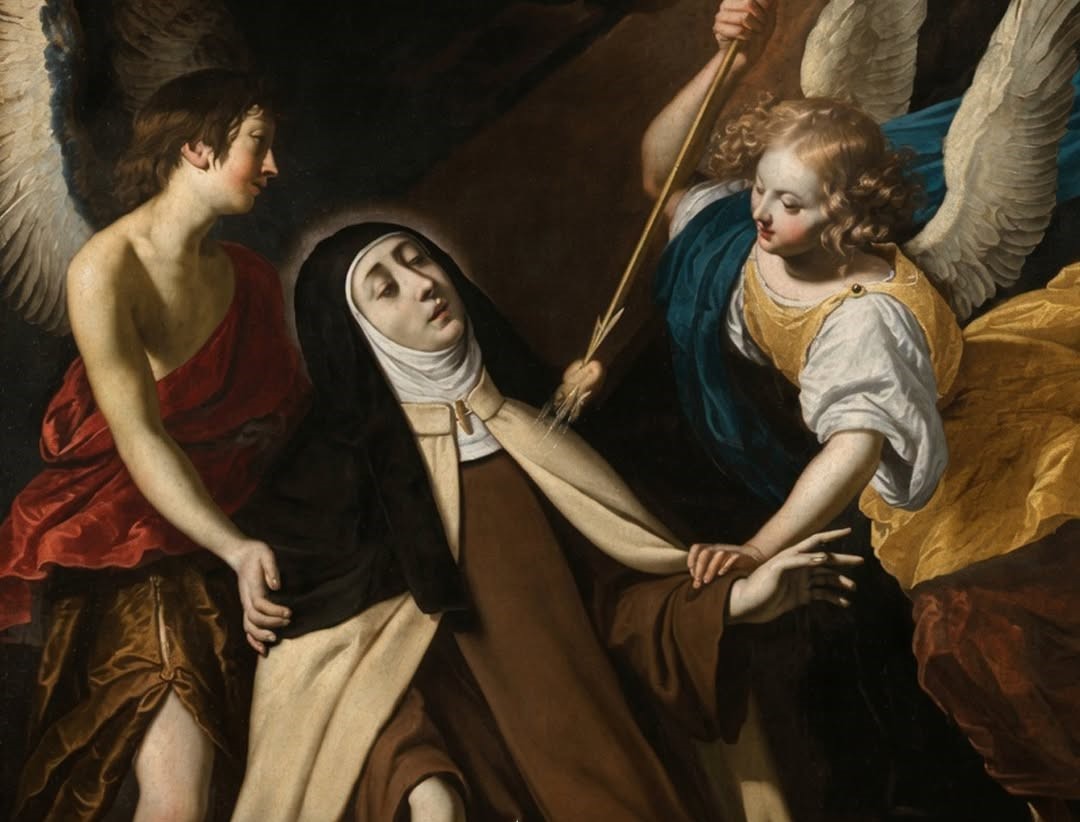
“The soul is satisfied now with nothing less than God.”
— St. Teresa of Ávila
Among the extraordinary mystical experiences recorded in the history of the Catholic Church, few are as profound, beautiful, and theologically significant as the Transverberation (or “piercing”) of the heart of St. Teresa of Ávila. This remarkable event, experienced in 1559, has inspired theologians, artists, saints, and countless believers for more than four centuries. It stands as a vivid testimony to the transforming power of God’s love and to the heights of intimacy with Him to which every Christian is ultimately called.
Far from being merely an extraordinary private revelation, Teresa’s experience reveals a universal spiritual truth: when a soul completely surrenders to God, divine love purifies, transforms, and fills it with an unquenchable longing for Him alone.
St. Teresa of Ávila: A Mystic Formed by Grace
St. Teresa of Ávila (1515–1582), also known as St. Teresa of Jesus, was a Spanish Carmelite nun, reformer, spiritual writer, and one of the greatest mystics in Christian history. She dedicated her life to renewing the Carmelite Order through a return to prayer, simplicity, poverty, and contemplative living.
Her spiritual masterpieces, including The Life of Teresa of Jesus, The Way of Perfection, The Interior Castle, and Foundations, remain among the most influential works of Christian spirituality. In recognition of her profound theological insight, Pope St. Paul VI declared her a Doctor of the Church in 1970—the first woman ever to receive this title.
Teresa understood prayer not merely as the recitation of words but as “an intimate sharing between friends; it means taking time frequently to be alone with Him whom we know loves us.”
It was within this deep life of contemplative prayer that she received one of the Church’s most celebrated mystical graces.
The Transverberation: A Heart Pierced by Divine Love
Around the year 1559, while immersed in profound prayer, Teresa experienced what the Church calls the Transverberation of the Heart. The word transverberation comes from the Latin transverberare, meaning “to pierce through.”
In her autobiography, The Life of Teresa of Jesus (Chapter 29), she describes the experience with remarkable clarity:
“I saw in his hand a long spear of gold, and at the iron’s point there seemed to be a little fire. He appeared to me to be thrusting it at times into my heart and to pierce my very entrails; when he drew it out, he seemed to draw them out also, and to leave me all on fire with a great love of God. The pain was so great, that it made me moan; and yet so surpassing was the sweetness of this excessive pain, that I could not wish to be rid of it. The soul is satisfied now with nothing less than God.”
According to Teresa, the angel—traditionally identified by many as a seraph—held a golden spear tipped with fire. As it pierced her heart, she experienced both intense suffering and indescribable joy. The physical sensation was real, yet it communicated an even deeper spiritual reality: her entire being was overwhelmed by the love of God.
The paradox of the experience is striking. The pain was genuine, yet it was inseparable from an overwhelming sweetness. Teresa realized that divine love does not simply comfort the soul; it transforms it, purifies it, and consumes every attachment that keeps it from complete union with God.
A Mystical Grace Recognized by the Church
The Church has always distinguished authentic mystical experiences from imagination or emotional enthusiasm. St. Teresa herself was cautious about extraordinary phenomena and repeatedly submitted her experiences to confessors and theologians for discernment.
Her humility, obedience, unwavering fidelity to Catholic doctrine, and the abundant spiritual fruits of her life convinced the Church of the authenticity of her mystical experiences.
The Transverberation is therefore not regarded as a sensational miracle but as an extraordinary grace granted by God to a soul already deeply united with Him.
The Physical Sign of the Pierced Heart
One of the most remarkable aspects of this event concerns the physical condition of Teresa’s heart after her death.
When her relics were examined years later, her heart was found to bear a distinct wound that many associated with the piercing she had described in her writings. Although the Church does not require Catholics to believe that the wound resulted directly from the mystical experience, it has long been regarded as an extraordinary sign accompanying her sanctity.
Today, her heart is carefully preserved as a sacred relic in the Convent of the Annunciation of the Discalced Carmelites in Alba de Tormes, Spain, where it continues to be venerated by pilgrims from around the world.
For countless faithful, the relic serves as a tangible reminder that God’s grace can touch not only the soul but, at times, even leave visible traces upon the human body.
The Theology of Divine Love
The Transverberation should not be understood merely as an isolated mystical event. Rather, it illustrates one of the central themes of Christian spirituality: God desires complete union with the human soul.
Sacred Scripture frequently describes God’s love using the language of fire.
- “Our God is a consuming fire.” (Hebrews 12:29)
- “I came to cast fire upon the earth.” (Luke 12:49)
- “The love of God has been poured into our hearts through the Holy Spirit.” (Romans 5:5)
Teresa’s experience vividly illustrates these biblical truths. The fiery spear symbolizes divine charity entering the deepest part of the human heart, purifying selfishness and filling the soul with an ever-growing desire for God.
Her mystical wound became a sign of love that burns away everything contrary to holiness.
The Pain That Brings Joy
Modern culture often associates love only with comfort and pleasant emotions. Teresa’s experience reminds Christians that authentic love always involves sacrifice.
The suffering she experienced did not come from despair or punishment. Rather, it arose because finite human nature struggles to contain the infinite love of God.
This is why she could describe the experience as both painful and sweet.
The more closely the soul approaches God, the more it longs for complete union with Him. Every remaining attachment to sin or worldly distractions becomes a source of longing until the soul rests fully in God.
As St. Augustine famously wrote:
“You have made us for Yourself, O Lord, and our hearts are restless until they rest in You.”
Teresa’s pierced heart beautifully echoes this timeless truth.
Inspiration for Every Christian
Some may think that such mystical experiences are reserved only for great saints. While extraordinary visions are indeed rare and are never the goal of the spiritual life, the grace symbolized by Teresa’s Transverberation is offered to every Christian.
God desires to transform every heart through His love.
This transformation ordinarily occurs not through visions but through:
- faithful daily prayer,
- participation in the Holy Eucharist,
- frequent reception of the Sacrament of Reconciliation,
- meditation on Sacred Scripture,
- acts of charity,
- self-denial,
- humble obedience to God’s will,
- perseverance through suffering.
As these practices deepen our relationship with Christ, our hearts gradually become more receptive to the fire of divine love.
The Legacy of St. Teresa’s Burning Heart
The image of the pierced heart has inspired Christian art, theology, and spirituality for centuries. Gian Lorenzo Bernini’s famous marble sculpture, The Ecstasy of Saint Teresa, captures the mystery of this encounter with extraordinary beauty, portraying the saint overwhelmed by divine love as the angel prepares to pierce her heart.
Yet Teresa herself would remind us that the true miracle is not the vision but the life of holiness that follows. Her reform of the Carmelite Order, her profound spiritual writings, her perseverance through illness and opposition, and her unwavering fidelity to Christ demonstrate that authentic mystical experiences always bear the fruit of deeper charity, humility, and service.
A Call to Let God Transform Our Hearts
The Transverberation of St. Teresa’s heart is not merely a story from the sixteenth century; it is an invitation addressed to every believer today.
God continues to seek hearts willing to surrender completely to Him. He desires to replace fear with trust, selfishness with charity, and lukewarm faith with burning love.
Perhaps our hearts will never bear the physical wound that Teresa’s did. Yet every Christian is called to experience a spiritual transformation in which the Holy Spirit kindles within us a love that surpasses every earthly desire.
When we allow Christ to reign fully in our lives, we discover, as Teresa did, that “the soul is satisfied now with nothing less than God.”
Prayer
O glorious St. Teresa of Ávila,
Doctor of the Church, faithful reformer, and mystic of divine love, obtain for us the grace to seek God above all things.
Teach us to persevere in prayer, to embrace God’s will with generous hearts, and to surrender every attachment that keeps us from perfect union with Christ.
May the fire of the Holy Spirit burn within us as it burned within your heart. Help us to desire holiness more than comfort, truth more than approval, and God more than all earthly treasures.
Pray that our hearts may become living temples of divine love until the day we behold the Lord face to face.
St. Teresa of Ávila, pray for us. Amen.
Reflection
Have you ever sincerely asked God to set your heart ablaze with His love—even if that love calls you to sacrifice, purification, and complete surrender?
The Lord does not ask every Christian to experience extraordinary mystical phenomena. He does, however, invite every disciple to become a saint. May the witness of St. Teresa of Ávila inspire us to seek that consuming love which alone can satisfy the deepest desires of the human heart.
Leave a Reply