
Part IV: Calvary, the Crucifixion, the Seven Last Words, and the Triumph of the Resurrection
“And I, when I am lifted up from the earth, will draw all people to Myself.” — John 12:32
Introduction
The journey that began in the Garden of Gethsemane now reaches its climax on the hill of Golgotha. Every event leading to this moment—the betrayal, the arrest, the trials, the scourging, and the painful ascent to Calvary—has prepared us for the central mystery of the Christian faith: the death and resurrection of Jesus Christ.
For Christians, Calvary is not merely the site of an execution. It is the place where heaven and earth meet, where divine justice and divine mercy embrace, where the eternal Son of God offers Himself as the perfect sacrifice for the salvation of the world.
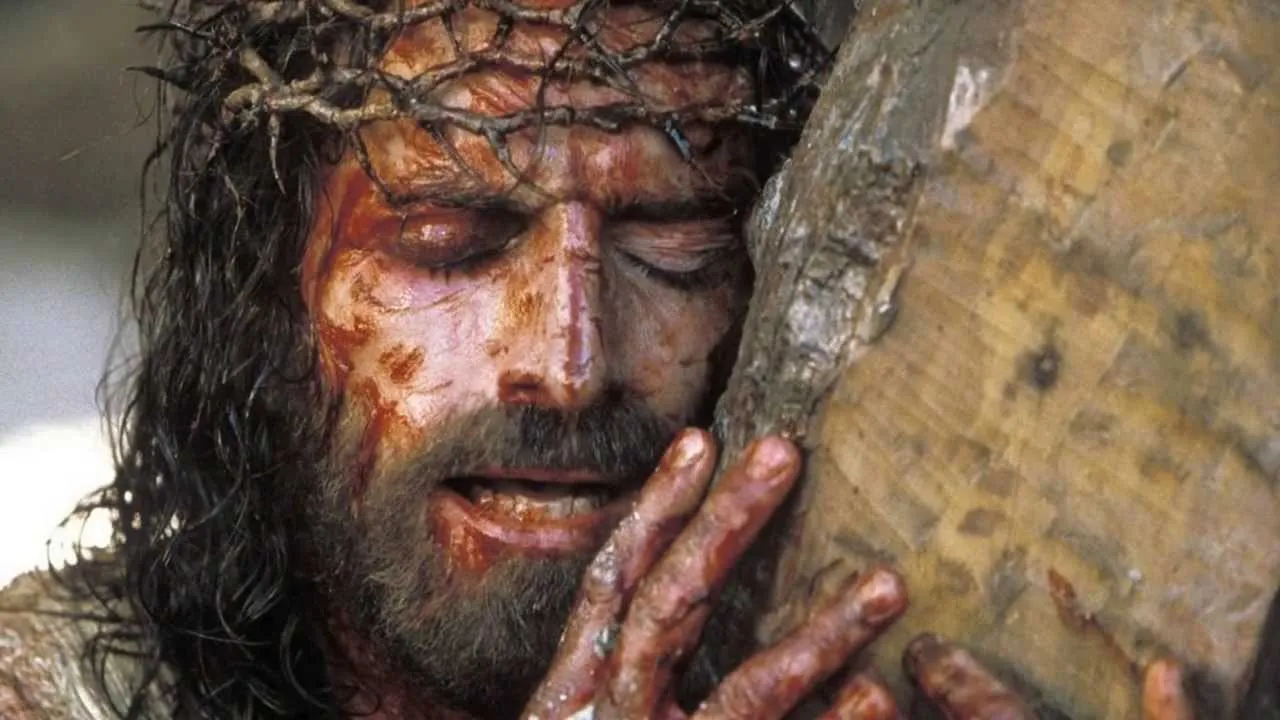
Mel Gibson’s The Passion of the Christ reaches extraordinary artistic and spiritual intensity in these final scenes. The film does not merely recount the Crucifixion as a historical event; it invites viewers to contemplate the mystery of God’s love revealed through the Cross. Every nail driven into Christ’s hands, every word spoken from the Cross, and every drop of His Precious Blood proclaims the immeasurable depth of God’s mercy toward humanity.
Golgotha: The Place of the Skull
After His exhausting journey through the streets of Jerusalem, Jesus arrives at Golgotha, meaning “the Place of the Skull.”
Historically, Roman crucifixions were carried out outside the city walls as a public warning to others. The condemned were stripped of their dignity and exposed before the crowd.
Yet the location carries profound theological meaning.
The Church Fathers often associated Golgotha with the place where Adam was buried according to ancient Christian tradition. Whether historically verifiable or not, the symbolism is striking. The first Adam brought death through disobedience; the New Adam, Jesus Christ, conquers death through perfect obedience.
St. Paul writes:
“For as by one man’s disobedience many were made sinners, so by one man’s obedience many will be made righteous.” (Romans 5:19)
Thus, Calvary becomes the place where humanity’s tragic history is reversed.
The Stripping of Christ
Before the Crucifixion, Jesus is stripped of His garments.
The soldiers tear away the robe that has become attached to His wounded flesh, causing fresh agony.
The Gospels simply state:
“They divided His garments among them.”
Behind this brief statement lies profound humiliation.
The Son of God, through whom all things were created, is deprived of everything.
He possesses no earthly wealth.
No dignity in the eyes of the world.
No comfort.
No protection.
He embraces complete poverty.
The scene reminds Christians that Christ emptied Himself entirely for our sake.
As St. Paul declares:
“Though He was rich, yet for your sake He became poor, so that by His poverty you might become rich.” (2 Corinthians 8:9)
The Nailing to the Cross
Perhaps no scene in the film is more haunting than the nailing of Jesus to the Cross.
The Roman executioners stretch His arms across the rough wood.
Large iron nails are driven through His wrists and feet.
The sound of the hammer echoes with chilling finality.
Gibson films the scene without unnecessary dialogue.
The silence is almost unbearable.
The viewer is invited not merely to witness physical suffering but to contemplate divine love.
The hands that healed lepers are pierced.
The feet that walked across Galilee preaching the Kingdom are fastened to wood.
The hands that blessed children are now immobilized.
Yet even in this apparent defeat, Christ freely offers Himself.
The Cross is not forced upon Him.
He embraces it.
As Jesus had already proclaimed:
“No one takes My life from Me, but I lay it down of My own accord.” (John 10:18)
The Cross Is Raised
Once Jesus is nailed to the Cross, the soldiers lift it upright.
The Cross crashes into its place.
Every movement intensifies His agony.
Yet this moment fulfills His own prophecy:
“When I am lifted up from the earth, I will draw all people to Myself.”
The Cross becomes both an altar and a throne.
On earthly thrones kings rule over subjects.
From the Cross, Christ reigns by giving His life for sinners.
His victory comes not through domination but through sacrificial love.
The Seven Last Words of Christ
One of the greatest treasures of Christian spirituality is the meditation on the Seven Last Words spoken by Jesus from the Cross.
Although no single Gospel records all seven sayings, together they reveal the heart of the Redeemer.
1. “Father, forgive them…”
The first word is forgiveness.
Despite unimaginable suffering, Jesus prays for those responsible for His death.
“Father, forgive them, for they know not what they do.”
This prayer reveals the very heart of the Gospel.
Love answers hatred.
Mercy answers violence.
Forgiveness answers sin.
Christ practices what He preached in the Sermon on the Mount.
He does not merely command forgiveness.
He embodies it.
2. “Today you will be with Me in Paradise.”
Beside Jesus hangs a repentant criminal.
He acknowledges his guilt and turns toward Christ with humble faith.
“Jesus, remember me when You come into Your kingdom.”
Jesus immediately responds:
“Today you will be with Me in Paradise.”
This brief exchange beautifully illustrates the boundless mercy of God.
No life is beyond redemption.
Even in the final moments of earthly existence, sincere repentance opens the door to salvation.
The Good Thief stands as a perpetual sign of hope for every sinner.
3. “Behold your Mother.”
At the foot of the Cross stand Mary and the beloved disciple.
Jesus entrusts them to one another.
“Woman, behold your son.”
“Behold your mother.”
For Catholics, this moment extends beyond a simple act of filial care.
The Church sees here the spiritual motherhood of Mary toward all believers.
The beloved disciple represents every faithful Christian.
Mary becomes the Mother of the Church, continuing her maternal mission after Christ’s Ascension.
Mel Gibson captures this scene with remarkable tenderness.
Mary does not collapse in despair.
She remains standing.
Her silent fidelity mirrors her unwavering faith.
4. “My God, My God…”
Perhaps the most misunderstood saying from the Cross is:
“My God, My God, why have You forsaken Me?”
Some interpret these words as despair.
The Church understands them differently.
Jesus is quoting Psalm 22.
The Psalm begins with anguish but ends in confidence and ultimate victory.
By praying its opening verse, Jesus identifies Himself with all who experience suffering while simultaneously fulfilling Messianic prophecy.
Even in apparent abandonment, He remains perfectly united with the Father.
5. “I Thirst.”
On one level, Jesus expresses genuine physical thirst.
After scourging, blood loss, and crucifixion, dehydration would have been severe.
Yet Christian tradition also recognizes a deeper meaning.
Christ thirsts for souls.
He longs for humanity to accept the salvation He offers.
St. Teresa of Calcutta often reflected upon these words, seeing in them Christ’s continuing thirst for every human heart.
6. “It Is Finished.”
These words are not a cry of defeat.
They are a proclamation of victory.
The mission entrusted by the Father has been accomplished.
The prophecies are fulfilled.
The sacrifice has been offered.
Redemption has been won.
The Greek expression Tetelestai carries the sense of something brought to perfect completion.
Nothing more is required.
The perfect sacrifice has been made.
7. “Father, into Your hands…”
Jesus dies as He has lived—in complete trust.
“Father, into Your hands I commend My spirit.”
The final word is not fear.
It is surrender.
The Son returns everything to the Father.
This perfect obedience undoes Adam’s disobedience.
The Death of Christ
When Jesus breathes His last, creation itself responds.
Darkness covers the land.
The earth trembles.
The rocks split apart.
The Temple veil is torn from top to bottom.
These signs proclaim that something infinitely greater than an ordinary death has occurred.
The separation between God and humanity has been overcome.
The torn veil symbolizes free access to the Father through Christ.
No longer is God’s presence hidden behind barriers.
The Cross opens the way.
Satan’s Defeat
One of Mel Gibson’s most memorable artistic moments occurs immediately after Christ’s death.
Satan screams in despair.
Throughout the film, evil appeared to triumph.
Now the truth is revealed.
The Cross has become Satan’s defeat.
By accepting death, Christ destroys death.
By entering the realm of the grave, He breaks its power forever.
As Hebrews proclaims:
“Through death He destroyed the one who has the power of death, that is, the devil.”
The victory is not achieved by force but by sacrificial love.
The Roman Centurion
Standing beneath the Cross, the Roman centurion witnesses everything.
His hardened heart begins to change.
Finally he confesses:
“Truly this was the Son of God.”
This remarkable profession comes not from a disciple but from a Roman soldier.
The first public confession after Christ’s death comes from a Gentile.
It anticipates the universal mission of the Church.
The salvation accomplished on Calvary is intended not only for Israel but for the entire world.
The Pietà: A Mother’s Silent Sorrow
After Jesus is removed from the Cross, His body is placed in Mary’s arms.
The scene recalls Michelangelo’s famous Pietà.
No words are necessary.
Mary gazes upon the broken body of her Son.
Her sorrow is immeasurable.
Yet beneath that sorrow lies unwavering faith.
She believes God’s promises even when surrounded by death.
Her fidelity offers an enduring model for every Christian facing suffering and loss.
The Burial
Joseph of Arimathea and Nicodemus lovingly prepare Jesus’ body for burial.
The stone is rolled across the entrance of the tomb.
Silence descends.
To human eyes, the story appears finished.
Hope seems buried.
The disciples are scattered.
The world believes darkness has won.
Yet God is already preparing the greatest miracle in history.
The Resurrection
Gibson wisely portrays the Resurrection with profound simplicity.
The stone is rolled away.
The burial cloths lie empty.
The risen Christ stands.
The wounds remain visible.
The nails have not erased His identity.
Rather, they have become glorious signs of victory.
The Resurrection transforms everything.
Without it, the Cross would remain a tragic execution.
With it, the Cross becomes the source of eternal life.
As St. Paul declares:
“If Christ has not been raised, your faith is futile.”
But Christ has been raised.
Death has been conquered.
Sin has been defeated.
Hope has become an eternal reality.
The Cross and the Empty Tomb
The film concludes not with suffering but with hope.
This is deeply significant.
Christianity is not ultimately a religion centered on pain.
It is centered on love that triumphs over pain.
The Cross cannot be separated from the empty tomb.
Good Friday always points toward Easter Sunday.
Every Christian cross ultimately leads to resurrection.
Every act of faithful suffering offered in union with Christ participates in His victory.
Conclusion
The final scenes of The Passion of the Christ draw viewers into the very heart of the Christian mystery. Calvary is not simply the place where Jesus died; it is the place where humanity is reconciled to God, where sin is conquered by mercy, and where sacrificial love is revealed as the greatest power in the universe.
Mel Gibson’s portrayal of the Crucifixion challenges believers not merely to admire Christ’s sacrifice but to respond to it with faith, gratitude, repentance, and renewed discipleship. The Resurrection, presented with quiet majesty, reminds us that suffering and death never have the final word. The empty tomb proclaims the victory of Christ and the promise of eternal life for all who follow Him.
In Part V, the concluding installment of this series, we will evaluate the film’s biblical accuracy, explore its rich Catholic symbolism, examine the controversies surrounding its release, assess its cinematic legacy, and reflect on its enduring spiritual impact on Christians throughout the world.
Leave a Reply