
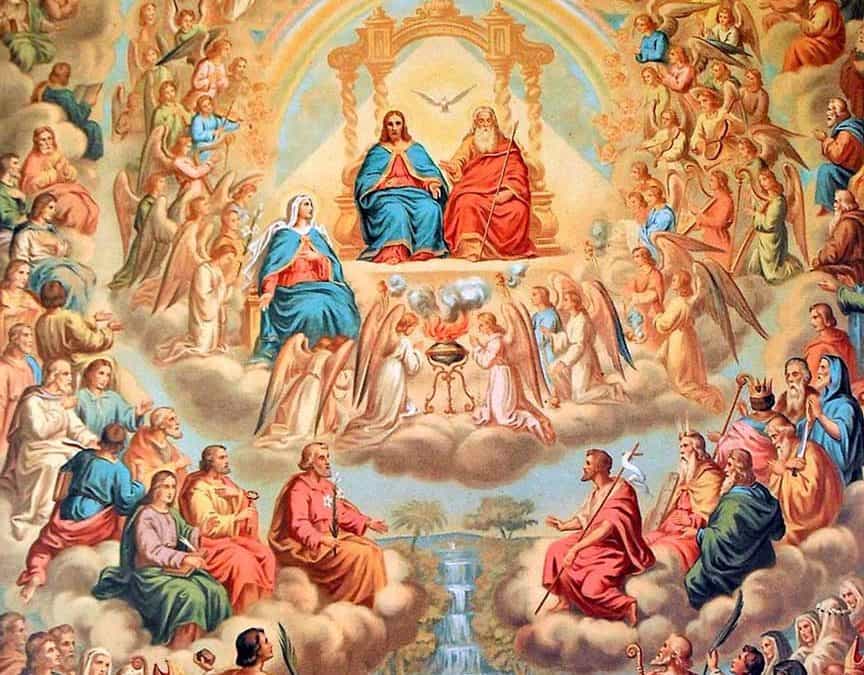
“The Family Gathered Around the Lamb” | All Saints Day
A family photograph can make us pause. We look at the faces and remember the stories: someone’s courage, someone’s kindness, the love that held people together through hard times.
Today, on All Saints’ Day, the Church opens a much larger family album. In the vision of Revelation, John sees “a great multitude that no one could count, from every nation, from all tribes and peoples and languages,” standing before God and the Lamb.
They are not gathered because they were all alike, or because they had easy lives. They are gathered because God brought them through, and because Christ is at the center of their joy.
Saint John gives us the beginning of this story: “See what love the Father has given us, that we should be called children of God; and that is what we are.”
We do not begin by proving ourselves worthy of God’s family. God comes to us first and calls us his children. Yet John is honest: “What we will be has not yet been revealed.” We are still on the way. We have received the promise that, when Christ is revealed, we will be like him, because we will see him as he is. This promise gives us hope as we continue our journey toward heaven.
Pope Saint John Paul II described this as the gift of adoption that comes to fullness in Christ: in him, we belong to God as children belong to a Father, and the way toward holiness passes through the Beatitudes.
That means All Saints’ Day is not only a day for admiring extraordinary people from a distance. It is a day for remembering who we are called to become. The saints show us what God’s love can do in a human life, and the same God is still at work in us.
They are people who belonged to God, trusted his mercy, and kept letting him raise them up. Their holiness began not with their achievement, but with the Father’s love.
The saints show us where this journey leads. In the first reading, John sees “a great multitude, which no one could count, from every nation, race, people, and tongue. They stood before the throne and before the Lamb, wearing white robes and holding palm branches in their hands.
When asked who they are, the answer is: “These are the ones who have survived the time of great distress; they have washed their robes and made them white in the Blood of the Lamb.” Their salvation belongs to God and to Christ.
Their victory is not that they never suffered. Their holiness is not a trophy they earned by themselves. They have been saved by God; their robes are made white in the blood of Christ. They have been brought through suffering by God, and their salvation belongs to God and to the Lamb.
Their song says it plainly: “Salvation comes from our God, who is seated on the throne, and from the Lamb.”
This is an important reminder because sometimes holiness can sound like an exhausting demand: “Try harder. Be better. Never fail.” The Gospel does call us to change, but it does not tell us to save ourselves. It calls us to follow Jesus. The saints’ good lives do not replace God’s grace; they show what grace can bring about in people who keep turning toward Christ.
How do we learn to walk this path? Jesus tells us in the Beatitudes: “Blessed are the poor in spirit,” “Blessed are they who mourn,” “Blessed are the meek,” and “Blessed are they who hunger and thirst for righteousness.”
At first, these words can sound upside down. The world often calls the successful, powerful, comfortable, and admired “blessed.” Jesus speaks of the poor in spirit, the merciful, the peacemakers, and those who suffer for what is right. He is not saying that poverty, grief, or persecution are good in themselves, or that we should seek suffering for its own sake. He is revealing where God is at work and what kind of heart is open to his kingdom.
Pope Benedict XVI taught that the Beatitudes show us the spiritual features of Jesus himself. They express his life, his Passion and Resurrection, and invite us to follow him. Following the Beatitudes means following him. With his help, what seems impossible becomes possible.
The Catechism makes the same point: the Beatitudes “depict the countenance of Jesus Christ and portray his charity.” They describe the Christian vocation and sustain hope in the midst of suffering. 3
So, the poor in spirit are not people who think they are worthless. They are people who know they cannot save themselves and place their trust in God.
The meek refuse to make domination their way of life.
Those who hunger for righteousness long for a world shaped by God’s truth and justice.
The merciful do not use another person’s failure as an excuse to withhold compassion.
The peacemakers do more than avoid arguments; they work to repair what sin and hostility have broken.
And those persecuted for righteousness’ sake keep faith with God even when faithfulness costs them.
These are not eight unrelated instructions, or impossible demands placed on us from a distance. They are the path of Jesus, and he calls us to walk it in the circumstances of our own lives.
The saints show us that this path can take many forms. Some served the poor; some taught the faith; some endured imprisonment; some quietly cared for family and neighbors. Their circumstances were different, but Christ was at work in them.
Pope Francis reminds us that holiness is often found not in extraordinary events but in daily fidelity to baptism and in love for God and neighbor.
Today’s feast also reminds us that holiness does not lead us into isolation. The saints are not distant figures whom we can only admire. They belong to the family of God, and the Church on earth is joined to the Church in glory in the communion of saints.
Pope Saint John Paul II describes the saints as brothers and sisters who are close to us: their example strengthens our pilgrimage, and we may seek their intercession as we follow Christ.
So, when we honor the saints, we do more than remember them. We learn from their example and ask their prayers as we follow Christ. Their variety matters: holiness does not require every life to look the same. It may take the form of quiet fidelity in family life, compassionate service, courageous witness, patient endurance, or a sincere return to God after failure. The common thread is not that every saint had the same story. It is that each life was offered to Christ.
We began with a family photograph. Today, the Church gives us something more: a glimpse of the family gathered around the Lamb. Its members come from every people and language. They have known hardship, yet Christ has brought them through. Their joy is not self-congratulation, but praise to God.
And that family is not complete without us. We are God’s children now, still on the way, still being formed in the likeness of Christ. The saints show us that the way is real not because they saved themselves, but because God’s grace was at work in them.
Today, then, we give thanks for their witness, ask their help, and renew our hope: the Father who calls us his children is leading us, too, toward the fullness of life with him.
✍ Fr Tojan Abraham MCBS
Leave a Reply