
Theme: “Meeting Christ in the Eucharist and Confession”
Scripture: Daily Mass Readings
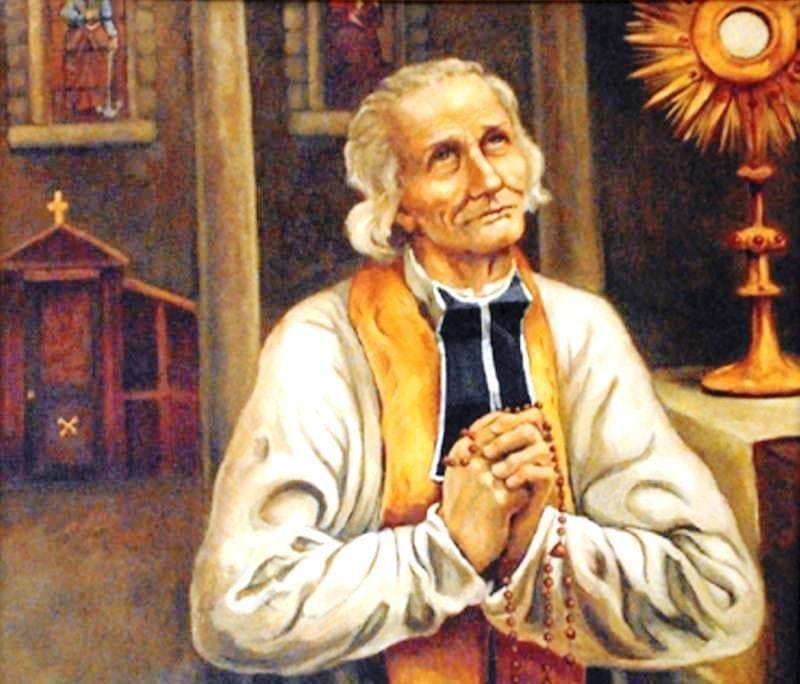
Memorial: Saint John Mary Vianney, Patron Saint of Parish Priests
Introduction
Dear brothers and sisters in Christ,
Today the Church celebrates the memorial of one of her greatest pastors, Saint John Mary Vianney, affectionately known as the Curé of Ars. He was not a famous theologian, a gifted preacher, or a miracle worker in the ordinary sense. He was a humble parish priest in a small French village whose extraordinary holiness transformed countless lives.
People traveled hundreds of miles to the little village of Ars simply to meet him. Some waited for days just to spend a few minutes in the confessional. Why? Because they encountered not merely a priest—they encountered the mercy of Jesus Christ.
Saint John Vianney reminds us that the heart of every parish, and indeed the heart of every Christian life, is found in two great gifts: the Eucharist and the Sacrament of Reconciliation.
These two sacraments are like two beating hearts that keep the spiritual life alive. One nourishes us with Christ Himself; the other heals us when sin wounds our relationship with God.
A Priest in Love with Jesus
Saint John Vianney once said,
“The priesthood is the love of the Heart of Jesus.”
Those words reveal the secret of his life.
He believed that every priest is called not to point people to himself but to Christ. His greatest joy was celebrating Holy Mass. He often wept while standing at the altar because he knew that heaven touched earth whenever the Eucharist was celebrated.
He once remarked,
“If we really understood the Mass, we would die of joy.”
Think about those words.
How often do we come to Mass distracted by our phones, our worries, our schedules, or simply out of habit? We sometimes forget what is really happening.
At every Mass:
- Christ becomes truly present.
- Calvary is made sacramentally present.
- Heaven opens.
- Angels adore.
- Grace is poured out.
- The faithful receive the Bread of Life.
The Eucharist is not merely a symbol or a reminder. It is Jesus Himself—Body, Blood, Soul, and Divinity—offering Himself to us.
Saint John Vianney spent long hours before the tabernacle because he knew that the greatest treasure on earth was hidden there.
He encouraged his parishioners simply to sit quietly before Jesus.
When someone asked what he did during long periods of Eucharistic adoration, he replied:
“I look at Him, and He looks at me.”
What a beautiful description of prayer!
Prayer is not always about speaking many words. Sometimes the deepest prayer is simply remaining in the loving presence of Christ.
The Confessional: The Place of Mercy
If the altar was the center of Saint John Vianney’s priesthood, the confessional was its beating heart.
He spent as many as twelve to sixteen hours each day hearing confessions.
Imagine that.
Day after day.
Year after year.
Listening.
Counseling.
Encouraging.
Absolving.
Bringing sinners back to God.
He never saw the confessional as a courtroom where people were condemned.
He saw it as the Father’s house where lost sons and daughters returned home.
He understood that every confession is another chapter in the story of the Prodigal Son.
God is always waiting.
Always forgiving.
Always embracing.
Unfortunately, many Catholics today stay away from Confession.
Some say,
“I haven’t committed serious sins.”
Others say,
“I confess directly to God.”
Some are embarrassed.
Others have been away for years.
Saint John Vianney would gently remind us that Confession is not about informing God of our sins—He already knows them.
Confession is about opening our hearts so that God’s mercy may heal us.
He once said,
“The good God knows everything. Even before you confess, He already knows your sins. Yet He wants you to tell them to Him, so that He may forgive you.”
How comforting those words are!
No sin is greater than God’s mercy.
No failure is beyond His forgiveness.
No one is too far away to return home.
Why We Need Both Sacraments
The Eucharist and Confession belong together.
Confession prepares our hearts to receive Jesus worthily.
The Eucharist strengthens us to resist future temptation.
One heals.
The other nourishes.
One cleanses.
The other strengthens.
One restores friendship with God.
The other deepens that friendship.
Imagine inviting a guest into your home while leaving the house dirty and neglected.
Naturally, we would clean it first.
Likewise, Confession cleans the soul so that Christ may dwell there with greater fruitfulness in Holy Communion.
Saint John Vianney constantly encouraged frequent confession—not because he wanted people to focus on sin, but because he wanted them to experience freedom.
The Holiness of Ordinary Life
One remarkable aspect of Saint John Vianney’s spirituality was its simplicity.
He did not ask everyone to become monks or mystics.
He encouraged ordinary people to become saints through ordinary faithfulness.
He taught them to:
- attend Mass faithfully,
- pray daily,
- receive the sacraments regularly,
- forgive others,
- work honestly,
- care for the poor,
- love their families,
- and trust God’s mercy.
Holiness is not reserved for extraordinary people.
It begins in ordinary acts performed with extraordinary love.
Every Christian is called to holiness.
Not tomorrow.
Not after retirement.
Not when life becomes easier.
Today.
A Challenge for Our Times
Our modern world is busy, noisy, and distracted.
Many people have time for entertainment but little time for prayer.
We schedule appointments for almost everything except meeting Christ.
Saint John Vianney would ask us today:
- When was your last good confession?
- How do you prepare before Mass?
- Do you spend time with Jesus in Eucharistic adoration?
- Is Sunday Mass the center of your week or simply another obligation?
- Do you hunger for Christ as much as you hunger for success, comfort, or recognition?
These are not questions meant to produce guilt.
They are invitations to deeper love.
Jesus never forces Himself upon us.
He waits patiently.
He calls gently.
He longs to feed us with His Body and heal us with His mercy.
Lessons from the Curé of Ars
Saint John Vianney teaches us several enduring lessons:
First, holiness is possible for every Christian.
Second, the Eucharist is the greatest treasure on earth.
Third, Confession is not a burden but a gift.
Fourth, prayer transforms both individuals and parishes.
Fifth, one holy priest—or indeed one holy Christian—can change an entire community.
The village of Ars became famous not because of its buildings or wealth, but because one man allowed Christ to work through him.
Imagine what God could accomplish if each of us renewed our love for the Eucharist and approached the Sacrament of Reconciliation more frequently.
Conclusion
Dear friends,
Saint John Mary Vianney continues to speak to the Church today.
He reminds priests to shepherd with humility and love.
He reminds families to make Christ the center of the home.
He reminds young people that holiness is possible.
He reminds every Catholic that God’s mercy is greater than every sin.
Today, let us make two simple resolutions.
First, let us never take the Holy Eucharist for granted.
Every Mass is an encounter with the living Christ.
Second, let us rediscover the beauty of Confession.
If it has been months—or even years—since our last confession, perhaps today is the day to return.
As we approach the altar to receive the Body and Blood of Christ, let us ask the Curé of Ars to intercede for us, that our hearts may burn with love for Jesus in the Eucharist and rejoice in the healing grace of His forgiveness.
May our lives, like his, become living witnesses to the infinite mercy of God.
Saint John Mary Vianney, Patron of Parish Priests, pray for us.
Amen.
Leave a Reply