
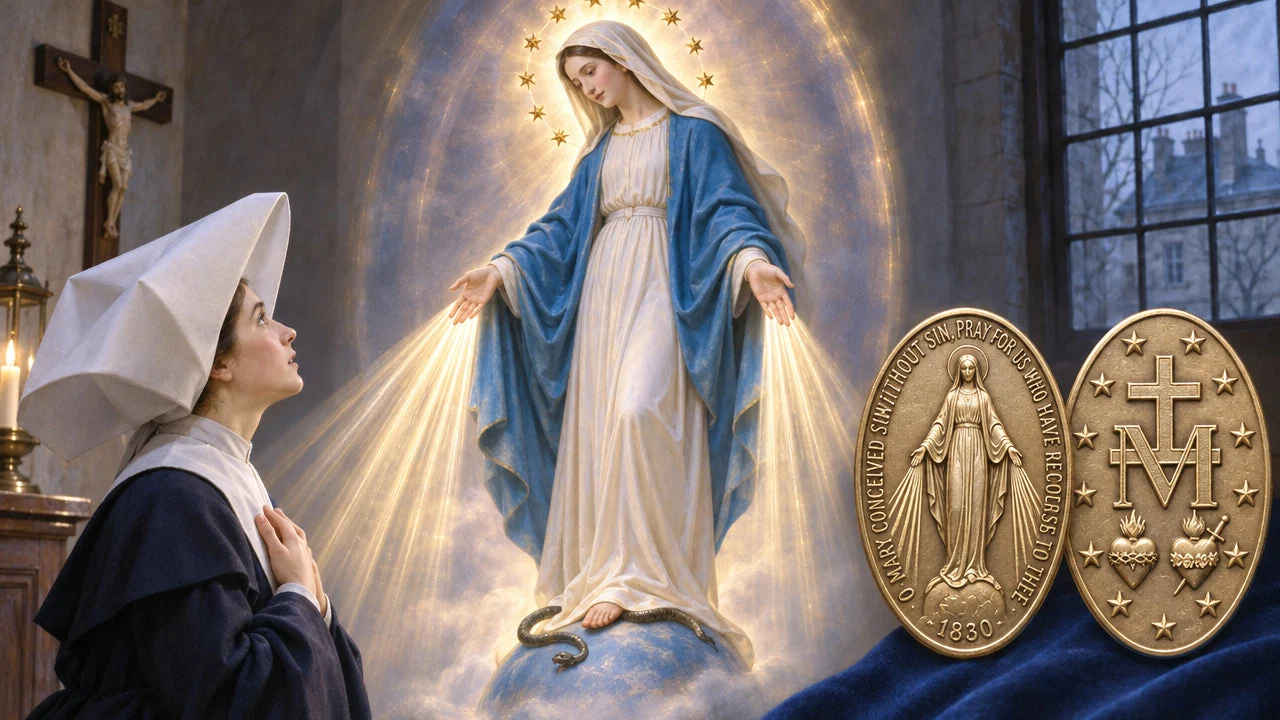
The Humble Daughter of Charity and the Visionary of the Miraculous Medal
Feast Day: 28 November
Saint Catherine Labouré was a French Daughter of Charity who became widely known throughout the Catholic Church because of the Marian apparitions she experienced in 1830. Through her, the Blessed Virgin Mary requested the creation of the Miraculous Medal, which became one of the most beloved sacramentals in Catholic devotion.
Although millions of Catholics throughout the world honour the Miraculous Medal, Catherine herself remained almost completely unknown during her lifetime. She never sought recognition or fame. For more than forty years, she quietly served the poor, the elderly and the sick as a Daughter of Charity in Paris.
Her life is a beautiful example of humility, obedience, simplicity and deep devotion to the Blessed Virgin Mary. She teaches us that God often accomplishes extraordinary things through people who are willing to remain hidden and faithful in ordinary duties.
1. Early Life and Family Background
Saint Catherine Labouré was born on 2 May 1806 in the village of Fain-lès-Moutiers, in Burgundy, France. Her baptismal name was Zoé Labouré.
She was born into a large farming family. Her father, Pierre Labouré, and her mother, Louise-Madeleine Gontard, raised their children in a Christian atmosphere.
Catherine was the ninth of eleven surviving children. Her childhood was marked by the simplicity of rural life, family responsibilities and the practice of Catholic faith.
When Catherine was only nine years old, her mother died on 9 October 1815. This was a painful experience for the young girl.
According to a traditional account, after her mother’s death, Catherine took a statue of the Blessed Virgin Mary into her arms and said:
“Now, dear Blessed Mother, you will be my mother.”
From that moment, she developed an exceptionally close relationship with Mary. Her devotion was not merely an external religious practice; it became a source of comfort, strength and guidance throughout her life.
As she grew older, Catherine helped with household responsibilities and agricultural work. She also cared for her younger siblings.
Although she received limited formal education, she possessed a strong practical intelligence, a generous heart and a deep desire to belong entirely to God.
2. Her Desire to Become a Daughter of Charity
As a young woman, Catherine felt increasingly attracted to religious life.
Her father, however, initially opposed her desire to enter a convent. He wanted her to marry and remain involved in family responsibilities.
For some time, Catherine continued working at home and helping her family. She also assisted in caring for the poor and the sick.
Eventually, she was able to pursue her vocation.
In January 1830, she entered the community of the Daughters of Charity of Saint Vincent de Paul at the convent in Châtillon-sur-Seine.
On 21 April 1830, she was transferred to the motherhouse of the Daughters of Charity at Rue du Bac in Paris.
The Daughters of Charity were founded by Saint Vincent de Paul and Saint Louise de Marillac. Their spirituality emphasised humility, simplicity, charity and service to Christ in the poor.
Catherine found in this congregation the opportunity to fulfil her desire to dedicate her entire life to God through service to others.
She was especially devoted to the Eucharist and the Blessed Virgin Mary.
3. Her First Experience of the Blessed Virgin Mary
In July 1830, Catherine experienced the first of several extraordinary encounters with the Blessed Virgin Mary.
On the night of 18 July 1830, the eve of the feast of Saint Vincent de Paul, Catherine was awakened by a mysterious light and the voice of a child, traditionally identified as her guardian angel.
The child invited her to go to the chapel because the Blessed Virgin was waiting for her.
Catherine followed the child to the chapel at the Rue du Bac convent.
There, according to her testimony, she saw the Blessed Virgin Mary seated near the sanctuary.
Catherine approached Mary and knelt beside her. She later described the experience as one of extraordinary intimacy and consolation.
She spoke with the Blessed Virgin for several hours.
Mary entrusted her with messages concerning the future of the Church, the suffering of the faithful and the need for prayer.
This experience deeply influenced Catherine’s spiritual life. She understood that she was being called to a special mission, although she did not yet know its full meaning.
4. The Apparition of 27 November 1830
The most important apparition took place on the evening of 27 November 1830, in the chapel of the Daughters of Charity at Rue du Bac, Paris.
It was a Saturday evening, and the community was gathered for meditation.
While praying, Catherine saw the Blessed Virgin Mary standing on a globe. Mary was dressed in a white silk robe and wore a white veil. Her feet rested upon a serpent, symbolising her victory over evil.
In her hands, Mary held a golden globe surmounted by a small cross, which she offered to God.
Suddenly, Catherine saw rings on Mary’s fingers, adorned with precious stones. Rays of light streamed from the stones and illuminated the globe beneath her feet.
Mary explained that these rays symbolised the graces that God grants to those who ask for them.
However, Catherine noticed that some of the stones did not give out any rays.
She understood that these represented graces which people failed to ask for.
The Blessed Virgin Mary then instructed her to have a medal struck according to the design she had seen.
Catherine was told that those who wore the medal with confidence would receive abundant graces.
The vision then changed, and Catherine saw the reverse side of the medal.
It displayed the letter M surmounted by a cross, with two hearts beneath it: the Sacred Heart of Jesus, crowned with thorns, and the Immaculate Heart of Mary, pierced by a sword.
Around the image appeared twelve stars.
The vision was surrounded by an oval frame bearing the inscription:
“O Mary, conceived without sin, pray for us who have recourse to thee.”
This was the beginning of the devotion that would become known throughout the world as the Miraculous Medal.
5. The Meaning of the Miraculous Medal
The medal requested by the Blessed Virgin Mary contains profound spiritual symbolism. Every detail invites Christians to reflect upon the mystery of Christ, the role of Mary and the power of God’s grace.
The Front Side of the Medal
1. Mary standing upon the globe
Mary’s position upon the globe symbolises her maternal relationship with humanity and her participation in God’s victory over evil.
2. The serpent beneath her feet
The serpent represents Satan and the power of sin. Mary’s victory recalls the biblical promise of Genesis 3:15 and points towards Christ’s ultimate victory over evil.
3. The rays of light from Mary’s hands
The rays symbolise the graces that God bestows upon humanity through Mary’s intercession.
4. The inscription
“O Mary, conceived without sin, pray for us who have recourse to thee.”
This prayer expresses the Catholic belief in Mary’s Immaculate Conception. It was also an important instrument in spreading devotion to this Marian privilege, which was solemnly defined as a dogma by Pope Pius IX in 1854.
The Reverse Side of the Medal
1. The Letter M
The letter M represents Mary, the Mother of Jesus.
2. The Cross above the M
The cross signifies Jesus Christ and His sacrifice. Its position above the letter M symbolises Mary’s intimate union with her Son in His saving mission.
3. The Two Hearts
The Sacred Heart of Jesus, surrounded by a crown of thorns, represents His immense love and suffering for humanity.
The Immaculate Heart of Mary, pierced by a sword, recalls her maternal suffering and her faithful participation in the mystery of Christ’s Passion.
4. The Twelve Stars
The twelve stars recall the biblical image in Revelation 12:1, which describes a woman clothed with the sun, with the moon beneath her feet and a crown of twelve stars.
Together, these symbols make the Miraculous Medal a beautiful reminder of the central mysteries of Christian faith.
It is important to remember that the medal is not a magical object. Its spiritual value lies in the faith, prayer, conversion and trust in God that it encourages. Catholics wear it as a sacramental and an expression of devotion to Mary and her Son, Jesus Christ.
6. The Approval and Production of the Miraculous Medal
After the apparition, Catherine was deeply convinced that the medal should be produced and distributed.
However, she was hesitant to speak publicly about her experiences.
She confided in her spiritual director, Father Jean-Marie Aladel, a priest of the Congregation of the Mission founded by Saint Vincent de Paul.
Initially, Father Aladel found it difficult to accept her account. Catherine continued to insist that the Blessed Virgin had requested the medal.
Eventually, after further discernment and ecclesiastical consultation, permission was granted for the first medals to be produced.
In 1832, the first medals were struck and distributed in Paris.
The medal quickly became popular among Catholics. Numerous people reported spiritual and physical favours after receiving it.
During an outbreak of cholera in Paris in 1832, the medal was distributed among the faithful, and many attributed remarkable graces and recoveries to Mary’s intercession.
As reports of favours spread, people began calling it the Miraculous Medal.
The devotion gradually spread throughout France and then across the world.
7. Catherine’s Hidden Life of Humility
One of the most extraordinary aspects of Saint Catherine’s life was her determination to remain hidden.
Although the Miraculous Medal was becoming famous throughout the Catholic world, very few people knew that Catherine was the person who had received the apparitions.
She did not seek publicity, recognition or special privileges.
After the apparitions, she continued her ordinary religious duties as a Daughter of Charity.
She was assigned to the hospice at Enghien, located in the Reuilly district of Paris, where she served elderly men, many of them former workers and servants.
Her responsibilities included caring for the sick, preparing meals, maintaining the household and attending to the needs of the elderly.
She performed these tasks with extraordinary simplicity and dedication.
She never considered her ordinary work insignificant. For her, every act of charity was an opportunity to serve Jesus Christ.
Even when others praised the Miraculous Medal, she did not reveal that she was the visionary.
She believed that the mission entrusted to her was more important than personal recognition.
Her hidden life is one of the most beautiful testimonies of Christian humility.
8. Her Devotion to the Eucharist
The Eucharist occupied a central place in the spiritual life of Saint Catherine Labouré.
She loved spending time before the Blessed Sacrament and considered prayer essential to her vocation.
Her devotion to Mary never separated her from Jesus. Rather, it continually led her towards the Eucharistic Lord.
She understood that the Blessed Virgin Mary always directs the faithful towards her Son.
Her spirituality reminds us that Marian devotion must lead us to a deeper love for the Eucharist, the celebration of Holy Mass and a more faithful Christian life.
For Catherine, the chapel was not merely a place of religious obligation. It was a place of encounter, intimacy and friendship with Jesus.
9. Her Love for the Poor and the Elderly
Saint Catherine spent more than four decades serving people who were often forgotten by society.
Her work among elderly men at the hospice of Enghien was not spectacular or publicly celebrated. Yet she performed it with remarkable patience.
She understood the dignity of every human person and treated the elderly with respect and kindness.
She cared for their physical needs, listened to their concerns and accompanied them in their suffering.
She also demonstrated a particular concern for those who were lonely, weak and dependent upon others.
Her life gives us an important lesson: holiness is not measured by extraordinary experiences but by the love with which we perform our daily responsibilities.
A simple act of kindness, a patient response, a visit to a sick person or a helping hand offered to someone in need can become a genuine expression of Christian holiness.
10. The Third Apparition and the Message of Mary
The apparition of 27 November 1830 is the most widely known, but Catherine also experienced another vision in December 1830.
During this experience, she again saw the Blessed Virgin Mary, who confirmed the importance of the mission entrusted to her.
Catherine continued to receive spiritual inspirations and experienced a profound relationship with Mary throughout her life.
The messages associated with these apparitions emphasised prayer, trust in God’s mercy, devotion to Mary and the need for conversion.
They also reminded Christians that God’s graces are abundant and that people should confidently approach Him in prayer.
11. The Revelation of Her Identity
For many years, Catherine’s identity as the visionary remained a secret.
Only her spiritual director, Father Aladel, knew the details of her experiences.
Towards the end of her life, however, Catherine felt that the time had come to reveal her identity.
In 1876, she informed her superior that she was the sister who had received the apparitions of the Blessed Virgin Mary.
Her revelation helped confirm the connection between the humble Daughter of Charity and the Miraculous Medal that had become so widely loved.
She had spent more than forty years fulfilling her mission without seeking recognition.
Her life demonstrates that God does not always ask His servants to be publicly known. Sometimes He asks them simply to remain faithful.
12. Her Final Days and Holy Death
Saint Catherine Labouré spent the final years of her life continuing her humble service at the hospice.
She was increasingly affected by age and physical weakness, but she remained devoted to prayer and her religious responsibilities.
On 31 December 1876, she died peacefully at the hospice of Enghien in Paris, at the age of seventy.
Her death was mourned by the religious community and those who had benefited from her kindness.
Her body was buried in the chapel of the Daughters of Charity at 140 Rue du Bac, Paris.
After her death, devotion to her grew considerably. The Church eventually recognised the extraordinary holiness of her life and the authenticity of the devotion associated with the Miraculous Medal.
13. Beatification and Canonisation
The reputation for holiness of Saint Catherine continued to grow after her death.
During the examination of her remains in 1933, her body was found remarkably well preserved. Today, her body rests in a glass reliquary beneath a side altar in the Chapel of Our Lady of the Miraculous Medal at Rue du Bac, Paris.
The Church formally recognised her holiness:
- Beatification: 28 May 1933, by Pope Pius XI.
- Canonisation: 27 July 1947, by Pope Pius XII.
- Liturgical feast: 28 November, particularly observed by the Vincentian Family.
- Place of veneration: Chapel of Our Lady of the Miraculous Medal, Paris.
The Roman Martyrology also commemorates her on 31 December, the anniversary of her death. Diocèse de Paris+2
14. The Miraculous Medal and Its Worldwide Influence
The Miraculous Medal has become one of the most widely distributed Catholic sacramentals in the world.
Millions of Catholics wear it around their necks, keep it in their homes and carry it as a reminder of Mary’s maternal protection and intercession.
The medal is particularly associated with:
- Devotion to the Immaculate Conception.
- Trust in the maternal intercession of Mary.
- Prayer for spiritual and physical healing.
- Conversion and reconciliation with God.
- Protection against spiritual dangers.
- Renewed commitment to Jesus Christ.
One particularly remarkable story associated with the medal concerns Alphonse Ratisbonne, a Jewish banker who experienced a profound conversion to Catholicism in Rome in 1842 after encountering an extraordinary vision of the Blessed Virgin Mary. He had been wearing the Miraculous Medal.
This event helped spread devotion to the medal internationally. Diocèse de Paris+1
The Church teaches that sacramentals are sacred signs that prepare people to receive grace and dispose them to cooperate with it. The Miraculous Medal is therefore not a magical object or a substitute for faith, prayer and the Sacraments. It is a reminder to live under Mary’s maternal guidance and remain close to Jesus.
15. Spiritual Lessons from the Life of Saint Catherine Labouré
A. Holiness is possible in ordinary life
Catherine did not become famous because of her public preaching, intellectual achievements or leadership positions.
She spent most of her life performing simple duties in a hospice.
She teaches us that holiness is not reserved for extraordinary people or extraordinary circumstances. We can become saints through ordinary responsibilities performed with extraordinary love.
B. Humility is greater than recognition
Catherine was entrusted with a remarkable mission, yet she remained hidden for more than forty years.
She did not seek applause or admiration.
In a world where people often desire recognition and public attention, her life reminds us that what matters most is not whether people know us but whether God finds us faithful.
C. Mary always leads us to Jesus
The Miraculous Medal is deeply Marian, but its central message is Christ-centred.
The cross above the letter M reminds us that Mary is inseparably united with the saving mission of her Son.
True devotion to Mary must lead us towards Jesus, the Eucharist, the Gospel and a life of Christian holiness.
D. Prayer opens our hearts to God’s grace
The rays flowing from Mary’s hands symbolise the abundant graces that God wishes to give humanity.
The empty rays remind us of the importance of asking for God’s help.
We must never become discouraged in prayer. Even when our problems seem impossible, we must continue to approach the Lord with confidence.
E. Serving the poor is serving Christ
Catherine spent more than forty years caring for elderly and sick people.
Her life reminds us of the words of Jesus:
“Whatever you did for one of the least of these brothers and sisters of mine, you did for me.” (Matthew 25:40)
Every Christian is called to recognise Christ in the sick, elderly, lonely, poor and abandoned.
F. A mother’s love can transform a child’s life
After losing her earthly mother, Catherine found comfort in the Blessed Virgin Mary.
Her relationship with Mary sustained her throughout her vocation.
Her story reminds us of the importance of maternal love, family prayer and the spiritual formation of children.
16. A Personal Reflection on the Feast of Saint Catherine Labouré
There is something deeply beautiful about the life of Saint Catherine Labouré.
She received the privilege of experiencing extraordinary encounters with the Blessed Virgin Mary. Through her, one of the most beloved Marian devotions in the Catholic Church came into existence.
Yet, after all these extraordinary experiences, she returned to her ordinary responsibilities.
She cooked, cleaned, cared for the elderly, attended to the sick and performed the simple duties entrusted to her.
She did not consider herself important because of the apparitions. She did not demand special treatment. She did not seek to become famous.
This is perhaps the greatest miracle of her life: the humility with which she accepted God’s extraordinary mission while remaining faithful to ordinary duties.
Today, many people wear the Miraculous Medal. Some wear it seeking protection during difficult journeys. Others wear it while facing illness, family problems, financial struggles or uncertainty about the future.
But the real invitation of the medal is much deeper.
It calls us to trust God, seek Mary’s intercession, abandon sin and follow Jesus more faithfully.
When we wear the Miraculous Medal, let us remember that Mary is not simply asking us to carry her image. She is inviting us to imitate her faith, humility and obedience.
At the wedding feast of Cana, Mary gave the disciples a message that remains relevant to every Christian:
“Do whatever he tells you.” (John 2:5)
That is the heart of authentic Marian devotion.
May Saint Catherine Labouré teach us to become humble servants of God, faithful to prayer and generous in our love for the poor.
17. Prayer to Saint Catherine Labouré
Heavenly Father, we thank You for the life and example of Saint Catherine Labouré, Your humble servant and faithful daughter of the Blessed Virgin Mary.
Through her powerful intercession, grant us a deeper love for Jesus and a sincere devotion to His Blessed Mother.
Teach us to imitate her humility, simplicity, obedience and generosity. Help us recognise Christ in the poor, the sick, the elderly and all those who need our love and attention.
Through the intercession of Our Lady of the Miraculous Medal, shower Your abundant graces upon our families.
Bless those who are suffering from illness, those who are troubled by family difficulties, those who are struggling financially and those who have lost hope.
May the Miraculous Medal remind us always of Your love and Mary’s maternal protection.
Mother Mary, lead us closer to Jesus. Help us remain faithful to His Gospel and receive the grace to live holy lives.
Saint Catherine Labouré, pray for us.
We ask this through Christ our Lord. Amen.
18. A Short Prayer to Our Lady of the Miraculous Medal
O Mary, conceived without sin, pray for us who have recourse to thee.
O Mother of mercy, look with love upon our families and all those who seek your maternal intercession. Obtain for us the grace of conversion, healing, peace and perseverance in faith.
Protect us from evil, strengthen us in times of temptation and lead us always to your Son, Jesus Christ.
Amen.
19. Important Facts About Saint Catherine Labouré
| Particular | Details |
|---|---|
| Name | Saint Catherine Labouré |
| Baptismal name | Zoé Labouré |
| Born | 2 May 1806 |
| Birthplace | Fain-lès-Moutiers, Burgundy, France |
| Parents | Pierre Labouré and Louise-Madeleine Gontard |
| Religious congregation | Daughters of Charity |
| Founder of congregation | Saint Vincent de Paul and Saint Louise de Marillac |
| Marian apparitions | 1830 |
| Most famous apparition | 27 November 1830 |
| Special devotion | Our Lady of the Miraculous Medal |
| Place of service | Hospice of Enghien, Paris |
| Died | 31 December 1876 |
| Beatified | 28 May 1933 |
| Canonised | 27 July 1947 |
| Canonising Pope | Pope Pius XII |
| Feast Day | 28 November |
Conclusion
Saint Catherine Labouré teaches us that the greatest achievements in the spiritual life often happen quietly, away from public attention.
She was a humble religious sister who spent her life serving the poor and elderly. Yet, through her obedience and faithfulness, the Church received the beautiful devotion of the Miraculous Medal.
Her life reminds us that holiness is found in prayer, humility, obedience, charity and complete trust in God.
May we learn from her example to love the Blessed Virgin Mary, remain close to the Eucharistic Jesus and serve our brothers and sisters with generous hearts.
Saint Catherine Labouré, pray for us!
Our Lady of the Miraculous Medal, pray for us!
References and Further Reading
- Diocese of Paris – Saint Catherine Labouré. Read the official diocesan biography.
- Daughters of Charity – Saint Catherine Labouré. Read her congregation’s account.
- Congregation of the Mission – The Story of the Visionary of Rue du Bac. Read further.
- Vatican Apostolic Archives – Canonisation documentation. Consult the historical record.
Leave a Reply