
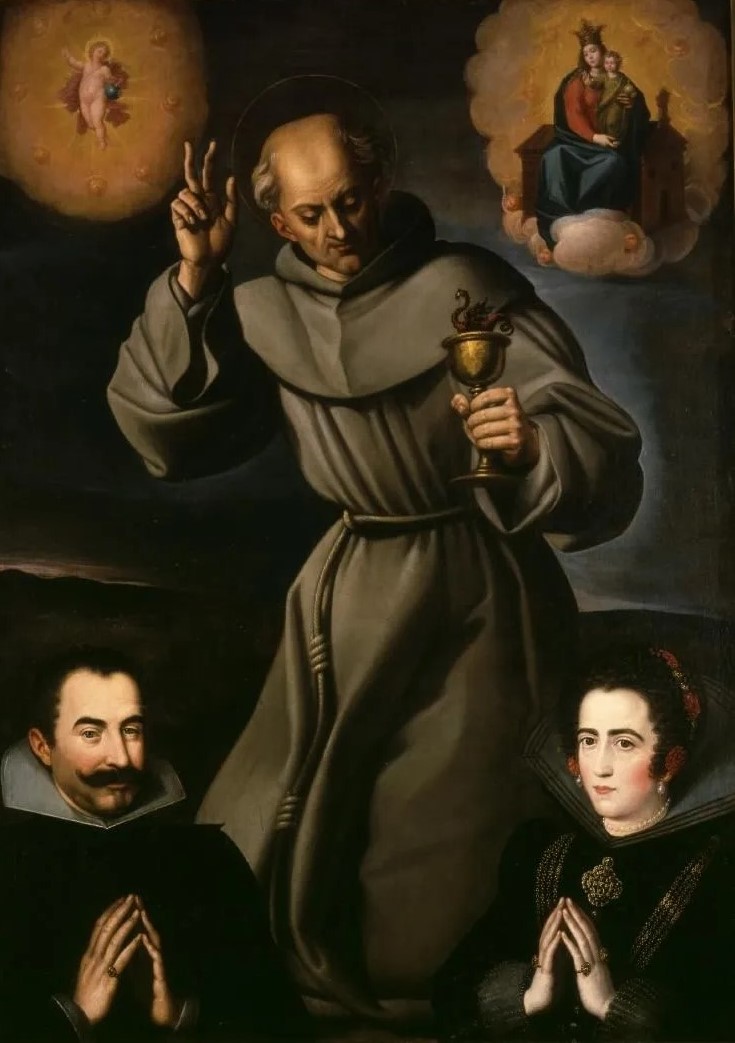
Franciscan Priest, Missionary, Preacher and Defender of the Catholic Faith
Feast Day: 28 November
Saint James of the Marches, also known as Saint James of the Marche or Giacomo della Marca, was a Franciscan priest, renowned preacher, missionary and defender of the Catholic faith. He was one of the most remarkable Franciscan saints of the fifteenth century, known for his extraordinary preaching, austere life, devotion to the Blessed Virgin Mary and tireless efforts to bring people back to Christ.
His life was marked by prayer, penance, missionary journeys and an unwavering commitment to the Gospel. He travelled extensively throughout Italy and other parts of Europe, preaching to enormous crowds, reconciling enemies, encouraging sinners to repent and strengthening Christian communities in their faith.
Saint James reminds us that holiness is not simply a matter of personal devotion; it must also express itself through courageous witness, service to others and a passionate love for the salvation of souls.
1. Early Life and Family Background
Saint James of the Marches was born on 1 September 1391 in Monteprandone, a small town in the Marches region of central Italy. His baptismal name was Dominic (Domenico).
He was born into a humble family and grew up in an environment where Christian faith and traditional values played an important role. From childhood, he demonstrated intelligence, discipline and a sincere desire to learn.
His parents provided him with a religious upbringing, and he gradually developed a deep attraction to prayer and the spiritual life.
As a young man, Dominic pursued his education and studied at the University of Perugia, where he obtained a degree in civil and canon law. His intellectual abilities opened the possibility of a promising professional career. However, his heart was increasingly drawn towards a life dedicated entirely to God.
His education would later become an important instrument in his preaching, theological teaching and defence of the Catholic faith.
2. His Call to Religious Life
After completing his studies, Dominic experienced a growing desire to abandon worldly ambitions and dedicate himself to religious life.
He was particularly attracted to the spirituality of Saint Francis of Assisi and the Franciscan ideal of poverty, humility and complete dependence on Divine Providence.
In 1416, he entered the Franciscan Order of Friars Minor at the convent of the Portiuncula near Assisi. He received the religious name James.
His decision marked the beginning of a remarkable spiritual journey. He embraced a life of simplicity, prayer, fasting and obedience. He was especially devoted to the Eucharist and the Blessed Virgin Mary.
He understood that a preacher must first become a person of prayer. Before proclaiming the Word of God to others, he sought to allow that Word to transform his own heart.
3. A Life of Prayer and Penance
Saint James was known for his extraordinary discipline and austere lifestyle. He practised severe penances, fasted regularly and spent long hours in prayer.
He desired to imitate Christ not only through preaching but also through personal sacrifice.
His Franciscan spirituality was rooted in humility and detachment from worldly possessions. Although he possessed considerable intellectual gifts, he never sought personal recognition or material comfort.
He believed that the effectiveness of preaching depended not merely on eloquence but on the holiness of the preacher.
His life teaches an important spiritual lesson: the credibility of Christian witness comes from the harmony between what we proclaim and how we live.
4. Ordination and the Beginning of His Preaching Ministry
On 13 June 1420, Saint James was ordained a priest. He soon began his apostolic ministry, preaching throughout Tuscany, Umbria and the Marches.
His preaching was powerful, direct and deeply rooted in Scripture. He spoke about sin, repentance, conversion, the mercy of God, the importance of prayer and the necessity of living according to the Gospel.
He was particularly gifted in explaining difficult theological truths in a way that ordinary people could understand.
His sermons attracted enormous crowds. People travelled considerable distances to hear him preach. Many were moved to repentance, abandoned sinful practices and returned to the Sacraments.
He did not preach merely to impress his listeners. His greatest desire was to lead people to a personal encounter with Jesus Christ.
5. A Great Missionary Who Travelled Throughout Europe
Saint James became one of the most influential Franciscan missionaries of his time.
His missionary journeys extended far beyond Italy. He preached and carried out ecclesiastical missions in Germany, Austria, Sweden, Denmark, Bohemia, Poland, Hungary and Bosnia.
He travelled through difficult territories, often facing opposition, danger and hardship. Nevertheless, he remained faithful to his mission.
He was particularly concerned about divisions within Christianity and worked to encourage reconciliation between groups separated by religious controversies.
During the period of the Council of Basel, he worked towards reconciliation with moderate Hussite groups. He also participated in efforts connected with the reunion of the Eastern Churches with Rome at the Council of Ferrara-Florence.
His missionary work demonstrates that the Church’s mission is not limited by geographical boundaries. Wherever people need the Gospel, there is a call to proclaim Christ.
6. Devotion to the Holy Name of Jesus
One of the most distinctive characteristics of Saint James’s spirituality was his devotion to the Holy Name of Jesus.
Following the example of Saint Bernardine of Siena, he promoted devotion to the Most Holy Name of Jesus throughout his missionary journeys.
He understood that the name of Jesus was not simply a religious expression but a reminder of the saving presence and power of Christ.
He encouraged people to honour the Holy Name, call upon Jesus in their difficulties and allow their lives to be transformed by His love.
He particularly promoted the traditional Franciscan devotion associated with the monogram of Christ, IHS.
A spiritual lesson from his devotion
The name of Jesus should not remain only on our lips. It must become the centre of our thoughts, decisions, relationships and daily activities.
For Saint James, devotion to the Holy Name was an invitation to live more faithfully in the presence of Christ.
7. His Concern for the Poor and the Establishment of Monti di Pietà
Saint James was not concerned only with preaching and theological controversies. He was deeply attentive to the suffering of ordinary people, especially those trapped in poverty and debt.
During the fifteenth century, many poor families were exploited by moneylenders who charged extremely high interest rates. People who borrowed money for basic necessities often found themselves trapped in an endless cycle of debt.
Saint James supported the establishment of institutions known as Monti di Pietà (Mounts of Piety).
These charitable financial institutions were created to provide loans to poor people on more reasonable terms, helping them avoid exploitation by unscrupulous lenders.
He encouraged Christian communities to establish such institutions as practical expressions of charity and social responsibility.
His work contributed to the development and spread of the Monti di Pietà movement, which became an important part of Catholic social and charitable history.
Saint James teaches us that Christian charity must address not only the spiritual needs of people but also their material suffering.
A Church that preaches the Gospel must also stand beside those who are poor, vulnerable and exploited.
8. His Work for the Reform of the Franciscan Order
Saint James belonged to the Observant branch of the Franciscan Order, which sought a more faithful observance of the original Franciscan ideals of poverty, prayer and simplicity.
Together with other important Franciscan reformers, particularly Saint Bernardine of Siena and Saint John of Capistrano, he worked to renew the spiritual life of the Order.
The Observant movement emphasised fidelity to the Rule of Saint Francis, personal holiness, simplicity of life and dedication to preaching.
However, differences arose between the Observants and the Conventual Franciscans concerning the interpretation and practice of Franciscan poverty.
In 1455, Pope Callixtus III appointed Saint James to help resolve certain disputes between the two branches. His decision was subsequently published in a papal document in 1456, although it did not satisfy both sides.
Despite the difficulties, Saint James continued to work for the spiritual renewal of religious life.
His example reminds religious men and women that authentic reform begins with personal conversion, humility and renewed fidelity to one’s vocation.
9. His Mission in Hungary and the Defence of Christian Communities
In 1456, following the death of Saint John of Capistrano, Saint James was sent to Hungary to continue missionary and ecclesiastical work in the region.
The Christian territories of Central and Eastern Europe were facing serious political and military challenges, particularly from the expanding Ottoman Empire.
Saint James encouraged Christian communities through preaching and missionary activity. His work was part of the wider efforts of the Church to strengthen the faith of people living in difficult circumstances.
He also undertook diplomatic and ecclesiastical missions in various European territories.
His life was therefore not simply that of a preacher standing in a pulpit. He was a missionary, reformer, diplomat and spiritual guide who placed his intellectual abilities and personal courage at the service of the Church.
10. A Controversy Concerning the Precious Blood of Christ
In 1462, Saint James became involved in a theological controversy concerning the Precious Blood of Jesus.
While preaching at Brescia, he discussed a theological opinion concerning the relationship between Christ’s humanity and divinity during the three days between His death and Resurrection.
His words were challenged by a Dominican inquisitor, and the matter eventually reached Rome.
The question was discussed before Pope Pius II and the cardinals around Christmas 1462. No definitive judgment was issued in the matter.
This episode demonstrates the complicated theological debates that characterised the Church during the fifteenth century.
Despite the controversy, Saint James continued his ministry and remained dedicated to the preaching of the Gospel.
11. His Humility and Refusal of Ecclesiastical Honours
Although Saint James was highly respected for his learning, preaching and missionary achievements, he remained committed to his Franciscan vocation.
In 1460, he was offered the bishopric of Milan. However, he declined the honour.
He preferred to continue his life of missionary preaching and religious service rather than accept a prestigious ecclesiastical position.
His decision reflected his desire to remain faithful to the simplicity and poverty of Saint Francis.
He understood that greatness in the Church does not come from titles, positions or worldly recognition. It comes from faithful service to God and His people.
His life offers an important lesson to everyone entrusted with leadership: authority should always be exercised with humility and a spirit of service.
12. His Final Years and Holy Death
After decades of tireless missionary activity, Saint James gradually withdrew from his extensive travels.
He spent the final three years of his life in Naples, continuing his religious life and remaining devoted to prayer.
Despite his age and physical exhaustion, his commitment to Christ never weakened. He had spent nearly half a century preaching, teaching, travelling and serving the Church.
Saint James died peacefully in Naples on 28 November 1476.
His body was buried in the Franciscan church of Santa Maria la Nuova in Naples, where he was venerated by the faithful.
His death did not bring an end to his influence. His reputation for holiness, missionary dedication and miraculous intercession continued to attract devotion.
13. Beatification and Canonisation
The Church formally recognised the holiness of Saint James after his death.
- Beatification: Pope Urban VIII beatified him in 1624.
- Canonisation: Pope Benedict XIII canonised him in 1726.
- Feast Day: 28 November.
He is especially honoured in Monteprandone, his birthplace, and in Naples, where he is venerated as one of the city’s patron saints.
His feast is an opportunity to remember the extraordinary missionary spirit of the Franciscan Order and the importance of preaching the Gospel with courage and conviction.
14. Symbols and Artistic Representations
Saint James of the Marches is traditionally represented in religious art with several distinctive symbols.
1. The Franciscan habit: He is generally depicted wearing the brown or grey habit of the Franciscan friars, representing poverty, humility and his religious vocation.
2. The chalice with a serpent: One of his most recognisable attributes is a chalice from which a serpent emerges. This is traditionally associated with accounts of attempts to poison him, although the symbolism has also been connected with the theological controversy surrounding the Precious Blood.
3. The book: A book represents his learning, theological knowledge, preaching and writings.
4. The Holy Name of Jesus: This symbol recalls his special devotion to the Most Holy Name of Jesus and his efforts to spread this devotion among the faithful.
15. Spiritual Lessons from the Life of Saint James
The life of Saint James of the Marches offers several important lessons for Christians today.
A. Education must serve God
Saint James was highly educated and possessed a doctorate in law. Yet he did not use his knowledge merely for personal advancement.
He placed his intellectual abilities at the service of the Church and the Gospel.
His life reminds us that education becomes truly meaningful when it is directed towards truth, justice, service and the common good.
B. Preaching must begin with personal holiness
Saint James spent long hours in prayer and practised a life of penance.
He understood that preaching without personal conversion loses its spiritual credibility.
Every Christian is called to proclaim Christ through words and actions. Parents, teachers, priests, religious and laypeople must first allow the Gospel to transform their own lives.
C. We must defend the faith with courage
Saint James travelled through different countries and faced considerable opposition in fulfilling his mission.
His courage reminds us not to abandon our Christian convictions because of criticism or difficulties.
We must remain faithful to the Gospel while witnessing to Christ with humility, charity and respect for others.
D. Christian charity must reach the poor
His support for the Monti di Pietà demonstrates that Christian holiness includes practical concern for those who suffer economically.
Our faith must inspire us to help struggling families, protect vulnerable people and work for a society founded on justice and compassion.
E. The Holy Name of Jesus must be at the centre of our lives
Saint James promoted devotion to the Holy Name of Jesus.
In a world filled with anxiety, uncertainty and distractions, Christians must rediscover the importance of calling upon Jesus and placing their trust in Him.
The name of Jesus brings hope, strength and consolation to those who believe.
16. A Personal Reflection on the Feast of Saint James of the Marches
The life of Saint James of the Marches invites us to ask an important question: What are we doing with the gifts God has given us?
God had blessed Saint James with intelligence, education, eloquence and extraordinary missionary courage. He could have pursued a comfortable professional career and enjoyed worldly recognition. Instead, he chose to dedicate his entire life to proclaiming Christ.
He travelled from one country to another, faced difficulties and endured hardships because he believed that the Gospel was worth giving his whole life for.
Today, we may not be called to travel across Europe preaching to enormous crowds. However, we are all called to become missionaries in our own families, workplaces, parishes and communities.
A father can become a missionary by teaching his children to pray. A mother can become a missionary by transmitting the faith through her love and sacrifices. A teacher can become a missionary by guiding students towards truth and goodness. A priest can become a missionary by faithfully proclaiming the Word of God and accompanying people in their spiritual struggles.
We must also remember the poor and those who are economically exploited. Saint James understood that proclaiming the Gospel means caring for the whole person.
As we celebrate his feast, let us renew our commitment to prayer, the Sacraments, devotion to the Holy Name of Jesus and practical charity towards our brothers and sisters.
May Saint James of the Marches inspire us to become courageous witnesses of Christ wherever God has placed us.
17. Prayer to Saint James of the Marches
Heavenly Father, we thank You for the life and witness of Saint James of the Marches, Your faithful servant and courageous missionary.
Through his powerful intercession, grant us the grace to grow in holiness, deepen our love for Jesus and remain faithful to the Gospel.
Give us the courage to proclaim Your Word, the wisdom to defend our faith, the humility to serve others and the generosity to care for the poor and suffering.
May his devotion to the Holy Name of Jesus inspire us to call upon Your Son in every circumstance of our lives.
Bless our families, strengthen our priests and religious, guide our young people and encourage all those who work for the spread of the Gospel.
When we face difficulties, grant us perseverance. When we experience fear, give us courage. When we encounter suffering, strengthen our hope.
Saint James of the Marches, pray for us, that we may become faithful disciples and courageous witnesses of Jesus Christ.
We ask this through Christ our Lord. Amen.
18. Short Prayer for the Feast Day
Saint James of the Marches, faithful Franciscan priest and courageous preacher of the Gospel, pray for us. Obtain for us a deep love for Jesus, devotion to His Holy Name, courage in defending our faith and generosity towards the poor. Help us become missionaries of Christ in our families and communities. May our words and actions lead others closer to God. Amen.
19. Some Facts About Saint James of the Marches
| Particular | Details |
|---|---|
| Name | Saint James of the Marches |
| Italian name | San Giacomo della Marca |
| Birth | 1 September 1391 (traditional date) |
| Birthplace | Monteprandone, Italy |
| Religious Order | Order of Friars Minor (Franciscans) |
| Ordination | 13 June 1420 |
| Death | 28 November 1476 |
| Place of death | Naples, Italy |
| Beatification | 1624 |
| Canonisation | 1726 |
| Pope who canonised him | Benedict XIII |
| Feast Day | 28 November |
| Special devotion | Holy Name of Jesus |
| Known for | Preaching, missions, Franciscan reform and charity towards the poor |
Conclusion
Saint James of the Marches was a man who allowed God to use his talents, education and entire life for the service of the Gospel. His missionary journeys, powerful preaching, devotion to Jesus and concern for the poor made him one of the outstanding Franciscan figures of the fifteenth century.
His example challenges us to move beyond a comfortable and passive Christianity. We are called to pray deeply, live faithfully, serve generously and proclaim Christ courageously.
May his life inspire us to make the Holy Name of Jesus known and loved throughout the world.
Saint James of the Marches, pray for us!
References and Further Reading
- The Catholic Encyclopedia, “St. James of the Marches.” Read the biography.
- Franciscan Media, “Saint James of the Marche.” Saint of the Day.
- Franciscan Tradition, “St. James of the Marches: Tireless Preacher and Missionary.” Read further.
- CapDox, “Saint James of the Marches – Franciscan Priest.” Franciscan writings and biography.
Leave a Reply