
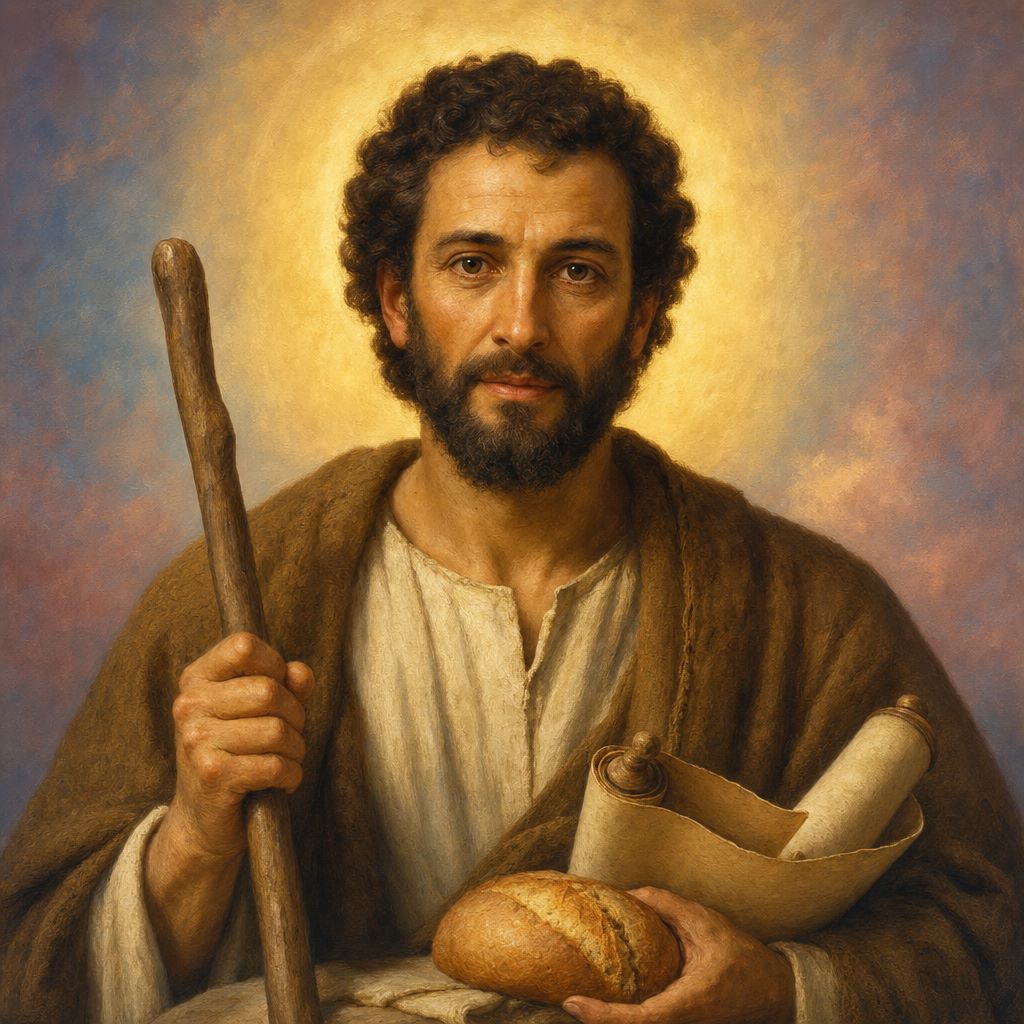
Feast Day: September 25 | First Century
Saint Cleopas, also known as Cleophas, was one of the disciples of Jesus Christ who encountered the Risen Lord on the road to Emmaus on Easter Sunday. Although his name appears only briefly in the Gospel, his encounter with Jesus has become one of the most beautiful and meaningful accounts of the Resurrection.
Cleopas was a disciple who experienced disappointment and sorrow after the crucifixion of Jesus. Yet, through a personal encounter with the Risen Christ, his sadness was transformed into joy, his confusion into understanding, and his uncertainty into faith.
The Gospel of Luke presents him as a witness to the Resurrection and reminds Christians that Jesus continues to walk with His disciples, even when they fail to recognize His presence.
The Church commemorates Saint Cleopas on September 25.


Introduction
1. Biblical Background of Saint Cleopas
Saint Cleopas is mentioned by name in the Gospel of Luke:
“Then one of them, whose name was Cleopas, answered him, ‘Are you the only stranger in Jerusalem who does not know the things that have taken place there in these days?’” (Luke 24:18)
The name Cleopas is associated with one of the two disciples who were travelling from Jerusalem to Emmaus after the crucifixion of Jesus.
The Gospel does not provide detailed information about his birth, family, occupation, or early life. It does not explicitly state when he first became a follower of Jesus. However, the Emmaus narrative reveals that he was among those who had placed their hope in Christ and were deeply affected by His death.
Cleopas is remembered especially for his encounter with the Risen Lord and his recognition of Jesus in the breaking of bread.
Some ancient Christian traditions identify him among the seventy disciples of Jesus. However, the New Testament itself does not explicitly confirm this identification.
2. The Journey to Emmaus
The most important event in the life of Saint Cleopas is recorded in Luke 24:13–35.
On the very day of the Resurrection, two disciples were travelling from Jerusalem to a village called Emmaus, approximately seven miles away according to the traditional conversion of the distance given in the Gospel.
They were discussing the events surrounding the suffering and death of Jesus. Their hearts were filled with sorrow and disappointment.
They had hoped that Jesus would redeem Israel, but His crucifixion had shattered their expectations.
As they walked, Jesus Himself came near and began travelling with them. However, their eyes were prevented from recognizing Him.
The Risen Lord asked them what they were discussing. They stopped and looked sad.
Cleopas was surprised that this stranger appeared unaware of the events that had taken place in Jerusalem.
He explained how Jesus of Nazareth had been a prophet mighty in deed and word before God and all the people. He spoke about how the chief priests and rulers had handed Jesus over to be condemned to death and crucified.
He also mentioned the report of some women who had visited the tomb and found it empty.
The disciples had heard that Jesus was alive, but they had not yet understood the meaning of these events.
Their words revealed the depth of their disappointment:
“But we had hoped that he was the one to redeem Israel.” (Luke 24:21)
This sentence expresses the pain of every person who has experienced shattered hopes, unanswered prayers, and unexpected suffering.
Yet, even in their sadness, Jesus was walking beside them.
3. Jesus Explains the Scriptures
During the journey, Jesus gently corrected the disciples’ misunderstanding.
He explained that the Messiah had to suffer before entering into His glory.
Beginning with Moses and all the prophets, He interpreted to them the things concerning Himself in all the Scriptures.
This moment was a profound lesson in faith. The disciples had interpreted the crucifixion as a defeat, but Jesus revealed that His suffering and death were part of God’s saving plan.
The Cross was not the end of the story. It was the passage to the Resurrection.
The disciples listened as Jesus opened their minds to understand the Scriptures. Their hearts gradually began to change.
Later, they would recall:
“Were not our hearts burning within us while he was talking to us on the road, while he was opening the scriptures to us?” (Luke 24:32)
The experience of Cleopas teaches us that the Word of God can bring light into the darkest moments of our lives.
When we are confused, Scripture helps us understand God’s plan. When we are discouraged, the promises of God renew our hope. When we are suffering, the Word of God reminds us that suffering does not have the final word.
4. “Stay with Us, Lord”
As they approached Emmaus, Jesus appeared to be continuing His journey.
But the disciples invited Him to remain with them:
“Stay with us, because it is almost evening and the day is now nearly over.” (Luke 24:29)
Jesus accepted their invitation.
This simple request has become one of the most beloved prayers of Christian spirituality.
The disciples did not yet recognize Jesus, but they felt drawn to His presence. They wanted to continue listening to Him and spending time with Him.
Their invitation reveals the importance of hospitality, friendship, and openness to God.
Sometimes the Lord comes into our lives through unexpected people, ordinary conversations, and seemingly insignificant moments. We may not immediately recognize His presence, but when we welcome others with love, we may unknowingly welcome Christ Himself.
The experience of Cleopas encourages every Christian family to make room for Jesus in daily life.
Our homes should be places where Christ is welcomed through prayer, forgiveness, kindness, and love.
5. Recognition of Jesus in the Breaking of Bread
The most decisive moment of the Emmaus encounter took place at the table.
When Jesus sat down with the disciples, He took bread, blessed it, broke it, and gave it to them.
At that moment, their eyes were opened, and they recognized Him.
Luke writes:
“When he was at the table with them, he took bread, blessed and broke it, and gave it to them. Then their eyes were opened, and they recognized him.” (Luke 24:30–31)
This is the climax of the story.
The disciples had listened to Jesus explain the Scriptures, but they recognized Him in the breaking of bread.
For Catholics, this passage has a special Eucharistic significance.
The actions of Jesus recall the Last Supper and point toward the Church’s celebration of the Holy Eucharist. The disciples’ encounter reminds us that the Risen Christ is truly present with His people and that the Eucharist is a privileged place of encounter with Him.
At every Holy Mass, the faithful gather to listen to the Word of God and participate in the breaking of the Eucharistic Bread.
The Emmaus story beautifully connects these two dimensions of Christian worship: the Liturgy of the Word and the Liturgy of the Eucharist.
The disciples’ eyes were opened, and they recognized Jesus. Their sadness was transformed into joy, and their hearts were filled with renewed faith.
The Catechism of the Catholic Church teaches that the Eucharist is the memorial of Christ’s Passover and the sacrament of His Body and Blood.
The experience of Saint Cleopas invites us to approach the Holy Eucharist with faith, reverence, and love.
6. The Disciples Return to Jerusalem
After recognizing Jesus, the disciples discovered that He had vanished from their sight.
Although they could no longer see Him physically, they knew that He was alive.
Their reaction was immediate. They did not remain in Emmaus, enjoying their personal experience in isolation.
Instead, they returned to Jerusalem.
The Gospel tells us:
“That same hour they got up and returned to Jerusalem.” (Luke 24:33)
They found the Eleven and their companions gathered together. The disciples in Jerusalem were already proclaiming that the Lord had risen and had appeared to Simon.
Cleopas and his companion then shared what had happened on the road and how Jesus had been made known to them in the breaking of bread.
This return to Jerusalem is an important part of the story.
An encounter with the Risen Lord transforms disciples into witnesses.
The disciples who had been walking away from Jerusalem in sorrow now returned with joy and hope. They had encountered Christ, and they wanted to share the Good News with others.
Saint Cleopas teaches us that faith is not meant to remain a private experience. Those who encounter Jesus are called to share His love and proclaim His Resurrection through their words and actions.
7. Saint Cleopas and the Other Disciple
The Gospel of Luke does not reveal the name of the second disciple who accompanied Cleopas.
Throughout Christian history, different traditions have attempted to identify this person.
Some early Christian writers associated the unnamed disciple with Simon, sometimes identified in tradition as the son of Cleopas. Other interpretations have suggested Saint Luke himself.
However, the Gospel does not identify the companion, and these explanations remain traditional interpretations rather than established biblical facts.
The anonymity of the second disciple also gives the story a universal meaning.
Every Christian can see himself or herself in the unnamed disciple. The journey to Emmaus represents the journey of every believer who seeks Christ amid uncertainty, sorrow, and hope.
8. Was Saint Cleopas the Same Person as Clopas?
The New Testament mentions another person with a similar name.
In John 19:25, the Gospel refers to Mary, the wife of Clopas, who stood near the Cross of Jesus alongside the Blessed Virgin Mary and Mary Magdalene.
Some Christian traditions and biblical interpretations have identified Cleopas of Emmaus with Clopas mentioned in John’s Gospel.
However, the names appear in different forms in the original Greek, and the New Testament does not explicitly state that these two individuals were the same person.
Therefore, it is important to distinguish between the biblical account and later traditions.
The Cleopas who met the Risen Jesus on the road to Emmaus is clearly identified in Luke 24. His precise relationship to Clopas and Mary of Clopas remains uncertain.
9. The Later Life and Martyrdom of Saint Cleopas
The New Testament does not provide a detailed account of the later life of Saint Cleopas.
According to ancient Christian tradition, he continued to proclaim the Resurrection of Jesus and eventually suffered martyrdom.
A tradition recorded in the ninth-century Martyrology of Ado of Vienne states that Cleopas was killed at Emmaus because of his confession of Christ, the Lord whom he had recognized in the breaking of bread.
According to this tradition, he was martyred in the same place where he had welcomed the Risen Lord into his home.
This account is part of the Church’s ancient tradition rather than a detailed historical record preserved in the New Testament.
The tradition of his martyrdom reflects the transformation of a discouraged disciple into a courageous witness to the Resurrection.
The man who once walked away from Jerusalem in sadness became a witness to the truth that Jesus Christ is alive.
10. The Spiritual Lessons from Saint Cleopas
The life and encounter of Saint Cleopas offer several important lessons for Christians today.
1. Jesus walks with us even when we do not recognize Him
The disciples did not recognize Jesus immediately, but He was already walking beside them.
In our own lives, we may sometimes feel abandoned by God. During illness, family problems, financial difficulties, or personal disappointments, we may wonder whether the Lord is truly with us.
The Emmaus story reminds us that Jesus remains near, even when His presence is not immediately visible.
2. The Word of God brings hope
Jesus explained the Scriptures to the disciples and helped them understand the meaning of His suffering.
The Word of God continues to strengthen our faith and renew our hope.
Reading the Bible, listening to the Gospel, and reflecting on God’s promises can help us discover His presence in our daily struggles.
3. Welcome Jesus into your home
The disciples invited Jesus to stay with them.
Every Christian family is called to welcome Christ through daily prayer, the reading of Scripture, forgiveness, and love.
When Jesus becomes the centre of family life, our homes can become places of peace and hope.
4. Recognize Jesus in the Holy Eucharist
Cleopas recognized Jesus in the breaking of bread.
The Eucharist is the source and summit of Christian life. Through the celebration of Holy Mass, Catholics encounter Christ in the proclamation of His Word and in the sacrament of His Body and Blood.
Saint Cleopas encourages us to participate in the Holy Eucharist with devotion and faith.
5. Share the joy of the Resurrection
After recognizing Jesus, the disciples immediately returned to Jerusalem to share their experience.
Every Christian is called to become a witness to the Risen Lord.
We proclaim the Resurrection not only through words but also through forgiveness, compassion, service, and love.
6. Do not lose hope when life becomes difficult
The disciples had lost hope after the death of Jesus.
Yet their journey ended in joy because they encountered the Risen Lord.
Their story reminds us that God can transform our sorrow into hope and lead us toward a deeper understanding of His love.
11. Saint Cleopas: A Model for Eucharistic Adoration
Saint Cleopas has a special place in the spiritual life of Catholics because his encounter with Jesus is closely connected with the breaking of bread.
His experience reminds us that the Eucharist is not merely a religious ritual but a personal encounter with the living Christ.
In Eucharistic adoration, we remain in the presence of Jesus with faith and love.
Like the disciples at Emmaus, we can say:
“Stay with us, Lord.”
We can ask Jesus to remain with our families, guide our decisions, strengthen our faith, and bring peace into our hearts.
Saint Cleopas teaches us to approach the Eucharistic Lord with an open heart, trusting that He can transform our lives through His presence.
12. Feast Day of Saint Cleopas
September 25
The Roman Martyrology commemorates Saint Cleopas on September 25 as a disciple of the Lord who encountered the Risen Christ on the road to Emmaus.
His feast invites the faithful to meditate on the Resurrection, the Word of God, and the presence of Christ in the Holy Eucharist.
Prayer to Saint Cleopas
Saint Cleopas, faithful disciple of the Risen Lord, pray for us.
You who walked with Jesus on the road to Emmaus, help us to recognize His presence in our daily lives.
When we are discouraged, strengthen our hope. When we are confused, guide us toward the light of God’s Word. When we are burdened by sorrow, remind us that Jesus walks beside us.
Obtain for us the grace to welcome Christ into our homes, recognize Him in the Holy Eucharist, and share the joy of His Resurrection with others.
May our hearts burn with love for Jesus, and may we remain faithful to Him throughout our lives.
Saint Cleopas, witness of the Resurrection, pray for us.
Amen.
Conclusion
Saint Cleopas is remembered as a disciple whose encounter with the Risen Jesus transformed his sorrow into joy and his uncertainty into faith.
His journey to Emmaus remains a powerful reminder that Jesus is always near, even when we fail to recognize Him.
Through the Scriptures, the Holy Eucharist, and the loving presence of Christ in our daily lives, the Lord continues to open our eyes and renew our hearts.
May Saint Cleopas inspire us to welcome Jesus into our homes, recognize Him in the breaking of bread, and become courageous witnesses to the joy of the Resurrection.
Saint Cleopas, pray for us!
Biblical References
- Luke 24:13–35 — Jesus appears to the disciples on the road to Emmaus.
- Luke 24:18 — Cleopas is named in the Gospel.
- Luke 24:27 — Jesus explains the Scriptures.
- Luke 24:29 — The disciples invite Jesus to remain with them.
- Luke 24:30–31 — Jesus is recognized in the breaking of bread.
- Luke 24:32 — The disciples’ hearts burn as Jesus explains the Scriptures.
- Luke 24:33–35 — The disciples return to Jerusalem and share their testimony.
- John 19:25 — Mary of Clopas is mentioned near the Cross.
Sources and Further Reading
- Catholic Encyclopedia – Cleophas
- Emmaus-Nicopolis – Christian Tradition
- Custody of the Holy Land – Saint Simeon and Saint Cleopas
- Vatican News – Reflection on the Road to Emmaus
Leave a Reply