
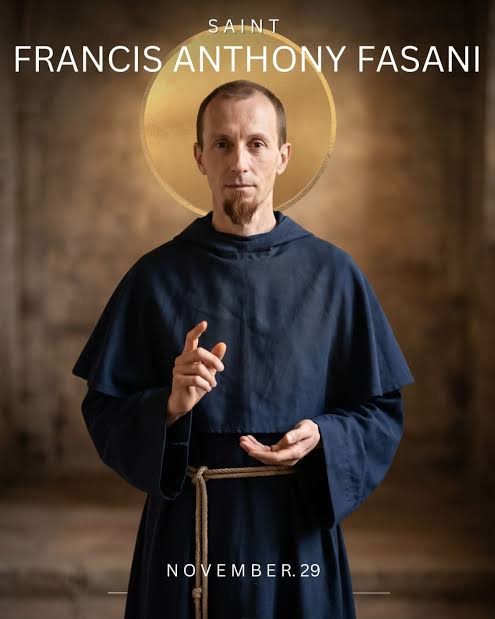
The Franciscan Priest, Preacher, Confessor and Friend of the Poor
Feast Day: 29 November
Saint Francesco Antonio Fasani was an Italian Franciscan priest renowned for his deep spirituality, devotion to the Blessed Virgin Mary, extraordinary love for the poor, and tireless dedication to the salvation of souls. Known affectionately as Padre Maestro (Father Master), he combined profound theological knowledge with genuine pastoral charity. His life was a beautiful example of Franciscan simplicity, humility, prayer and service.
He spent most of his priestly ministry in his hometown of Lucera, Italy, where he became a beloved spiritual father to the people. His famous expression, “The Will of God: That is my Paradise,” beautifully summarises the spirituality that guided his entire life.
1. Early Life and Family Background
Francesco Antonio Fasani was born on 6 August 1681 in Lucera, a town in the province of Foggia, in the Apulia region of southern Italy. His parents were Giuseppe Fasani and Isabella Della Monaca, who raised him in a deeply Christian atmosphere.
At Baptism, he received the name Giovanniello. From his childhood, he displayed an inclination towards prayer, learning and religious life. His parents provided him with a strong Christian upbringing, helping him develop the virtues of faith, humility and generosity.
As a young boy, he began his education at the Franciscan convent of the Friars Minor Conventual in Lucera. Through his association with the Franciscan community, he gradually discovered his vocation to religious life.
Attracted by the spirituality of Saint Francis of Assisi and Saint Anthony of Padua, he desired to dedicate his entire life to God through the Franciscan way of life.
2. Religious Vocation and Franciscan Formation
Francesco Antonio entered the Order of Friars Minor Conventual in 1695 and made his religious profession in 1696. Upon entering religious life, he adopted the names of Saint Francis and Saint Anthony, expressing his desire to imitate these two great Franciscan saints.
He pursued his studies with great dedication. After completing his humanities and philosophical studies, he continued his theological formation in various Franciscan centres, including Agnone and Assisi.
His time in Assisi was particularly significant because he studied near the tomb of Saint Francis, whose spiritual example deeply influenced him.
On 19 September 1705, he was ordained a priest in Assisi. He continued his theological studies and completed his academic formation in 1707.
His intellectual abilities and dedication to theological learning were widely recognised. In 1709, he obtained an advanced theological degree. From that time onwards, he was popularly known as Padre Maestro, meaning Father Master.
This title reflected not only his academic achievements but also his wisdom, spiritual maturity and ability to guide others.
3. A Distinguished Franciscan Priest and Teacher
After completing his studies, Father Fasani returned to Lucera in 1707. He remained there for the rest of his life, dedicating approximately thirty-five years to religious formation and pastoral ministry.
Within the Franciscan Order, he undertook several important responsibilities.
He served as:
- Professor of scholastic philosophy.
- Spiritual formator of young Franciscan religious.
- Master of novices.
- Superior of the Franciscan community.
- Provincial Minister of his religious province.
As a teacher, he was respected for his intellectual depth and clarity. As a religious superior, he demonstrated wisdom, humility and charity.
He understood that religious leadership was not about authority or privilege but about service, responsibility and personal holiness.
His fellow Franciscans admired his discipline, prayerfulness and fidelity to the Franciscan spirit.
The people of Lucera developed such affection for him that a popular saying emerged:
“Whoever wishes to see how Saint Francis looked during his lifetime should come and see Padre Maestro.”
This remarkable expression reveals how closely his contemporaries associated his life with the spirit of Saint Francis of Assisi.
4. An Extraordinary Preacher of God’s Word
One of the most important dimensions of Saint Francesco Antonio Fasani’s ministry was his dedication to preaching.
He travelled throughout Lucera and the surrounding regions of Apulia and Molise, proclaiming the Gospel and inviting people to conversion.
He preached parish missions, spiritual retreats, Lenten sermons and novenas. His preaching was deeply rooted in Sacred Scripture and directed towards transforming people’s lives.
He did not preach merely to increase people’s religious knowledge. He wanted them to abandon sin, practise virtue and develop a deeper relationship with Jesus Christ.
His sermons were characterised by:
- Deep knowledge of Sacred Scripture.
- Simplicity and clarity of expression.
- Strong spiritual conviction.
- An emphasis on repentance and conversion.
- Encouragement towards holiness and Christian charity.
People were attracted to his preaching because they recognised that he practised what he proclaimed.
His life itself became a living sermon.
5. A Compassionate Confessor and Minister of Reconciliation
Saint Francesco Antonio Fasani had a particular gift for the ministry of confession.
He understood the importance of the Sacrament of Reconciliation in restoring sinners to friendship with God. He spent long hours listening to people, guiding them spiritually and helping them experience the mercy of Christ.
He welcomed people from every background with patience and kindness. Whether they were wealthy or poor, educated or uneducated, he treated everyone with equal dignity.
He never wanted sinners to feel rejected or abandoned.
His approach to confession was rooted in the conviction that God’s mercy is greater than human weakness.
He encouraged penitents to turn away from sin and begin a renewed Christian life.
Through his patient ministry, many people experienced spiritual healing and conversion.
His example reminds priests that the confessional must always be a place where people encounter the merciful love of God.
6. His Deep Love for the Holy Eucharist
The Holy Eucharist occupied a central place in the spiritual life of Saint Francesco Antonio Fasani.
For him, the Eucharist was not simply one devotion among many. It was the centre and summit of Christian life and the source of strength for his priestly ministry.
He celebrated Holy Mass with profound reverence and devotion. His intense Eucharistic spirituality inspired the faithful to develop a greater love for Jesus present in the Blessed Sacrament.
He particularly encouraged frequent and even daily Holy Communion, helping people understand the importance of receiving Christ with faith and devotion.
His Eucharistic spirituality was inseparable from his pastoral charity.
He believed that a priest who draws strength from the Eucharist must also become a person of love, compassion and self-giving service.
For him, the altar and the lives of the poor were closely connected. The Jesus whom he adored in the Blessed Sacrament was the same Jesus whom he encountered in the suffering and needy.
7. His Extraordinary Love for the Poor and Needy
One of the most beautiful characteristics of Saint Francesco Antonio Fasani was his extraordinary love for the poor.
He did not consider charity merely an occasional religious duty. It was an essential expression of his Christian identity.
Every day, he personally distributed alms to the poor from the resources of his religious community. He also approached benefactors to obtain additional assistance for families experiencing hardship.
He was willing to sacrifice his personal possessions to help those in need. Historical accounts of his life describe his readiness to give even his own clothing to cover a poor person who was inadequately dressed.
He cared especially for:
- Poor families and those without sufficient food.
- Orphans and abandoned children.
- Sick people and the elderly.
- Prisoners and those awaiting execution.
- People experiencing loneliness and suffering.
He did not simply give material assistance. He offered companionship, encouragement, prayer and spiritual guidance.
He understood that poverty involved more than the absence of material possessions. Many people also suffered from loneliness, rejection and the loss of hope.
His charity reflected the love of Christ, who identified himself with the hungry, the thirsty, the sick and those imprisoned (Matthew 25:31–46).
8. His Ministry to Prisoners and the Condemned
Among the different forms of his apostolate, his ministry to prisoners deserves special attention.
The Bishop of Lucera entrusted him with the spiritual care of prisoners. Father Fasani visited them regularly, offering encouragement, prayer and the opportunity to receive the sacraments.
He treated prisoners not merely as offenders but as human beings loved by God and capable of repentance.
He particularly devoted himself to those condemned to death, accompanying them during their final moments.
He wanted them to approach death with repentance, faith and confidence in God’s mercy.
His ministry reveals an important Christian truth: no person is beyond the reach of God’s mercy.
Even those who have committed serious sins must never be deprived of the opportunity to repent and experience the forgiveness of God.
Saint Francesco Antonio Fasani reminds us that the Church must never abandon those who are suffering, imprisoned or rejected by society.
9. His Special Devotion to the Immaculate Virgin Mary
Saint Francesco Antonio Fasani possessed a deep and tender devotion to the Blessed Virgin Mary, particularly under her title of the Immaculate Conception.
His love for Mary was rooted in his desire to understand her unique role in God’s plan of salvation.
He devoted himself to studying the mystery of Mary’s Immaculate Conception and encouraging the faithful to develop a deeper relationship with her.
He preached about her maternal love, her holiness and her unique place in the history of salvation.
For him, devotion to Mary was never separated from devotion to Jesus Christ. Mary always led people towards her Son.
His Marian spirituality was inspired by the Franciscan tradition, which had a particularly strong devotion to the mystery of the Immaculate Conception.
Through his preaching and personal example, he helped strengthen Marian devotion among the people of Lucera and the surrounding regions.
His life encourages Christians to seek Mary’s intercession and imitate her humility, obedience and complete surrender to God’s will.
10. His Franciscan Spirituality
The spirituality of Saint Francesco Antonio Fasani was deeply rooted in the example of Saint Francis of Assisi.
He embraced the Franciscan ideals of poverty, humility, obedience, penance, fraternity and evangelical charity.
He believed that genuine holiness required a complete surrender to God.
His spiritual life was characterised by:
- A profound love for Jesus Christ.
- Devotion to the Holy Eucharist.
- Love for the Immaculate Virgin Mary.
- A spirit of prayer and contemplation.
- Fidelity to the evangelical counsels.
- Generosity towards the poor.
- Patience in suffering.
- Complete trust in Divine Providence.
His prayers were often filled with expressions of love for God. He addressed the Lord as the Supreme Love, Immense Love, Eternal Love and Infinite Love.
His spirituality teaches us that holiness is not simply about performing religious activities. It is about allowing God’s love to transform every dimension of our lives.
11. His Famous Saying: “The Will of God: That Is My Paradise”
Perhaps the most memorable expression associated with Saint Francesco Antonio Fasani is:
“Volontà di Dio, paradiso mio!”
Translated into English:
“The Will of God: That is my Paradise!”
This was the expression that summarised his understanding of Christian life.
He believed that true happiness was found in accepting and fulfilling God’s will.
For him, obedience to God was not a burden but a source of spiritual freedom and joy.
When he experienced difficulties, responsibilities, suffering or illness, he sought to unite everything with God’s loving plan.
This spirituality reminds us of the prayer Jesus taught his disciples:
“Thy will be done, on earth as it is in heaven.” (Matthew 6:10)
His words offer a powerful lesson for Christians today.
We often seek happiness through success, wealth, recognition and personal achievements. However, Saint Fasani reminds us that lasting happiness comes from placing our lives in God’s hands.
Accepting God’s will does not mean giving up our responsibilities or efforts. Rather, it means trusting God while faithfully doing everything that is expected of us.
12. His Final Illness and Holy Death
In 1742, Saint Francesco Antonio Fasani became seriously ill.
Even during his final illness, he maintained his characteristic spirit of faith, surrender and joy.
He accepted his suffering as an opportunity to unite himself more closely with Christ.
His final days were marked by prayer and devotion to the Blessed Virgin Mary. He received the consolation of the Church’s sacraments and prepared himself for his encounter with God.
On 29 November 1742, he died peacefully in the Franciscan convent of his native city of Lucera.
He was sixty-one years old.
His death brought profound sorrow to the people who had experienced his kindness and pastoral care.
According to historical accounts, people ran through the streets crying:
“The saint has died! The saint has died!”
His body was buried in the Church of Saint Francis in Lucera.
However, his spiritual influence did not end with his death. The faithful continued to seek his intercession, and his reputation for holiness spread throughout the region.
13. Beatification and Canonization
The people of Lucera had recognised Father Fasani’s holiness even during his lifetime. After his death, devotion to him increased considerably.
In 1746, only four years after his death, the Bishop of Lucera initiated the canonical investigation into his life, virtues and miracles.
The process continued over many decades.
On 21 June 1891, Pope Leo XIII recognised the heroic nature of his virtues.
On 15 April 1951, Pope Pius XII beatified him after the approval of two miracles attributed to his intercession.
A further miracle was approved in 1985.
Finally, on 13 April 1986, Pope Saint John Paul II canonised Francesco Antonio Fasani in Saint Peter’s Basilica in Vatican City.
During the canonisation celebration, the Pope presented him as an outstanding example of priestly life and pastoral dedication.
He particularly emphasised his ministry of reconciliation, his love for the poor and his dedication to the people entrusted to his pastoral care.
Today, Saint Francesco Antonio Fasani is remembered as one of the great Franciscan saints of southern Italy.
14. Lessons from the Life of Saint Francesco Antonio Fasani
The life of Saint Francesco Antonio Fasani offers several important lessons for Christians, priests, religious and all people seeking holiness.
1. Holiness begins with love for God.
Father Fasani’s life was centred on his relationship with God. His learning, preaching, prayer and charitable activities all flowed from his love for the Lord.
2. Knowledge must be accompanied by humility.
He was a highly educated theologian, but his academic achievements never separated him from ordinary people. He used his knowledge to serve the Church and guide others towards God.
3. The poor deserve our personal attention.
He did not remain distant from those experiencing hardship. He personally visited, comforted and assisted them. His example challenges us to make charity a practical expression of our faith.
4. The Sacrament of Reconciliation is a ministry of mercy.
His patient service in the confessional reminds us that the Church must always offer sinners the opportunity to experience God’s forgiveness.
5. The Eucharist must transform our lives.
His deep Eucharistic devotion teaches us that receiving Jesus in Holy Communion must lead us towards greater love, forgiveness and service.
6. Nobody should be abandoned.
His ministry among prisoners and condemned people reminds us that every human being possesses dignity and deserves compassion.
7. Accept God’s will with trust.
His famous expression, “The Will of God: That is my Paradise,” teaches us to surrender our lives to Divine Providence.
15. Relevance of Saint Francesco Antonio Fasani for the Church Today
The life of Saint Francesco Antonio Fasani remains particularly relevant in today’s world.
We live in a society where people often measure success through wealth, influence, academic achievements and social recognition. His life offers a different understanding of greatness.
He was a distinguished scholar, an important religious superior and a respected preacher. Yet, his lasting greatness came from his humility, compassion and love for God.
His life is especially meaningful for priests and religious.
He reminds priests that their ministry must be rooted in prayer, the Eucharist and the Sacrament of Reconciliation. A priest must be a teacher of the faith, a minister of God’s mercy and a compassionate father to the people.
His example is also valuable for families and young people. He teaches that holiness is possible in ordinary daily life through faithfulness, generosity, prayer and obedience to God.
His love for the poor challenges every Christian community to become more welcoming and attentive to those who are forgotten.
Above all, his life reminds us that true happiness is found not in possessing everything we desire but in surrendering ourselves to the loving will of God.
16. Prayer Through the Intercession of Saint Francesco Antonio Fasani
Heavenly Father,
We thank You for the life and witness of Saint Francesco Antonio Fasani, Your faithful servant and priest.
Through his intercession, grant us a deeper love for Jesus in the Holy Eucharist and a sincere devotion to the Blessed Virgin Mary.
Teach us to serve the poor with generosity, comfort the sick with compassion and welcome sinners with the mercy of Christ.
Bless all priests and religious with the spirit of prayer, humility and pastoral charity. May they become faithful shepherds who lead Your people towards holiness.
Strengthen those who are suffering, those who feel abandoned, those imprisoned by fear and those who have lost hope.
Help us to accept Your holy will in every circumstance of life, trusting that Your plans are always guided by infinite love and wisdom.
May we learn from Saint Francesco Antonio Fasani to proclaim the Gospel through our words and actions.
Through Christ our Lord. Amen.
Saint Francesco Antonio Fasani, pray for us!
Our Father… Hail Mary… Glory Be…
17. Biblical Reflections Inspired by His Life
The following Scripture passages beautifully express the spirituality and apostolic mission of Saint Francesco Antonio Fasani.
| Scripture | Spiritual theme |
|---|---|
| Matthew 25:31–46 | Love and service towards the poor |
| Luke 4:18–19 | Proclaiming the Gospel to the poor |
| Matthew 6:10 | Surrender to God’s will |
| John 6:35 | Love for the Holy Eucharist |
| John 20:22–23 | The ministry of reconciliation |
| Philippians 2:5–8 | Humility and obedience |
| Romans 12:12–13 | Prayer, hope and generosity |
| Matthew 5:7 | Blessed are the merciful |
Conclusion
Saint Francesco Antonio Fasani was a priest who united theological wisdom with practical charity, deep contemplation with active ministry, and love for the Eucharist with love for the poor.
His life demonstrates that genuine holiness is not measured by positions of authority, academic qualifications or public recognition. It is measured by the depth of our love for God and our willingness to serve others.
For thirty-five years, he faithfully served the people of Lucera as a preacher, teacher, confessor and spiritual father. His compassion reached the poor, the sick, prisoners and those who had been forgotten by society.
His famous words continue to inspire Christians everywhere:
“The Will of God: That is my Paradise!”
May his intercession help us discover the joy of doing God’s will and inspire us to become instruments of His mercy and love.
Saint Francesco Antonio Fasani, faithful Franciscan priest, friend of the poor and servant of God’s mercy, pray for us!
References and Further Reading
- Holy See, Francesco Antonio Fasani (1681–1742), Biography and Canonisation, 13 April 1986. Vatican – Official Biography.
- Dicastery for the Causes of Saints, Francesco Antonio Fasani. Official Canonisation Record.
- Franciscan Media, Saint Francesco Antonio Fasani. Saint of the Day.
- Municipality of Lucera, San Francesco Antonio Fasani. Historical Biography.
Leave a Reply