
Feast Day: August 16
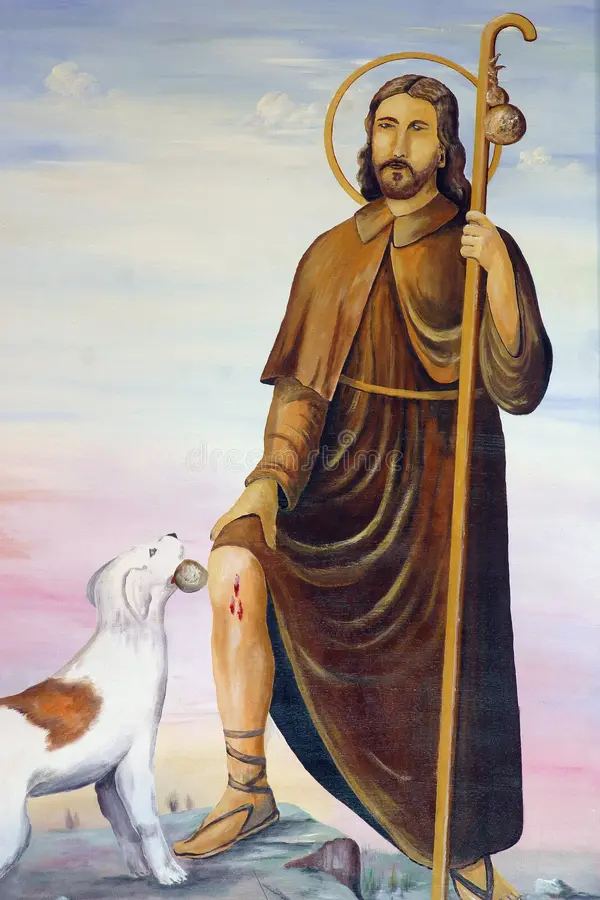
Saint Roch, also known as Saint Rocco, is one of the most beloved saints associated with compassion for the sick, care for those suffering from plague and contagious disease, and trust in God during times of crisis. His image is often recognized by the presence of a faithful dog, traditionally shown bringing him bread while he was sick and isolated.
For centuries, Christians have turned to Saint Roch as a powerful intercessor, especially during epidemics and outbreaks of infectious disease. His life is a beautiful testimony to the words of Jesus:
“I was sick and you visited me.”
— Matthew 25:36
Saint Roch did not run away from suffering. Instead, he moved toward those who were suffering. At a time when fear often separated people from the sick, he chose compassion. When he himself became ill and abandoned, God provided for him in an unexpected way.
His life reminds us that love is stronger than fear, service is greater than comfort, and God never abandons those who place their trust in Him.
The Early Life of Saint Roch
Saint Roch is traditionally believed to have been born around 1295 in Montpellier, in southern France, although the exact historical details of his life are surrounded by ancient traditions and are not known with complete certainty.
According to tradition, he was born into a wealthy and respected family. His parents were deeply devoted Christians.
Some accounts tell us that Roch was born with a distinctive red birthmark in the shape of a cross on his chest, which was seen as a sign of the special mission that God had prepared for him.
Roch lost his parents while he was still young. Having inherited considerable wealth, he faced an important decision.
He could have chosen a life of comfort, security, and privilege.
Instead, inspired by the Gospel, he chose another path.
He distributed much of his wealth to the poor and set out as a pilgrim, dedicating his life to God and to the service of others.
This decision would lead him into a world filled with suffering.
But it would also reveal the extraordinary compassion of his heart.
A Pilgrim in a Time of Plague
During the fourteenth century, Europe experienced devastating outbreaks of plague and disease. Entire communities suffered. Fear spread from town to town.
It was during this period, according to tradition, that Saint Roch travelled through regions affected by epidemic disease.
Instead of avoiding the sick, Roch cared for them.
He visited those suffering from the plague, comforted them, prayed with them, and helped them in whatever way he could.
Tradition tells us that many people were healed through his prayers and through the sign of the cross.
For Roch, the sick were not people to be feared or abandoned.
They were Christ.
Every suffering person became an opportunity to serve Jesus.
His example reflects the words of Christ:
“Whatever you did for one of the least of these brothers and sisters of mine, you did for me.”
— Matthew 25:40
Saint Roch’s life challenges us even today.
It is easy to love people when they are healthy, successful, attractive, or useful to us.
But Christian love is tested when we encounter suffering.
Do we move closer to those who suffer?
Or do we turn away?
Saint Roch chose to move closer.
Saint Roch Becomes Sick
After spending years caring for victims of plague, Saint Roch himself became seriously ill.
He developed symptoms associated with the disease and found himself in a painful situation.
The man who had cared for others now needed care himself.
To avoid becoming a danger to others, Roch withdrew from the community and went into isolation.
Tradition tells us that he found shelter in a forest or lonely place outside the town.
There, weak and suffering, he placed himself completely in the hands of God.
This is one of the most touching moments in the story of Saint Roch.
He had left wealth behind.
He had served strangers.
He had cared for the abandoned.
And now he himself was alone.
Yet God did not abandon him.
The Faithful Dog and the Bread
One of the most famous traditions associated with Saint Roch tells of a dog that came to him each day carrying bread.
The dog belonged to a local nobleman, traditionally known as Gothard or Gottardo.
Day after day, the dog brought bread to the sick saint.
The animal’s unusual behaviour attracted the attention of its owner, who eventually followed the dog and discovered Roch lying sick and alone.
Gothard was deeply moved by what he saw.
He began to care for the saint, and Roch eventually recovered.
The faithful dog became one of the most recognizable symbols of Saint Roch.
In Christian art, he is often shown:
- Dressed as a pilgrim.
- Carrying a pilgrim’s staff.
- Showing a wound or swelling on his leg.
- Accompanied by a dog carrying bread.
- Pointing to the mark of his illness.
The dog and the bread have become symbols of God’s providence.
Sometimes help comes from the people we expect.
But sometimes God sends help from a completely unexpected direction.
When human beings forget us, God has not forgotten us.
Returning Home
After recovering, Saint Roch eventually returned toward his homeland.
However, his journey was not yet over.
Because he had been away for many years and because of political tensions and conflicts of the time, Roch was not recognized when he returned.
According to tradition, he was suspected of being a spy or an enemy.
He was arrested and imprisoned.
The great pilgrim who had travelled from town to town caring for the sick now found himself behind prison walls.
It was another profound test.
Yet Roch did not abandon his faith.
He accepted his suffering with patience and continued to trust in God.
Tradition tells us that he spent several years in prison before his death.
When he died, his identity and holiness were eventually recognized.
The humble servant of the sick was honoured by the very world that had once failed to recognize him.
The Death and Legacy of Saint Roch
Saint Roch is traditionally believed to have died around 1327, although the exact date and many details of his biography remain uncertain.
What is certain is the extraordinary influence of his devotion.
During later outbreaks of plague, Saint Roch became one of the most popular saints invoked for protection against contagious diseases.
Churches, chapels, hospitals, and confraternities were dedicated to him.
His devotion spread throughout:
- France
- Italy
- Spain
- Germany
- Portugal
- Croatia
- Latin America
- India and many other parts of the Christian world
Wherever people faced disease, fear, and uncertainty, they remembered the pilgrim who had once chosen to serve the sick.
Patron Saint of the Sick and Those Suffering from Epidemics
Saint Roch is especially invoked as a patron of:
- People suffering from contagious diseases.
- Victims of epidemics and plague.
- The sick and those caring for them.
- Pilgrims and travellers.
- Dogs and animals in some traditions.
- Those who are falsely accused or imprisoned.
His intercession became especially significant during times of epidemic.
Throughout history, Christians have turned to the saints not because saints replace God, but because they are friends of God and intercede for us.
When we ask Saint Roch to pray for us, we are asking a faithful servant of Christ to join his prayers to ours before God.
What Saint Roch Teaches Us Today
1. Do Not Be Afraid to Serve
Fear is natural.
But love can take us beyond fear.
Saint Roch lived in a world threatened by deadly disease. Yet he chose compassion over self-protection.
His example reminds us that Christian love sometimes requires courage.
We may not all be called to dramatic acts of heroism, but every day we meet people who need compassion.
The lonely person needs a conversation.
The elderly person needs a visit.
The grieving person needs comfort.
The poor person needs help.
The sick person needs care.
We can all become instruments of God’s love.
2. The Sick Are Not Invisible
One of the greatest lessons of Saint Roch is that sick people must never be forgotten.
Illness can isolate a person.
Sometimes people who are sick feel that they have become a burden.
Saint Roch reminds us that visiting and caring for the sick is a deeply Christian act.
A hospital visit, a phone call, a prayer, a message, or simply sitting beside someone in silence can become a ministry of love.
3. One Day, the Helper May Need Help
Roch spent his life caring for others.
Then he became sick himself.
This teaches us humility.
Sometimes we are strong.
Sometimes we are weak.
Sometimes we give.
Sometimes we need to receive.
There is no shame in needing help.
Even the person who has spent a lifetime caring for others may one day need someone to bring them bread.
The Gospel teaches us not only how to give but also how to receive with humility.
4. God Provides in Unexpected Ways
Perhaps the most memorable image from the life of Saint Roch is the dog bringing him bread.
It is a reminder that God’s providence can arrive through unexpected people and unexpected circumstances.
When we feel alone, we should never assume that our story is over.
God can open a door when we see no way forward.
He can send a friend when we feel abandoned.
He can provide strength when we believe we have none left.
As Saint Paul wrote:
“My grace is sufficient for you, for power is made perfect in weakness.”
— 2 Corinthians 12:9
5. Faithfulness Does Not Always Mean an Easy Life
Saint Roch served the sick.
Yet he became sick.
He cared for others.
Yet he experienced abandonment.
He dedicated his life to goodness.
Yet he was imprisoned.
This is an important lesson.
Faithfulness to God does not guarantee a life without suffering.
But it gives suffering a new meaning.
The Christian does not believe that God abandons us when we suffer.
Instead, we believe that Christ Himself walks with us through suffering.
Saint Roch teaches us to remain faithful even when we do not understand God’s plan.
Saint Roch and the Modern World
The recent experience of global pandemics has made the message of Saint Roch especially meaningful for our time.
The world has witnessed how illness can create fear, isolation, grief, and uncertainty.
We have also seen the extraordinary dedication of doctors, nurses, health-care workers, volunteers, priests, religious, and ordinary people who risked their comfort to care for others.
In such moments, the witness of Saint Roch speaks clearly.
Compassion must not disappear in times of crisis.
The sick need treatment, but they also need dignity.
The dying need medical care, but they also need love.
Families experiencing loss need more than information; they need consolation.
Saint Roch reminds us that the greatest medicine of the human heart is often compassion.
A Reflection for Families
Saint Roch’s story can also speak to family life.
In every family, there are times when someone becomes sick, elderly, weak, or dependent on others.
These moments can be difficult.
They require patience.
They require sacrifice.
But they can also become moments of grace.
When we care for a sick parent, spouse, child, or relative, we are living the Gospel.
Love becomes real when it costs something.
Saint Roch teaches us that compassion is not merely a feeling.
Compassion is love that takes action.
Prayer to Saint Roch
O glorious Saint Roch,
you gave up the comforts of life and devoted yourself to the service of the sick and suffering.
With courage and compassion, you cared for those whom others feared to approach.
Pray for all who are suffering from illness, especially those affected by contagious diseases and epidemics.
Intercede for doctors, nurses, health-care workers, caregivers, and all who dedicate their lives to the service of the sick.
Help us to overcome fear with faith, selfishness with generosity, and indifference with compassion.
When we feel lonely, remind us that God has not abandoned us.
When we are weak, help us to trust in His strength.
When others suffer, give us the courage to become instruments of God’s healing love.
Through your prayers, may we grow in faith, hope, and charity.
Saint Roch, compassionate servant of the sick, pray for us.
Amen.
Conclusion
Saint Roch gave up wealth to serve.
He walked as a pilgrim.
He cared for the sick.
He himself became sick.
He experienced loneliness and imprisonment.
Yet through every stage of his journey, his life remained a testimony to faith and love.
His story teaches us a simple but powerful lesson:
Do not be afraid to love those who suffer.
The world may remember Saint Roch for the dog carrying bread.
But behind that beautiful image is an even greater message.
The saint who brought hope to the sick eventually found himself in need of help.
And when he had nothing left, God still provided.
May Saint Roch inspire us to become people of compassion.
May we never turn away from those who suffer.
May we learn to give generously and receive humbly.
And when we walk through our own moments of sickness, fear, or loneliness, may we remember:
God never forgets His children.
Saint Roch, patron of the sick and suffering, pray for us.
Leave a Reply