
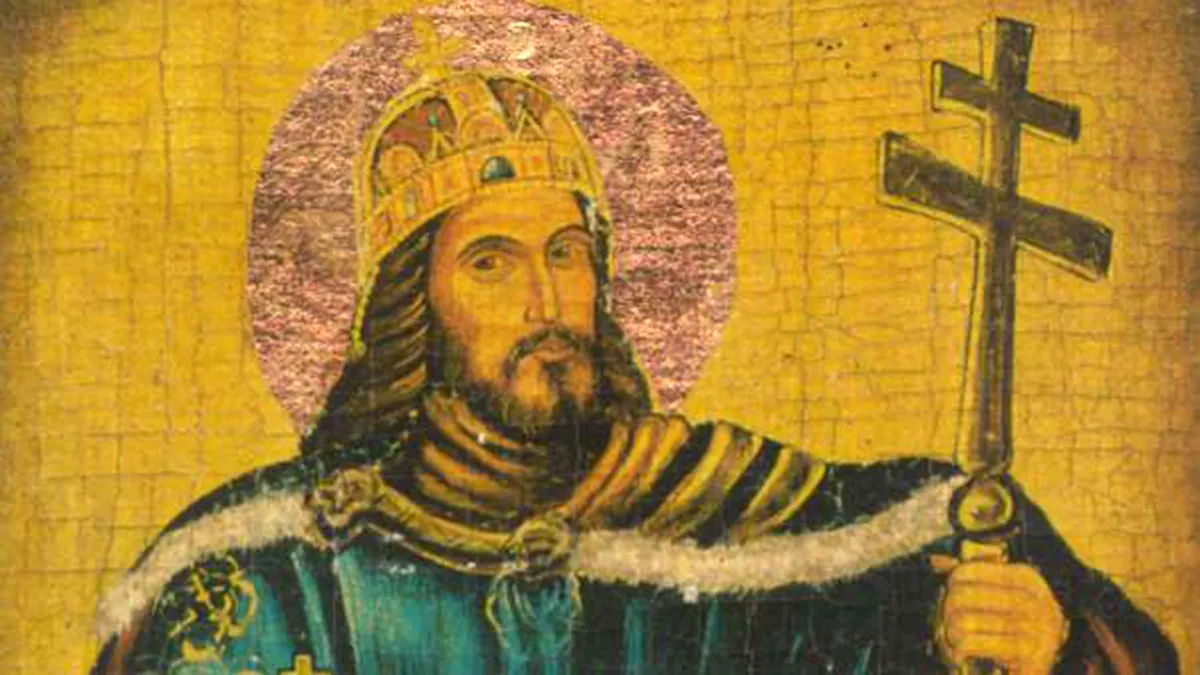
Feast Day: August 16
Saint Stephen of Hungary stands among the great Christian rulers of history. He was not merely a king who happened to be a Christian; he was a man who understood his royal authority as a responsibility entrusted to him by God. Through faith, wisdom, courage, and perseverance, he helped transform the Hungarian people into a Christian nation and laid the foundations of a kingdom that would endure for centuries.
Remembered as the first King of Hungary, Saint Stephen is honoured as the founder of the Hungarian state and one of the most important figures in the Christian history of Central Europe. His life teaches us that political power, leadership, family life, and national identity can all be placed at the service of God and the common good.
Early Life
Saint Stephen was born around 969 or 975 and was originally named Vajk. He was the son of Grand Prince Géza, the ruler of the Magyars, and Sarolt, who came from a powerful Christian family.
The Magyar people had entered the Carpathian Basin toward the end of the ninth century. At the time of Stephen’s birth, Christianity was beginning to spread among them, but many still followed their ancient pagan customs and religious practices.
Stephen’s father, Géza, recognized that Hungary’s future required stronger connections with Christian Europe. He himself accepted baptism and encouraged the spread of Christianity, although the complete conversion of the nation was still far from accomplished.
Young Vajk was baptized and received the Christian name Stephen, traditionally understood to have been chosen in honour of Saint Stephen, the first Christian martyr.
From his youth, Stephen was formed for a great mission. He would one day inherit not only political leadership over his people but also the enormous task of guiding a newly emerging nation toward Christian faith and civilization.
Marriage and the Beginning of a New Era
Stephen married Gisela of Bavaria, a Christian princess who played an important role in the development of Christianity in Hungary.
Their marriage was significant both politically and spiritually. Through this union, Hungary strengthened its relationship with the Christian kingdoms of Europe. Gisela herself supported the Church and the growth of Christian life in the kingdom.
When Géza died around 997, Stephen succeeded him. However, his leadership was immediately challenged.
According to ancient Hungarian customs, leadership could pass according to seniority within the ruling family. A relative named Koppány challenged Stephen’s authority and became the leader of resistance against him.
The conflict was more than a struggle for political power. It also represented a confrontation between the emerging Christian order that Stephen wished to establish and the older pagan traditions that resisted change.
Stephen emerged victorious. His victory enabled him to begin the great work that would define his life: the establishment of a united and Christian Hungary.
The First King of Hungary
Stephen understood that Hungary needed more than military strength. It needed unity, law, institutions, and a spiritual foundation.
Around the year 1000, Stephen was crowned King of Hungary. His coronation symbolized the recognition of Hungary as a Christian kingdom within the wider family of European nations.
Tradition strongly associates his crown with papal recognition, and the Holy Crown of Hungary eventually became one of the most powerful symbols of Hungarian identity and Christian heritage.
Stephen’s kingship was not simply an honour. It was a vocation.
He believed that a ruler should govern according to justice and protect the weak, promote peace, defend the Church, and work for the good of the people.
His reign became a remarkable example of how Christian faith could shape public life.
Building a Christian Nation
One of Saint Stephen’s greatest achievements was the organization of the Church in Hungary.
He established dioceses and supported the creation of a stable ecclesiastical structure. Bishops and priests were encouraged to preach the Gospel, celebrate the sacraments, and educate the people in the Christian faith.
Stephen also founded churches and monasteries. These institutions became centres not only of worship but also of learning, culture, charity, and social development.
Christianity gradually became deeply rooted in Hungarian society.
The king understood that the conversion of a people could not be accomplished merely by issuing commands. A Christian nation required Christian teachers, places of worship, a sacramental life, and the patient formation of hearts.
Therefore, Stephen worked to build structures that would help the faith endure long after his own death.
His vision was larger than his own lifetime.
He was building for future generations.
A King Guided by the Gospel
Saint Stephen is remembered as a ruler who sought to unite political responsibility with Christian morality.
He introduced laws that helped organize the kingdom and encouraged the observance of Christian practices. Sunday worship and the celebration of Christian feast days became important elements in the life of the kingdom.
But Stephen’s ideal of leadership was not based simply on authority or force.
He believed that a ruler must possess virtues.
A king should be:
- Just toward his people.
- Merciful toward those who suffer.
- Humble before God.
- Respectful toward the Church.
- Wise in choosing advisers.
- Hospitable toward strangers.
- Faithful to Christian principles.
One of the most beautiful aspects of his spiritual legacy is found in the advice traditionally associated with him for his son, Prince Emeric.
Stephen taught his son that a ruler must cultivate virtues such as humility, mercy, patience, courage, wisdom, and justice.
He also emphasized the importance of welcoming foreigners and strangers.
A kingdom, he taught in essence, becomes weak when it closes itself entirely within its own narrow world. Diversity, hospitality, and openness can enrich a nation.
These ideas reveal the depth of Stephen’s Christian vision.
For him, greatness was not simply the ability to conquer.
True greatness meant serving.
Saint Stephen and His Son, Saint Emeric
One of the greatest joys of Stephen’s life was his son, Saint Emeric, also known as Imre.
Emeric was carefully educated and prepared to become the future ruler of Hungary. Stephen hoped that his son would continue the work of building a strong and Christian kingdom.
The relationship between Stephen and Emeric gives us a beautiful example of Christian fatherhood.
Stephen did not simply want to prepare his son for political power.
He wanted to prepare him for holiness.
He instructed him in virtue and encouraged him to live a life centred on God.
Tragically, Emeric died unexpectedly in a hunting accident in 1031.
For Stephen, the death of his beloved son was a devastating personal loss. It also created a serious crisis for the future of the kingdom because the heir he had carefully prepared was gone.
Yet Stephen continued to place his trust in God.
His life reminds us that even saints experience sorrow.
Faith does not mean that we will never suffer.
Faith means that even in the darkness of suffering, we continue to hold the hand of God.
A Life Tested by Suffering
The later years of Stephen’s life were marked by personal grief, illness, and political difficulties.
The death of Emeric was perhaps the greatest sorrow of his life. The question of succession created tension and uncertainty.
Stephen himself suffered from poor health during his final years.
The great king who had built a kingdom now had to experience the limits of human strength.
This is one of the reasons his story remains spiritually powerful.
Saint Stephen was not holy because his life was free from problems.
He was holy because he remained faithful through his problems.
He had known success, victory, and honour.
But he also knew loss, sickness, uncertainty, and sorrow.
His life demonstrates that holiness is not found in escaping the cross.
Holiness is found in carrying the cross with faith.
Hungary Entrusted to the Blessed Virgin Mary
One of the most beloved traditions concerning Saint Stephen is his special devotion to the Blessed Virgin Mary.
As his life came to an end, Stephen entrusted Hungary to the protection of the Mother of God.
This act of consecration became deeply significant in Hungarian Catholic tradition.
The Blessed Virgin Mary came to be honoured in Hungary with the title Magna Domina Hungarorum — Great Lady of the Hungarians, and devotion to Mary became closely connected with the spiritual identity of the nation.
For Stephen, Mary was not merely a distant figure from the Gospel.
She was a mother.
At the end of his earthly life, when his own plans for the future had been shaken by the death of his son, he placed his kingdom into the maternal hands of the Blessed Virgin.
This was an extraordinary act of faith.
Stephen recognized that even a king could not control the future.
Only God is Lord of history.
Death of Saint Stephen
Saint Stephen died on August 15, 1038, the Solemnity of the Assumption of the Blessed Virgin Mary, according to the traditional account.
His death occurred after a lifetime dedicated to the formation of Hungary as a Christian kingdom.
His work, however, did not end with his death.
The institutions he established, the Church he supported, and the Christian identity he helped form continued to shape Hungarian history.
In 1083, Stephen was canonized, together with his son Saint Emeric and Bishop Saint Gerard of Csanád.
Thus, the royal family and the early Church of Hungary became closely linked in the memory of the nation.
Saint Stephen became the patron saint of Hungary and remains one of the country’s most beloved historical and religious figures.
The Holy Crown and the Legacy of a Saint
The crown associated with Saint Stephen eventually became one of Hungary’s most important national symbols.
For centuries, the Hungarian crown represented not only political authority but also the Christian foundations of the kingdom.
Stephen himself came to symbolize something even greater than monarchy.
He became a symbol of:
- Faith.
- National unity.
- Christian civilization.
- Responsible leadership.
- Justice and peace.
- Trust in Divine Providence.
His legacy continues to inspire Christians, political leaders, families, and all those who carry responsibility for others.
Lessons from the Life of Saint Stephen
1. Leadership Is a Service
Saint Stephen teaches us that authority is not a privilege to be enjoyed but a responsibility to be carried.
Every person who has authority — parents, priests, teachers, political leaders, employers, and community leaders — should remember that leadership must serve the good of others.
Jesus said:
“Whoever wishes to be great among you must be your servant.”
— Matthew 20:26
Stephen attempted to live this principle in the responsibility entrusted to him.
2. Build for Future Generations
Stephen did not live only for the problems of his own day.
He built churches, established dioceses, organized institutions, and educated his son for the future.
We too must ask:
What are we building that will remain after us?
Are we building faith in our children?
Are we strengthening our families?
Are we leaving behind a better Church and society?
True Christian leadership thinks beyond the present moment.
3. Power Without Virtue Is Dangerous
Stephen understood that a ruler needed more than intelligence and strength.
He needed virtue.
The same is true today.
Education without wisdom can be dangerous.
Power without humility can become oppression.
Wealth without generosity can become selfishness.
Success without God can leave the human heart empty.
Saint Stephen reminds us that character is more important than position.
4. Welcome the Stranger
One of the remarkable themes associated with Stephen’s teaching is hospitality toward foreigners and strangers.
This remains deeply relevant today.
Christians are called to see every human person with dignity.
Hospitality does not mean abandoning wisdom or responsibility, but it does mean refusing to allow fear, prejudice, or selfishness to destroy our humanity.
Jesus Himself said:
“I was a stranger and you welcomed me.”
— Matthew 25:35
5. Faith Must Shape Daily Life
Saint Stephen did not keep Christianity confined to private prayer.
He allowed faith to influence the way he governed, made decisions, educated his son, and served his people.
This is an important challenge for every Christian.
Our faith should influence:
- Our family relationships.
- Our work.
- Our use of money.
- Our treatment of others.
- Our decisions.
- Our service to society.
Christianity is not simply something we practise inside a church building.
It is a way of life.
6. Give Your Future to God
Stephen experienced one of the deepest sorrows a parent can experience: the death of a child.
His carefully planned future was suddenly changed.
Yet he continued to trust God.
At the end of his life, he entrusted his kingdom to the Blessed Virgin Mary.
We too often try to control everything.
We plan our careers, families, finances, and futures.
Planning is good.
But there comes a moment when we must recognize:
The future ultimately belongs to God.
A Message for Our Times
The world today has many leaders, but it desperately needs servant leaders.
It has many powerful people, but it needs people of character.
It has advanced technology, but it needs wisdom.
It has wealth, but it needs compassion.
Saint Stephen of Hungary speaks powerfully to our modern world because he reminds us that the strength of a nation is not measured only by its economy, military power, or political influence.
A nation becomes truly strong when its people value:
Faith, family, justice, mercy, truth, service, and human dignity.
His life also speaks to parents.
Stephen’s greatest concern was not simply that his son should inherit a throne.
He wanted his son to inherit virtue.
Parents today may ask themselves:
What is the greatest inheritance we can give our children?
Certainly, education and financial security are valuable.
But an even greater inheritance is a living faith, a good character, a heart capable of love, and the ability to trust God.
Prayer to Saint Stephen of Hungary
O glorious Saint Stephen of Hungary,
faithful servant of Christ and wise ruler of your people,
you dedicated your life to building a nation upon the foundations of faith and justice.
Teach us to use every responsibility entrusted to us for the good of others.
Pray for parents, leaders, priests, teachers, and all those who guide and serve others.
Help us to lead with humility, to act with justice, to welcome others with charity, and to remain faithful to Christ in times of both joy and suffering.
As you entrusted Hungary to the loving protection of the Blessed Virgin Mary, help us also to entrust our families, our communities, and our future into her maternal care.
May we learn from your example that true greatness is found not in power but in service, not in selfish ambition but in love, and not in worldly success but in faithfulness to God.
Saint Stephen of Hungary, pray for us.
Amen.
Conclusion
Saint Stephen of Hungary was a king, a husband, a father, a statesman, and a saint.
His greatness did not come simply from wearing a crown.
His greatness came from kneeling before God.
He understood that a kingdom could only stand securely when its foundations were strong. Therefore, he sought to build Hungary upon the foundations of Christian faith, justice, and moral responsibility.
His life leaves us with a powerful question:
What kind of kingdom are we building with our own lives?
Every family is a small kingdom.
Every parish is a spiritual community.
Every place of work is an opportunity to serve.
Every position of responsibility is a chance to build something good.
Like Saint Stephen, may we build not merely for ourselves but for those who will come after us.
And when our plans fail, when sorrow enters our lives, and when the future becomes uncertain, may we have the faith to place everything into the hands of God.
Saint Stephen of Hungary, Apostle of your nation and faithful servant of Christ, pray for Hungary and pray for us all.
,
Leave a Reply