
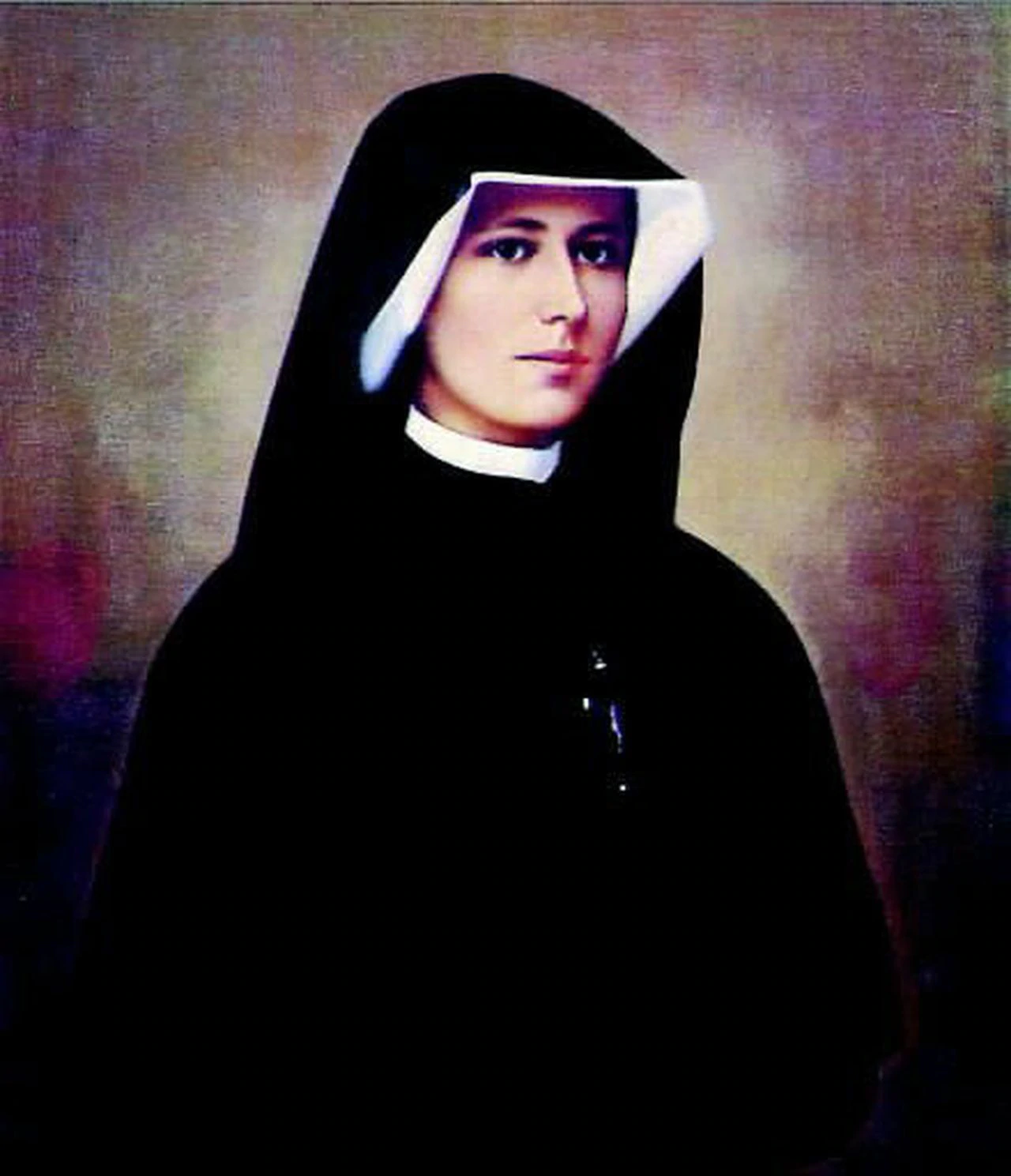
Saint Faustina Kowalska
25 August 1905 – 5 October 1938
Feast Day: 5 October
Known as: Apostle of Divine Mercy, Secretary of Divine Mercy
Canonized: 30 April 2000 by Pope Saint John Paul II
Saint Maria Faustina Kowalska is one of the most beloved saints of modern times. A humble Polish religious sister who lived only thirty-three years, she became the great apostle of God’s Divine Mercy. Through her life, writings, suffering and mystical encounters with Christ, the Church received a renewed call to trust in God’s merciful love and to become merciful toward others.
Her message can be summed up in the words associated with the image of the Merciful Jesus:
“Jesus, I trust in You.”
Saint Faustina’s spirituality is not simply a devotion to a particular prayer or image. At its heart is the Gospel itself: God is rich in mercy, Christ has conquered sin and death, and every sinner is invited to return to the merciful Heart of Jesus.
Pope Saint John Paul II presented Faustina to the universal Church as a gift for our time and emphasized that her message of Divine Mercy is deeply rooted in the Gospel of the risen Christ. (Vatican)
1. The Childhood of Helena Kowalska
Saint Faustina was born Helena Kowalska on 25 August 1905 in the village of Głogowiec, near Łódź, Poland. She was the third of ten children in a poor but deeply religious farming family.
Her parents, Stanisław and Marianna Kowalska, taught their children the importance of prayer, work and faith. The family lived simply, and Helena experienced poverty from an early age.
She had only a limited formal education. Yet from childhood she possessed a strong desire to know and love God.
According to the Vatican biography, she showed an early love of prayer, work, obedience and concern for the poor. She received her First Holy Communion at the age of nine, and the Eucharist made a profound impression upon her spiritual life. (Vatican)
Her childhood was ordinary in many respects. She was not raised in a wealthy or influential environment. She did not receive a sophisticated theological education.
This is important when considering her later mission.
God did not choose a famous theologian to proclaim His mercy.
He chose a humble young woman.
2. The Call to Religious Life
From childhood, Helena felt drawn toward religious life. However, her parents initially did not give permission for her to enter a convent.
At the age of sixteen she left home and worked as a domestic servant in order to support herself and help her family.
Her desire for religious life remained strong.
Eventually, she experienced a decisive call to leave everything and follow Christ. On 1 August 1925, she entered the Congregation of the Sisters of Our Lady of Mercy.
There she received the religious name:
Sister Maria Faustina of the Blessed Sacrament.
She would spend the remaining thirteen years of her life within the congregation.
The Vatican records that she served in different convents, including Kraków, Płock and Vilnius, performing humble occupations such as cook, gardener and porter. Outwardly, her life appeared ordinary and even monotonous. Inwardly, however, she experienced an extraordinary union with God. (Vatican)
This contrast is one of the most beautiful aspects of her life.
3. A Hidden Life of Holiness
Saint Faustina did not become holy through extraordinary external achievements.
She became holy through ordinary duties performed with extraordinary love.
She cooked.
She cleaned.
She worked in the garden.
She served others.
She prayed.
She obeyed.
She suffered.
She trusted.
She loved.
Her holiness developed in the hidden places of daily life.
This is particularly important for ordinary Christians. Most people will never preach before thousands, write famous books or accomplish spectacular things.
But everyone can:
- pray faithfully;
- forgive someone;
- serve one’s family;
- care for the poor;
- perform one’s duties honestly;
- receive the Eucharist worthily;
- go to Confession;
- trust God during suffering;
- show mercy to someone who has hurt us.
Saint Faustina teaches that holiness is not measured by how extraordinary our circumstances are, but by how completely we surrender ourselves to God.
4. The Mystical Life of Saint Faustina
Although Faustina’s external life was simple, her interior life was extraordinarily profound.
She experienced visions and mystical encounters with Jesus, the Blessed Virgin Mary, angels and saints. She also experienced severe spiritual trials and physical suffering.
The Vatican biography records extraordinary mystical gifts attributed to her, while emphasizing that such gifts themselves do not constitute holiness. Faustina herself understood that union with God and conformity to His will are what truly matter. (Vatican)
This distinction is essential.
A person may receive extraordinary spiritual experiences and still fail to love God and neighbour.
For Faustina, the goal was never mystical experience.
The goal was union with God.
5. The Vision of the Merciful Jesus
The most famous mystical experience associated with Saint Faustina occurred on 22 February 1931, when she saw Christ appearing as the Merciful Jesus.
According to her Diary, Jesus appeared dressed in white. One hand was raised in blessing, while the other touched His garment near His heart. From His heart came two rays, one pale and the other red.
Jesus instructed her to have an image painted according to what she had seen, with the words:
“Jesus, I trust in You.”
The Vatican records this revelation and notes that the image was subsequently painted in 1934 by the artist Eugeniusz Kazimirowski according to Faustina’s instructions. (Vatican Press)
The image became one of the most recognizable Catholic images of the twentieth century.
6. What Do the Two Rays Mean?
The two rays flowing from the heart of Christ are traditionally understood in connection with the mystery of Christ’s pierced side.
Pope Saint John Paul II explained during Faustina’s canonization that the rays represent blood and water.
They recall the Gospel of Saint John:
“One of the soldiers pierced his side with a spear, and at once blood and water came out.”
— John 19:34
The red ray recalls Christ’s Blood and the mystery of His sacrifice.
The pale ray recalls water and is associated with Baptism and the gift of the Holy Spirit.
Pope John Paul II connected these rays with the pierced Heart of Christ and the mystery of Divine Mercy flowing toward humanity. (Vatican)
Thus the image is not simply a devotional painting.
It directs us toward the Paschal Mystery:
Christ crucified.
Christ risen.
Christ forgiving.
Christ pouring out His mercy.
7. “Jesus, I Trust in You”
Perhaps the simplest and most powerful expression of Faustina’s spirituality is:
Jesus, I trust in You.
Trust is at the centre of Divine Mercy spirituality.
Trust does not mean pretending that suffering does not exist.
It does not mean that everything will happen according to our wishes.
It means placing our lives into the hands of God even when we cannot understand His ways.
When we are afraid:
Jesus, I trust in You.
When we are sick:
Jesus, I trust in You.
When our family is suffering:
Jesus, I trust in You.
When we have sinned:
Jesus, I trust in You.
When we cannot see the way forward:
Jesus, I trust in You.
When death approaches:
Jesus, I trust in You.
The spirituality of Faustina therefore leads the Christian away from despair and toward confidence in God’s mercy.
8. The Message of Divine Mercy
The message entrusted to Faustina can be understood through several closely connected themes.
1. God is merciful
God does not desire the destruction of the sinner. His mercy calls the sinner back to Himself.
2. Jesus is the revelation of the Father’s mercy
The mercy of God is revealed most perfectly in Jesus Christ, especially in His Passion, Death and Resurrection.
3. We must trust in God’s mercy
The Christian response to mercy is trust.
4. We must ask for mercy
Faustina was encouraged to pray for God’s mercy upon herself and the whole world.
5. We must become merciful
Receiving God’s mercy requires us to extend mercy to others.
This last point is crucial.
Divine Mercy is not merely something we receive.
It is something we must live.
9. The Three Ways of Practising Mercy
Faustina’s spirituality emphasizes concrete mercy.
Mercy must become visible in Christian life.
We can show mercy through:
By deed
Helping those who are in need.
By word
Speaking words that console, encourage and forgive.
By prayer
Praying for people, especially those who are suffering and those who have turned away from God.
Christian mercy therefore becomes practical.
A person cannot sincerely say, “Jesus, I trust in You,” while deliberately refusing to forgive everyone else.
Trust in Divine Mercy should gradually transform us into people of mercy.
10. The Diary of Saint Faustina
One of the most important spiritual writings associated with the twentieth century is the Diary of Saint Faustina, commonly known as Divine Mercy in My Soul.
Faustina wrote about her spiritual experiences, struggles, prayers, revelations and encounters with Christ.
The Vatican describes her Diary as the record of her encounter with Jesus and as an important expression of her mission to proclaim God’s mercy. (Vatican)
It is important to read the Diary in harmony with Sacred Scripture and the teaching of the Catholic Church.
Faustina herself remained deeply devoted to the Church, the sacraments, the Eucharist, Confession and obedience.
Her spirituality was not independent of Catholic faith.
It was profoundly Catholic.
11. The Chaplet of Divine Mercy
One of the most widespread devotional practices associated with Saint Faustina is the Chaplet of Divine Mercy.
It is traditionally prayed using a rosary.
The central prayer repeatedly asks the Father to have mercy on the world through the Passion of Jesus Christ.
The Chaplet can be prayed:
- for oneself;
- for family members;
- for the sick;
- for the dying;
- for sinners;
- for souls in need of God’s mercy;
- for the whole world.
It is particularly associated with the Hour of Mercy, around 3:00 p.m., recalling the hour traditionally associated with Christ’s death.
The Vatican’s presentation of Faustina’s mission identifies the Chaplet and prayer at the Hour of Mercy among the devotional practices associated with her message. (Vatican)
12. Divine Mercy Sunday
Another major element of Faustina’s mission is the Feast of Divine Mercy.
The Church celebrates Divine Mercy Sunday on the Second Sunday of Easter, that is, the Sunday following Easter Sunday.
Pope Saint John Paul II formally established this celebration for the universal Church during the canonization of Faustina in 2000. (Divine Mercy)
The choice of the Sunday after Easter is deeply meaningful.
Easter reveals that Christ has conquered sin and death.
Divine Mercy Sunday therefore points to the merciful love flowing from the Paschal Mystery.
The Resurrection is not merely a historical event to remember.
It is an invitation to trust in the living Christ.
13. Saint Faustina and Confession
The spirituality of Divine Mercy has a particularly close connection with the Sacrament of Reconciliation.
Sin can make a person believe:
“God will never forgive me.”
Divine Mercy responds:
Come back to Christ.
The Church’s message is not that sin does not matter.
Rather, sin matters precisely because God’s love is so great.
Christ calls the sinner to conversion.
Through sincere repentance and sacramental Confession, the sinner encounters the mercy of God.
This makes Faustina especially relevant to modern Christians who struggle with guilt, shame, discouragement or the feeling that they have gone too far from God.
No human misery is greater than God’s capacity to forgive the repentant sinner.
14. Saint Faustina and the Eucharist
Faustina had a profound devotion to the Eucharist.
The Vatican biography specifically notes her love of the Eucharist as an important part of her spiritual life. (Vatican)
For her, Jesus was not merely an idea or a distant figure from history.
He was truly present and encountered in the sacramental life of the Church.
The Eucharist and Divine Mercy therefore belong together.
At every Mass we encounter the mystery of Christ’s sacrificial love.
The same Heart from which the rays of mercy flow is the Heart of the One who gives Himself for us.
15. Saint Faustina and the Blessed Virgin Mary
Faustina also possessed a deep devotion to the Blessed Virgin Mary.
She understood Mary as the Mother of Mercy.
Mary directs Christians toward Jesus.
At Cana she tells the servants:
“Do whatever he tells you.”
— John 2:5
That is also an excellent summary of Christian spirituality.
Mary does not replace Christ.
She leads us to Him.
Pope Saint John Paul II himself recalled Faustina’s Marian devotion and invoked Mary’s intercession in connection with her mission. (Vatican)
16. Suffering in the Life of Saint Faustina
Saint Faustina’s life was marked by considerable suffering.
She suffered from illness, spiritual trials and misunderstanding.
She eventually became seriously ill with tuberculosis.
Yet she tried to unite her suffering with the Passion of Christ and to offer herself in prayer for sinners.
She died in Kraków on 5 October 1938, at only 33 years of age. (Vatican)
Her death reminds us that a short life can have an enormous spiritual influence.
The measure of a life is not simply its length.
It is its love.
17. Her Death and the Growth of Her Mission
After her death, devotion to Faustina and the message of Divine Mercy continued to spread.
She was beatified by Pope John Paul II on 18 April 1993.
Seven years later, on 30 April 2000, Pope John Paul II canonized her in Rome.
At the canonization Mass, the Pope presented Faustina’s witness as a gift to the whole Church and emphasized the connection between her message and the Gospel of Divine Mercy. (Vatican)
Her relics are venerated at the Sanctuary of Divine Mercy in Kraków-Łagiewniki. (Divine Mercy)
18. Saint Faustina and Pope Saint John Paul II
There is a remarkable connection between Saint Faustina and Pope Saint John Paul II.
Both were Polish.
Both lived through the terrible suffering of the twentieth century.
Both experienced the tragedy of war and totalitarianism.
And both emphasized the merciful love of God as a source of hope for humanity.
Pope John Paul II played a major role in making Faustina’s message known throughout the universal Church.
At her canonization, he described Divine Mercy as God’s gift to the Church and to humanity.
He later wrote:
“Divine Mercy! This is the Easter gift that the Church receives from the risen Christ and offers to humanity.” (Vatican)
19. The Universal Church Recognizes Her Feast
On 18 May 2020, the Congregation for Divine Worship announced that Pope Francis had approved the inscription of Saint Faustina Kowalska in the General Roman Calendar as an optional memorial.
Her liturgical memorial is celebrated on:
5 October.
The Vatican decree describes Faustina as a herald of God’s mercy and states that her spirituality inspired a movement dedicated to proclaiming and imploring Divine Mercy throughout the world. (Vatican)
Thus her message, which began in the hidden life of a Polish religious sister, has become part of the devotional and liturgical life of the universal Church.
20. What Saint Faustina Teaches Us Today
Saint Faustina’s message is extraordinarily relevant to our time.
We live in a world marked by:
- war;
- violence;
- family divisions;
- loneliness;
- anxiety;
- poverty;
- hatred;
- unforgiveness;
- spiritual confusion;
- fear of the future.
The answer of Divine Mercy is not naïve optimism.
It is Christ.
The wounded and risen Christ reveals that suffering and sin do not have the final word.
Mercy does.
Forgiveness does.
Love does.
Resurrection does.
21. Five Lessons from Saint Faustina
1. Never despair of God’s mercy
No matter how serious our sins are, we should never conclude that God cannot forgive us when we sincerely repent.
2. Trust Jesus
Our lives are often filled with uncertainty.
Faith teaches us to say:
Jesus, I trust in You.
3. Go frequently to Confession
Divine Mercy is not merely a comforting idea. Christ gives His forgiveness sacramentally through His Church.
4. Be merciful to others
We cannot ask God for mercy while deliberately refusing mercy to those around us.
5. Offer suffering to God
Our sufferings can become opportunities for deeper union with Christ when they are accepted and offered to Him.
22. Saint Faustina’s Spirituality in One Sentence
The entire spirituality of Saint Faustina can be summarized as:
Receive God’s mercy, trust in His mercy, pray for mercy, and become an instrument of mercy.
This is why the devotion is not centred merely on an image or a particular prayer.
The real goal is transformation.
We look at the merciful Christ so that our own hearts may become more merciful.
23. A Practical Prayer Inspired by Saint Faustina
When you wake up in the morning:
“Jesus, I trust in You. Guide me today according to Your will.”
When you face difficulties:
“Jesus, I trust in You.”
When someone hurts you:
“Jesus, give me the grace to forgive.”
Before Confession:
“Merciful Jesus, give me a truly contrite heart.”
Before receiving Holy Communion:
“Jesus, make my heart like Your merciful Heart.”
At 3:00 p.m.:
“Jesus, for the sake of Your sorrowful Passion, have mercy on us and on the whole world.”
Before sleep:
“Merciful Jesus, I place my life, my family and the whole world in Your hands.”
24. A Short Reflection for the Feast of Saint Faustina
Saint Faustina did not become an apostle of mercy because her life was free from suffering.
She became an apostle of mercy in the midst of suffering.
She did not preach that life would always be easy.
She preached that God is always worthy of trust.
Her life asks us a simple question:
Do I really trust Jesus?
We may say the words easily:
“Jesus, I trust in You.”
But true trust is tested when prayers appear unanswered, when illness comes, when relationships break, when financial difficulties arise, when the future is uncertain and when we do not understand God’s plan.
Saint Faustina teaches us to place even these things into the hands of Christ.
The merciful Jesus does not promise that we will never suffer.
He promises that we will never be abandoned.
25. Conclusion
Saint Faustina Kowalska was a humble Polish nun who lived a hidden life, yet through her the Church received a powerful reminder of one of the central truths of the Gospel:
God is merciful.
Her life points us toward the wounded Heart of Christ.
Her Diary invites us deeper into trust.
The Divine Mercy image reminds us of the Blood and Water flowing from Christ.
The Chaplet teaches us to pray for mercy.
Divine Mercy Sunday directs us back to the mystery of Easter.
And her life challenges us to become merciful ourselves.
Saint Faustina died at only thirty-three years of age. Yet her spiritual influence continues throughout the world.
Her message remains wonderfully simple:
Do not run away from Jesus because you are a sinner. Run toward Him because He is merciful.
When we cannot understand God’s plan, let us say:
Jesus, I trust in You.
When we have fallen:
Jesus, I trust in You.
When we are afraid:
Jesus, I trust in You.
When we suffer:
Jesus, I trust in You.
And when we receive God’s mercy, may we become instruments of that same mercy for others.
Saint Maria Faustina Kowalska, Apostle of Divine Mercy, pray for us.
Jesus, I trust in You.
Key Facts at a Glance
| Birth name | Helena Kowalska |
| Born | 25 August 1905 |
| Birthplace | Głogowiec, Poland |
| Religious congregation | Sisters of Our Lady of Mercy |
| Religious name | Sister Maria Faustina |
| Entered religious life | 1 August 1925 |
| Principal mission | Proclaiming God’s Divine Mercy |
| Famous devotional image | Divine Mercy Image |
| Inscription | “Jesus, I trust in You” |
| Major writing | Diary: Divine Mercy in My Soul |
| Death | 5 October 1938 |
| Age at death | 33 |
| Beatification | 18 April 1993 |
| Canonization | 30 April 2000 |
| Canonized by | Pope Saint John Paul II |
| Liturgical memorial | 5 October |
| Shrine | Divine Mercy Sanctuary, Kraków-Łagiewniki |
The Vatican’s official biography, canonization homily and 2020 decree provide particularly strong primary sources for a publication on Saint Faustina. (Vatican)
Leave a Reply