
Introduction
Saint Margaret Mary Alacoque (1647–1690) was a French Catholic religious sister and mystic who played a significant role in spreading devotion to the Sacred Heart of Jesus throughout the Catholic Church. Through her life of prayer, humility, suffering, and love for the Eucharist, she became known as the Apostle of the Sacred Heart.
Living in seventeenth-century France, Margaret Mary experienced what she understood as special revelations of Jesus Christ, who called her to make known the immense love of His Sacred Heart for humanity. Her mission emphasized the need to respond to that love through prayer, Eucharistic adoration, frequent Holy Communion, repentance, and reparation for sin.
The devotion to the Sacred Heart did not originate with Saint Margaret Mary; it has deep roots in Sacred Scripture and the spiritual tradition of the Church. However, her mystical experiences and her perseverance in communicating their message helped the devotion spread widely and eventually receive official liturgical recognition.
Her feast is celebrated on October 16. Her life continues to invite Christians to contemplate the merciful love of Christ and to respond to it with hearts filled with gratitude and faith.
Early Life and Family Background
Saint Margaret Mary Alacoque was born on July 22, 1647, in L’Hautecour, in the Burgundy region of France. She was the daughter of Claude Alacoque and Philiberte Lamyn. Her family was Christian, and from an early age Margaret displayed a strong attraction to prayer and the things of God.
Even as a child, she showed a particular love for Jesus in the Blessed Sacrament. She preferred moments of silence and prayer and developed a deep interior life. Her spirituality was marked by a tender devotion to Christ and a desire to belong entirely to Him.
One of the most significant events of her childhood was the death of her father. This loss brought considerable hardship to the family. Margaret and her mother experienced difficulties involving relatives and family property, and their circumstances became painful and uncertain.
During these years, Margaret found consolation in prayer. Her growing relationship with Jesus became a source of strength when human comfort seemed limited.
Her early life teaches us that faith does not necessarily remove suffering from our path. Rather, faith can become the place where we discover God’s presence in the midst of suffering.
Illness and Devotion to the Blessed Virgin Mary
During her childhood, Margaret suffered a prolonged and serious illness that left her unable to move normally for several years. This period of physical suffering deeply influenced her spiritual life.
In her distress, she turned to the Blessed Virgin Mary and made a promise to consecrate herself to religious life. According to the traditional accounts of her life, she subsequently recovered her health. In gratitude, she adopted the name Mary, becoming known as Margaret Mary.
Her experience strengthened her conviction that her life belonged to God. She increasingly desired to dedicate herself to prayer and service rather than pursue the ordinary expectations placed upon a young woman of her time.
Nevertheless, her vocation was not realized without struggle. As she grew older, family circumstances and social expectations made her decision difficult. For a time, she considered the possibility of living a more conventional life.
Eventually, her desire for consecration became clear, and she resolved to enter religious life.
Entering the Visitation Monastery
On May 25, 1671, Margaret Mary entered the Visitation Monastery at Paray-le-Monial, France. The Order of the Visitation of Holy Mary had been founded by Saint Francis de Sales and Saint Jane Frances de Chantal.
The Visitation sisters sought holiness through prayer, humility, gentleness, and fidelity to community life. These ideals suited Margaret Mary’s spiritual temperament, although her formation involved trials and challenges.
She professed her religious vows on November 6, 1672, and devoted herself to the life of a religious sister.
Margaret Mary did not seek recognition or special privileges. She desired to become humble, obedient, and faithful in the ordinary duties of the convent. She accepted the responsibilities entrusted to her and tried to serve her sisters with charity.
Her life in the monastery was not always peaceful. Her unusual spiritual experiences sometimes caused misunderstanding, and not everyone accepted her account of what she believed Jesus was revealing to her.
Yet she continued to practise obedience and humility. She learned that a life of holiness requires not only fervent prayer but also patience, perseverance, and charity when others fail to understand us.
The Revelations of the Sacred Heart of Jesus
The defining moment of Saint Margaret Mary’s spiritual mission began on December 27, 1673, when she experienced what she described as a revelation of Jesus Christ during prayer.
Over the following months, she reported further mystical experiences in which Jesus made known to her the love of His Sacred Heart.
The Sacred Heart was presented as a sign of Christ’s burning love for humanity: a love that gives itself completely, suffers for sinners, and desires a response of love from every human heart.
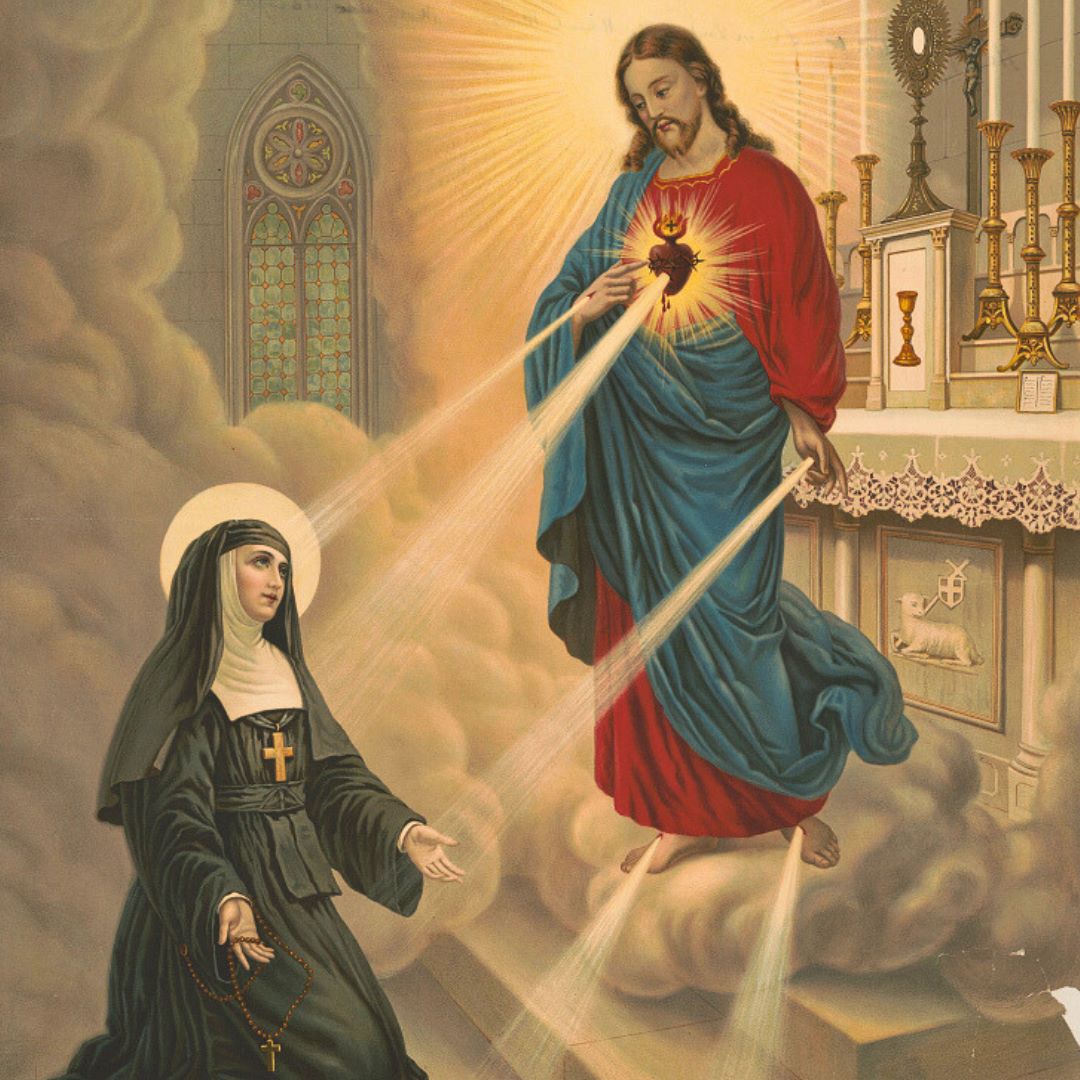
The traditional imagery associated with these revelations includes a heart surrounded by a crown of thorns, pierced by a wound, and crowned with a flame and a cross. Each symbol expresses an important aspect of Christian faith.
- The heart represents the personal and merciful love of Jesus.
- The crown of thorns recalls the suffering Christ endured because of human sin.
- The wound recalls His Passion and the piercing of His side on the Cross.
- The flame symbolizes the burning love of Christ.
- The cross proclaims His self-giving sacrifice for the salvation of the world.
These symbols are not intended to separate Christ’s love from His suffering. Rather, they reveal that His love remained faithful even when He was rejected, wounded, and crucified.
Margaret Mary understood her mission as a call to help the faithful recognize this love and respond to it with gratitude, repentance, and devotion.
The Great Apparition of 1675
Among the mystical experiences associated with Saint Margaret Mary, the apparition traditionally dated to June 1675 holds particular importance.
During prayer before the Blessed Sacrament, she reported that Jesus showed her His Heart and expressed His desire that humanity recognize His immense love, especially in the face of indifference and ingratitude.
In the traditional account, Christ’s message included the words:
“Behold this Heart which has loved men so much.”
This short expression captures the central message of the devotion: Jesus Christ loves humanity with a love that is generous, faithful, and merciful, yet that love is often met with indifference.
Margaret Mary understood that she was being called to encourage the establishment of a feast in honour of the Sacred Heart. The feast would invite the faithful to contemplate Christ’s love, receive Him in the Eucharist, and offer prayers of thanksgiving and reparation.
The message was not simply about external religious practices. At its centre was a call to conversion of heart.
Christians were invited to examine their lives, recognize God’s mercy, turn away from sin, and love Jesus with greater sincerity.
Saint Claude de la Colombière: A Spiritual Guide
An important person in Saint Margaret Mary’s life was Saint Claude de la Colombière, a Jesuit priest who became her spiritual director and supporter.
When Father Claude arrived at Paray-le-Monial in 1675, Margaret Mary had already faced considerable opposition and uncertainty concerning her mystical experiences.
Father Claude approached her testimony with discernment. He eventually became convinced of the spiritual value of her mission and helped her communicate the message of the Sacred Heart.
His support was especially important because Margaret Mary did not seek to establish her mission through personal authority. She wished to remain faithful to the Church and obedient to her religious superiors.
Saint Claude encouraged her to trust in God while continuing to fulfil her ordinary duties. He also helped promote devotion to the Sacred Heart beyond the walls of the monastery.
Their relationship demonstrates the importance of wise spiritual guidance. Extraordinary spiritual experiences must be approached with humility, discernment, and fidelity to the Church. Genuine devotion should lead to deeper faith, charity, peace, and obedience rather than pride or spiritual self-importance.
Opposition, Suffering, and Perseverance
Saint Margaret Mary did not find immediate acceptance for her mission. Some members of her religious community questioned her experiences, and certain people considered her claims mistaken.
These difficulties caused her considerable suffering. Yet she did not respond with bitterness or hostility. She continued to fulfil her duties, pray faithfully, and treat others with charity.
Her perseverance was not based merely on a conviction that she was right. She sought to surrender herself to God and remain faithful to the responsibilities of religious life.
Gradually, attitudes within her community changed. In 1683, she was appointed assistant superior, and she later served as mistress of novices. These responsibilities gave her opportunities to teach younger sisters about prayer, humility, and devotion to the Sacred Heart.
In 1686, a chapel dedicated to the Sacred Heart was established at Paray-le-Monial, and the feast began to be observed within the community.
Her story reminds us that the work of God may unfold slowly. Not every sincere effort is immediately understood, and not every spiritual mission receives instant approval. Patience, discernment, and perseverance remain essential virtues in Christian life.
The Spiritual Meaning of Devotion to the Sacred Heart
Devotion to the Sacred Heart of Jesus is much more than a devotion to a religious image. It is a way of contemplating the mystery of Christ’s love, revealed most fully in His Incarnation, Passion, death, and Resurrection.
The heart of Jesus reminds Christians that God is not distant from human suffering. In Jesus, divine love entered human history, shared our condition, and gave itself for our salvation.
The devotion invites the faithful to develop a personal relationship with Christ, allowing His love to transform their attitudes, decisions, and relationships.
1. A call to recognize Christ’s love
The Sacred Heart reminds us that Christ loves us even when we are weak, sinful, or struggling. His mercy invites us to return to Him with sincere repentance and confidence.
2. A call to Eucharistic adoration
Margaret Mary emphasized the importance of spending time with Jesus in the Blessed Sacrament. Eucharistic adoration gives believers an opportunity to remain quietly in the Lord’s presence, express gratitude, seek forgiveness, and renew their commitment to Him.
3. A call to repentance and reparation
Reparation means responding to Christ’s love with sincere sorrow for sin and a desire to make amends. It includes prayer, conversion, works of mercy, and efforts to repair the harm caused by our actions.
It is not an attempt to purchase God’s forgiveness. Rather, it is the loving response of a heart that recognizes the seriousness of sin and desires to grow in holiness.
4. A call to love our neighbours
Authentic devotion to the Sacred Heart must produce practical charity. We cannot honour the merciful Heart of Jesus while remaining indifferent to the suffering of others.
The devotion should make us more forgiving, compassionate, patient, and generous, particularly towards those who are poor, lonely, rejected, or wounded.
The Holy Hour and the First Friday Devotion
Two practices closely associated with Saint Margaret Mary are the Holy Hour and receiving Holy Communion on the First Friday of the month.
The Holy Hour
The Holy Hour is a period of prayer spent with Jesus, particularly in Eucharistic adoration. It is associated with Christ’s agony in Gethsemane and His invitation to His disciples to remain with Him in prayer.
In Matthew 26:40, Jesus asks His disciples, “Could you not watch with me one hour?”
The Holy Hour allows the faithful to meditate on Christ’s suffering, express love and gratitude, pray for sinners, and bring the needs of the world before God.
It need not involve elaborate prayers. A quiet period of Scripture reading, reflection, adoration, and personal prayer can be a meaningful response to the Lord’s invitation.
The Nine First Fridays
The First Friday devotion is traditionally associated with receiving Holy Communion on the first Friday of nine consecutive months, together with a sincere desire to honour the Sacred Heart of Jesus.
This practice developed through the spirituality associated with Saint Margaret Mary and the Church’s subsequent promotion of the devotion.
The traditional promise associated with the nine First Fridays concerns the grace of final repentance and the reception of the sacraments at the hour of death. This promise should never be treated as a mechanical guarantee that makes conversion or a faithful Christian life unnecessary. The devotion is meant to encourage genuine love of Christ, repentance, perseverance, and participation in the sacramental life of the Church.
The First Friday devotion is most fruitful when it leads us to a deeper relationship with Jesus and a more faithful practice of the Gospel.
The Spread and Recognition of the Devotion
Following Saint Margaret Mary’s death, devotion to the Sacred Heart continued to spread through the work of the Visitation sisters, the Jesuits, and other Catholic communities.
Saint Claude de la Colombière played a significant role in promoting the devotion, while Margaret Mary’s writings and the testimony of those who knew her helped communicate its spiritual meaning.
The Church gradually gave official recognition to the devotion. In 1765, Pope Clement XIII approved the celebration of the feast of the Sacred Heart in certain places. In 1856, Pope Pius IX extended the feast to the universal Church.
These developments helped establish the Sacred Heart devotion as a prominent feature of Catholic spirituality.
The devotion has continued to flourish through Eucharistic adoration, First Friday observances, the enthronement of the Sacred Heart in homes, prayers of consecration, and the celebration of the Solemnity of the Sacred Heart of Jesus.
In his 2024 encyclical Dilexit Nos, Pope Francis reflected on the human and divine love of Christ symbolized by His heart, placing this devotion within the broader Christian call to encounter and respond to the love of Jesus.
Beatification and Canonization
The Church formally recognized Saint Margaret Mary’s holiness after examining her life, virtues, and spiritual mission.
- September 18, 1864: Pope Pius IX beatified her.
- May 13, 1920: Pope Benedict XV canonized her.
She is remembered as one of the principal saints associated with devotion to the Sacred Heart of Jesus. Her feast is celebrated on October 16 in the Roman Catholic calendar.
Her life remains especially meaningful for those who wish to deepen their Eucharistic spirituality, cultivate a personal relationship with Christ, and discover the transforming power of divine love.
The Spiritual Lessons of Saint Margaret Mary Alacoque
1. Let yourself be loved by Jesus
Many people approach God primarily through fear, guilt, or a sense of unworthiness. Saint Margaret Mary directs our attention to the merciful love of Christ. We are invited to acknowledge our sins honestly while trusting in the Lord who calls us to conversion.
2. Remain faithful during misunderstandings
Margaret Mary experienced opposition even within her religious community. Her perseverance teaches us to remain humble and charitable when our intentions are misunderstood.
3. Make time for prayer
Her devotion to the Eucharist reminds us that prayer is not merely a duty to complete. It is an opportunity to spend time with the One who loves us.
4. Allow love to transform your heart
Devotion should change the way we live. If we contemplate Christ’s patience, we must learn patience. If we receive His mercy, we must show mercy. If we reflect on His sacrifice, we must become more generous in serving others.
5. Offer your suffering to God
Margaret Mary’s life included illness, family difficulties, and spiritual trials. She teaches us to bring our suffering to Christ and unite it with prayer, while also seeking appropriate help and support when needed.
6. Keep Christ at the centre of your family
The Sacred Heart can become a focal point of family prayer. Families may pray together, forgive one another, read the Gospel, and place their joys and struggles before Jesus.
The true honour given to the Sacred Heart is shown not merely by displaying its image, but by allowing Christ’s love to shape the life of the home.
A Feast-Day Meditation on Saint Margaret Mary Alacoque
Today, as we remember Saint Margaret Mary Alacoque, let us pause and contemplate the Heart of Jesus.
We live in a world where many hearts are wounded. Some are burdened by guilt; others carry the pain of rejection, loneliness, betrayal, or disappointment. Many people appear strong on the outside while silently longing to be understood and loved.
The devotion to the Sacred Heart reminds us that Jesus knows the human heart. He knows our struggles, our weaknesses, our fears, and our deepest longings. He does not invite us to hide from Him. He invites us to come closer.
Perhaps today we need to spend a little more time with Jesus. Perhaps we have been so occupied with responsibilities that we have forgotten to sit quietly in His presence. Perhaps we have received His mercy but found it difficult to forgive someone who hurt us.
Saint Margaret Mary invites us to return to the Heart of Christ, not simply to ask for blessings, but to learn how to love.
Let us ask ourselves: Is my heart becoming more like the Heart of Jesus? Am I more patient with my family? More compassionate towards the suffering? More willing to forgive? More faithful in prayer? More attentive to the poor and forgotten?
The Sacred Heart is a reminder that love is not merely a feeling. It is a decision to remain faithful, to give generously, to forgive sincerely, and to seek the good of others.
On this feast day, let us place our families, our parishes, our priests, our religious communities, and all those who suffer before the Heart of Jesus.
May the Heart that loved humanity so faithfully teach us to love God wholeheartedly and to love one another with genuine Christian charity.
Sacred Heart of Jesus, make our hearts like Yours.
Prayer to Saint Margaret Mary Alacoque
O Saint Margaret Mary Alacoque, faithful servant of Jesus and apostle of His Sacred Heart, I turn to you with confidence and ask for your intercession.
You who devoted your life to contemplating the immense love of Jesus, help me to know Him more deeply and to love Him more sincerely. Teach me to find consolation in His presence, especially when I am burdened by worries, disappointments, and suffering.
Pray that my heart may be purified of pride, selfishness, resentment, and indifference. Obtain for me the grace to forgive those who have hurt me, to seek reconciliation where there is division, and to serve those who are in need.
Beloved saint, help me to grow in devotion to the Blessed Sacrament. Teach me to spend time in prayer, to receive the Holy Eucharist with faith and reverence, and to approach the Sacrament of Reconciliation with sincere repentance.
Intercede for my family, my loved ones, and all those who have entrusted their intentions to my prayers. May the Sacred Heart of Jesus bring peace to troubled homes, strength to those who are suffering, hope to those who are discouraged, and conversion to those who have wandered far from God.
Saint Margaret Mary, help me to trust in the merciful love of Christ and to make His love visible through my words and actions.
May the Sacred Heart of Jesus reign in my heart, in my family, and throughout the world.
Saint Margaret Mary Alacoque, pray for us.
Sacred Heart of Jesus, I place my trust in You. Amen.
References and Further Reading
1. Vatican City State — Saint Margaret Mary Alacoque: The Messenger of the Heart of Christ. https://www.vaticanstate.va/en/component/content/article/october-16-saint-margaret-mary-alacoque.html
2. The Holy See — Pope Francis, Dilexit Nos: Encyclical Letter on the Human and Divine Love of the Heart of Jesus Christ (2024). https://www.vatican.va/content/francesco/en/encyclicals/documents/20241024-enciclica-dilexit-nos.html
3. The Catholic Encyclopedia — St. Margaret Mary Alacoque. https://www.newadvent.org/cathen/09653a.htm
4. The Catholic Encyclopedia — Devotion to the Sacred Heart of Jesus. https://www.newadvent.org/cathen/07163a.htm
5. Archdiocese of Toronto — St. Margaret Mary Alacoque and the Sacred Heart of Jesus. https://www.archtoronto.org/en/outreach/archdiocesan-blog/archdiocesan/st.-margaret-mary-alacoque-and-the-sacred-heart-of-jesus/
6. Oblates of St. Francis de Sales — St. Margaret Mary Alacoque. https://www.oblates.org/st-margaret-mary-alacoque
Leave a Reply