
Introduction
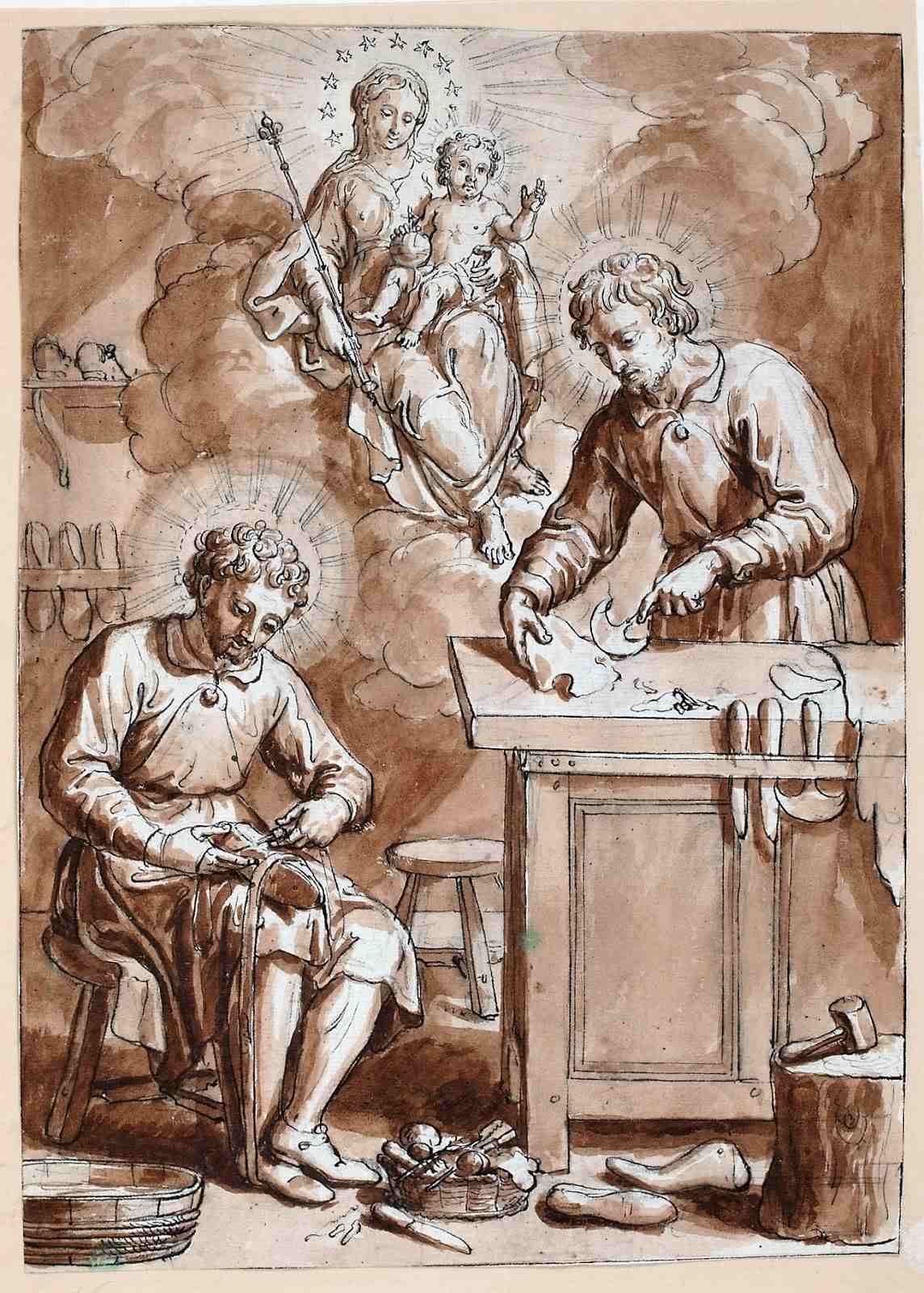
Saints Crispin and Crispinian are venerated as early Christian martyrs who courageously proclaimed their faith in Jesus Christ and served the poor through their daily work. According to Christian tradition, these two saints were brothers who travelled from Rome to Gaul, present-day France, where they preached the Gospel and earned their living as shoemakers.
Their story combines missionary zeal, honest labour, charity toward the poor, and fidelity to Christ in the face of persecution. Rather than depending on others for their livelihood, they are said to have supported themselves through their craft and used their earnings to help those in need.
Saints Crispin and Crispinian became especially beloved as the patron saints of shoemakers, cobblers, leatherworkers, tanners, and saddlers. Their feast is celebrated on October 25.
Although many details of their traditional biography cannot be verified historically, the early veneration of these martyrs at Soissons in France is well attested. Their enduring place in Christian tradition reminds us that holiness can be found not only in extraordinary public ministries but also in ordinary work performed with faith, integrity, and love.
Feast Day: October 25
Traditional place of martyrdom: Soissons, Gaul, in present-day France
Traditional date of martyrdom: Around 285–286 AD
Patronage: Shoemakers, cobblers, leatherworkers, tanners, and saddlers
Symbols in Christian art: Shoemaking tools, shoes, leather, and the palm of martyrdom
1. The Historical Background of the Saints
The lives of Saints Crispin and Crispinian belong to the period of the early Church, when Christians were spreading the Gospel throughout the Roman Empire despite periods of hostility and persecution.
The Roman Empire included many different religious traditions. Although the treatment of Christians varied across time and place, certain emperors and local authorities regarded Christian worship as a threat to established religious and political expectations. Christians who refused to participate in pagan religious practices could face discrimination, imprisonment, torture, or death.
The persecution associated with Emperor Diocletian and his co-rulers became particularly severe during the early fourth century. Traditional accounts associate Crispin and Crispinian with the persecution under Maximian, Diocletian’s co-emperor in the western part of the empire.
The traditional date of their martyrdom is often given as October 25, 285 or 286. However, the precise chronology and many details of their lives remain uncertain.
What is historically significant is that the two saints were venerated at Soissons at an early date. By the sixth century, a substantial church had been built over the place traditionally associated with their burial. This early cult of the martyrs demonstrates that their memory had become important in the Christian community.
Their story was subsequently enriched by accounts of their missionary activities, charitable work, and miraculous deliverance from torture. These details should be understood as part of the saints’ traditional hagiography rather than as independently verified historical facts.
Nevertheless, the central message of their veneration remains powerful: Christians remembered them as witnesses who valued fidelity to Christ more than personal safety.
2. Two Brothers Called to Proclaim the Gospel
According to the traditional account, Crispin and Crispinian came from a distinguished Roman family. Having embraced Christianity, they desired to share the Gospel with people who had not yet encountered the message of Jesus Christ.
They eventually travelled to Gaul and settled in Soissons, a city in the region that is now northern France.
The brothers did not limit their missionary activity to preaching in public. They sought to become part of the community in which they lived. They worked with their hands, developed relationships with local people, and used their everyday presence as an opportunity to share their faith.
Their story illustrates a fundamental principle of Christian evangelization: the Gospel is communicated not only through sermons and formal instruction but also through personal relationships, honest conduct, generosity, and a life consistent with Christian teaching.
The brothers are remembered as missionaries who did not separate their faith from their daily responsibilities. Their work, conversations, and acts of charity became part of their witness to Christ.
Although the precise circumstances of their arrival in Gaul cannot be established with certainty, their traditional story continues to inspire Christians to proclaim the Gospel through both words and deeds.
3. Shoemakers Who Served the Poor
One of the best-known features of the traditional account is that Crispin and Crispinian earned their livelihood by making shoes.
During the day, they are said to have proclaimed the Christian faith and formed relationships with the people of Soissons. Through their craft, they supported themselves and avoided becoming a financial burden on the community.
Their work also provided an opportunity to assist people in need. According to tradition, they charged modest prices and used their earnings to help the poor.
This combination of missionary service and manual labour made them especially memorable. They were not presented as men who regarded ordinary work as an obstacle to holiness. Instead, their craft became an integral part of their Christian witness.
The brothers’ example reminds us that honest work possesses dignity. A person does not need to occupy a prominent position or perform an extraordinary task to serve God faithfully. Work carried out with integrity can support a family, contribute to society, and provide opportunities to help others.
A shoemaker repairing footwear, a farmer cultivating the land, a teacher educating children, a nurse caring for patients, and a parent raising a family can all serve God through their daily responsibilities.
The essential question is not whether a person’s occupation appears important in the eyes of the world. It is whether that work is performed with honesty, responsibility, and love.
Saints Crispin and Crispinian invite us to recognize the spiritual value of ordinary labour.
4. Faith Expressed Through Practical Charity
The traditional story of the two saints emphasizes their concern for the poor. Their work was not simply a means of earning money for themselves. It also enabled them to assist people who could not easily afford the necessities of life.
Shoes were an important practical necessity. For people who walked long distances, worked outdoors, or lived in difficult conditions, proper footwear could make a considerable difference to daily life.
By helping the poor obtain shoes, the brothers demonstrated a form of charity that responded to a concrete human need.
Their example is consistent with the teaching of Saint James, who warns against a faith that offers words of encouragement without practical assistance:
“What good is it if you say you have faith but do not have works?” (James 2:14).
Christian charity is not limited to expressions of sympathy. It seeks ways to alleviate suffering and protect human dignity.
Sometimes charity requires financial generosity. At other times, it involves sharing professional skills, offering time, providing food, helping someone find employment, visiting the lonely, or supporting a person who has fallen into difficulty.
The story of Crispin and Crispinian reminds us that we should not wait until we possess great wealth or exceptional influence before beginning to help others. We can begin with the gifts, abilities, and opportunities already entrusted to us.
5. The Courage of Their Christian Witness
According to their traditional biography, the brothers’ missionary activity eventually attracted hostility from those who opposed Christianity.
Their refusal to abandon their faith brought them before the authorities. The traditional account associates their trial with Maximian, who is said to have attempted to persuade them to renounce Christ through threats and promises.
The brothers remained steadfast. They were unwilling to exchange their Christian faith for security, social advancement, or personal comfort.
Their story reflects the experience of many early Christians who faced pressure to abandon their convictions. For the martyrs, faith was not simply a private opinion that could be discarded whenever it became inconvenient. It was a relationship with Christ that gave meaning to their lives and hope beyond death.
Christian martyrdom does not mean seeking suffering or treating violence as something desirable. Rather, it means remaining faithful to God when a person is threatened with suffering or death because of that fidelity.
The witness of the martyrs reminds Christians that there are values more important than popularity, convenience, and personal advantage.
In contemporary life, many Christians may not face the same threats described in the traditional accounts of ancient martyrdom. Nevertheless, they can encounter pressure to compromise their conscience, conceal their faith, or participate in dishonest practices.
The courage of Crispin and Crispinian invites believers to remain faithful to Christ through truthfulness, integrity, and perseverance, even when doing so carries a personal cost.
6. The Traditional Account of Their Martyrdom
The traditional narrative describes the brothers as enduring severe torture because they refused to renounce Christianity. Some versions recount extraordinary attempts to kill them, including being thrown into water with millstones attached to them and being subjected to fire.
These dramatic details belong to the later legendary accounts of their martyrdom and cannot be confidently established as historical events.
The story concludes with their execution by beheading, traditionally dated to October 25 in the late third century.
For generations, Christians remembered the two men as martyrs who preferred death to the abandonment of their faith. Their courage became part of the spiritual heritage of the Church, particularly in France, where their cult was centred at Soissons.
The historical value of individual episodes in a martyrdom narrative must be distinguished from the broader evidence for the early veneration of the martyrs themselves. In the case of Crispin and Crispinian, the precise details of their suffering remain uncertain, but their longstanding commemoration is an important part of Christian history.
Their witness directs attention to the meaning of martyrdom: the supreme testimony of a life that belongs to Christ.
7. The Early Veneration of Saints Crispin and Crispinian
The veneration of Crispin and Crispinian became established in Soissons, where a church was built over the place traditionally identified with their graves.
Their memory spread beyond the region. During the early medieval period, their names appeared in Christian liturgical and devotional traditions, and their feast became associated with the world of artisans and skilled workers.
Traditions concerning their relics also developed. Some relics were reportedly transferred to Rome, while others became associated with Osnabrück in Germany. These traditions contributed to the spread of their veneration across different parts of Europe.
Their patronage of shoemakers and leatherworkers reflects the traditional account of their occupation. Over time, workers and guilds associated with footwear and leather goods looked to them as heavenly patrons.
The connection between the saints and working people gave their devotion a particular character. They were remembered not only as martyrs but also as men whose holiness was expressed through practical skills and concern for those in need.
Their story became a reminder that the Church’s saints come from many different walks of life and that Christian holiness can flourish in the workshop as well as in the monastery, the parish, or the mission field.
8. Saints Crispin and Crispinian as Patrons of Shoemakers
Saints Crispin and Crispinian are especially known as the patron saints of shoemakers, cobblers, tanners, saddlers, and other leatherworkers.
This patronage developed from the traditional belief that they made shoes to support themselves and assist the poor.
For centuries, artisans often organized themselves into guilds that provided professional support, religious fellowship, and charitable assistance. The saints became important figures in the devotional life of some of these communities.
Their patronage offers a meaningful reminder that work can be a vocation. A profession is not merely a means of earning an income; it can also become a way to serve others and contribute to the common good.
For shoemakers and craftspeople, the saints’ example encourages pride in honest workmanship, fairness toward customers, generosity toward those in need, and perseverance in difficult circumstances.
Their intercession can also be sought by people who are unemployed, struggling to sustain a small business, facing financial uncertainty, or trying to provide for their families through honest labour.
The saints’ story encourages every worker to unite professional responsibility with Christian virtue.
9. Saint Crispin’s Day and Shakespeare’s Henry V
Saint Crispin’s Day became widely known in English literature through William Shakespeare’s historical play Henry V.
On October 25, 1415, the English army under King Henry V fought the French at the Battle of Agincourt during the Hundred Years’ War. The battle took place on the feast day traditionally associated with Saints Crispin and Crispinian.
In Shakespeare’s play, the king delivers a famous speech encouraging his soldiers before the battle. The speech imagines that those who survive the day will remember their shared experience with pride and affection.
The most celebrated expression from the speech is:
“We few, we happy few, we band of brothers.”
The passage is often remembered for its themes of courage, solidarity, shared sacrifice, and the bonds formed through hardship.
Although Shakespeare’s speech is a literary work rather than a source for the saints’ biography, its association with their feast demonstrates how the memory of Crispin and Crispinian entered European cultural history.
Their feast day became connected not only with Christian devotion but also with a famous literary reflection on courage and brotherhood.
For Christian readers, the connection can invite reflection on the proper meaning of brotherhood. True fraternity is not merely a bond between people who share a difficult experience. It also involves mutual responsibility, respect, and a willingness to seek the good of others.
10. The Spiritual Lessons of Saints Crispin and Crispinian
1. Holiness is possible in ordinary work
The traditional story of the two saints places their missionary activity alongside the practical task of making shoes.
Their example challenges the idea that holiness belongs only to people who perform visibly religious duties. Every honest occupation can become a place of discipleship when it is carried out with love, integrity, and responsibility.
A Christian can honour God in a workshop, office, classroom, hospital, farm, shop, or home.
2. Faith should lead to action
The brothers are remembered for using their work to assist the poor.
Their story reminds us that Christian faith must influence how we treat others. Prayer and worship are essential, but they should also inspire generosity, compassion, and practical service.
A faith that remains indifferent to human suffering has not yet fully expressed the love of Christ.
3. Integrity matters more than profit
The traditional account presents the brothers as men who supported themselves through honest labour.
Their example invites workers and business owners to resist the temptation to pursue profit through deception, exploitation, or unfair treatment.
Honest work may sometimes appear less profitable than dishonest shortcuts, but integrity protects human dignity and builds trust.
4. The poor deserve practical assistance
The brothers’ reputation for charity emphasizes that the needs of the poor should be taken seriously.
Charity begins when we look beyond our own concerns and recognize the dignity of those who are struggling. It becomes real when we share our resources, time, knowledge, or skills in ways that genuinely help.
5. Courage is part of Christian discipleship
The saints are remembered as martyrs who remained faithful to Christ under persecution.
Their witness encourages Christians to defend the truth, protect the vulnerable, and refuse to compromise their conscience merely to avoid criticism or inconvenience.
Christian courage should always be united with humility, charity, and respect for human dignity.
6. Mission begins where we are
According to tradition, Crispin and Crispinian evangelized through their presence in the community and their daily work.
Their story reminds us that we do not need to wait for perfect circumstances before serving God. We can begin by living the Gospel faithfully where we are, among the people we meet each day.
7. Brotherhood should lead to mutual service
The saints are traditionally remembered as brothers who shared a common faith and mission.
Their example invites families, religious communities, parishes, and workplaces to cultivate unity through service rather than self-interest. Genuine brotherhood is strengthened when people support one another, share responsibilities, and remain faithful during difficulties.
11. Saints Crispin and Crispinian and the Dignity of Work Today
The story of Saints Crispin and Crispinian has particular relevance in a world where many people struggle to find secure employment or earn a sufficient livelihood.
Workers may experience low wages, unsafe conditions, unfair treatment, unemployment, or uncertainty about the future. Small business owners and craftspeople may struggle to sustain their work amid rising costs and changing markets.
The traditional example of the two saints invites Christians to recognize both the dignity of work and the dignity of workers.
Work is not merely a tool for producing goods or generating profit. It provides opportunities for human creativity, service, cooperation, and personal development. It also supports families and contributes to the well-being of society.
The Christian understanding of work therefore calls for honesty from workers, fairness from employers, responsible use of resources, and respect for the rights and needs of every person.
The saints’ association with shoemaking also reminds us not to overlook professions that may receive little public recognition. Every community depends on people whose practical skills make daily life possible.
A craftsperson who works carefully, a shopkeeper who treats customers fairly, a mechanic who repairs a vehicle honestly, and a labourer who fulfils responsibilities faithfully can all bear witness to Christian values.
Saints Crispin and Crispinian encourage us to see our work as an opportunity to love our neighbour and honour God.
12. A Brief Feast-Day Meditation
On October 25, we remember Saints Crispin and Crispinian, two martyrs whose traditional story unites the dignity of work with the courage of Christian faith.
They are remembered as missionaries who made shoes with their hands, proclaimed Christ through their words, and used their resources to assist the poor. When persecution threatened their lives, they remained faithful to the Lord.
Their story invites us to examine the way we live our faith in ordinary circumstances.
Do we work honestly? Do we treat the people around us with fairness and respect? Do we notice the needs of those who are poor? Are we willing to stand by what is right when doing so becomes difficult?
We sometimes imagine that holiness requires extraordinary opportunities. Yet the witness of these saints reminds us that God can use ordinary work, simple acts of generosity, and daily responsibilities to shape a holy life.
A person may never preach to a large crowd or undertake a distant mission. Nevertheless, a life of integrity, kindness, and practical charity can bring the light of Christ to many people.
Today, let us ask the Lord to bless all who work with their hands, all who struggle to provide for their families, and all who seek employment with dignity. May the example of Saints Crispin and Crispinian inspire us to work faithfully, share generously, and remain steadfast in our love for Christ.
13. Prayer to Saints Crispin and Crispinian
Saints Crispin and Crispinian, faithful witnesses of Jesus Christ, pray for us.
You are remembered for proclaiming the Gospel through your lives, earning your livelihood through honest work, and showing kindness to those in need. Obtain for us the grace to unite our faith with our daily responsibilities.
Pray for shoemakers, cobblers, leatherworkers, artisans, and all who depend on their skills and labour to support their families. May they find dignity in their work, fairness in their dealings, and strength in times of difficulty.
Intercede for those who are unemployed, those whose businesses are struggling, and those who worry about providing for their loved ones. May they receive the opportunities, assistance, and encouragement they need.
Teach us to value honest labour, to resist greed and dishonesty, and to remember the poor in our decisions. Help us use our talents and resources for the good of others.
When we face pressure to abandon what is right, strengthen our courage. When we grow discouraged, renew our hope. When we become selfish, open our hearts to generosity.
May our work become an offering to God, our words bear witness to Christ, and our actions reflect the love of the Gospel.
Saints Crispin and Crispinian, pray for us, that we may remain faithful to Jesus Christ in our daily lives and persevere in faith until the end.
Amen.
References and Further Reading
- Gabriel Meier, “Sts. Crispin and Crispinian,” The Catholic Encyclopedia (1908). A traditional account of the saints, their veneration, patronage, and the historical limitations of their biographies.
https://www.newadvent.org/cathen/04491a.htm - Catholic Online, “Sts. Crispin & Crispinian.” A brief overview of their traditional feast day, missionary story, and patronage.
https://www.catholic.org/saints/saint.php?saint_id=113 - Nominis, “Saints Crépin et Crépinien.” A French Catholic resource concerning the saints’ traditional association with Soissons and shoemaking.
https://nominis.cef.fr/contenus/saints/2076/Saints-Crepin-et-Crepinien.html - Alban Butler, Lives of the Saints, October 25: Saints Crispin and Crispinian. A historical devotional account of the traditional narrative.
https://sacred-texts.com/chr/lots/lots331.htm - William Shakespeare, Henry V, Act IV, Scene 3. The literary passage known as the Saint Crispin’s Day speech, associated with the Battle of Agincourt in 1415.
- The Holy Bible. Particularly Matthew 5:13–16 on Christian witness; Matthew 25:31–46 on service to those in need; Ephesians 4:28 on honest work and generosity; Colossians 3:17, 23–24 on working for the Lord; and James 2:14–17 on faith expressed through action.
Final Reflection
Saints Crispin and Crispinian remind us that a life of holiness can be built through ordinary work, generous service, and steadfast faith. Their traditional story continues to inspire workers and believers to recognize the dignity of labour, care for the poor, and remain faithful to Christ even when the path becomes difficult.
May their example encourage us to make every honest task an opportunity to serve God and every act of charity a testimony to the love of Jesus Christ.
Leave a Reply