
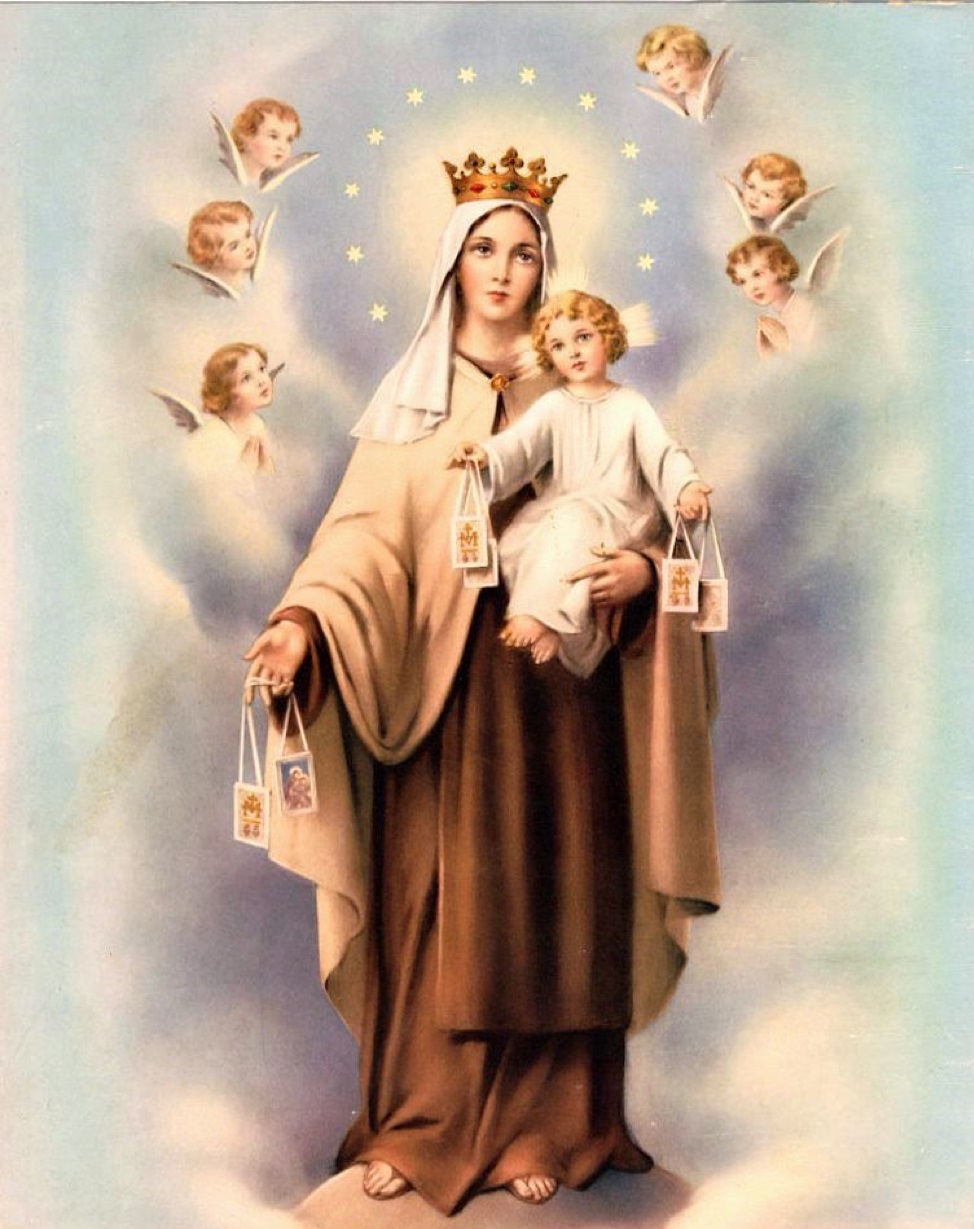
History, Devotion, the Brown Scapular, Miracles, and Spiritual Legacy
Feast Day: 16 July
Introduction
Among the many titles given to the Blessed Virgin Mary, Our Lady of Mount Carmel is one of the oldest, most beloved, and spiritually rich. Rooted in biblical history, nourished by the contemplative life of the Carmelites, and spread throughout the world through devotion to the Brown Scapular, this Marian title has inspired countless Christians for over eight centuries.
The devotion to Our Lady of Mount Carmel is much more than a feast or a pious tradition. It is a way of life—one that calls believers to imitate Mary’s faith, purity, prayerfulness, humility, and complete surrender to God’s will. Millions of Catholics wear the Brown Scapular as a sign of their consecration to Mary and their desire to follow Christ more faithfully under her maternal protection.
Every year on 16 July, the universal Church celebrates the Feast of Our Lady of Mount Carmel, remembering Mary’s special relationship with the Carmelite Order and her continuing care for all who seek her intercession.
Mount Carmel in the Bible
To understand the devotion, one must first understand the significance of Mount Carmel, a mountain range overlooking the Mediterranean Sea in present-day Israel.
The Hebrew word “Carmel” means “garden,” “orchard,” or “vineyard of God.” Its fertile slopes have symbolized beauty, fruitfulness, and divine blessing since biblical times.
Elijah and the Prophets of Baal
Mount Carmel became famous through the ministry of the Prophet Elijah.
During the reign of King Ahab, Israel had largely abandoned the worship of the true God in favor of Baal, a Canaanite deity promoted by Queen Jezebel. Elijah courageously challenged the 450 prophets of Baal to a dramatic contest on Mount Carmel (1 Kings 18).
Two altars were prepared. The prophets of Baal prayed all day, but no fire came from heaven. Elijah then rebuilt the altar of the Lord, drenched it with water, and prayed:
“Answer me, Lord, answer me, so these people will know that you, Lord, are God.”
Immediately, fire descended from heaven and consumed the sacrifice, proving that the God of Israel alone is the true God.
The people fell to the ground, proclaiming:
“The Lord—He is God! The Lord—He is God!”
This event made Mount Carmel a lasting symbol of faithfulness to God.
Elijah’s Vision of the Cloud
After years of drought, Elijah prayed again on Mount Carmel.
His servant eventually saw:
“A little cloud no bigger than a man’s hand rising from the sea.” (1 Kings 18:44)
Soon heavy rain fell upon the land.
Early Christian writers later interpreted this tiny cloud as a symbolic image of the Blessed Virgin Mary.
Just as the small cloud brought life-giving rain to a dry land, Mary brought Jesus Christ, the Savior, into a spiritually dry world.
Origins of the Carmelite Order
After the time of Elijah, Mount Carmel continued to attract people seeking silence and communion with God.
During the twelfth century, Christian hermits settled on Mount Carmel. They lived simple lives of prayer, penance, manual labor, and meditation on Scripture.
These hermits built a small chapel dedicated to the Blessed Virgin Mary and became known as:
The Brothers of the Blessed Virgin Mary of Mount Carmel
Eventually, this community became the Order of Carmelites, one of the oldest religious orders in the Church.
Unlike many other religious communities founded by a single saint, the Carmelites trace their spiritual heritage to the prophet Elijah and the contemplative tradition associated with Mount Carmel.
The Blessed Virgin Mary and Carmel
The Carmelites considered Mary not only their patroness but also their Mother and Queen.
She became the perfect model of the Carmelite vocation because she:
- listened attentively to God’s Word
- treasured it in her heart
- remained faithful beneath the Cross
- lived a hidden life of prayer
- surrendered completely to God’s will
The Carmelite motto beautifully reflects this Marian spirit:
“With zeal have I been zealous for the Lord God of hosts.”
Mary embodies perfect zeal because every aspect of her life pointed toward Christ.
St. Simon Stock and the Brown Scapular
The most famous event associated with Our Lady of Mount Carmel occurred in 1251.
Who Was St. Simon Stock?
St. Simon Stock was an English Carmelite who became Prior General of the Order during a difficult period.
Political upheaval forced many Carmelites to leave the Holy Land and establish monasteries throughout Europe. The Order faced uncertainty and declining support.
Simon prayed fervently for Mary’s assistance.
The Vision
According to Carmelite tradition, on 16 July 1251, the Blessed Virgin Mary appeared to St. Simon Stock.
She held the Brown Scapular in her hands and said:
“Receive, my beloved son, this scapular of your Order. It shall be a sign of my protection and a pledge of salvation. Whoever dies clothed in this shall not suffer eternal fire.”
This promise became known as the Scapular Promise.
The Church encourages devotion to the Brown Scapular while emphasizing that the promise is not magical. Rather, it expresses Mary’s maternal care for those who faithfully seek to live as disciples of Christ.
What Is the Brown Scapular?
Originally, a scapular was part of a monk’s habit—a long piece of cloth worn over the shoulders while working.
Eventually, a smaller version developed for the laity.
The Brown Scapular consists of two small pieces of brown wool connected by cords and worn over the shoulders.
It symbolizes:
- belonging to Mary
- discipleship
- commitment to Christ
- prayer
- purity
- trust in God’s mercy
It is not an amulet or lucky charm.
Its value depends upon the faith, devotion, and Christian life of the person wearing it.
Enrollment in the Brown Scapular
Catholics are normally enrolled in the Brown Scapular by a priest or deacon using the Church’s approved rite.
After enrollment, another Brown Scapular may replace the original without repeating the ceremony.
Those enrolled are encouraged to:
- attend Mass regularly
- receive the sacraments
- pray daily
- imitate Mary’s virtues
- practice charity
- remain faithful to Christ
The Sabbatine Privilege
Another tradition associated with the Brown Scapular is the Sabbatine Privilege.
This devotion originated in the Middle Ages and expressed the belief that Mary would especially assist her faithful children after death, particularly on the Saturday following their passing.
While the historical document often connected with this privilege is not considered authentic, the Church has consistently encouraged confidence in Mary’s maternal intercession for the souls of the faithful.
The deeper message remains unchanged:
Mary never abandons those who faithfully seek to follow Christ.
Carmelite Spirituality
The Carmelite tradition emphasizes interior transformation.
Its principal characteristics include:
1. Prayer
Prayer is the heart of Carmelite life.
Whether vocal prayer, meditation, or contemplation, Carmelites seek continual friendship with God.
2. Silence
Interior silence creates space to hear God’s voice.
3. Contemplation
Carmelite spirituality seeks not merely to know about God but to know Him personally through loving union.
4. Simplicity
Following Mary’s hidden life at Nazareth, Carmelites value humility and simplicity.
5. Service
Contemplation naturally leads to loving service of others.
Great Carmelite Saints
Throughout history, Carmel has produced remarkable saints.
St. Teresa of Ávila
The great reformer of the Carmelite Order.
She emphasized mental prayer and intimate friendship with Christ.
St. John of the Cross
One of Christianity’s greatest mystics.
His writings on the “Dark Night of the Soul” continue to shape spiritual theology.
St. Thérèse of Lisieux
Known as “The Little Flower.”
Her “Little Way” of spiritual childhood transformed modern Catholic spirituality.
St. Edith Stein (St. Teresa Benedicta of the Cross)
Jewish philosopher, Carmelite nun, martyr of Auschwitz, and co-patroness of Europe.
St. Elizabeth of the Trinity
A modern Carmelite mystic whose writings focus on the indwelling of the Holy Trinity.
Miracles Associated with Our Lady of Mount Carmel
Numerous miracles have been attributed to Mary’s intercession under this title.
These include:
- healings
- protection during wars
- rescue from accidents
- conversions
- peace in families
- assistance at the hour of death
While individual stories vary, they all point toward Mary’s loving concern for her spiritual children.
Our Lady of Mount Carmel Around the World
The feast is celebrated with extraordinary devotion in many countries.
Italy
Large processions, flowers, music, and parish festivals honor Our Lady.
Spain
One of the country’s most beloved Marian feasts.
Many fishing communities entrust themselves to her care.
Latin America
Millions participate in novenas and public celebrations.
India
Our Lady of Mount Carmel enjoys deep devotion in Kerala, Goa, Tamil Nadu, Karnataka, and many other regions.
Many churches, schools, convents, and seminaries bear her name.
The Carmelite Sisters, Carmelite Fathers, and numerous lay associations actively promote her spirituality.
The Feast Day
The Feast of Our Lady of Mount Carmel is celebrated on 16 July.
The liturgy emphasizes:
- Mary’s maternal care
- contemplative prayer
- fidelity to Christ
- hope of eternal life
- discipleship
Many faithful renew their Brown Scapular enrollment on this day.
Lessons from Our Lady of Mount Carmel
Mary teaches us to:
- trust God completely
- treasure God’s Word
- persevere in prayer
- remain faithful during suffering
- seek silence amidst noise
- imitate Christ daily
- serve others generously
- hope confidently in God’s promises
Her life reminds Christians that holiness grows quietly through daily faithfulness.
Devotion Today
In today’s busy world, the spirituality of Mount Carmel is more relevant than ever.
Modern society often values speed, productivity, and constant activity. Carmel reminds believers that true fruitfulness begins with communion with God.
The Brown Scapular remains one of the Church’s most widespread sacramentals, worn by millions of Catholics as a simple but profound sign of trust in Mary’s guidance.
Through this devotion, Christians are invited not only to seek Mary’s protection but also to imitate her virtues and deepen their relationship with Jesus Christ.
Prayer to Our Lady of Mount Carmel
O most beautiful Flower of Carmel, fruitful vine, splendor of heaven, holy and singular, who brought forth the Son of God while remaining ever Virgin, assist us in our necessities.
O loving Mother, Star of the Sea and Queen of Carmel, look with compassion upon your children. Teach us to listen to God’s Word with faith, to persevere in prayer, to carry our crosses with hope, and to follow your Son with generous hearts.
May the Brown Scapular remind us each day that we belong to you and that, under your motherly protection, we are called to grow in holiness. Obtain for us the grace to live in friendship with Christ, to serve our neighbors with charity, and to persevere faithfully until we share the joy of eternal life in the Kingdom of Heaven.
Our Lady of Mount Carmel, pray for us. Amen.
Conclusion
The devotion to Our Lady of Mount Carmel is a treasure of the Catholic Church, uniting biblical history, contemplative spirituality, Marian devotion, and a profound call to holiness. From the prophetic witness of Elijah on Mount Carmel to the humble hermits who sought God in silence, from the vision of St. Simon Stock to the worldwide spread of the Brown Scapular, this tradition continues to inspire millions of faithful believers.
Our Lady of Mount Carmel invites every Christian to enter the “school of Mary,” where prayer deepens faith, contemplation leads to charity, and discipleship becomes a daily response to God’s love. Her maternal protection is not a substitute for Christian commitment but a powerful encouragement to live the Gospel with fidelity.
As we celebrate her feast each year on 16 July, may we entrust ourselves anew to her loving care, seeking not only her protection but also the grace to imitate her humility, purity, and unwavering obedience to God’s will. Under the mantle of Our Lady of Mount Carmel, may we grow ever closer to Christ and persevere in hope until we reach the eternal joy of heaven.
Leave a Reply