
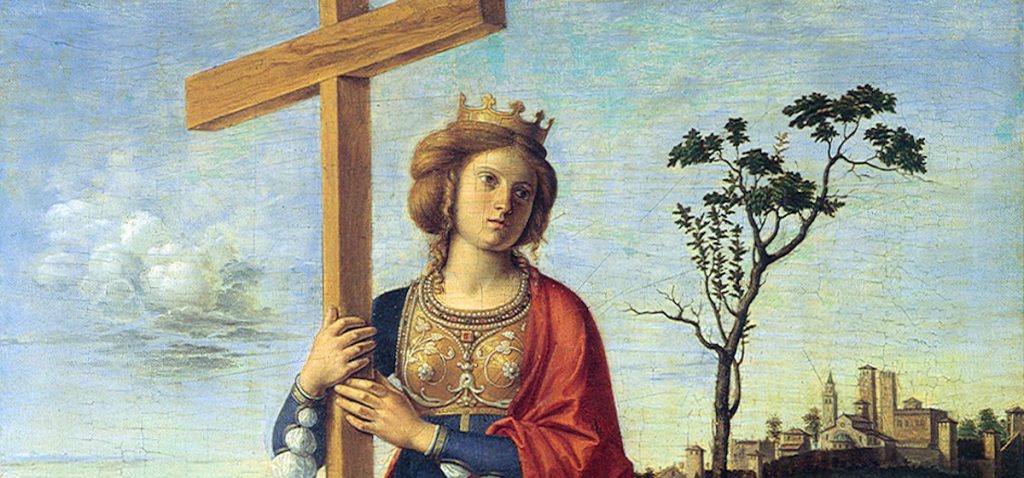
The Christian Empress Who Sought the Holy Places
Saint Helena of Constantinople, also known as Saint Helen, was the mother of the Roman Emperor Constantine the Great and one of the most revered women in early Christian history. She is remembered especially for her deep Christian faith, her pilgrimage to the Holy Land, her generous support for the Church, and the ancient Christian tradition that associates her with the discovery of the True Cross of Jesus Christ.
Her life is a remarkable story of how a woman of humble origins rose to become one of the most influential figures in the Roman Empire. Yet her greatness is not remembered merely because she became an empress or the mother of a powerful emperor. Christians remember her because she used her position, wealth, and influence to serve the cause of faith.
Saint Helena stands as a powerful example of a truth that remains relevant today:
True greatness is not found in power, wealth, or social position, but in the good we do with the gifts God has entrusted to us.
In many traditions, Saint Helena is commemorated on August 18 in the Catholic Church, while her feast is observed on May 21 in the Eastern Orthodox tradition.
1. The Early Life of Saint Helena
The precise details of Helena’s early life are not known with certainty. Ancient sources provide only limited information, and later traditions added various details to her story.
She is generally believed to have been born around 248–250 AD, possibly in or near Drepanum in Bithynia, in Asia Minor, a town later renamed Helenopolis in her honour.
Helena is traditionally believed to have come from a humble background. Saint Ambrose, writing in the fourth century, referred to her as a stabularia, a Latin term that may suggest an association with an inn, stable, or lodging place. This tradition has often been understood as indicating that she came from an ordinary social background.
Whatever her exact origins, Helena’s life would eventually take her from relative obscurity to the centre of the Roman world.
Her story is therefore also a story of hope: God can raise up people from the most ordinary circumstances and use them for extraordinary purposes.
2. Helena and Constantius Chlorus
Helena became associated with Constantius Chlorus, a Roman military officer who would later become one of the most important rulers of the Roman Empire.
The exact nature of their relationship remains a subject of historical discussion. Some sources describe Helena as his wife, while others suggest that their union may not have been a formal marriage according to later Roman standards.
Around the year 272, Helena gave birth to their son:
Constantine
This child would later become known to history as Constantine the Great, the first Roman emperor to openly favour Christianity and one of the most influential rulers in the history of the Church.
Helena’s role as the mother of Constantine would eventually place her at the centre of some of the most important developments in the Christianization of the Roman Empire.
However, her life was not without sorrow.
As Constantius advanced politically, he entered into a marriage with Theodora, the stepdaughter of Emperor Maximian. Helena was separated from Constantius, and for a time she disappeared from the centre of public life.
Yet her son Constantine remained deeply attached to her.
Years later, when Constantine became emperor, he brought his mother back into a position of great honour.
3. Constantine Becomes Emperor
The early fourth century was a period of enormous change for both the Roman Empire and Christianity.
Christians had suffered repeated persecutions under various Roman rulers. The Church had endured martyrdom, confiscation of property, imprisonment, and destruction of places of worship.
Then Constantine rose to power.
In 312 AD, Constantine defeated his rival Maxentius at the famous Battle of the Milvian Bridge.
Christian tradition connects this event with Constantine’s vision of a heavenly sign associated with Christ. According to ancient accounts, Constantine adopted the Christian symbol and interpreted his victory as being connected with the God of the Christians.
The following year, 313 AD, Constantine and Licinius issued what became known as the Edict of Milan, granting toleration to Christianity and other religions within the empire.
The persecution of Christians was coming to an end.
The Church, which had survived centuries of hardship, was now entering a new era.
Helena was living at the heart of this extraordinary transformation.
4. Helena’s Conversion and Christian Faith
The exact date and circumstances of Helena’s conversion to Christianity are not completely known.
The historian Eusebius of Caesarea, a contemporary who wrote about Constantine and his family, presents Helena as a deeply devout Christian woman in her later years.
Some traditions suggest that Constantine’s rise and his growing association with Christianity influenced her faith. Others believe that Helena may have been attracted to Christianity even earlier.
Whatever the precise circumstances, one fact is clear:
Helena became a devoted supporter of the Christian faith.
Her faith was not merely private.
She used her imperial position to support Christian communities, assist the poor, honour holy places, and promote the building of churches.
Eusebius describes her as a woman of great piety and generosity.
Her example reminds us that faith should not remain only in words.
Faith becomes visible through charity, service, and the choices we make.
5. The Empress Mother
After Constantine became emperor, Helena received exceptional honours.
She was given the title:
Augusta
This was one of the highest honours that could be bestowed upon a woman in the Roman imperial world.
Coins were struck bearing her image. Her influence and dignity were publicly recognized throughout the empire.
Yet Helena’s importance was not simply ceremonial.
She became a respected figure within Constantine’s imperial household and played an important role in the Christian transformation of the empire.
What makes Helena especially remarkable is the way she used this position.
Instead of seeking only personal luxury or political influence, she turned much of her attention toward faith, charity, and the sacred places associated with Jesus Christ.
6. Saint Helena’s Pilgrimage to the Holy Land
The event for which Saint Helena is most famous is her pilgrimage to the Holy Land.
Around 326–328 AD, despite being an elderly woman, Helena travelled from the Roman world to Palestine.
This journey was extraordinary.
Travel during the fourth century was long, difficult, and often dangerous. Yet Helena undertook the pilgrimage because of her desire to visit the places associated with the life, death, and resurrection of Jesus Christ.
She travelled to places connected with:
- Bethlehem
- Jerusalem
- Mount of Olives
- The site of Christ’s Passion
- Other places associated with the history of salvation
For Helena, this was not merely a royal tour.
It was an act of faith.
She wanted to encounter the places where Christ had been born, had preached, had suffered, had died, and had risen again.
Her pilgrimage helped establish an enduring Christian tradition: the pilgrimage to the Holy Land.
Even today, millions of Christians travel to these sacred places seeking a deeper spiritual connection with the Gospel.
7. The Search for the Holy Places
By the time Helena arrived in Jerusalem, nearly three centuries had passed since the death and resurrection of Jesus.
Jerusalem had undergone enormous political and physical changes.
After the destruction of Jerusalem by the Romans in the first century, the city was later rebuilt and reorganized under Roman rule. Some Christian traditions held that pagan structures had been erected over or near places connected with Christ’s Passion and Resurrection.
Helena, with the support of Constantine, encouraged the identification and restoration of important Christian holy places.
This work led to the construction of some of the most important churches in Christian history.
8. The Church of the Holy Sepulchre
One of the greatest achievements associated with Helena and Constantine was the development of the sacred complex at the site traditionally identified as the place of Christ’s Crucifixion and Resurrection.
The Roman structures at the site were removed, and the area was excavated.
A magnificent Christian complex was built.
This became the Church of the Holy Sepulchre.
The church remains one of the holiest places in Christianity.
For centuries, pilgrims from across the world have travelled to Jerusalem to pray at the places traditionally associated with:
- Calvary, where Jesus was crucified
- The tomb where He was buried
- The Resurrection of Christ
Although Constantine was the emperor responsible for imperial patronage and construction, Helena’s pilgrimage and devotion are closely connected with the rediscovery and veneration of these sacred places.
9. The Tradition of the Discovery of the True Cross
Perhaps the best-known story associated with Saint Helena is the discovery of the True Cross.
According to ancient Christian tradition, during excavations near the site of Calvary, three crosses were discovered.
The question then arose:
Which of these was the Cross on which Jesus Christ had been crucified?
Later Christian tradition tells of a miraculous event used to identify the True Cross.
In one version, a dying or seriously ill woman was touched with the crosses. When she came into contact with one of them, she was healed.
That cross was then identified as the Cross of Christ.
Another tradition connects the identification with the raising of a dead person.
These accounts belong primarily to later Christian tradition and hagiography. The earliest historical evidence is more limited, and historians debate the exact details.
Nevertheless, the tradition of Helena’s discovery of the True Cross became deeply rooted in Christian devotion.
Her name would forever be associated with the Cross.
10. The Meaning of the True Cross
Whether considered historically, devotionally, or spiritually, the story associated with Saint Helena directs Christians toward the central mystery of their faith:
The Cross of Jesus Christ
For Christians, the Cross is not merely an instrument of execution from the ancient world.
It is the sign of:
- Christ’s sacrifice
- God’s love
- Redemption
- Forgiveness
- Victory over sin
- Hope in suffering
- The promise of resurrection
Saint Paul wrote:
“We proclaim Christ crucified.”
— 1 Corinthians 1:23
And Jesus said:
“If anyone wishes to come after me, he must deny himself and take up his cross daily and follow me.”
— Luke 9:23
The Cross reminds us that love often involves sacrifice.
Yet the Christian message does not end with the Cross.
The Cross leads to the Resurrection.
This is one of the deepest spiritual lessons connected with Saint Helena:
Even the darkest Friday is not the end of the story. Easter morning is coming.
11. Churches Associated with Saint Helena
Helena’s pilgrimage and Constantine’s imperial support contributed to the construction of several important churches in the Holy Land.
The Church of the Nativity – Bethlehem
A great church was built over the site traditionally identified as the birthplace of Jesus.
The Church of the Nativity became one of Christianity’s most sacred shrines.
The Church of the Holy Sepulchre – Jerusalem
The sacred complex was built over the places traditionally associated with Christ’s Crucifixion, burial, and Resurrection.
It remains a major destination for Christian pilgrims.
The Church on the Mount of Olives
Helena is also traditionally associated with the development of Christian shrines connected with the Mount of Olives and the events of Christ’s life.
Through these projects, sacred geography became an important part of Christian devotion.
The places described in the Gospels were no longer only names in Scripture. They became places where Christians could gather, pray, and remember.
12. Saint Helena’s Charity and Love for the Poor
Saint Helena was not remembered only for magnificent churches and imperial projects.
Ancient accounts also describe her generosity and concern for ordinary people.
Eusebius portrays her as a woman who performed acts of charity and showed respect toward people of humble circumstances.
This aspect of her life is especially important.
It is easy to use wealth and power for personal comfort.
Helena had access to enormous privilege. Yet she became known for supporting the Church and helping others.
Her life asks an important question of every Christian:
How do I use the blessings I have received?
We may not possess imperial wealth.
But every person has something to offer:
- Time
- Kindness
- Knowledge
- Influence
- Material resources
- Encouragement
- Prayer
- Service
The greatness of a person is often revealed not by what they possess, but by what they are willing to share.
13. Saint Helena and the Family
Saint Helena is also remembered as the mother of Constantine.
The relationship between mother and son is an important part of her story.
Constantine honoured Helena and raised her to the highest position available to an imperial woman.
Her life reminds us of the influence that parents can have on future generations.
A mother’s faith, courage, sacrifices, and values can leave a lasting mark upon the lives of her children.
Helena probably never imagined that her son would become one of the most significant emperors in Christian history.
Yet her own faith and example would become part of the story of the Christian transformation of the Roman Empire.
14. Her Final Years and Death
Saint Helena died around 330 AD, though the precise date is uncertain.
She died after her pilgrimage to the Holy Land and after witnessing the remarkable growth of Christianity within the Roman Empire.
According to tradition, Constantine was deeply affected by the death of his mother.
Her remains were placed in a magnificent imperial tomb.
Over the centuries, relics associated with Saint Helena were venerated in various parts of Europe.
The Basilica of Santa Croce in Gerusalemme in Rome became especially associated with Helena and with relics connected with the Passion of Christ.
Her memory continued to spread throughout both Eastern and Western Christianity.
15. The Veneration of Saint Helena
Saint Helena is honoured as a saint by several Christian traditions.
She is particularly revered in:
- The Catholic Church
- The Eastern Orthodox Church
- Oriental Orthodox Churches
- The Anglican tradition
- Other Christian communities
Her feast days vary according to liturgical tradition.
In the Roman Catholic tradition, Saint Helena is commonly commemorated on August 18.
In the Eastern Orthodox tradition, Saints Constantine and Helena are commemorated together on May 21.
The Eastern Christian tradition gives Helena the title:
Equal to the Apostles
This title reflects the enormous influence associated with her support for Christianity and her contribution to the establishment of Christian holy places.
16. Saint Helena’s Legacy
Saint Helena’s influence can still be seen nearly seventeen centuries after her death.
Her legacy is present in:
1. Christian Pilgrimage
Her journey helped strengthen the importance of pilgrimage to the Holy Land.
2. Christian Holy Places
Some of the most important Christian shrines in Jerusalem and Bethlehem developed during the Constantinian period associated with her pilgrimage and imperial support.
3. Devotion to the Cross
Her name became permanently connected with the ancient Christian tradition concerning the discovery of the True Cross.
4. The Christianization of the Roman Empire
As the mother of Constantine and a prominent Christian woman within the imperial family, Helena became part of one of the most significant transformations in world and Church history.
5. An Example of Faith in Old Age
Helena undertook her great pilgrimage when she was already elderly.
Her life reminds us that there is no age limit to holiness, service, or spiritual renewal.
Many people believe that their best opportunities are behind them.
Saint Helena tells us otherwise.
Sometimes God’s greatest work in a person’s life begins later than expected.
17. Spiritual Lessons from Saint Helena
Seek Christ
Helena travelled across the empire in search of the places connected with Jesus.
Her journey reminds us that the Christian life is ultimately a search for Christ.
We may not be able to travel to Jerusalem, but we can seek Him:
- In prayer
- In the Scriptures
- In the Eucharist
- In the poor
- In acts of charity
- In the people around us
Use Your Position for Good
Helena possessed influence, wealth, and honour.
She used these gifts to support the Church and preserve places of faith.
Every person has some form of influence.
The question is:
Do we use it only for ourselves, or also for the good of others?
Never Stop Growing in Faith
Helena’s most famous spiritual achievements came during her later years.
Age did not stop her from undertaking a difficult pilgrimage.
We should never say:
“It is too late to begin again.”
Let the Cross Give You Hope
The Cross reminds us that suffering is real, but it is not meaningless.
For Christians, the Cross and Resurrection are inseparable.
When life becomes difficult, Saint Helena’s devotion to the Cross reminds us:
God can bring new life even from the places of greatest suffering.
18. A Prayer to Saint Helena
O glorious Saint Helena,
faithful servant of Christ and devoted seeker of the holy places,
you used the honour and influence given to you
to serve God and strengthen His Church.
Teach us to seek Christ with the same desire that led you
on pilgrimage to the Holy Land.
Help us to recognize the Cross not as a sign of defeat,
but as a sign of God’s saving love.
Pray for us that we may remain faithful in times of difficulty,
generous in times of abundance,
and humble in every success.
May we use every gift and opportunity God gives us
for the service of others and for the glory of His name.
Saint Helena,
woman of faith,
pilgrim of the Holy Land,
devoted servant of Christ,
pray for us.
Amen.
Conclusion
Saint Helena of Constantinople remains one of the most fascinating women in Christian history.
She began life, according to ancient tradition, from humble circumstances. She became the mother of an emperor and eventually received one of the highest honours of the Roman Empire. Yet her lasting greatness lies not in her royal title.
She is remembered because she became a pilgrim.
She sought the places where Jesus walked.
She honoured the places connected with His birth, death, and Resurrection.
She supported the Church.
She gave generously.
And, according to one of Christianity’s most enduring traditions, she discovered the Cross upon which the Saviour gave His life for the world.
Saint Helena teaches us that no matter where we begin, our lives can become a journey toward God.
Her story invites every Christian to ask:
What am I searching for?
May we, like Saint Helena, continue our search until we discover more deeply the One who is the source of all truth, love, and life—Jesus Christ.
A Quote for the Feast of Saint Helena
“Saint Helena searched the earth for the Cross of Christ; may we search our hearts until we discover the love that the Cross reveals.”
Saint Helena of Constantinople, pray for us!
Leave a Reply