
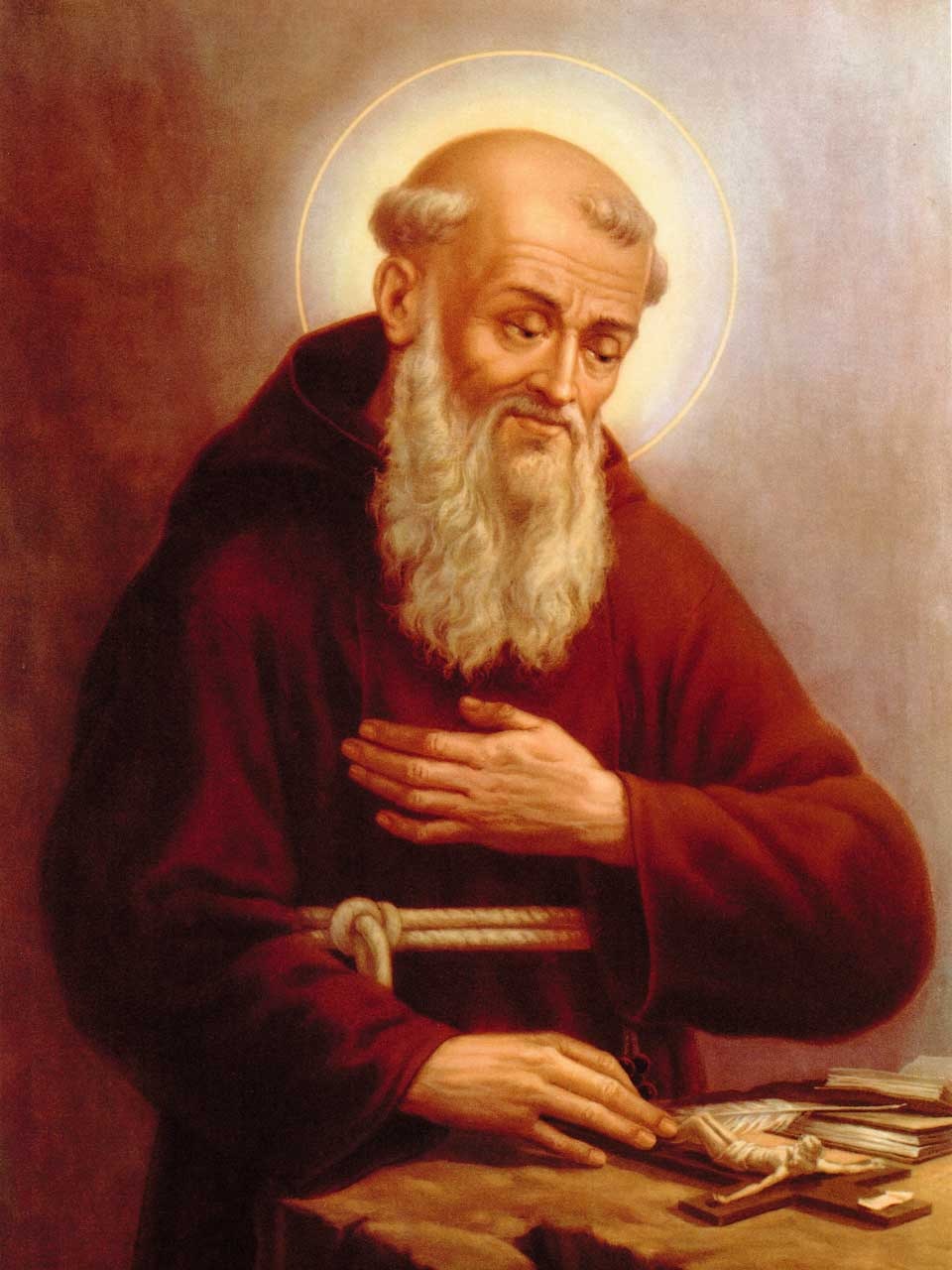
Capuchin Priest, Confessor and Servant of the Sick
(1686–1770) | Feast: 22 September
Saint Ignatius of Santhià was an Italian Capuchin priest whose life was marked by humility, obedience, prayer, sacramental ministry and compassionate service to the suffering. A gifted spiritual director and confessor, he became especially known for his patient welcome of sinners and for his care of the sick and poor. The Church remembers him as a man who united deep contemplation with practical charity. He was beatified by Pope Paul VI in 1966 and canonized by Pope John Paul II on 19 May 2002. (Vatican)


Early Life
Saint Ignatius of Santhià was born Lorenzo Maurizio Belvisotti on 5 June 1686 in Santhià, in the region of Vercelli in northern Italy. He was the fourth of six children of Pier Paolo Belvisotti and Maria Elisabetta Balocco.
His father died when Lorenzo was still a child. His mother therefore took particular care of his education and spiritual formation, entrusting him to the guidance of a pious and learned priest, Don Bartolomeo Quallio. Under this influence, Lorenzo grew both intellectually and spiritually and gradually discerned a vocation to the priesthood. (Vatican)
In 1706 he went to Vercelli for higher studies in philosophy and theology. He was ordained a diocesan priest in 1710. During his early priestly ministry, he served as chaplain and tutor to the noble Avogadro family and participated in popular missions organized by the Jesuits.
Although he was respected and offered important ecclesiastical positions, Lorenzo felt called to a simpler and more radically evangelical life.
Choosing the Capuchin Life
On 24 May 1716, Lorenzo entered the Capuchin Friars at Chieri. He received the religious name Brother Ignatius of Santhià.
His decision was not simply a change of ministry. He was choosing a life characterized by poverty, obedience, humility, fraternity and service.
The Vatican’s account of his life emphasizes that he desired to become an instrument in God’s hands and faithfully accepted the assignments given to him by his superiors. (Vatican)
This obedience became one of the defining characteristics of his spirituality.
He did not seek recognition. He sought only to serve Christ wherever he was sent.
Master of Novices
One of the important assignments in Saint Ignatius’s life came in 1731, when he was sent to Mondovì and appointed master of novices.
For many years he was responsible for the spiritual and human formation of young Capuchin friars. He understood that formation could not be accomplished merely through instructions and regulations. A spiritual guide must teach through his own example.
His approach was characterized by love, patience and personal attention. He tried to know the young friars entrusted to him and to help each one grow in fidelity to Christ and to the Franciscan vocation. (Vatican)
His method can be summarized in a simple principle:
Teach holiness not only by words, but by the witness of your own life.
This remains particularly relevant for priests, religious superiors, parents, teachers and anyone entrusted with the formation of others.
A Servant of the Sick
Saint Ignatius’s ministry was not confined to the monastery.
During the wars in Piedmont in the 1740s, large numbers of wounded soldiers and sick people required assistance. The Capuchins were asked to provide both spiritual and practical care in military hospitals.
Ignatius became involved in this ministry, serving in hospitals in Asti, Vinovo and Alessandria. He cared for wounded and suffering people with extraordinary dedication.
He did not separate spiritual ministry from human compassion.
He prayed with the sick.
He encouraged the suffering.
He served those who were wounded.
He accompanied people approaching death.
He brought the mercy of Christ into places filled with pain.
The Vatican describes him as serving in the hospitals with tireless activity and genuine evangelical love. (Vatican)
His example reminds Christians that charity is not merely an emotion. Christian love becomes concrete through service.
The Father of Sinners and the Lost
After the period of his hospital ministry, Saint Ignatius returned to Turin, where he spent many years exercising his priestly ministry.
He became particularly famous as a confessor and spiritual director.
People came to him with their sins, failures, fears and spiritual struggles. Rather than treating sinners with harshness, he welcomed them with patience and compassion.
Because of his special ability to accompany people who were spiritually wounded, he became known as the “father of sinners and the lost.” (Vatican)
This title reveals something profound about his understanding of the priesthood.
For Ignatius, the confessional was not a place where the sinner was condemned. It was a place where the sinner encountered the mercy of God.
He understood that people sometimes arrive at the sacrament of Reconciliation carrying enormous burdens: guilt, shame, fear, confusion and discouragement.
The priest’s task is to help them discover that God’s mercy is greater than their sin.
Spiritual Director
Saint Ignatius became one of the most sought-after spiritual directors and confessors in Turin.
He spent long hours listening to people, giving advice, hearing confessions and helping souls discern God’s will.
His ministry demonstrates the importance of patient listening in pastoral work.
Many people do not initially need complicated answers. They need someone who will listen to them with compassion and help them see their lives in the light of the Gospel.
Ignatius offered this kind of ministry.
He was deeply rooted in prayer, but his prayer always led him toward people.
He loved silence and contemplation, especially prayer before the Blessed Sacrament, yet he was equally ready to leave the monastery to visit the sick and poor. (Vatican Press)
Love for the Poor
Saint Ignatius did not merely preach charity. He practiced it.
He visited the sick and poor of Turin and sought assistance for people who lacked food and basic necessities. He became a friend and spiritual father to many who were forgotten by society.
His holiness therefore had two dimensions:
Contemplation and action.
He looked toward Christ in prayer and then recognized Christ in the suffering person before him.
This is profoundly Franciscan spirituality: to love God deeply and to express that love through humble service.
“Paradise Is Not Made for Slackers”
One saying traditionally associated with Saint Ignatius captures his energetic spirituality:
“Paradise is not made for slackers. Let us get to work!”
The Vatican records this saying in its biography of the saint. (Vatican)
The saying should not be understood simply as encouragement toward physical activity. For Saint Ignatius, Christian life required commitment.
Faith cannot remain merely an idea.
Prayer must produce conversion.
Conversion must produce charity.
Charity must become service.
Love of God must become love of neighbour.
The Christian cannot spend life waiting passively for holiness to happen.
God gives grace, but we must cooperate with that grace.
A Man of the Cross
In the final period of his life, Saint Ignatius suffered physical weakness and spent his last years in the infirmary of his convent.
Yet suffering did not turn him away from his ministry.
Even when he was old and weak, he continued to bless, hear confessions and counsel those who came to him.
His spirituality was deeply centered on Christ Crucified. The contemplation of the Cross and meditation on the Gospel nourished his interior life. (Vatican Press)
The Cross taught him that suffering united with Christ can become an offering of love.
He did not seek suffering for its own sake. Rather, when suffering came, he accepted it in faith and continued to love.
His Death
Saint Ignatius died in Turin on 22 September 1770, at the age of 84. His death occurred in the Capuchin convent after years of priestly and pastoral service.
The news of his death quickly spread, and large numbers of people came to pay their respects. His reputation for holiness had already become widespread during his lifetime. (Vatican Press)
The date of his death became his liturgical memorial: 22 September. (Causes Anti)
A Long Road to Canonization
The reputation for holiness surrounding Saint Ignatius led to the opening of his cause for canonization.
The process was unusually long. Difficulties caused by the French Revolution and later suppressions of religious orders interrupted the progress of the cause.
On 19 March 1827, Pope Leo XII recognized the heroic nature of his virtues.
More than a century later, Pope Paul VI beatified him on 17 April 1966.
Finally, on 19 May 2002, Pope John Paul II canonized him in Saint Peter’s Square in Rome. (Vatican)
Thus, more than two centuries after his death, the Church formally recognized the holiness that generations of people had already experienced through his life and ministry.
The Spirituality of Saint Ignatius of Santhià
Several themes stand out in the life of this Capuchin saint.
1. Humility
Ignatius willingly abandoned positions that could have brought him honor and chose the humble life of a Capuchin friar.
His greatness came precisely through his willingness to become small.
2. Obedience
He accepted the assignments given to him by his superiors and sought God’s will through the ordinary responsibilities of religious life.
3. The Sacrament of Reconciliation
His extraordinary ministry as a confessor shows the importance he placed on conversion and God’s mercy.
He became a compassionate father to people who were spiritually wounded.
4. Compassion for the Sick
His service in military hospitals and his continued visitation of the sick demonstrated that Christian charity must embrace the whole person.
5. Love for the Poor
He sought practical help for those who lacked necessities and treated the poor with dignity.
6. Eucharistic and Crucifix-Centered Prayer
His interior life was nourished by prayer before the Blessed Sacrament and contemplation of Christ Crucified. (Vatican Press)
7. Perseverance
His life teaches that holiness is not achieved through a single heroic moment. It is formed through thousands of ordinary acts of fidelity.
Lessons for Christians Today
Saint Ignatius of Santhià speaks powerfully to the Church today.
Be merciful toward sinners
Every person carries wounds that may not be visible. Instead of quickly condemning others, Christians are called to become instruments of God’s mercy.
Serve those who suffer
Faith must lead us toward people who are sick, lonely, poor or forgotten.
Take prayer seriously
Ignatius combined intense prayer with active service. Christian spirituality needs both.
Do ordinary things faithfully
Holiness is often found in apparently small duties performed with great love.
Do not waste your life
His famous exhortation about Paradise and work reminds us that life is a gift entrusted to us by God.
We have a mission to fulfill.
Never despair of God’s mercy
Perhaps one of the greatest lessons of Saint Ignatius is found in his ministry to sinners.
No person should be considered beyond the reach of God’s grace.
The priest in the confessional, the parent welcoming a troubled child, the friend listening to someone in distress and the Christian helping someone who has fallen can all participate in the same ministry of mercy.
Saint Ignatius and the Priesthood
For priests, Saint Ignatius offers a particularly beautiful model.
He reminds priests that pastoral ministry is not merely administration, preaching or public activity.
A priest is called to:
- listen to souls;
- celebrate the Sacraments faithfully;
- accompany sinners;
- comfort the suffering;
- seek out the forgotten;
- teach by example;
- pray for those entrusted to his care;
- and lead people toward Jesus Christ.
Saint Ignatius’s ministry of confession is especially significant.
His life demonstrates how the priest can become a father of mercy, helping people return to God after failure.
Saint Ignatius of Santhià and the New Evangelization
The Church’s mission today requires not only proclamation but also personal accompaniment.
People often carry hidden wounds: family difficulties, loneliness, guilt, fear, addiction, disappointment and spiritual confusion.
Saint Ignatius shows how a priest can meet such people with patience rather than condemnation.
His ministry suggests a simple pastoral principle:
People must first experience the merciful heart of Christ before they can fully understand the demands of discipleship.
Mercy does not deny sin. Rather, mercy opens the door through which the sinner can return to God.
A Saint for Those Who Are Struggling
Saint Ignatius of Santhià can be remembered particularly by those who feel spiritually lost.
His title as a father of sinners and the lost is deeply consoling.
Someone who has fallen can return.
Someone who has wandered can come home.
Someone burdened by guilt can seek reconciliation.
Someone suffering can discover that Christ has not abandoned them.
Someone who feels useless can still serve.
And someone who believes that holiness is impossible can begin with one small act of love.
Prayer to Saint Ignatius of Santhià
Prayer to Saint Ignatius of Santhià
O glorious Saint Ignatius of Santhià,
faithful Capuchin priest and humble servant of Christ,
you devoted your life to prayer,
to the Sacrament of Reconciliation,
to the formation of souls,
and to the service of the poor and suffering.
Obtain for us a heart full of compassion.
Teach us to seek God sincerely,
to accept His will with humility,
and to persevere faithfully in our daily duties.
Help those who are burdened by sin
to experience the mercy of God.
Strengthen those who are sick and suffering.
Comfort those who are discouraged,
guide those who are lost,
and obtain hope for those who feel forgotten.
Teach us to love Jesus Crucified
and to remain close to Him in prayer.
May we never become lazy or indifferent
in the service of God and neighbour.
Pray especially for priests, confessors,
religious men and women,
and all who work for the salvation of souls.
Saint Ignatius of Santhià,
father of sinners and friend of the suffering,
pray for us,
that we may grow in humility, charity, obedience and holiness.
May our lives become a faithful offering to Christ
and a blessing to those whom God places in our path.
Through Christ our Lord.
Amen.
Conclusion
Saint Ignatius of Santhià lived a life in which prayer became service, suffering became an offering, and priesthood became an instrument of mercy.
He was a Capuchin friar who loved simplicity, a priest who loved souls, a confessor who welcomed sinners, a servant who cared for the sick and a spiritual father who guided people toward Christ.
His life reminds us that holiness does not necessarily require extraordinary circumstances. It requires extraordinary faithfulness in ordinary circumstances.
His message can be expressed in the spirit of the saying associated with him:
“Paradise is not made for slackers. Let us get to work!” (Vatican)
On his feast day, 22 September, we can ask Saint Ignatius of Santhià to teach us to pray deeply, serve generously, forgive readily and work faithfully for the Kingdom of God. (Causes Anti)
Saint Ignatius of Santhià, pray for us!
Saint Ignatius of Santhià, father of sinners and the lost, pray for us!
Saint Ignatius of Santhià, servant of the sick and poor, pray for us!
Saint Ignatius of Santhià, faithful son of Saint Francis, pray for us!
Leave a Reply