
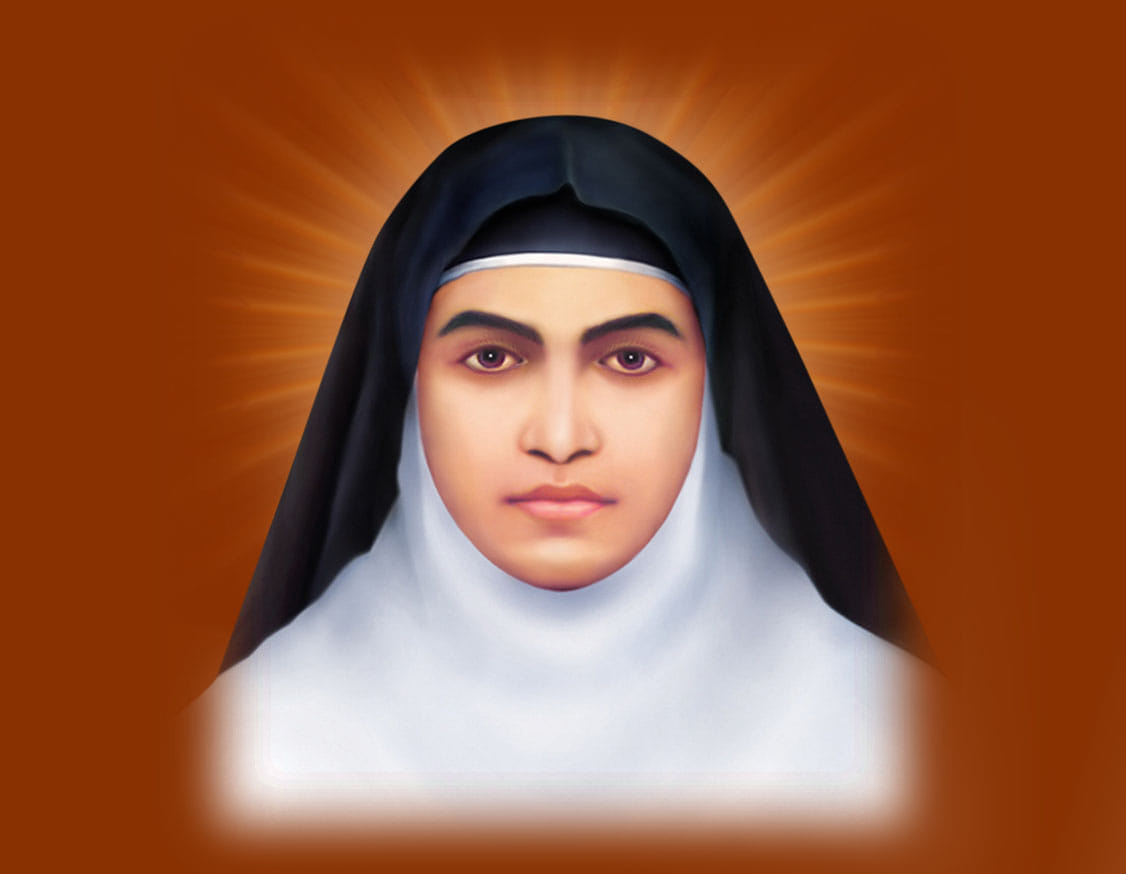
Part IX – Saint Alphonsa’s Enduring Message for the Modern World: Lessons for Every Christian
“God never abandons those who place their trust in Him.”
— A faithful English rendering reflecting a recurring theme in Saint Alphonsa’s writings and correspondence (the exact wording varies among published translations).
Introduction
More than a century has passed since the birth of Saint Alphonsa (1910–1946), yet her life continues to inspire millions of Christians across the world. Every year, pilgrims from different countries visit her tomb at Bharananganam, seeking her intercession for healing, peace, vocations, family life, and spiritual strength.
Why does a cloistered Franciscan Clarist nun, who never travelled beyond Kerala and left behind only a small collection of writings, continue to attract such devotion?
The answer lies in the universality of her witness.
Saint Alphonsa lived the Gospel in its simplest and purest form. She did not preach to vast crowds or establish great institutions. Instead, she showed that holiness is possible in ordinary life through faithful prayer, humble service, patient endurance, and unwavering trust in God.
In a world marked by rapid technological change, social uncertainty, and spiritual restlessness, her message is perhaps more relevant today than ever before.
A Saint for the Twenty-First Century
Modern society values:
- productivity,
- efficiency,
- popularity,
- wealth,
- comfort,
- personal success.
Saint Alphonsa proposes another measure of greatness.
She teaches that true success is not measured by what we possess but by how faithfully we love God and serve others.
Her life reminds Christians that eternal values never become outdated.
Faith.
Hope.
Charity.
Humility.
Prayer.
Forgiveness.
These virtues remain as necessary today as they were during the first century of Christianity.
What Saint Alphonsa Teaches Families
Families today face enormous pressures.
Economic uncertainty.
Health concerns.
Relationship difficulties.
Digital distractions.
Busy schedules.
Saint Alphonsa reminds Christian families that the home becomes holy when Christ occupies its center.
Her example encourages families to:
- pray together,
- forgive quickly,
- trust God during hardships,
- attend Holy Mass faithfully,
- teach children Christian values,
- cultivate gratitude.
She demonstrates that holiness begins not in extraordinary places but in ordinary homes where God is welcomed each day.
As Joshua declared:
“As for me and my household, we will serve the Lord.” (Joshua 24:15)
Lessons for Young People
Young people today encounter countless voices competing for their attention.
Career choices.
Social media.
Peer pressure.
Questions about identity.
Uncertainty about the future.
Saint Alphonsa offers a refreshing alternative.
She teaches that true identity is found in belonging to Christ.
As a young woman, she courageously followed God’s call despite opposition and personal sacrifice.
Her example invites young people to ask:
“Lord, what do You want me to do with my life?”
rather than merely,
“What will make me successful?”
She reminds them that God’s plan always leads to authentic happiness.
A Model for Religious Men and Women
Saint Alphonsa remains a powerful example for those living the consecrated life.
Her fidelity was expressed through:
- prayer,
- poverty,
- chastity,
- obedience,
- community life,
- hidden service.
She teaches religious that holiness grows through daily fidelity rather than extraordinary achievements.
Her life also reminds consecrated persons that every vocation finds its deepest meaning in union with Christ.
An Inspiration for Priests
Throughout her life Saint Alphonsa prayed constantly for priests.
She understood that priestly ministry carries immense spiritual responsibility.
Her example offers priests several enduring lessons.
Remain faithful to prayer.
Celebrate the Eucharist with reverence.
Serve God’s people with humility.
Trust God during discouragement.
Carry the Cross with hope.
Her witness also reminds the faithful never to underestimate the importance of praying for their priests.
A praying Church strengthens her shepherds.
Hope for the Sick and Suffering
Perhaps no group finds greater consolation in Saint Alphonsa than those experiencing illness.
She did not merely speak about suffering.
She lived it.
Her chronic illnesses never destroyed her faith.
Instead, they deepened her union with Christ.
To those carrying heavy crosses she says:
You are not forgotten.
Your suffering has meaning.
Christ walks beside you.
Your prayers matter.
Hope remains possible.
These truths continue to comfort countless pilgrims who seek her intercession.
A Lesson for Caregivers
Saint Alphonsa’s life also speaks to those who care for the sick:
- parents,
- nurses,
- physicians,
- caregivers,
- chaplains,
- family members.
Her example reminds them that compassionate care is itself a participation in Christ’s healing ministry.
Jesus taught:
“I was sick and you visited Me.” (Matthew 25:36)
Every act of kindness offered to the suffering becomes an act of love toward Christ Himself.
A Witness in an Age of Anxiety
Anxiety has become one of the defining experiences of modern life.
People worry about:
- health,
- employment,
- finances,
- relationships,
- violence,
- loneliness,
- the future.
Saint Alphonsa does not promise that difficulties will disappear.
Instead, she points believers toward trust.
Her life echoes the words of Jesus:
“Do not let your hearts be troubled. Believe in God; believe also in Me.” (John 14:1)
Faith does not eliminate uncertainty.
It transforms uncertainty into hope.
Living Simply in a Consumer Culture
Modern society often encourages people to measure themselves by possessions.
Saint Alphonsa chose simplicity.
She teaches that lasting happiness cannot be purchased.
Peace comes from communion with God.
Her Franciscan spirit reminds Christians that simplicity creates space for generosity.
When possessions no longer dominate the heart, love grows more freely.
The Dignity of Hidden Work
Many people feel unnoticed.
Parents caring for children.
Teachers.
Volunteers.
Caregivers.
Religious sisters.
Those whose daily work rarely receives public recognition.
Saint Alphonsa assures them that God sees every hidden sacrifice.
Nothing done for love is ever wasted.
Jesus promised:
“Your Father who sees in secret will reward you.” (Matthew 6:4)
Her own hidden life confirms this promise.
Holiness Is Possible for Everyone
Perhaps Saint Alphonsa’s greatest message is this:
Holiness is attainable.
Many Christians mistakenly believe sainthood belongs only to extraordinary individuals.
Saint Alphonsa demonstrates otherwise.
She possessed no exceptional physical strength.
She held no influential position.
She produced no celebrated theological masterpieces.
She simply loved God faithfully.
The Second Vatican Council affirmed this universal vocation:
“All the faithful… are called to the fullness of the Christian life and to the perfection of charity.” (Lumen Gentium, 40)
Saint Alphonsa’s life beautifully illustrates this teaching.
Living Saint Alphonsa’s Spirituality Today
How can Christians imitate Saint Alphonsa in practical ways?
Begin every day with prayer.
Offer the day to God before beginning ordinary work.
Receive the Eucharist with reverence.
Allow Christ to become the source of daily strength.
Accept unavoidable suffering with trust.
Instead of asking only “Why?”, also ask “How can this draw me closer to Christ?”
Practice hidden charity.
Perform acts of kindness without expecting recognition.
Pray for priests.
Remember those entrusted with shepherding God’s people.
Love the Blessed Virgin Mary.
Allow her to lead you ever closer to Jesus.
Keep Heaven before your eyes.
Live each day in the light of eternity.
Saint Alphonsa and Pope Benedict XVI
During the canonization Mass on 12 October 2008, Pope Benedict XVI summarized Saint Alphonsa’s witness with profound insight. He highlighted how she transformed suffering into a joyful offering united with Christ and became a sign of hope for all who experience pain and hardship.
The Pope reminded the universal Church that her life demonstrates the power of God’s grace working through apparent weakness.
This recognition elevated Saint Alphonsa from being only a beloved Indian saint to a model for Catholics throughout the world.
Her Relevance Beyond India
Although deeply rooted in the Syro-Malabar tradition and the culture of Kerala, Saint Alphonsa’s message transcends every cultural boundary.
Christians in Africa recognize her perseverance.
European pilgrims admire her humility.
American Catholics find inspiration in her Eucharistic devotion.
Asian believers identify with her simplicity and trust.
Her witness belongs to the universal Church.
As holiness always does, it speaks every language.
Reflection Questions
- What aspect of Saint Alphonsa’s spirituality speaks most deeply to my life?
- How can I imitate her trust in God’s providence?
- Do I believe that holiness is possible for ordinary Christians?
- What hidden act of charity can I perform today?
- How can my family grow closer to Christ through prayer and forgiveness?
Prayer Inspired by Saint Alphonsa
Lord God,
You called Saint Alphonsa to reveal the beauty of holiness through a life of humility, prayer, suffering, and love.
Help us to follow her example in our own circumstances.
Teach our families to pray together.
Guide our young people to seek Your will.
Strengthen priests and religious in their vocation.
Comfort the sick and the lonely.
Fill our hearts with charity, patience, forgiveness, and unwavering hope.
May we never measure our lives by worldly success but by faithful love for You and for our neighbour.
Through the prayers of Saint Alphonsa, grant that we may persevere faithfully until the day we rejoice with all the saints in Your heavenly Kingdom.
Through Christ our Lord.
Amen.
Saint Alphonsa’s Legacy in One Sentence
If the entire life of Saint Alphonsa could be summarized in one sentence, it would be this:
Holiness is found in loving Christ completely through humble prayer, faithful suffering, joyful obedience, and selfless charity.
This is the enduring message she offers every generation.
Key Takeaways
- Saint Alphonsa’s spirituality remains deeply relevant in the twenty-first century.
- She offers practical guidance for families, young people, priests, religious, caregivers, and those who suffer.
- Her life demonstrates that holiness is possible in ordinary circumstances.
- She reminds Christians to value prayer, the Eucharist, humility, forgiveness, simplicity, and hope above worldly success.
- Her witness continues to inspire the universal Church as a model of joyful fidelity to Christ.
Preview of Part X
The concluding chapter will bring this series together with:
- A synthesis of Saint Alphonsa’s spiritual wisdom
- Authentic quotations and key themes at a glance
- A timeline of her life and canonization
- Frequently Asked Questions (FAQ) for readers
- Suggested reading and bibliography
- Complete references
- A concluding prayer and act of consecration through the intercession of Saint Alphonsa
References
- Holy Bible (NRSV Catholic Edition or another approved Catholic translation): Joshua 24:15; Matthew 25:36; John 14:1; Matthew 6:4.
- Second Vatican Council, Lumen Gentium, §40 (The Universal Call to Holiness).
- Catechism of the Catholic Church, §§2012–2016 (The Universal Call to Holiness).
- Pope Benedict XVI, Homily at the Canonization of Saint Alphonsa, 12 October 2008.
- Congregation for the Causes of Saints, Positio super Vita, Virtutibus et Fama Sanctitatis Servae Dei Alphonsae Muttathupadathu.
- Franciscan Clarist Congregation (FCC), official biographies, letters, and archival publications on Saint Alphonsa.
- Syro-Malabar Church, official liturgical and historical publications on Saint Alphonsa.
Editorial Note : Since this is the penultimate chapter, the concluding Part X should function as a definitive reference section. In addition to the bibliography and final reflections, including a timeline, FAQ, glossary of key spiritual terms, and a carefully sourced collection of Saint Alphonsa’s authentic sayings will make the article both academically stronger and more useful for long-term readers and search visibility.
Leave a Reply